
Type & Discipline
Salutogenesis is a theoretical orientation, not a manualized therapy, drawn from medical sociology and health psychology 1. Its defining move is to invert the usual clinical question: instead of asking what causes disease (pathogenesis), it asks what generates and sustains health, and why some people stay well under loads that sicken others 5. The framework’s central construct is the sense of coherence (SOC), defined by Aaron Antonovsky as “a global orientation that expresses the extent to which one has a pervasive, enduring though dynamic feeling of confidence” that life is comprehensible, manageable, and meaningful 1.
For a practicing therapist, salutogenesis sits one level up from any specific technique. It is a lens that reframes the goal of treatment from removing pathology toward strengthening the orientation and resources that let a person metabolize stress without being overwhelmed 6. It pairs naturally with strengths-based, resilience-oriented, and biopsychosocial practice rather than competing with diagnostic or symptom-focused work LLM.
Creators & Lineage
The model is the work of Aaron Antonovsky (1923-1994), an Israeli-American sociologist who earned his PhD at Yale before moving to Israel in 1960 and later holding the Kunin-Lunenfeld Chair in Medical Sociology at Ben-Gurion University 4. The concept emerged from his observation that some people remained healthy and even thrived after extreme adversity; he coined the term salutogenesis after noting that a subset of Holocaust survivors functioned well despite severe trauma 5. His foundational texts are Health, Stress and Coping (1979) and Unraveling the Mystery of Health (1987), the latter introducing the formal SOC measure developed with his wife, Helen 4.
Antonovsky’s thinking shares intellectual territory with the stress-and-coping tradition associated with Lazarus and Folkman, with resilience theory, and with the later positive-psychology movement, all of which foreground resources and adaptive capacity rather than deficit LLM. It also aligns with the biopsychosocial model in treating health as multiply determined across biological, psychological, and social levels LLM. The work continues internationally through salutogenesis research communities, including scholars such as Shifra Sagy and Antonovsky’s son Avishai 4.
Core Principles
The health-ease/dis-ease continuum. Salutogenesis rejects the binary of healthy-versus-sick in favor of a continuum along which every person sits at any moment 5. Antonovsky argued that a continuum model is “a more powerful and more accurate conception of reality” than a dichotomy 5. Clinically, this means no client is ever simply “well” or “unwell”; the question is which direction they are moving and what moves them toward ease LLM.
Stress and tension are normal. The model distinguishes ordinary tension, the demand inherent in living, from debilitating stress 5. Stressors are ubiquitous and not inherently pathogenic; whether tension resolves benignly or becomes harmful depends on the resources a person can bring to bear 5.
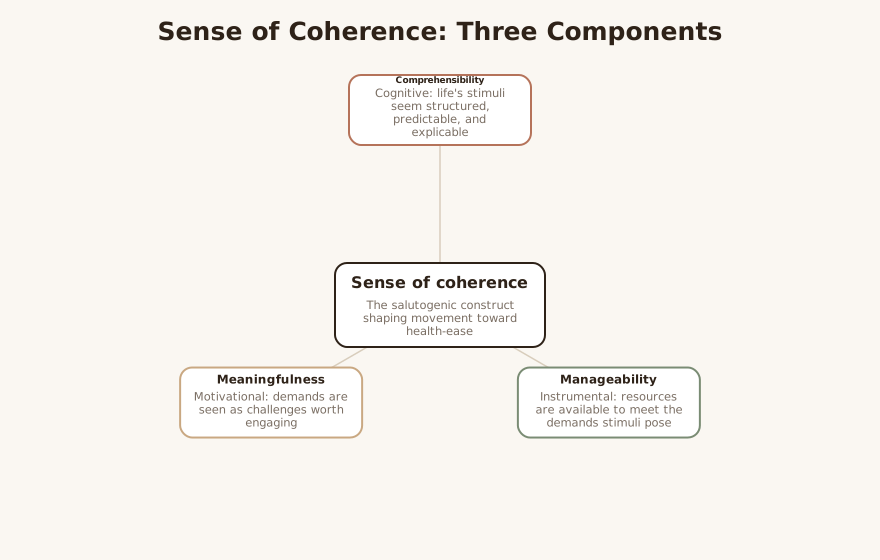
The three components of sense of coherence. SOC has a cognitive component, comprehensibility, the perception that stimuli from one’s internal and external environment are structured, predictable, and explicable; an instrumental component, manageability, the sense that resources are available to meet the demands those stimuli pose; and a motivational component, meaningfulness, the appraisal of life’s demands as challenges worthy of investment and engagement 1. Meaningfulness is generally regarded as the most important of the three because it drives the motivation to engage at all LLM.
Generalized resistance resources (GRRs). GRRs are the assets, internal and external, that a person can mobilize across a wide range of situations: money, ego-strength, social support, knowledge, cultural and spiritual frameworks, and material conditions 5. Repeated experiences of successfully using GRRs are what build a strong SOC over time, particularly experiences marked by consistency, a manageable balance of challenge to capacity, and participation in shaping outcomes 1.
Interventions & Techniques
Salutogenesis is a framework rather than a protocol, so its “interventions” are better understood as a set of clinical emphases that can be layered onto whatever modality a therapist already uses 6. The over-arching move is to adopt a salutogenic perspective alongside, not instead of, symptom-focused treatment: actively help the client identify and mobilize their generalized and specific resistance resources for effective tension management 6.
Concretely, this orientation translates into several practices LLM. First, comprehensibility-building: psychoeducation, formulation, and naming that help a chaotic experience become structured and explicable, so the client can predict and narrate what is happening to them 1. Second, manageability-building: a resource inventory and resource activation, surfacing the social, material, and internal supports the client already has and connecting them to the demand at hand 6. Third, meaningfulness-building: values clarification and engagement work that reframe demands as challenges worth investing in rather than burdens to endure 1.
In care settings, evidence supports strengthening SOC through the quality of the relationship itself, what one source describes as “respectful and present” interaction that acknowledges the individual as a person 6. There is also support for purpose-built interventions designed to strengthen SOC in chronic-illness populations 6.
LLM-generated illustrative example (not a guideline): A client recovering from a cardiac event feels that his body has become unpredictable and dangerous. The clinician works first on comprehensibility, mapping with him exactly what triggers his symptoms and what his rehabilitation plan does; then on manageability, listing the people and tools available for each foreseeable difficulty; then on meaningfulness, reconnecting the regimen to his wish to be present for his grandchildren. LLM
Evidence Base
The maturity of this literature is best described as established: SOC is one of the most extensively studied constructs in health psychology, with more than 1,700 studies employing its scales across at least 48 countries and 49 languages 23. The construct is well operationalized and cross-culturally portable, which is a meaningful strength relative to many clinical constructs 3.
The evidence is strongest for mental health. A systematic review of work from 1992 to 2003 found that a strong SOC protected against anxiety, depression, burnout, and hopelessness, and was strongly and positively related to optimism, hardiness, sense of control, and adaptive coping 2. SOC correlates from slight to good with mental-health measures such as the General Health Questionnaire and the Mental Health Inventory, in some samples accounting for a large share of variance, and a high SOC is consistently related to higher quality of life 3. More recent work has found SOC directly related to the mental component of health but not the physical, suggesting it operates primarily as a psychological process 2.
Honesty about limits matters here LLM. The physical-health and mortality evidence is more limited and mixed; predictive validity for outcomes like depression and mortality appears at one-year follow-up but weakens over longer horizons 23. Much of the literature is cross-sectional rather than longitudinal, causal mechanisms remain understudied, and the proliferation of modified scale versions has left consensual validity somewhat weak 23. Test-retest stability also declines over time, from roughly 0.69-0.78 at one year to about 0.54 at ten years, which complicates Antonovsky’s claim that adult SOC is relatively fixed 3. SOC is a robust correlate and plausible resource for mental health, but it is not a proven causal lever for physical disease LLM.
Populations & Indications
SOC has been studied across a wide span of populations relevant to behavioral health practice. Research includes survivors of specific adversities, Holocaust survivors, survivors of sexual abuse, targets of bullying, and war-exposed groups, as well as people navigating major life transitions such as menopause and caregiving for older adults 2. It has been examined in adolescents, in older adults, and in occupational groups including healthcare workers and employees under work stress 2.
In care settings, stronger SOC is associated with better health-related quality of life and reduced loneliness among nursing-home residents; better mental and physical quality of life and exercise adherence after myocardial infarction; positive health-behavior change in diabetes, where weak SOC was linked to substantially higher diabetes risk in prospective data; and, in cancer patients, better quality of life, fewer anxiety and depressive symptoms, and more positive coping 6. These overlap closely with the populations a salutogenic frame is most apt for: people with chronic illness, older adults, trauma survivors, caregivers, patients in rehabilitation, employees experiencing burnout, and refugees and displaced populations LLM.
Problems-for-Work
The salutogenic frame is most clinically useful for problems where the question is not only “how do we reduce symptoms” but “how does this person keep their footing under load” LLM.
- People with chronic illness adjustment. Where a diagnosis has made the body feel unpredictable, comprehensibility and manageability work directly targets the disorientation, and strong SOC predicts better quality of life across cardiac, diabetic, and oncology populations 6.
- Burnout and stress-related presentations. A strong SOC is protective against burnout and hopelessness, making resource activation and meaning-restoration a coherent target for depleted clinicians and overloaded employees 2.
- Demoralization and existential distress. Because meaningfulness is the motivational core of SOC, work that reconnects demands to values speaks directly to the loss of purpose at the heart of demoralization 1.
- Coping difficulties and low resilience. SOC’s positive relationship with control, hardiness, and adaptive coping makes a resource-inventory approach a natural fit for clients who feel they have nothing to draw on 2.
- Health anxiety and quality-of-life impairment. Building a structured, predictable understanding of bodily experience addresses the comprehensibility deficit that often fuels health anxiety LLM.
Contraindications, Cautions & Cultural Humility
Salutogenesis has no contraindications in the pharmacological sense, but several cautions apply LLM. Because it is a frame and not a treatment, it should not displace evidence-based, symptom-focused care for acute or high-risk presentations; a salutogenic perspective complements disease treatment rather than substituting for it 6. Using “what keeps you well” language with a person in acute crisis or active suicidality can read as minimizing, so the frame is best introduced once safety and stabilization are addressed LLM.
There is a real risk of subtly blaming the client: if health is framed as a product of one’s own coherence and resources, a person whose resources have been stripped by poverty, discrimination, or displacement may hear that their suffering is a personal failing LLM. GRRs are explicitly material and structural, money, social support, cultural frameworks, so a salutogenic assessment must attend to what the environment has denied, not only to the client’s internal stance 5.
Cultural humility is essential at the collective level. Antonovsky himself was uneasy applying SOC to groups, doubting whether collectives hold a unified worldview 5. Recent research underscores the concern: a strong community sense of coherence can reinforce in-group narratives and actually hinder reconciliation between groups 5. The clinician should treat what counts as comprehensible, manageable, and meaningful as culturally situated rather than universal LLM.
Treatment-Plan Suggestions & SMART Objectives
| Goal | SMART objective (example) | Mechanism |
|---|---|---|
| Increase comprehensibility of a health condition | Within 4 sessions, client will articulate a structured, predictable account of his symptom triggers and treatment plan, rated by client as “mostly clear” | Comprehensibility component of SOC 1 |
| Build manageability through resource activation | Over 6 weeks, client will complete a written inventory of at least 5 internal and external resistance resources and link each to a specific stressor | Mobilizing generalized resistance resources 6 |
| Restore meaningfulness | Within 8 sessions, client will identify 3 valued life domains and one engaged action per week connecting current demands to those values | Meaningfulness as the motivational core of SOC 1 |
| Reduce burnout-related hopelessness | Over 8 weeks, client will report a measurable decrease in hopelessness on a standardized self-report while increasing use of adaptive coping | Strong SOC protects against burnout and hopelessness 2 |
| Improve coping repertoire | Within 6 sessions, client will demonstrate use of at least 2 new adaptive coping strategies during a logged real-world stressor | SOC’s positive relation to control and adaptive coping 2 |
| Strengthen quality of life in chronic illness | Over 12 weeks, client will report improved health-related quality of life on a validated measure alongside increased treatment adherence | SOC predicts quality of life and adherence in chronic illness 6 |
| Reframe stress as manageable tension | Within 5 sessions, client will reappraise 3 recurring stressors as challenges with available resources, recorded in a tension-tracking log | Distinguishing tension from debilitating stress 5 |
Common Misconceptions
“Salutogenesis is just positive thinking.” It is not an attitude or an affirmation practice; it is a structural orientation toward health origins that explicitly includes material and social resistance resources, not only mental ones 5. “A strong SOC means you avoid stress.” The model holds the opposite: stressors are ubiquitous and tension is normal, and a strong SOC is precisely what lets tension resolve without becoming harmful stress 5. “SOC is fixed in adulthood, so it cannot be a clinical target.” Antonovsky proposed relative stability, but test-retest correlations decline over a decade and intervention research targets SOC in chronic-illness populations, so it is better treated as dynamic 36. “It proves that mindset prevents disease.” The evidence is strongest for mental health and quality of life; the physical-health and mortality data are limited, mixed, and largely correlational, so causal claims about preventing physical disease overreach the evidence 2. “It replaces diagnosis and symptom-focused treatment.” Salutogenesis is meant to run alongside disease-oriented care, not to supplant it 6.
Training & Certification
There is no licensure or formal certification in salutogenesis; it is a research-based theoretical framework rather than a credentialed treatment, and it is most often learned through the academic literature LLM. The primary scholarly home is The Handbook of Salutogenesis, the open-access volume from which several authoritative chapters on the model, the construct, and its measurement are drawn 123. The foundational primary sources remain Antonovsky’s Health, Stress and Coping (1979) and Unraveling the Mystery of Health (1987) 4. Clinicians wishing to operationalize the construct typically use Antonovsky’s Orientation to Life Questionnaire, available in the 29-item and 13-item forms, which are validated across many languages and populations 36. Ongoing development is led by international salutogenesis research communities 4.
Key Terms
- Salutogenesis. The study of the origins of health, contrasted with pathogenesis, the study of the origins of disease 5.
- Sense of coherence (SOC). A global, enduring-yet-dynamic orientation reflecting confidence that life is comprehensible, manageable, and meaningful 1.
- Comprehensibility. Perceiving internal and external stimuli as structured, predictable, and explicable 1.
- Manageability. Perceiving that adequate resources are available to meet the demands one faces 1.
- Meaningfulness. Appraising life’s demands as challenges worthy of engagement and investment 1.
- Generalized resistance resources (GRRs). Broadly applicable assets, money, ego-strength, social support, knowledge, culture, that help manage stressors across situations 5.
- Health-ease/dis-ease continuum. The view of health as a spectrum rather than a healthy/sick binary 5.
- Orientation to Life Questionnaire (SOC-29 / SOC-13). Antonovsky’s self-report measure of SOC 3.
Resources & Further Reading
▶ Watch — a video introduction to this concept:
- The Sense of Coherence in the Salutogenic Model of Health (Handbook of Salutogenesis, NCBI Bookshelf)
- The Sense of Coherence: The Concept and Its Relationship to Health (Handbook of Salutogenesis, NCBI)
- The Sense of Coherence and Its Measurement (Handbook of Salutogenesis, NCBI)
- Aaron Antonovsky — including Health, Stress and Coping (1979) and Unraveling the Mystery of Health (1987)
- Salutogenesis (Wikipedia)
- Sense of Coherence (Health Promotion in Health Care — Vital Theories and Research, NCBI)
Reflective / Supervision Questions
- For a given client, which of the three components, comprehensibility, manageability, or meaningfulness, is most depleted, and how would your interventions differ depending on the answer? LLM
- When you map a client’s generalized resistance resources, are you attending to material and structural resources their environment may have denied them, or only to internal stance? LLM
- Where in your caseload might “what keeps you well” language land as minimizing, and how would you sequence stabilization before introducing a salutogenic frame? LLM
- Given that the physical-health evidence is limited and mixed, how do you describe the likely benefits of this work to clients without overstating them? 2
- Whose definitions of comprehensible, manageable, and meaningful are you using, and how do you check that they fit the client’s cultural world rather than yours? 5