
Type & Discipline
Anomie is a sociological construct, not a treatment model or a school of psychotherapy 1. It belongs to the discipline of sociology and, more specifically, to the Durkheimian tradition that treats social facts—rates, norms, collective forces—as realities that shape individual lives 1. The word itself derives from the Ancient Greek anomía, combining the privative prefix a- (“without”) with nomos (“law”), and so literally means “lawlessness,” though modern sociology reads it more broadly as normlessness or moral deregulation 6.
For clinicians, the categorical point matters from the outset: anomie names a condition of the social environment, not a diagnosis, a syndrome, or an intervention LLM. It describes what happens when “common values and common meanings are no longer understood or accepted, and new values and meanings have not developed,” leaving individuals without reliable guidance 1. Its clinical relevance is therefore indirect—it explains why certain presentations cluster in certain communities and circumstances, and it sharpens formulation, but any therapeutic use is borrowed and folded into recognized psychotherapy rather than delivered as “anomie treatment” LLM.
Creators & Lineage
The French sociologist Emile Durkheim introduced anomie into social science and gave it two successive formulations 6. In The Division of Labour in Society (1893), he used anomie to describe an industrial society in which the rapid specialization of labor outran the moral rules needed to coordinate it, so that producers lost contact with the consequences of their work and economic life became “unbridled and unregulated” 6. In Suicide (1897), he refined the idea: anomie arises from rapid social and economic change—including economic booms as well as busts—that disrupts the moral framework regulating people’s aspirations, producing what he called “the malady of the infinite,” an insatiable will with no bound to satisfy it 6. Durkheim did not coin the word from nothing; he borrowed it from the French philosopher Jean-Marie Guyau and substantially developed and popularized it 6.
The American sociologist Robert K. Merton carried anomie into mid-century sociology and criminology with his 1938 paper “Social Structure and Anomie,” published in the American Sociological Review 2. Merton reframed the concept around a structural mismatch in American society between culturally promoted goals—above all material success, the “American Dream”—and the legitimate, institutionalized means unequally available to reach them 5. The disjunction between universally promoted goals and unequally distributed means is, for Merton, the engine of anomie and deviance 5. His framework was later extended by Robert Agnew’s General Strain Theory, which broadened the sources of strain beyond blocked economic goals 2. The lineage running into clinical territory passes through this strain tradition and, separately, through existential psychology, which took up the experience of normlessness and meaninglessness at the level of the individual LLM.
Core Principles
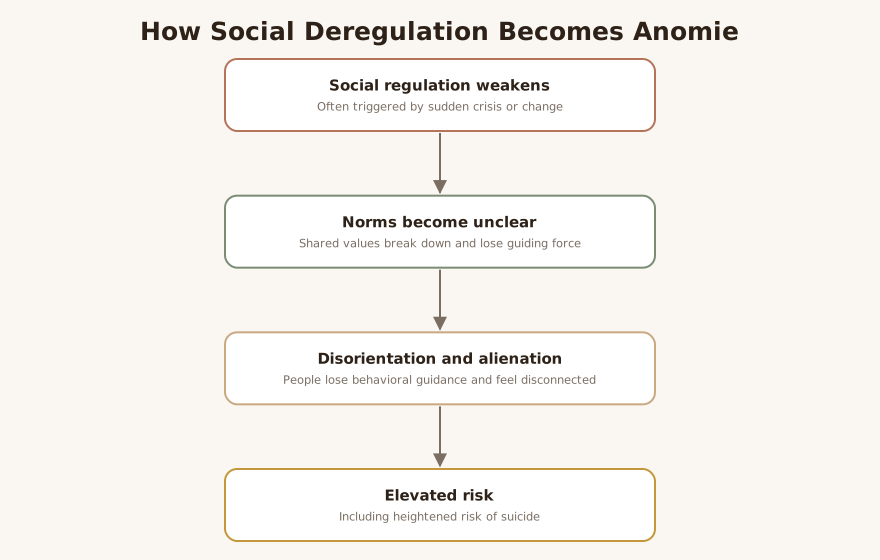
The first principle is social regulation. For Durkheim, human appetites are not naturally self-limiting; they require external moral regulation supplied by society, and when that regulation weakens, people are left without a sense of where striving should stop 4. Anomie is precisely the breakdown of this regulation—a state in which “society’s norms and values break down or become unclear,” so that individuals lose behavioral guidance and feel disconnected from the community 4.
The second principle is the link to crisis and change. Anomie is not a steady-state condition so much as a product of disruption 4. Durkheim located it in sudden life disruptions, noting that both economic downturns and booms can generate it, because each abruptly dislocates the relationship between people’s expectations and their circumstances 4. He captured the human cost in a memorable formulation: “The bond attaching people to life slackens because the bond attaching them to society is itself slack” 4.
The third principle, contributed by Merton, is the goals-means disjunction. Where Durkheim emphasized deregulated appetite, Merton emphasized structural contradiction: a culture that tells everyone they can “climb the ladder of success” while a social structure denies many the educational and social means to do so generates intense, patterned pressure 5. People experience strain to achieve the societal goal of success without possessing the means, and that strain drives the adaptations described below 5. A useful way to hold the two thinkers together is that Merton effectively offered two related theories at different levels of analysis—a macro-level account of anomie as a property of the social structure and a more micro-level account of strain as the pressure experienced by individuals within it 3.
Interventions & Techniques
Anomie supplies no protocol, manual, or technique of its own, because it is a sociological construct rather than a clinical method LLM. What it offers the clinician is an explanatory frame—a way of locating part of a client’s distress in the breakdown or absence of shared norms rather than solely in intrapsychic pathology LLM. The “techniques” below are recognized psychotherapeutic methods into which an anomie-informed formulation can be folded; the lens is sociological, the delivery is established therapy LLM.
A first move is naming the normative vacuum. Rather than treating a client’s disorientation as purely a cognitive distortion, the clinician can validate that the rules and reference points the client once relied on have genuinely dissolved—an accurate reading of their social world, not merely a symptom 1. A second is rebuilding regulation and structure: because anomie is partly a failure of external regulation, helping a client re-establish routines, roles, and realistic, attainable goals directly addresses the deregulated, “malady of the infinite” quality Durkheim described, and overlaps cleanly with behavioral activation and structured problem-solving 6. A third is reworking the goals-means relationship: Merton’s framework invites collaborative examination of whether a client is straining toward culturally imposed goals through means that are blocked or punishing, and whether goals, means, or both can be renegotiated 5. A fourth is rebuilding belonging, since social disconnection is intrinsic to anomie and reconnection to community, ritual, and shared meaning is itself regulatory 4.
LLM-generated illustrative example (not a guideline): A recently arrived immigrant client says, “Back home I knew exactly who I was supposed to be. Here none of the rules I grew up with seem to apply, and I don’t know the new ones.” A clinician working with an anomie-informed lens might respond, “That sounds less like something wrong with you and more like living in a gap between two sets of rules—where the old ones don’t fit and the new ones aren’t clear yet. Let’s start by building a few reliable anchors you can count on while we figure out the rest,” then move into concrete routine-building and community connection. LLM
Evidence Base
Honesty requires separating two claims LLM. As a sociological construct, anomie is established and foundational: it is more than a century old, was developed across Durkheim’s major works and Merton’s landmark 1938 paper, and remains a touchstone in sociology and criminology that continues to generate scholarship and extensions such as General Strain Theory 2. Empirically, anomic conditions correlate with elevated suicide rates, alienation, and various forms of deviance during economic crises and rapid social change—an association that runs back to Durkheim’s original statistical study of suicide 4.
As a clinical intervention, however, anomie has no evidence base of its own, because it was never intended to be a treatment LLM. There are no randomized controlled trials of “anomie therapy,” no manualized protocol, and no outcome literature for the construct as such LLM. Its clinical value is interpretive and formulatory: it helps explain connections between social instability and psychological distress, and it directs attention to social determinants that purely individual models can miss 4. The defensible position for a practitioner is to use anomie as a lens within an established modality—existential, meaning-centered, or structured cognitive-behavioral and systemic work—and never to represent it to clients or in documentation as an evidence-based therapy in its own right LLM. It is also worth flagging that even Merton’s structural theory has been critiqued for its age and scope, which is one reason later strain theorists revised and broadened it 2.
Populations & Indications
Anomie is most clinically illuminating where distress is bound up with disrupted, absent, or conflicting social norms rather than with a discrete, well-bounded symptom cluster LLM. Immigrants and displaced people are a paradigmatic fit, because migration and displacement often place a person in exactly the gap Durkheim described—between a coherent prior normative world and a new one whose rules are unfamiliar; the construct has been applied to displacement contexts including documented religious conversion patterns during El Salvador’s civil war 6. Communities after social disruption—following disasters, economic collapse, mass unemployment, or rapid social change—are also apt, since Durkheim tied anomie specifically to such disruptions, booms and busts alike 4.
Marginalized communities facing blocked legitimate opportunity map onto Merton’s goals-means disjunction, where culturally promoted success is held out but the means to it are structurally withheld 5. Adolescents and people in social transition (career change, divorce, retirement, leaving an institution) frequently occupy normatively ambiguous positions where old reference points have lapsed and new ones have not consolidated 1. People with substance use disorders are relevant on Merton’s own terms—he located withdrawal-based “retreatism,” exemplified by chronic substance use and disaffiliation, as one structured response to the strain of unattainable goals 5.
Problems-for-Work
Alienation and social disconnection. When a client reports feeling cut off from community and unmoored from shared values, anomie reframes this as a recognizable response to weakened social bonds, directing work toward reconnection and the rebuilding of belonging rather than treating isolation as a purely personal failing 4.
Suicidality. Durkheim’s original link between anomie and suicide is direct, and Britannica notes that “delinquency, crime, and suicide are often reactions to anomie”; an anomie-informed formulation can prompt the clinician to assess for recent social or economic disruption as a risk amplifier, always alongside—never instead of—standard risk assessment and safety planning 1.
Substance use disorders. Reading chronic use through Merton’s “retreatism” can help a clinician understand withdrawal from blocked goals as an adaptation, informing motivational and harm-reduction work that addresses the underlying strain rather than the substance alone 5.
Adjustment disorder and identity disturbance. For clients in the disorienting interval after a major transition, the construct names the specific texture of being between normative orders, which can guide structure-building and identity-reconstruction work 1.
Meaninglessness and demoralization. Durkheim’s “malady of the infinite”—striving without a sense of where it ends—closely parallels the emptiness and futility clients describe as meaninglessness, and links the sociological frame to existential and meaning-centered intervention 6.
Contraindications, Cautions & Cultural Humility
Anomie is a frame, not a treatment, so the central caution is against misuse rather than physiological risk LLM. The construct must never displace clinical fundamentals: where suicidality is present, the empirical anomie-suicide link is a reason to take social disruption seriously as a risk factor, not a reason to substitute sociological discussion for risk assessment, safety planning, and stabilization 1. Used carelessly, an explanatory frame can become fatalistic—telling a client their distress is “just society” can inadvertently strip agency, so the lens should be paired with concrete, regainable structure and choice LLM.
Cultural humility is essential and runs in two directions LLM. First, what looks like “normlessness” from the clinician’s vantage point may in fact be the client living by a coherent but different normative order; labeling another culture’s norms as anomie risks importing the clinician’s own standards as the universal yardstick, a particular danger given that the construct itself was built around a specific (often Western, individualist, success-oriented) cultural model 5. Second, Merton’s analysis is itself a critique of a structural injustice—the unequal distribution of means—so the construct should be used to illuminate the social and economic forces bearing on marginalized clients, not to pathologize their adaptations to those forces 5. The respectful application is to treat anomie as naming a feature of the client’s social world, validating their accurate perception of disrupted norms, while leaving their own values and cultural commitments intact and centered LLM.
Treatment-Plan Suggestions & SMART Objectives
| Goal | SMART objective (example) | Mechanism |
|---|---|---|
| Reduce alienation and rebuild belonging | Within 8 weeks, client will initiate and sustain 2 regular community or relational connections, logged weekly | Reconnection restores the social bonds whose slackening drives anomie 4 |
| Re-establish regulating structure after disruption | Within 4 weeks, client will implement a daily routine with fixed anchors (sleep, meals, one role-based activity), tracked 5+ days/week | External structure substitutes for lost normative regulation 6 |
| Renegotiate blocked goals-means tension | Over 6 sessions, client will identify 1 culturally imposed goal and define 2 attainable, values-aligned alternative pathways | Reworking the goals-means disjunction reduces strain 5 |
| Counter meaninglessness / the “malady of the infinite” | Within 10 sessions, client will articulate 3 self-chosen, bounded sources of meaning and act on them weekly | Self-authored limits replace insatiable, unbounded striving 6 |
| Support identity reconstruction in transition | By week 8, client will draft a personal values-and-roles statement bridging old and new contexts | Constructed reference points fill the normative gap 1 |
| Reduce substance use understood as retreatism | Over 12 weeks, client will substitute 2 value-aligned activities for prior use episodes, tracked weekly | Addressing underlying strain undercuts withdrawal-based adaptation 5 |
| Mitigate suicide risk amplified by social disruption | Each session, client will review and update a collaborative safety plan; clinician will reassess social-disruption stressors | Disrupted social bonds are treated as a modifiable risk context 1 |
Common Misconceptions
“Anomie just means a person has no morals.” This misreads the construct: anomie is a social condition of weakened or unclear shared norms, not a defect of individual character, and Durkheim explicitly located it in the breakdown of regulation at the level of society 4.
“Anomie is a clinical diagnosis.” It is a sociological construct with no place in any diagnostic manual; treating it as a syndrome to be diagnosed in a person is a category error, however useful it may be for formulation LLM.
“Durkheim and Merton meant the same thing by anomie.” They did not: Durkheim emphasized deregulated appetite during social disruption, while Merton emphasized a structural mismatch between cultural goals and institutionalized means, and the shift moved the focus from societal breakdown toward patterned individual adaptation 6.
“Anomie only happens in economic hard times.” Durkheim was explicit that prosperity and booms can be anomic too, because sudden upward dislocation also breaks the fit between expectation and circumstance 4.
“It applies only to crime.” Although Merton’s theory became foundational in criminology, the construct also speaks to suicide, alienation, substance use, and psychological distress more broadly 1.
Training & Certification
There is no certification in anomie, because it is a sociological construct rather than a clinical credential LLM. A clinician’s competence here comes from two sources: grounding in the sociological literature so the concept is used accurately, and training in the empirically supported modalities through which any clinical application is actually delivered LLM. Reading Durkheim and Merton directly—or at minimum reliable summaries of Suicide, The Division of Labour in Society, and the 1938 “Social Structure and Anomie” paper—guards against the common misreadings above 2. Familiarity with later developments such as General Strain Theory helps the clinician recognize the construct’s limits and revisions 2. Because anomie-informed work intersects directly with suicide risk, marginalization, and cultural difference, ongoing supervision is important wherever the lens is applied to vulnerable clients LLM.
Key Terms
Anomie — a condition of normlessness or breakdown of social regulation in which shared values and meanings become unclear, producing disorientation and heightened risk 1.
Normlessness / moral deregulation — the core experiential content of anomie: the loss of clear behavioral guidance when collective norms weaken or fail to develop 4.
Anomic suicide — Durkheim’s category of suicide arising specifically from anomic conditions, when sudden disruption (downturn or boom) loosens the bond attaching the individual to society 4.
The malady of the infinite — Durkheim’s phrase for the insatiable, unbounded striving that results when social regulation no longer limits human appetite 6.
Goals-means disjunction — Merton’s structural account of anomie: the gap between culturally promoted goals and the unequally distributed legitimate means to attain them 5.
Modes of adaptation — Merton’s five responses to strain—conformity, innovation, ritualism, retreatism, and rebellion—describing how individuals reconcile (or fail to reconcile) cultural goals with available means 5.
Resources & Further Reading
▶ Watch — a video introduction to this concept:
- Anomie | Definition, Types, & Facts (Encyclopaedia Britannica)
- Anomie Theory in Sociology (Simply Psychology)
- Strain and Anomie Theory by Robert K. Merton (Criminology Web)
- Anomie and Strain: Context and Consequences of Merton’s Two Theories (ResearchGate)
- Merton, R. (1938) Social Structure and Anomie — annotated bibliography
- Anomie (Wikipedia)
Reflective / Supervision Questions
- When a client presents as disoriented or “lost,” am I reflexively locating the problem inside them, or am I asking what has happened to the norms and social bonds around them? LLM
- How do I distinguish a genuine breakdown of the client’s normative world from my own discomfort with norms that simply differ from mine? 5
- For a marginalized client straining toward goals whose means are structurally blocked, am I helping renegotiate the goals-means relationship, or implicitly blaming them for the gap? 5
- Given the established link between anomie and suicide, am I assessing recent social and economic disruption as a risk context alongside standard risk evaluation? 1
- When I use anomie as a frame, am I pairing it with concrete, regainable structure so it restores agency rather than reinforcing fatalism? LLM
- Am I representing this construct accurately—as a sociological lens within established therapy—rather than as a treatment in its own right? LLM