
Type & Discipline
Deconversion is a construct within the psychology of religion, situated in the broader study of religious change 2. It names the process by which a person leaves, loses, or substantially abandons a religious faith they previously held 1. Crucially, deconversion is a descriptive and explanatory research concept rather than a therapy, a manualized protocol, or a diagnosis; clinicians borrow it as an organizing lens, not as a treatment in itself LLM.
The term is older than its modern empirical usage, but its contemporary clinical relevance rests on two bodies of work: John Barbour’s literary-philosophical analysis of deconversion as a recurring autobiographical pattern, and Heinz Streib’s program of cross-cultural empirical research that operationalized the concept for systematic study 12. Together these reframed “losing one’s faith” from a moral or theological judgment into a researchable, multidimensional psychological process 2.
Deconversion is best distinguished from adjacent constructs. It is not the same as ordinary doubt, which may resolve within continued faith, nor identical to disaffiliation, which is only one of its possible components 2. It also differs from conversion run in reverse: the empirical literature treats deconversion as having its own structure, trajectories, and predictors rather than as a mirror image of joining a faith 6.
Creators & Lineage
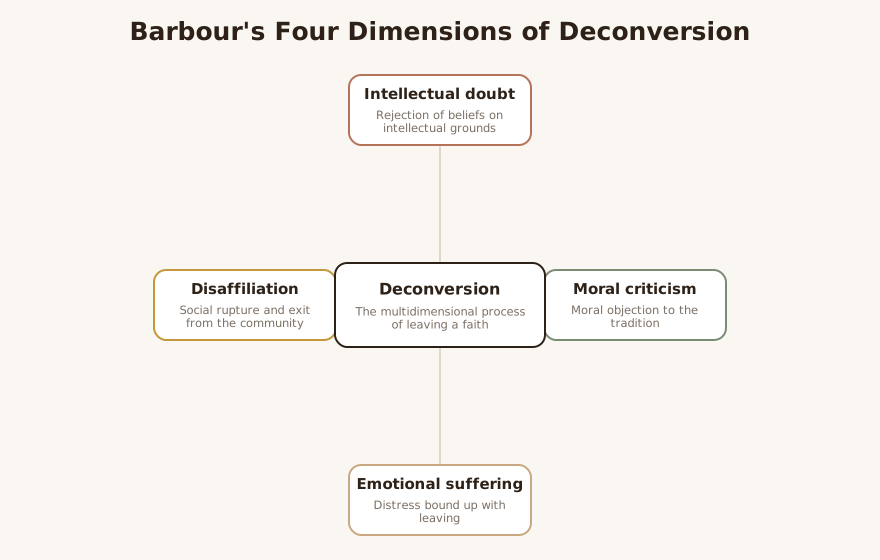
The conceptual anchor is John D. Barbour’s 1994 book Versions of Deconversion: Autobiography and the Loss of Faith, which analyzed how writers across centuries narrated leaving belief 1. Barbour distilled deconversion into four recurring dimensions that remain the field’s most cited framework: (1) intellectual doubt or denial of the truth of a belief system; (2) moral criticism of the religion or its adherents; (3) emotional suffering, including grief, guilt, loneliness, or despair; and (4) disaffiliation from the religious community 1. These dimensions are analytic, not sequential: a given person may experience some and not others, and in varying order LLM.
Heinz Streib and colleagues then moved the construct from autobiography into systematic social science 2. In the Bielefeld-Based Cross-Cultural Study on Deconversion, Streib, Ralph W. Hood Jr., Barbara Keller, Ralph-Matthias Csoff, and Christopher Silver gathered qualitative and quantitative data from deconverts in Germany and the United States, combining narrative interviews, faith-development assessment, and standardized measures 34. This project produced both a refined definition of deconversion and an empirically grounded typology of its trajectories 24.
Streib and Keller’s work explicitly built a “contours of a concept” treatment, specifying which features distinguish deconversion from mere doubt or routine religious change and identifying the dimensions that empirical research should track 2. The lineage also connects to research on religious socialization and faith development, and the adolescent literature extends it into how parental and peer factors shape early disaffiliation 5. Bruce Hunsberger’s earlier work on “amazing apostates” and the loss of faith is part of the same intellectual stream feeding contemporary deconversion research LLM.
Core Principles
First, deconversion is multidimensional. Barbour’s four dimensions — intellectual doubt, moral criticism, emotional suffering, and disaffiliation — mean that two people who both “left the church” may have undergone very different processes, one driven primarily by intellectual rejection and another by moral revulsion or social rupture 1. Clinically, this argues against treating all leavers as a single population LLM.
Second, deconversion is a process, not an event. Streib’s research frames it as an unfolding trajectory with antecedents, a course, and outcomes, rather than a single moment of decision 2. A precipitating crisis may be visible, but the surrounding movement often spans years 6.
Third, deconversion follows distinguishable trajectories. Rather than one path, the Bielefeld study identified multiple types of deconversion, differing in whether the person exits religion entirely, migrates to another tradition, adopts a privatized or “spiritual but not religious” stance, or moves toward a more secular humanism 24. The trajectory matters because outcomes are not uniform 6.
Fourth, deconversion has measurable predictors and outcomes. Recent work has examined who is more likely to deconvert and what tends to follow, treating both the antecedents (developmental, relational, and cognitive) and the sequelae (changes in well-being, identity, and worldview) as empirical questions rather than assumptions 6. This is the principle most relevant to honest clinical expectation-setting LLM.
Fifth, deconversion is relationally embedded. Especially in adolescence, parental religiosity and peer environments shape whether and how a young person disaffiliates, underscoring that leaving faith is rarely a purely private cognitive act 5.
Interventions & Techniques
Because deconversion is a construct rather than a modality, there is no “deconversion therapy”; instead the framework informs assessment and case formulation within established psychotherapies LLM. The most defensible clinical use is to map a client’s experience onto Barbour’s four dimensions to locate where the distress actually lives 1. A few applied moves follow naturally from the research:
- Dimensional assessment. Ask, in effect, which of the four dimensions is driving the presentation — is this primarily intellectual doubt, moral criticism, emotional suffering, or the social rupture of disaffiliation? 1
- Trajectory clarification. Help the client articulate where they are heading (toward atheism/secular humanism, toward another tradition, toward a privatized spirituality, or toward an as-yet-undefined stance), since outcome data suggest the destination shapes adjustment 24.
- Normalizing the process frame. Position the experience as a recognized, studied trajectory rather than a personal failure or pathology, which can reduce shame 2.
- Grief and meaning work. Address the losses — of certainty, community, ritual, and sometimes family — using the clinician’s existing grief and meaning-reconstruction skills LLM.
- Attending to the relational field. With adolescents and emerging adults, explicitly include parental and peer dynamics in the formulation, as these are documented contributors 5.
LLM-generated illustrative example (not a guideline): A 29-year-old raised in a strict evangelical home presents with insomnia and “free-floating dread” after stopping attendance at her church. Mapping onto Barbour’s dimensions, the clinician finds her intellectual doubt is actually mild; the engine is emotional suffering (guilt, fear of damnation) plus an impending disaffiliation she has not told her parents about. Treatment therefore centers on grief, anticipatory family conflict, and shame — not on debating doctrine. LLM
Evidence Base
Honest characterization: deconversion is an established research construct with a growing and methodologically respectable empirical base, but only modest evidence for any specific clinical intervention built on it 236. The construct itself is well validated conceptually — Barbour’s dimensions and Streib’s typology are widely used and have held up across the cross-cultural Bielefeld data 124.
The empirical strength lies chiefly in description and prediction. The Bielefeld-Based Cross-Cultural Study assembled qualitative and quantitative data from deconverts in two countries, lending the typology cross-national grounding rather than resting on a single sample 34. More recent quantitative work has moved into characteristics, predictors, and outcomes of deconversion, including who deconverts and how well-being and worldview shift afterward 6. The adolescent literature adds developmental specificity by isolating parental and peer factors 5.
What the evidence base does not yet provide is a tested, deconversion-specific treatment protocol with outcome trials LLM. Clinicians should therefore treat deconversion as a robust formulation tool whose downstream interventions (grief work, cognitive work, family work) borrow their evidence from their parent modalities rather than from deconversion research per se LLM. Generalizability also warrants caution: much foundational data comes from German and U.S. samples, and findings may not transfer cleanly to other religious and cultural contexts 3.
Populations & Indications
The construct is most directly indicated for religious leavers and faith-transition clients 2. This includes adults exiting high-control, fundamentalist, or otherwise demanding religious groups, where the four dimensions and the social cost of disaffiliation are often pronounced 1. It also fits adolescents and emerging adults questioning inherited faith, a population for whom parental and peer influences are documented drivers of the process 5.
Other apt populations include people in interfaith or mixed-belief families, where one member’s deconversion reshapes the family system; LGBTQ+ individuals reconciling identity with a religious upbringing, for whom moral criticism and emotional suffering dimensions may be acute; and former converts who later disaffiliate, illustrating that deconversion can follow conversion within a single life LLM. More broadly, the framework is indicated whenever a client presents with religious or spiritual struggle organized around leaving rather than deepening faith 2.
Problems-for-Work
- Religious and spiritual struggle. Use the four-dimension map to distinguish a primarily intellectual crisis from a moral or emotional one, directing intervention accordingly 1.
- Loss of meaning and worldview disruption. Frame the dismantling of a comprehensive belief system as a meaning-reconstruction task, not merely “doubt” 2.
- Identity disruption and role exit. Address the loss of a religious identity and social role as the person renegotiates who they are outside the tradition 2.
- Grief and loss of community. Treat disaffiliation as a genuine bereavement of community, ritual, and belonging 1.
- Family conflict and estrangement. Anticipate and work with relational rupture, especially where parental religiosity is strong, which is most salient for younger clients 5.
- Shame and guilt. Target the emotional-suffering dimension — guilt, fear, loneliness — that frequently outlasts the intellectual decision to leave 1.
LLM-generated illustrative example (not a guideline): A father estranged from his adult son after the son left the family’s faith presents for his own anxiety. Locating the son’s likely trajectory (toward secular humanism rather than another religion) helps the father stop “negotiating doctrine” and instead grieve the shared religious world he assumed they’d always inhabit, which lowers the conflict temperature at home. LLM
Contraindications, Cautions & Cultural Humility
The first caution is clinician neutrality. Deconversion research is descriptive; it does not establish that leaving faith is healthier or unhealthier than staying 2. A therapist’s own beliefs — whether religious or secular — can bias the work toward subtly encouraging or discouraging departure, which is an ethical hazard given the client’s vulnerability LLM. The clinical task is to support the client’s autonomous process, not to validate or contest the religion itself 2.
Second, do not assume distress equals pathology, or that resolution equals leaving. Some deconversion trajectories lead to greater well-being, others to lasting struggle, and outcomes vary by type; predicting a single “right” endpoint for a given client is not supported 46. Equally, some clients integrate doubt and remain within faith, which deconversion research neither prevents nor pathologizes 2.
Third, cultural and contextual humility is essential. The foundational data are largely German and American, and the meaning, cost, and feasibility of leaving a religion differ enormously across cultures, where disaffiliation can carry safety, legal, or familial consequences far beyond the original samples 3. With adolescents, clinicians must weigh the relational embeddedness of the process and avoid framing a young person’s questioning in ways that inflame family conflict 5. Finally, deconversion-as-construct does not replace risk assessment: where leaving faith is accompanied by acute depression, suicidality, or threats to safety, those clinical priorities come first LLM.
Treatment-Plan Suggestions & SMART Objectives
| Goal | SMART objective (example) | Mechanism |
|---|---|---|
| Localize the distress across dimensions | Within 3 sessions, client will identify which of the four deconversion dimensions (intellectual, moral, emotional, disaffiliation) is most distressing, rated 0-10 | Barbour’s multidimensional model directs intervention to the active driver 1 |
| Reduce shame and guilt | Over 6 weeks, client will report a ≥3-point drop on a 0-10 guilt rating tied to leaving, tracked weekly | Targets the emotional-suffering dimension as distinct from intellectual content 1 |
| Clarify trajectory and expectations | By session 4, client will articulate their anticipated post-religious stance and one realistic expectation about adjustment | Trajectory typology shows outcomes vary by destination 24 |
| Grieve community and ritual loss | Within 8 sessions, client will complete one structured grief exercise naming ≥3 specific losses (relationships, rituals, certainty) | Reframes disaffiliation as bereavement requiring mourning 1 |
| Rebuild meaning and worldview | Over 2 months, client will draft a provisional values statement independent of the former belief system | Meaning reconstruction following worldview disruption 2 |
| Address family/relational rupture | Within 6 sessions, client will plan and rehearse one boundaried disclosure or conversation with a family member | Relational embeddedness, especially with parental religiosity 5 |
| Distinguish doubt from decision | By session 5, client will state whether they are exploring doubt within faith or moving toward exit, with no pressure to resolve prematurely | Honors that doubt need not culminate in disaffiliation 2 |
| Stabilize mood and safety | Ongoing: client will use an agreed safety/coping plan and report mood weekly during the transition | Protects against depression/risk that can accompany worldview loss 6 |
Common Misconceptions
- “Deconversion is just losing faith overnight.” The research frames it as an unfolding trajectory with antecedents and outcomes, not a single decisive event 26.
- “It’s conversion in reverse.” Empirically, deconversion has its own dimensions, types, and predictors rather than being a symmetrical mirror of joining 16.
- “All deconverts become atheists.” The typology includes migration to other traditions, privatized spirituality, and secular humanism — multiple destinations, not one 24.
- “Deconversion always improves (or always harms) mental health.” Outcomes vary by trajectory and individual; the evidence does not license a blanket prognosis 46.
- “It’s purely an intellectual matter.” Barbour’s model gives equal weight to moral criticism, emotional suffering, and social disaffiliation, which often dominate the clinical picture 1.
- “It’s a private, individual process.” Especially for younger people, parental and peer factors materially shape the path 5.
Training & Certification
There is no certification in “deconversion,” consistent with its status as a research construct rather than a treatment modality LLM. Clinicians acquire competence by training in the psychology of religion and in spiritually integrated or culturally responsive psychotherapy, then applying the deconversion framework within those competencies LLM. The primary literature is the most direct route to fluency: Barbour’s Versions of Deconversion for the conceptual scaffold, and Streib and colleagues’ empirical publications and the Bielefeld project materials for the research grounding 124. Continuing education in religious and spiritual struggles, faith development, and grief/meaning work supplies the adjacent skills that deconversion-informed care actually deploys LLM.
Key Terms
- Deconversion: the process of leaving, losing, or abandoning a previously held religious faith 1.
- The four dimensions (Barbour): intellectual doubt, moral criticism, emotional suffering, and disaffiliation — the analytic components of deconversion 1.
- Disaffiliation: the social/organizational component of leaving — separation from the religious community — which is one dimension, not the whole 1.
- Deconversion trajectory/type: the patterned route a deconvert follows (e.g., toward atheism, another tradition, privatized spirituality, or secular humanism) 24.
- Doubt vs. deconversion: doubt is a precursor that may resolve within faith; deconversion involves substantive departure 2.
- Predictors and outcomes: the antecedent factors that raise the likelihood of deconversion and the downstream changes in well-being and worldview 6.
Resources & Further Reading
▶ Watch — a video introduction to this concept:
- Versions of Deconversion: Autobiography and the Loss of Faith — John D. Barbour (1994)
- The Variety of Deconversion Experiences: Contours of a Concept — Streib & Keller (2004)
- Deconversion: Qualitative and Quantitative Results from Cross-Cultural Research — Streib, Hood, Keller, Csoff, Silver
- The Bielefeld-Based Cross-Cultural Study on Deconversion (project page) — Universitat Bielefeld
- Deconversion Processes in Adolescence: The Role of Parental and Peer Factors — Religions (MDPI, 2020)
- Characteristics, Predictors and Outcomes of Religious Deconversion — IJPR (2025)
Reflective / Supervision Questions
- When a client describes leaving their faith, am I locating which of Barbour’s four dimensions is driving the distress, or am I treating “leaving” as one undifferentiated thing? 1
- How might my own religious or secular convictions be subtly steering this client toward, or away from, departure — and how do I keep the work autonomy-supporting? 2
- Am I tracking the client’s trajectory (where they are heading) rather than assuming a single endpoint, given that outcomes differ by type? 46
- For an adolescent or emerging-adult client, have I adequately formulated the parental and peer field, not just the individual’s beliefs? 5
- Where the foundational evidence is German/American, what cultural and safety considerations might make this client’s deconversion materially different? 3
- Within which established, evidence-based modality am I actually delivering this work, and does my formulation reflect that deconversion is a lens rather than a treatment? LLM