
Type & Discipline
Theory of mind (ToM) is a theoretical construct in developmental cognitive psychology, not a treatment modality. LLM It names the capacity to attribute independent mental states—beliefs, desires, intentions, knowledge, and emotions—to oneself and to others, and to use those attributions to predict and explain behavior. 1 Because the same behavior can flow from different mental states, and because a person can hold a belief that is false yet still act on it, ToM is fundamentally about representing representations rather than tracking reality directly. 2 It sits within the broader family of social cognition, alongside related constructs such as empathy, perspective-taking, and mentalizing. LLM
For clinicians, ToM is most useful as an organizing lens rather than a billable service. LLM It helps explain why a child can read fluently yet misjudge a peer’s intentions, why an adult with a psychotic disorder may misattribute hostile motives, and why social-skills coaching sometimes fails to generalize. LLM The construct gives a shared vocabulary across developmental, educational, and clinical settings. 3
Creators & Lineage
The phrase “theory of mind” was introduced by David Premack and Guy Woodruff in their 1978 paper asking whether a chimpanzee could attribute mental states to others. 1 They argued that an individual has a theory of mind when they impute mental states to self and others, and they framed it as a “theory” because such states are not directly observable and are used to make predictions. 1 The paper’s commentary spurred philosophers and psychologists to design tests that could distinguish genuine mental-state attribution from simpler behavior-reading. 2
Heinz Wimmer and Josef Perner translated that challenge into a developmental experiment in 1983 by inventing the false-belief paradigm, in which a child must predict the behavior of a character who holds a belief the child knows to be mistaken. LLM Simon Baron-Cohen, Alan Leslie, and Uta Frith adapted this into the widely used Sally–Anne test in 1985, building directly on Wimmer and Perner’s work. 4 These three lines—Premack and Woodruff’s comparative framing, Wimmer and Perner’s developmental task, and Baron-Cohen and colleagues’ clinical application—form the lineage most clinicians encounter. LLM
The construct draws on Piagetian cognitive-development theory, which described preschool egocentrism, and extends it by specifying a discrete representational milestone rather than a global stage shift. 6 It also intersects with social-cognition theory and, more loosely, with attachment theory, where early caregiver mind-mindedness is theorized to scaffold a child’s growing sense of other minds. LLM
Core Principles
First, mental states are representational and can diverge from reality; understanding this divergence is the crux of mature ToM. 2 A child who grasps false belief understands that another person can hold and act on a representation of the world that is simply wrong. 4
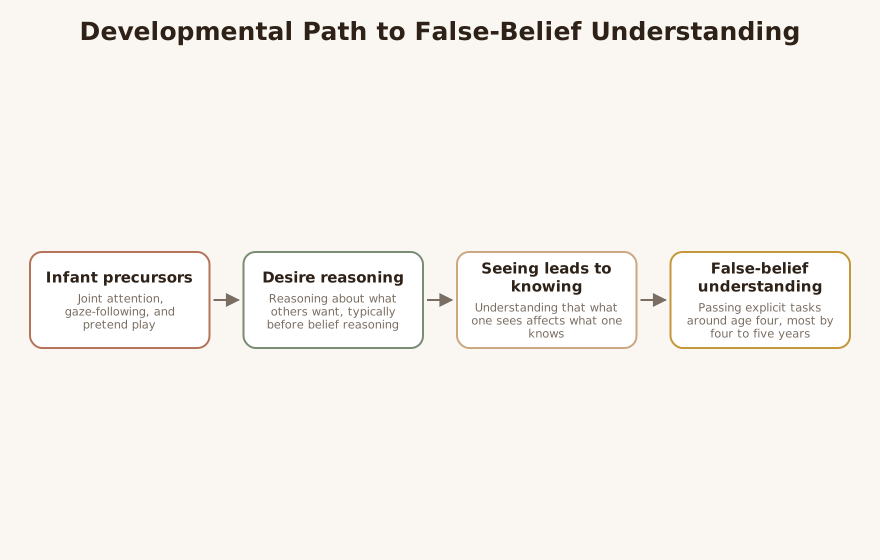
Second, ToM is developmentally graded rather than all-or-nothing. 6 Precursors appear in infancy—joint attention, gaze-following, and pretend play—well before children can pass an explicit false-belief task. 3 Desire reasoning and an understanding of seeing-leads-to-knowing typically precede belief reasoning. 6
Third, the canonical milestone is that typically developing children begin to pass explicit false-belief tasks around age four, with most succeeding by four to five years. 4 Before this, children tend to answer such tasks egocentrically, reporting where an object actually is rather than where a mistaken character would look for it. 4
Fourth, ToM is not a single monolithic ability. 2 Implicit, fast-acting mentalizing and explicit, effortful belief reasoning can dissociate, which matters when a person passes a verbal task yet still struggles in real-time social interaction. 2
Interventions & Techniques
ToM itself is assessed and trained rather than “delivered.” LLM The first-order false-belief task—the Sally–Anne procedure—is the prototypical assessment: a child watches Sally hide a marble and leave, watches Anne move it, and is asked where Sally will look upon returning. 4 Passing requires the child to set aside their own knowledge of the marble’s true location and reason from Sally’s outdated belief. 4 Second-order tasks (“Where does John think Mary thinks the ball is?”) probe more advanced, recursive mentalizing and emerge later in development. LLM
In intervention, ToM concepts are typically embedded inside established modalities rather than used standalone. LLM Within social-skills training and within cognitive behavioral therapy, clinicians scaffold perspective-taking through explicit modeling, comic-strip or thought-bubble visualizations of others’ hidden thoughts, video review of social exchanges, and structured “what might they be thinking?” prompts. LLM For autistic children, naturalistic developmental behavioral approaches target ToM precursors—joint attention, imitation, and shared affect—before explicit belief reasoning. LLM
LLM-generated illustrative example (not a guideline): A clinician working with an 8-year-old who consistently assumes peers are “being mean” pauses a recorded classroom clip and asks the child to draw what each peer might be thinking in a thought bubble, then compares the child’s first guess to alternative explanations. LLM
Evidence Base
The maturity of the underlying developmental finding is established. LLM The basic trajectory—precursors in infancy, explicit false-belief mastery around four years, recursive second-order reasoning later—has been replicated across hundreds of studies and many cultures, making it one of the more robust findings in developmental psychology. 6 The Sally–Anne paradigm itself produced a clear signal: in the original 1985 study, roughly 85% of typically developing children and 86% of children with Down syndrome passed, whereas only about 20% of children with autism did. 4
Evidence about ToM training is more mixed and should be presented to families with appropriate honesty. LLM Structured interventions can reliably teach children to pass false-belief tasks, but generalization of that skill to spontaneous, real-world social behavior is inconsistent and often limited. LLM Later research also questioned whether passing a verbal task reflects full social understanding, since some autistic individuals pass explicit tasks while still showing atypical spontaneous gaze and real-time mentalizing. 4 The clinical takeaway is that ToM is a well-validated developmental construct, but it is not a turnkey treatment target with guaranteed transfer. LLM
Populations & Indications
ToM assessment and scaffolding are most relevant for children and for toddlers and preschoolers, in whom the construct is actively emerging and where delay is most detectable. 6 Children with autism spectrum disorder are the most studied clinical group, given the historical finding of relative difficulty on false-belief tasks. 4 Children with developmental delays and children with hearing impairment—particularly deaf children of hearing parents with limited early language access—frequently show delayed false-belief understanding, underscoring the role of conversational input in ToM growth. LLM
Beyond childhood, people with schizophrenia commonly show mentalizing difficulties that contribute to misreading intentions and social withdrawal, making ToM a relevant frame in adult psychosis-spectrum work as well. LLM In each population, the construct is an explanatory lens for social difficulty, not a diagnosis in itself. LLM
Problems-for-Work
ToM thinking maps onto several presenting problems clinicians routinely address. LLM For social communication deficits and pragmatic language difficulties, the relevant question is whether the client can infer a listener’s knowledge and intentions; a child who narrates without checking whether the listener shares background knowledge is showing a ToM-linked gap. LLM For perspective-taking difficulties and social cognition deficits, false-belief reasoning is the developmental anchor—can the client represent that another person holds different, possibly mistaken, information? 2
For autism spectrum disorder and developmental delay, ToM precursors (joint attention, shared affect) guide where to begin scaffolding. LLM For empathy deficits, it is worth distinguishing cognitive perspective-taking (knowing what another feels) from affective empathy (caring about it), since the two can dissociate and call for different targets. LLM For social skills deficits more broadly, ToM offers a why behind surface behavior, helping the clinician choose between teaching scripts and teaching flexible inference. LLM
LLM-generated illustrative example (not a guideline): For an adolescent with social skills deficits who interrupts repeatedly, a clinician reframes the goal from “wait your turn” to “notice when your friend still has more to say,” targeting the underlying inference about the other’s intention rather than the surface behavior alone. LLM
Contraindications, Cautions & Cultural Humility
ToM is a construct, so it carries no medical contraindications, but several cautions apply. LLM First, do not equate a failed false-belief task with absent empathy or with a fixed deficit; many autistic people care deeply about others and reason about minds through different routes, and the deficit framing has been criticized as stigmatizing and incomplete. 4 Second, verbal false-belief tasks are confounded by language and executive demands, so a child with a language disorder or limited test-language proficiency may fail for reasons unrelated to social cognition. LLM
Cultural humility matters because mental-state talk varies across families and cultures; the amount and style of “thinking and feeling” conversation a child hears shapes task performance, so norms derived from one population should not be applied uncritically to another. LLM Avoid presenting ToM as a single universal yardstick of social competence, and frame any assessment finding as one data point within a fuller clinical picture. LLM
Treatment-Plan Suggestions & SMART Objectives
| Goal | SMART objective (example) | Mechanism |
|---|---|---|
| Build first-order belief reasoning | Within 12 weeks, child correctly predicts a story character’s action based on the character’s false belief in 4 of 5 structured trials | Explicit modeling of belief–reality divergence 4 |
| Strengthen perspective-taking in vivo | Within 8 weeks, child generates at least 2 plausible alternative explanations for a peer’s behavior in 3 of 4 role-plays | Inference practice replacing single-explanation bias LLM |
| Reduce hostile misattribution | Over 10 sessions, client pauses to consider a peer’s likely intention before responding in 70% of recorded incidents | Mentalizing inserted before reaction LLM |
| Improve pragmatic, listener-aware communication | Within 6 weeks, child supplies needed background information to an uninformed listener in 4 of 5 narration tasks | Modeling listener knowledge states LLM |
| Develop second-order/recursive reasoning | Within 16 weeks, adolescent answers second-order belief questions correctly in 3 of 4 vignettes | Scaffolded recursive mentalizing LLM |
| Generalize skills to natural settings | Over the term, caregiver reports use of a perspective-taking strategy in 3 real situations per week | Cross-setting practice and caregiver coaching LLM |
| Distinguish cognitive vs affective empathy | Within 8 weeks, client labels both what another feels and a caring response in 4 of 5 scenarios | Separating inference from concern LLM |
Common Misconceptions
A frequent misconception is that ToM is a single switch that turns on at age four; in reality it is a graded set of abilities with precursors in infancy and continued refinement into adolescence and beyond. 6 Another is that failing a false-belief task means a person lacks empathy or cannot care about others—false-belief reasoning is a cognitive inference, distinct from affective concern, and the two can dissociate. LLM
A third misconception is that ToM is exclusively an autism issue; mentalizing difficulties appear across schizophrenia, some developmental delays, and conditions affecting early language access, and individual variation exists throughout the typical population. LLM Finally, clinicians sometimes assume that passing a verbal task equals competent social functioning, but explicit task success can coexist with real-time social difficulty, so a “pass” should not be over-read. 4
Training & Certification
There is no certification in “theory of mind,” because it is a construct rather than a modality. LLM Relevant competencies are acquired through standard graduate training in developmental and clinical psychology, school psychology, and speech-language pathology, where ToM is taught as part of social-cognitive development. LLM Clinicians who apply ToM concepts therapeutically typically hold credentials in the host modality—for example, training in social-skills programs, cognitive behavioral therapy, or naturalistic developmental behavioral interventions—and add ToM as a conceptual and assessment layer. LLM Familiarity with standardized social-cognition measures and with the false-belief paradigms described above is the practical entry point. 4
Key Terms
Theory of mind (ToM): the ability to attribute independent mental states to self and others to predict and explain behavior. 1 False belief: a belief that contradicts reality, which a person may nonetheless hold and act upon. 2 First-order false-belief task: a measure (e.g., Sally–Anne) of reasoning about what one other person believes. 4 Second-order false-belief task: reasoning about what one person thinks another person believes. LLM Mentalizing: the broader, often spontaneous process of inferring mental states. 2 Joint attention: sharing focus on an object with another person, an early ToM precursor. 3 Egocentrism: the Piagetian tendency of young children to reason from their own viewpoint. 6
Resources & Further Reading
- Does the chimpanzee have a theory of mind? — Premack & Woodruff (1978)
- Theory of mind: a new perspective on the puzzle of belief ascription (PMC/NIH)
- What Is Theory of Mind in Psychology? — Simply Psychology
- Sally–Anne test — Wikipedia
- Theory of Mind and the Sally Anne Test — YouTube
- Theory of Mind — Lumen Lifespan Development
Reflective / Supervision Questions
- When a client struggles socially, how do you distinguish a genuine mentalizing gap from a language, attention, or anxiety-driven explanation? LLM
- Are you framing ToM findings as deficits, or as differences in how a client reasons about minds, and how does that framing affect your alliance? LLM
- For a client who passes explicit perspective-taking tasks but still struggles in vivo, what does that dissociation tell you about your treatment target? LLM
- How does the mental-state talk in a family’s culture and language shape what counts as “typical” here, and are your norms appropriate to this client? LLM
- When ToM-focused gains fail to generalize beyond the session, what does that suggest about where the real work needs to happen? LLM