
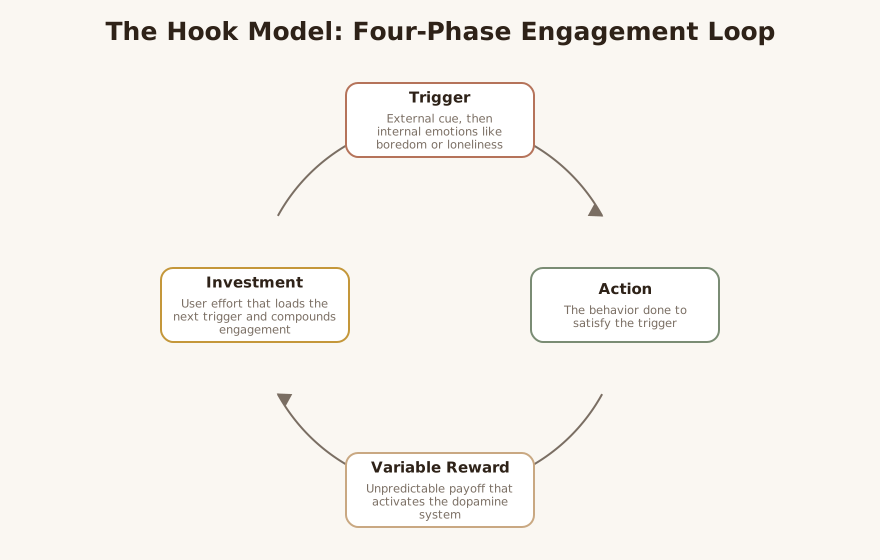
The Hook Model is not a psychotherapy, and a clinician will not find it in any treatment manual. It is a product-design framework that explains how digital products engineer repeat engagement, and it earns a place in a clinical wiki for one reason: it is the clearest available map of the machinery our clients are up against when they describe themselves as unable to put down their phones. LLM Understanding the loop lets us name the mechanism without moralizing, validate the client’s difficulty as engineered rather than weak-willed, and reverse-engineer the same levers in service of behavior change. LLM
Type & Discipline
The Hook Model is a framework drawn from behavioral design and product design rather than from clinical science. LLM Its author, Nir Eyal, describes his work as sitting “at the intersection of psychology, technology, and human potential,” a discipline he calls Behavioral Design. 1 The model is presented as “a four-step process embedded into the products of many successful companies” that brings customers back repeatedly. 1 In product-management glossaries it is defined as “a four-phase framework designed to help businesses create habit-forming products,” with the explicit goal of producing “voluntary, high-frequency engagement.” 5
For the practicing therapist, the relevant translation is this: the same psychological principles that designers use to build a habit are the principles a clinician can study to interrupt one. LLM The framework is descriptive and prescriptive for designers; for us it functions as a case-formulation lens for compulsive technology use. LLM
Creators & Lineage
The model was developed by Nir Eyal, a New York Times bestselling author who teaches at Stanford’s Graduate School of Business and the Hasso Plattner Institute of Design, and whose books—including Hooked—have sold over a million copies in more than thirty languages. 1 Other sources describe him as a behavioral economist and entrepreneur who built the methodology to help businesses “build competitive advantages through habit formation during early product development.” 5
The intellectual lineage runs through behaviorism. LLM The variable-reward component is a direct descendant of operant conditioning, specifically the variable schedules of reinforcement studied by B.F. Skinner, which produce the highest and most persistent rates of responding. LLM Eyal himself frames variable reward as foundational, calling “variable schedules of reward… one of the most powerful tools that companies use to hook users.” 2 The model also sits within the broader traditions of persuasive technology and habit-loop theory (the cue–routine–reward sequence), and its action phase draws conceptually on making behavior “easy and appealing” by maximizing motivation and ability—the logic of the Fogg Behavior Model, even where sources describe it without naming Fogg. 4
Core Principles
The central claim is that an engagement habit forms by cycling a user through four phases repeatedly until the behavior becomes automatic. 5 Eyal’s own definition: the Hooked Model describes “a user’s interactions with a product as they pass through four phases: a trigger to begin using the product, an action to satisfy the trigger, a variable reward for the action, and some type of investment.” 2
Three principles do most of the work. First, triggers migrate inward. Products initially depend on external triggers—“paid ads,” “blog posts,” or “a link from a friend”—but the goal is for the user to move “from requiring an external trigger… to using it because of an internal, unconscious trigger, like an emotion.” 4 Once that migration happens, the product no longer needs to advertise; loneliness, boredom, or uncertainty becomes the cue. 4 Second, unpredictability sustains desire. Variable rewards “activate the dopamine system,” and the variability—not the reward itself—is what drives the repeated checking behavior. 4 Third, investment compounds engagement. Every bit of effort a user puts in (“sharing data, sharing preferences, uploading content, or paying”) both increases the likelihood of return and “implies an action that improves the service for the next go-around,” loading the next trigger. 42
Interventions & Techniques
For a clinician, the “interventions” are not design tactics but the four phases used as a structured interview and intervention scaffold. LLM Each phase maps to a clinical move.
Trigger. Triggers are “cues to action… they come in the form of internal and external triggers.” 6 Clinically, this is functional analysis: help the client distinguish the external prompt (a notification) from the internal antecedent (the affective state the product has colonized). LLM Naming the internal trigger—“What am I feeling in the second before I reach for it?”—is the leverage point. LLM
Action. The action is “the habitual behavior itself, the thing we do with little or no conscious thought.” 6 Because designers minimize friction (single sign-on, auto-filled forms), the clinical counter-move is to add friction: increase the effort and reduce the ability that the product worked to maximize. 4
Variable Reward. Eyal divides rewards into three families—“rewards of the tribe” (connection and belonging), “rewards of the hunt” (material items or information), and “rewards of the self” (feeling good about oneself). 4 Identifying which reward type is operative tells the clinician what unmet need the behavior is meeting, which is what an alternative behavior must also supply. LLM
Investment. Investments are “things the user does to increase the likelihood of the next pass through the Hook.” 6 In treatment, the client can deliberately invest in the recovery loop instead—logging streaks, committing socially, building a competing routine. LLM
LLM-generated illustrative example (not a guideline): A clinician working with a client who compulsively checks Instagram maps the loop together: internal trigger = a flash of social anxiety after a work meeting; action = thumb-swipe to open the app; variable reward = the unpredictable arrival of likes (a reward of the tribe); investment = posting a story, which guarantees future notifications. Once the loop is on paper, the work targets each node—an if-then plan for the anxiety trigger, deleting the app from the home screen to add friction, and a competing tribe reward (texting a friend). LLM
Evidence Base
Honesty about maturity matters here. LLM The Hook Model is established as a behavioral-design framework—it is widely taught, cited across the product industry, and grounded in well-replicated behaviorist findings about variable reinforcement. 12 That status is not the same as evidence for a clinical intervention. LLM There are no randomized trials of “Hook Model therapy,” because it is not a therapy; the provided sources are a trade book and industry explainers, not peer-reviewed clinical literature. 135
What is evidentially solid is the model’s behaviorist substrate: variable schedules of reward reliably produce persistent, hard-to-extinguish responding, which is why Eyal calls them among the most powerful tools available. 2 The clinical inference—that mapping and disrupting this loop helps clients reduce compulsive use—is reasonable and consistent with habit-reversal and functional-analytic approaches, but it is an extrapolation, not a directly tested claim. LLM Use the model as a formulation aid, not as a stand-alone evidence-based treatment. LLM
Populations & Indications
The framework is most clinically relevant to clients whose presenting problem involves engineered digital engagement. LLM These include people with internet and smartphone addiction, adolescents and young adults (the heaviest users of variable-reward social platforms), and people with behavioral addictions such as gambling and gaming, whose mechanics are explicit applications of variable reinforcement. LLM It also speaks to consumers and to clients in general habit-change work, where the same four phases can be deployed constructively. 5
A second, indirect population is product designers and developers themselves—clients who may carry guilt or ambivalence about building the very systems described here, or who can be coached to apply the framework ethically. LLM The model gives shared language for that conversation. LLM
Problems-for-Work
- Compulsive social media use. Map the tribe/hunt/self reward driving each platform; the clinical insight is that variability, not content, is the hook. 4
- Gaming disorder. Loot boxes and intermittent progression are textbook variable-reward schedules; naming the schedule de-shames the difficulty of stopping. 2
- Internet and smartphone addiction. Target the internal-trigger migration—what emotion now auto-cues the device—rather than the surface behavior. 4
- Behavioral addictions (e.g., gambling). The “rewards of the hunt” framing makes the near-miss/jackpot architecture legible to the client. 4
- Impulsivity and dopamine-driven reward seeking. Use the dopamine-anticipation distinction to explain why wanting outlasts liking. 4
- Procrastination and avoidance. Identify the avoided affect as the internal trigger and the device as the relief behavior. LLM
- Habit formation and breaking. Run the loop in reverse to install a wanted habit—deliberate trigger, low-friction action, built-in reward, escalating investment. 6
Contraindications, Cautions & Cultural Humility
There is no “contraindication” to a formulation lens, but there are real cautions. LLM First, the model is a corporate engagement framework, and the sources present it overwhelmingly as a business strategy with little ethical commentary—one explainer “does not discuss ethics… or responsible use guidelines,” and another only cautions designers “take care not to ask too much of your users,” a usability note rather than a moral one. 3 A clinician must therefore supply the ethical frame the model omits, and avoid teaching clients self-manipulation tactics in a way that reinforces a sense of being controlled. LLM
Second, beware pathologizing ordinary use; high engagement is the designed outcome, so a client’s struggle is evidence of effective engineering, not of personal deficiency, and this reframe is itself therapeutic. 2 Third, exercise cultural humility: access to technology, the social meaning of connection (“rewards of the tribe”), and the stakes of disconnection differ across communities, generations, and neurotypes, and a blanket “reduce screen time” goal can sever a marginalized or disabled client’s primary social lifeline. LLM Tailor goals to the client’s context and values, not to a generic abstinence ideal. LLM
Treatment-Plan Suggestions & SMART Objectives
| Goal | SMART objective (example) | Mechanism |
|---|---|---|
| Build awareness of internal triggers | Client will log the emotion preceding device pickup at least once daily for 2 weeks | Targets the internal-trigger migration that sustains the loop 4 |
| Add friction to the action phase | Client will move 3 named apps off the home screen and enable grayscale within 1 session | Reverses the designer’s minimization of effort/ability 4 |
| Substitute the operative reward | Client will replace 2 daily social-media check-ins with a “tribe” reward (a text to a friend) over 3 weeks | Supplies the same reward type (tribe) via a non-compulsive behavior 4 |
| Disrupt variable reinforcement | Client will batch notifications to two scheduled windows daily for 2 weeks | Converts variable, unpredictable cues into a predictable schedule 2 |
| Redirect investment | Client will invest 10 min/day in a competing habit (e.g., reading log) for 21 days | Loads the next trigger toward the desired loop, not the product 6 |
| Reduce avoidance-driven use | Client will use a 60-second urge-surf before opening the app, 80% of urges, for 2 weeks | Interrupts the trigger-to-action link at the impulse point LLM |
| Increase self-efficacy / shame reduction | Client will articulate the four-phase loop driving their use by session 3 | De-shames via mechanistic understanding of engineered design 1 |
Common Misconceptions
- “The Hook Model is a treatment for tech addiction.” It is a design framework; clinical use is an extrapolation, not a validated protocol. 5LLM
- “It’s the same as the cue–routine–reward habit loop.” It overlaps but adds the investment phase, which is what compounds engagement over time. 2
- “The reward is the content.” Eyal’s claim is that the variability drives behavior by activating dopamine-anticipation, distinct from the reward’s content. 4
- “External triggers are the problem.” The durable driver is the internal trigger—an emotion the product has captured—so removing notifications alone is rarely sufficient. 4
- “It’s inherently manipulative.” Eyal frames it as a tool that should be used for products that “materially improve people’s lives,” though the broader source set largely sidesteps ethics, leaving the moral frame to the practitioner. 63
Training & Certification
There is no clinical certification in the Hook Model, and none is implied by the framework. LLM The primary training resource is Eyal’s book Hooked: How to Build Habit-Forming Products, supplemented by his teaching at Stanford’s Graduate School of Business and the Hasso Plattner Institute of Design and the explanatory material on his Nir & Far site. 1 For clinicians, the appropriate “credential” is competence in the host modality—functional analysis, stimulus control, and habit-reversal training within CBT—rather than any Hook-Model-specific qualification. LLM
Key Terms
- Trigger: a cue to action; external (ad, notification) or internal (an emotion or state). 64
- Internal trigger: an emotion or situation that becomes associated with product use and cues it without prompting. 4
- Action: “the habitual behavior itself, the thing we do with little or no conscious thought,” shaped by motivation and ability. 6
- Variable reward: an unpredictable payoff that activates dopamine pathways; categorized as rewards of the tribe, the hunt, and the self. 4
- Investment: user effort (data, content, money, time) that improves the product for the next cycle and loads the next trigger. 24
- The Hook: one full pass through all four phases; repeated passes form the habit. 2
Resources & Further Reading
▶ Watch — a video introduction to this concept:
- Hooked: How to Build Habit-Forming Products — Nir Eyal (official book page)
- How to Manufacture Desire — Nir & Far (Nir Eyal)
- The Hook Model of Behavioral Design — MindTools
- The Hook Model: Retain Users by Creating Habit-Forming Products — Amplitude
- Hook Model — ProductPlan Glossary
- Nir Eyal: Trigger users’ actions and reward them to build habits — UI Patterns
Reflective / Supervision Questions
- When a client describes compulsive use, do I reflexively frame it as a willpower failure, or do I locate the difficulty in the engineered loop? LLM
- Which of the three reward types (tribe, hunt, self) is my client actually seeking, and does my treatment plan supply that same need through a healthier behavior? 4
- Am I teaching the client to disrupt the loop, or inadvertently teaching them to self-manipulate in ways that deepen their sense of being controlled? LLM
- Have I named the internal trigger, or am I only intervening on the external one? 4
- For this particular client, is reduced technology use a values-congruent goal, or am I imposing a culturally narrow abstinence ideal that ignores their need for connection or accommodation? LLM
- Where am I documenting this work—am I billing a recognized modality (CBT functional analysis, stimulus control, habit reversal) and using the Hook Model only as formulation? LLM