
Type & Discipline
Compassionate Mind Training (CMT) is a technique cluster rather than a freestanding therapy: it is the set of structured, experiential exercises that operationalize Compassion-Focused Therapy (CFT) within clinical psychology 1. CFT itself is an integrative, evolutionarily-informed psychotherapy developed for people whose difficulties are organized around shame and self-criticism, and CMT is the engine by which its central change process — the deliberate cultivation of compassionate capacities — is delivered 2. The distinction matters clinically: CFT supplies the model, formulation, and therapeutic stance, while CMT supplies the repeated practices that build the targeted attributes and skills 1. LLM In practice this means a clinician can borrow CMT exercises into another treatment frame, but doing so without the underlying CFT formulation risks deploying the techniques without their rationale.
CMT sits firmly in the so-called “third wave” of cognitive and behavioral therapies, alongside other approaches that foreground the relationship to inner experience rather than the direct disputation of thought content 1. It draws on evolutionary psychology, neuroscience, attachment theory, and contemplative (including Buddhist) traditions of mind training 5. LLM Its discipline of origin is clinical psychology, but it has been adopted across counseling, psychiatry, and allied health settings.
Creators & Lineage
CMT and the wider CFT model were developed by Professor Paul Gilbert, a British clinical psychologist, who established the Compassionate Mind Foundation as the home of both the therapy and the training program 4. Gilbert’s foundational accounts trace the origins and nature of the approach to his clinical observation that some patients could generate alternative, “rational” thoughts in standard cognitive therapy yet derive no emotional relief, because the alternative thoughts were delivered in a cold or hostile inner tone 1. This led to a focus on the affect and function of self-relating, not only its content 2.
The lineage runs through evolutionary psychology — the idea that human minds carry old, evolved emotion systems that can be soothed or inflamed by social signals 1. It integrates mindfulness-based attention training as a preparatory skill 5, attachment theory’s account of how care from others becomes internalized 1, and a model of affect regulation systems that Gilbert places at the center of the work 2. LLM Gilbert has presented the rationale and core practices in introductory lectures and accessible books, broadening the audience beyond specialist psychotherapists 63.
Core Principles
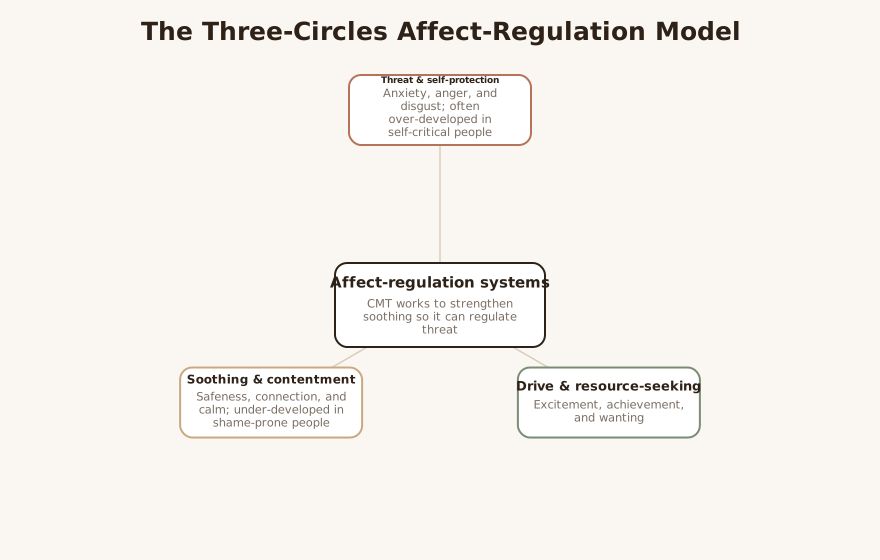
The organizing principle is the affect-regulation systems model, often taught as “three circles”: a threat and self-protection system (anxiety, anger, disgust), a drive and resource-seeking system (excitement, achievement, wanting), and a soothing and contentment system (safeness, connection, calm) 2. CFT proposes that highly self-critical and shame-prone people have an over-developed threat system and an under-developed soothing system, so they cannot easily generate feelings of safeness even when they “know” they are not in danger 1. CMT’s central aim is to build and strengthen the soothing/affiliative system so it can regulate threat 2.
A second principle is that compassion is not a soft or merely pleasant attitude but has two psychologies: a sensitivity to suffering and the motivation and courage to act to alleviate and prevent it 1. LLM This reframes self-compassion away from indulgence and toward an active, strengthening stance — useful when patients fear that being kinder to themselves will make them lazy or weak.
A third principle is the non-blaming, evolutionary framing of distress: patients are taught that they did not design their brains and that much of their suffering arises from “tricky brain” loops between old and new mental systems 1. LLM This de-shaming move is itself therapeutic and is a prerequisite for the exercises to land, because a person flooded with self-blame cannot easily practice self-kindness.
Interventions & Techniques
CMT typically begins with attention and body-based foundations. Soothing-rhythm breathing slows the breath to a comfortable rhythm (roughly three seconds in, a pause, three seconds out) while the patient adopts a gentle facial expression and grounds in bodily sensation; it is the entry practice for engaging the soothing system 5. A simple body scan building on this breathing releases tension region by region 5.
Imagery practices form the core. Creating a safe place uses multisensory imagery to build an internal sense of safeness and emotional connection 5. Compassionate-color imagery visualizes a warm color of kindness entering and spreading through the body 5. The pivotal exercise is the compassionate self: the patient imaginatively embodies an idealized version of themselves possessing wisdom, strength, warmth, and a sense of responsibility, and practices acting and feeling from that identity 5. Related practices include creating a compassionate ideal — a separate, perfectly compassionate figure that offers unconditional care 5 — and directing compassion in three flows: out toward others, into oneself from others, and from the compassionate self toward one’s own struggling self 5.
Beyond imagery, CMT uses written and dialogic methods. Compassionate letter-writing has the patient write to themselves from the compassionate self, modeling a warm, understanding, encouraging inner voice 5. Multiple-selves work and chair-based methods externalize the angry, anxious, sad, and compassionate “parts” so the patient can relate to each from the compassionate self 1. Clinicians also use a CFT formulation worksheet that maps the roots of shame, the patient’s fears, their protective (safety) strategies, and the unintended consequences of those strategies 5.
LLM-generated illustrative example (not a guideline): A patient who freezes before performance reviews practices soothing-rhythm breathing, then writes a compassionate letter from the perspective of “the version of me who has survived every prior review.” The letter names the fear, validates it as protective, and offers a warm, concrete plan — not reassurance, but courage. LLM
Evidence Base
The assigned maturity label for CMT is “established,” and it is widely disseminated and integrated into mainstream third-wave practice 1. LLM However, honesty about the evidence requires a caveat: the literature provided here, and much of the most-cited literature generally, is authored by the originator and is largely theoretical, descriptive, and model-building rather than independent outcome-trial evidence 12. Gilbert’s foundational papers articulate the rationale and the mechanism (strengthening the affiliative system to regulate threat) but are not themselves controlled efficacy studies 1.
There are signals of clinical effect in the explanatory literature — for example, reported improvements in eating-disorder symptomatology including bulimia nervosa, and described applicability to anxiety, anger, and depression 5. LLM These should be read cautiously: the early CFT/CMT trial base is generally characterized by small samples, heterogeneous formats, and a mix of clinical and non-clinical populations, so effect sizes and durability are not yet firmly established from the sources at hand. LLM The defensible summary is that CMT has a coherent, well-articulated theoretical foundation and promising-to-moderate outcome support, with the strongest current case being for shame- and self-criticism-driven presentations, and with independent, adequately powered replication still maturing.
Populations & Indications
CMT was designed first for people with high self-criticism and shame, and these remain its clearest indications 1. It has been applied with eating-disorder patients, where shame and harsh self-evaluation are central, with reported symptom improvement 5. The wider CFT literature describes use with depression, anxiety, anger, and — notably — populations often considered difficult to engage with standard cognitive work, including people with psychosis and trauma histories, for whom safeness and affect regulation are primary targets 25.
CMT is also used preventively and in non-clinical and general populations, including in self-help and group formats, reflecting Gilbert’s framing of compassion training as a broadly human capacity-building practice rather than only a disorder-specific treatment 34. LLM In selecting patients, the most reliable indicator is functional rather than diagnostic: a patient whose problems are maintained by a hostile inner voice and an inability to feel soothed is a candidate, regardless of the presenting diagnosis.
Problems-for-Work
Self-criticism and shame. The prototypical target; CMT directly trains an alternative warm inner voice and uses formulation to reduce the self-blame loop 1.
LLM-generated illustrative example (not a guideline): A perfectionistic trainee who berates herself after any error practices the compassionate-self exercise before reviewing her work, shifting the internal tone from prosecutorial to coaching. LLM
Self-soothing deficits and emotional dysregulation. Soothing-rhythm breathing and safe-place imagery give the patient a portable, body-level route into the affiliative system when threat spikes 5.
Perfectionism and low self-esteem. Reframing the inner critic as an over-active, evolved threat strategy de-personalizes it, and compassionate letter-writing rehearses a non-contingent sense of worth 15.
Depression, anxiety, and PTSD. Used as an adjunct to address the shame, harsh self-relating, and low felt-safeness that frequently maintain these conditions 25. LLM For trauma, the soothing-system focus is often a stabilization tool sequenced before more activating processing work.
Contraindications, Cautions & Cultural Humility
The most clinically important caution is “fear of compassion”: some patients, particularly those with trauma or early attachment disruption, experience warmth and soothing as threatening, grief-evoking, or destabilizing rather than calming 1. LLM This is not a reason to abandon CMT but a signal to slow down, normalize the reaction as a learned protective response, and titrate exposure to affiliative imagery carefully. LLM Compassionate imagery can also surface intense affect or backdraft (a surge of pain when one finally receives kindness), so clinicians should have a stabilization and grounding plan in place.
CMT is generally a within-treatment skill set, not a crisis intervention, and is not a substitute for risk management, medication review, or trauma-specific processing where indicated 2. LLM On cultural humility: the construct of self-compassion, the imagery used (safe places, idealized figures), and the very acceptability of turning warmth inward vary across cultural and religious frames, so figures and language should be co-created with the patient rather than imposed 5. LLM The evolutionary, de-shaming rationale is itself a value position and should be offered, not assumed.
Treatment-Plan Suggestions & SMART Objectives
| Goal | SMART objective (example) | Mechanism |
|---|---|---|
| Reduce harsh self-criticism | Patient will reduce self-rated self-criticism on a 0-10 scale from 8 to 4 over 10 sessions, evidenced by a weekly log | Builds compassionate self-voice; reduces threat-system activation 1 |
| Increase access to felt safeness | Patient will practice soothing-rhythm breathing 5 days/week and report onset of calm within 3 minutes by week 6 | Strengthens soothing/affiliative system 5 |
| Tolerate self-directed warmth | Patient will complete one compassionate-self imagery practice without urge to stop in 4 of 5 attempts by week 8 | Graded exposure to compassion; addresses fear of compassion 1 |
| Internalize a supportive inner voice | Patient will write one compassionate letter per week for 6 weeks and rate believability rising from 2/10 to 6/10 | Rehearses non-hostile self-relating 5 |
| Decompose shame-driven parts | Patient will use multiple-selves mapping to identify and name 3 self-states and respond to each from the compassionate self in session by week 5 | Externalizes affect; enables compassionate relating to parts 1 |
| Reduce shame-maintained avoidance | Patient will enter 2 previously avoided situations using a pre-prepared compassionate-self stance over 4 weeks | Re-pairs feared cues with affiliative regulation 5 |
| Build de-shaming psychoeducation | Patient will articulate the three-systems model in their own words and apply it to one recent episode by week 3 | Cognitive reframe of distress as evolved, not personal failing 2 |
Common Misconceptions
“Compassion means going easy on yourself.” CFT explicitly defines compassion as including the courage and motivation to confront and alleviate suffering, not avoidance of difficulty 1. LLM The compassionate self is strong and responsible, not permissive.
“CMT is just relaxation or positive thinking.” The breathing and imagery practices target a specific affect-regulation system and are paired with formulation, not deployed as generic relaxation 2. LLM
“It is the same thing as CFT.” CMT is the exercise component; CFT is the full model, formulation, and stance within which the exercises are used 1. LLM
“If it feels distressing, the patient is doing it wrong.” Fear of and resistance to compassion are predicted by the model and are clinically informative, not failures of practice 1. LLM
Training & Certification
The Compassionate Mind Foundation, the charity Gilbert founded in 2006, is the principal training body and describes itself as the home of CFT and CMT and a leading provider of trainings and research 4. Its offerings are tiered, from beginner through intermediate and advanced workshops to a 10-month Diploma in Compassion Focused Therapy for in-depth practitioner training 4. The Foundation also runs specialized workshops (for example in cancer support, group therapy, and grief), case-discussion supervision, personal-practice events, and bespoke in-house training 4.
LLM There is no single universally mandated license to “practice CMT”; it is most appropriately practiced by clinicians already qualified in a core psychotherapy, who add CMT through structured training and supervision. LLM Personal practice of the exercises by the clinician is strongly emphasized in the tradition, on the premise that one cannot guide a patient into a state one has not experienced. Free guided practices and meditations are available from the Foundation to support both clinicians and patients 4.
Key Terms
Affect-regulation systems (three circles). The model of threat/protection, drive/resource-seeking, and soothing/contentment systems whose balance CMT aims to shift toward soothing 2.
Soothing/affiliative system. The evolved system associated with safeness, contentment, and connection, often under-developed in self-critical patients and the primary target of CMT 1.
Soothing-rhythm breathing. The foundational slowed-breathing and grounding practice used to engage the soothing system 5.
Compassionate self. An imaginatively embodied identity characterized by wisdom, strength, warmth, and responsibility, from which other practices are performed 5.
Fear of compassion. The phenomenon, common in trauma and attachment-disrupted patients, of experiencing warmth as threatening rather than soothing 1.
Two psychologies of compassion. The sensitivity to suffering plus the motivation and courage to alleviate it 1.
Resources & Further Reading
▶ Watch — a video introduction to this concept:
- The origins and nature of compassion focused therapy (Gilbert, 2014, British Journal of Clinical Psychology)
- Introducing compassion-focused therapy (Gilbert, Advances in Psychiatric Treatment)
- The Compassionate Mind: A New Approach to Life’s Challenges (Gilbert, 2009/2010)
- The Compassionate Mind Foundation
- 16 Compassion Focused Therapy Techniques & Exercises (PositivePsychology.com)
- Compassion Focused Therapy: An Introduction — Prof. Paul Gilbert (video)
Reflective / Supervision Questions
- When a patient generates “rational” alternative thoughts but feels no relief, how do I assess the emotional tone of their inner voice, and how would CMT change my next move?
- How do I distinguish a patient’s fear of compassion from disengagement or treatment resistance, and how would my pacing differ?
- What is my own relationship to self-compassion, and how might my discomfort with the exercises shape how I deliver them?
- Whose imagery is in the room — am I co-creating culturally resonant compassionate figures, or importing my own?
- How am I documenting CMT inside a billable psychotherapy frame so that the disorder-level targets and the technique are both clearly recorded?
- Given the maturity of the evidence, how do I describe CMT’s likely benefits to a patient honestly, without over-promising?