
Type & Discipline
Scaffolding is an instructional technique drawn from educational and developmental psychology rather than a freestanding psychotherapy 4. The term names the temporary, tailored support a more competent person provides so a learner can accomplish a task they could not yet manage alone, with that support progressively withdrawn as competence grows 4. It sits within a sociocultural account of learning and is tightly bound to Vygotsky’s zone of proximal development, the gap between what a learner can do independently and what they can do with guidance 2. For clinicians, scaffolding functions as a method embedded inside an existing modality, such as a skills module within cognitive behavioral therapy or behavioral skills training, rather than as a billable therapy in its own right LLM. Understanding its origins, its mechanism, and its conceptual limits keeps its clinical use precise and modest LLM.
Creators & Lineage
The metaphor of scaffolding was coined by David Wood, Jerome Bruner, and Gail Ross in their 1976 paper on the role of tutoring in problem solving, which examined how a tutor helps a young child build a structure beyond the child’s unaided ability 1. Their work described how the adult controls the elements of the task that initially exceed the child’s capacity, allowing the learner to concentrate on the parts within reach and gradually take over the whole 1. Although Wood, Bruner, and Ross did not originally frame the idea in Vygotskian terms, the concept was rapidly absorbed into and is now almost inseparable from Lev Vygotsky’s zone of proximal development, the difference between independent performance and performance achieved with assistance 2.
Vygotsky’s sociocultural theory supplies the deeper lineage: it holds that higher mental functions originate in social interaction and are internalized by the learner through guided participation with more knowledgeable others 5. The zone of proximal development is the region in which this assisted learning is most productive, and scaffolding is the practical means by which a teacher, parent, or clinician operates within it 5. From education the concept migrated into clinical and skills-based work, where it converges with behavioral skills training and with the graded, progressively independent structure already familiar in cognitive behavioral therapy LLM. The pairing of scaffolding with the zone of proximal development has nonetheless been described in the academic literature as a problematic relationship, because the two ideas come from different theoretical roots and are often fused more loosely than either author intended 3.
Core Principles
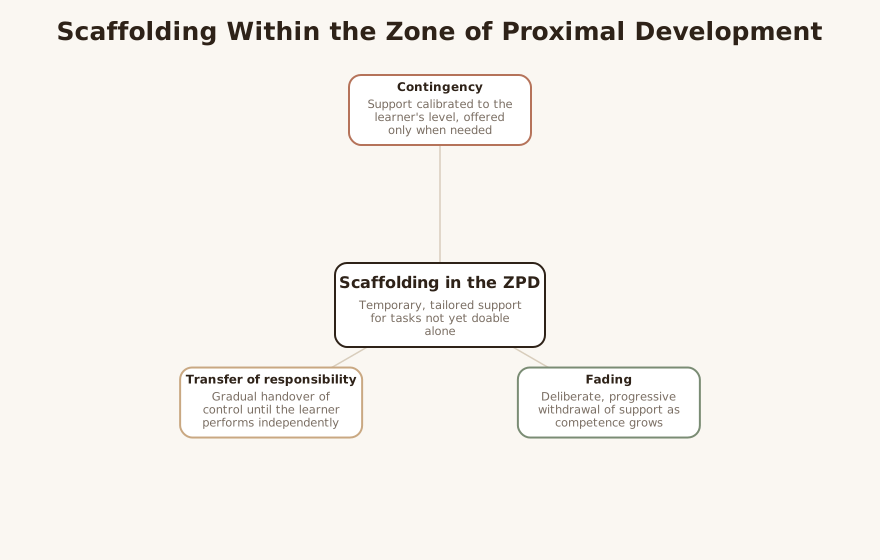
The first principle is contingency: effective support is calibrated to the learner’s current level, offered only when needed and matched to the specific point of difficulty 4. Support that is too heavy makes the learner passive, and support that is too light leaves the task out of reach, so the clinician continuously reads the learner’s response and adjusts 4. The second principle is fading, the deliberate, progressive withdrawal of support as the learner demonstrates competence, which distinguishes scaffolding from ordinary helping or doing the task for someone 4. Without fading there is assistance but no scaffolding, because the structure is meant to be temporary by design 4.
The third principle is transfer of responsibility, the gradual handover of cognitive and behavioral control from the supporter to the learner until the learner performs independently 4. These three features operate inside the zone of proximal development, the band of tasks a learner cannot yet do alone but can accomplish with guidance 2. Targeting work within that zone is itself a principle: tasks below it are mastered already and waste effort, while tasks far above it produce failure and discouragement 2. A further commitment is the social and dialogic nature of the process, since scaffolding in the Vygotskian tradition is achieved through interaction and shared activity rather than solitary practice 5. The original tutoring research also catalogued specific scaffolding functions, including recruiting the learner’s interest, simplifying the task, keeping the learner directed toward the goal, marking critical features, controlling frustration, and demonstrating idealized solutions 1.
Interventions & Techniques
Because scaffolding is a method rather than a therapy, “interventions” here means concrete ways to embed it inside recognized clinical and educational activities LLM. A core technique is task decomposition, breaking a skill into smaller component steps so the learner can succeed at each before they are combined 4. Modeling is closely related: the clinician demonstrates the target skill, including the reasoning behind it, so the learner sees an idealized version before attempting it 4. Prompting and cueing supply graduated hints, from broad reminders to specific direction, with the level of detail reduced over sessions as the learner internalizes the sequence 4.
Several established techniques organize the support 4. Activating prior knowledge connects the new skill to what the learner already commands, providing an anchor for the unfamiliar material 4. Thinking aloud makes the clinician’s covert problem-solving visible so the learner can imitate the process rather than only the product 4. Offering structured aids such as checklists, worksheets, sentence starters, or visual organizers externalizes part of the cognitive load, and these aids are removed as the learner no longer needs them 4. Throughout, the defining move is contingent adjustment and planned fading, so the same prompt that was given verbatim in an early session becomes a one-word cue and then nothing at all 4.
LLM-generated illustrative example (not a guideline): A clinician teaching paced breathing for panic first co-regulates breath aloud with the client in session (full modeling), then narrates only the count while the client leads (verbal prompt), then hands the client a small cue card to use between sessions (structured aid), and by the fourth week asks the client to initiate the skill at the first body-cue with no prompt at all (fading to independence) LLM.
Evidence Base
Scaffolding is best described as an established and widely adopted instructional concept, but “established” refers to its broad acceptance and pedagogical utility, not to a body of randomized clinical-outcome trials on scaffolding as a standalone treatment 4. The underlying sociocultural theory and the zone of proximal development are foundational, heavily cited reference points in developmental and educational psychology 5. The original tutoring study was an observational, descriptive account of adult-child interaction rather than a controlled trial, and it established the construct rather than its effect size 1.
Honesty requires naming two limits LLM. First, the relationship between scaffolding and the zone of proximal development is conceptually contested; critics in the academic literature argue the two are often conflated, applied loosely, and stretched well beyond their original meanings, which weakens claims that any given practice is “true” scaffolding 3. Second, scaffolding as such has not been validated as a clinical intervention with symptom-level outcome data, because it is a delivery method rather than a treatment, and its clinical warrant comes from its long pedagogical track record and from the evidence base of the modalities it sits inside, such as behavioral skills training and cognitive behavioral therapy LLM. Clinicians should therefore present scaffolding to clients and supervisees as a structured way of teaching skills, not as an evidence-based therapy on its own LLM.
Populations & Indications
Scaffolding was developed by observing young children, and children remain a primary population, particularly for early skill acquisition where adult guidance within the zone of proximal development is developmentally expected 1. It extends readily to adolescents and to students and learners of any age, where it structures the move from assisted to independent performance on academic and practical tasks 2. In clinical settings it is well suited to clients in skills-based therapy, where any coping, regulation, or behavioral skill must be taught, rehearsed, and then generalized to independent real-world use LLM.
It is especially relevant for people with learning disabilities and for clients with executive functioning or developmental challenges, where breaking tasks down, providing external structure, and fading support gradually are core accommodations rather than optional extras LLM. Caregivers and parents are themselves both a population and a delivery channel: clinicians can teach parents to scaffold their child’s emotion regulation and behavior, transferring the technique into the home LLM. Across these groups the indication is consistent: scaffolding applies wherever the therapeutic task is to build a competency the client cannot yet perform alone but can perform with appropriately calibrated support 2.
Problems-for-Work
Several presenting problems map cleanly onto a scaffolding approach LLM. For skill deficits and behavioral skill acquisition, the clinician decomposes the target skill, supports each component, and fades assistance until the client performs it independently, which is the exact arc scaffolding was designed to produce 4. For emotion regulation skill deficits, a regulation strategy is first co-performed with the clinician, then prompted, then cued, then handed fully to the client, matching support to the client’s moment-to-moment capacity 4.
For learning difficulties and academic difficulties, the clinician locates the precise point at which the learner stalls and provides graduated hints there rather than re-teaching material already mastered, keeping the work inside the zone of proximal development 2. For executive functioning deficits, external structures such as checklists, visual schedules, and step-by-step worksheets carry part of the planning and sequencing load until the client can internalize it 4. For low self-efficacy, the experience of repeated supported success, with help thinned as competence grows, builds the client’s evidence that they can perform the task themselves, which is itself a mechanism of change LLM. For developmental delays, expectations and support are pitched to the child’s current functioning and advanced incrementally rather than imposed at age-normed levels LLM.
LLM-generated illustrative example (not a guideline): A 14-year-old with executive functioning difficulties cannot independently start homework. The clinician and family build a visual checklist and the parent initially sits beside the teen to read each step aloud (full support), then moves to checking in at the first item only (partial support), then to a posted checklist the teen runs alone (faded support), so that responsibility transfers without the teen being left to fail LLM.
Contraindications, Cautions & Cultural Humility
Scaffolding has no contraindications in the pharmacological sense, but several cautions matter LLM. The most common failure is the absence of fading: support that is never withdrawn produces dependence and learned helplessness rather than competence, which is the opposite of the technique’s purpose 4. A second caution is miscalibration, since aiming below the zone of proximal development wastes effort and aiming far above it generates failure, frustration, and discouragement, so accurate ongoing assessment of the learner’s level is essential 2.
A further caution concerns the conceptual looseness already noted in the literature: applying the label “scaffolding” to any form of help, including support that is permanent or that does the task for the client, drifts from the construct and can mask the absence of genuine transfer of responsibility 3. Clinicians should also avoid treating scaffolding as a measure of the learner’s worth or fixed ability; it describes the support a task currently needs, not a verdict on the person LLM. Cultural humility is relevant because scaffolding and the zone of proximal development emerged from a sociocultural model in which learning is mediated by social interaction, and the expected roles of helper and learner, the comfort with adult direction, and the value placed on independent versus interdependent performance vary across cultures and families 5. The clinician should calibrate the degree of directiveness, the pace of fading, and the end-state of “independence” to the client’s own cultural context and family system rather than assuming a single universal standard LLM.
Treatment-Plan Suggestions & SMART Objectives
The contingency-fading structure makes scaffolding a practical engine for writing measurable skill-acquisition objectives within a broader treatment plan LLM. The examples below are illustrative templates to adapt, not prescriptions LLM.
| Goal | SMART objective (example) | Mechanism |
|---|---|---|
| Acquire a discrete coping skill | Within 3 sessions, client will perform all steps of one grounding technique with only a single-word prompt | Task decomposition plus graduated prompting within the zone of proximal development 4 |
| Generalize a skill to independence | Over 4 weeks, client will initiate a regulation skill in two logged real-world episodes per week without clinician cueing | Planned fading and transfer of responsibility 4 |
| Build emotion regulation under distress | Within 6 sessions, client will use a paced-breathing sequence during one in-session distress rehearsal with prompts reduced from full modeling to a cue card | Contingent support faded across sessions 4 |
| Support executive functioning | Over 3 weeks, client will complete a multi-step task using a self-managed written checklist on four of five attempts | External structure offloading cognitive load, then withdrawn 4 |
| Raise self-efficacy through graded success | Within 8 sessions, client will rate confidence on a target task and demonstrate one supported success per week with support thinned each week | Repeated faded success builds independent performance 2 |
| Coach a caregiver to scaffold at home | Within 4 sessions, parent will model, then prompt, then fade support for the child’s bedtime routine and log the level of help given | Transfer of the scaffolding method to the natural environment 4 |
| Target the precise learning sticking point | Within 2 sessions, client will identify the single step where the task breaks down and rehearse it with graduated hints | Keeping work inside the zone of proximal development 2 |
Common Misconceptions
A frequent misconception is that scaffolding means simply helping a client, when the defining feature is temporary, contingent support that is deliberately faded; permanent help is not scaffolding 4. A related error is omitting the fading stage, leaving the support permanently in place and producing dependence rather than the intended independent competence 4. Another is conflating scaffolding with the zone of proximal development as if they were a single, seamless idea, when the academic literature notes they come from different traditions and are often fused too loosely 3.
People also assume more support is always better, when over-support inside the zone of proximal development undermines learning by removing the productive struggle through which the learner takes over the task 2. A further misconception is that scaffolding is an evidence-based therapy in its own right; it is an instructional method whose clinical value is structural and whose outcome warrant comes from the modalities it is embedded in LLM. Finally, some treat the construct as a measure of the learner’s fixed capacity, when it describes the support a task currently requires and is expected to change as the learner progresses LLM.
Training & Certification
There is no certification in scaffolding and no credential is required to use it, because it is a public, widely disseminated educational concept rather than a proprietary clinical method LLM. Clinicians typically encounter it through graduate coursework in developmental, educational, or clinical psychology, through training in behavioral skills training and cognitive behavioral therapy where graded support and fading are already standard, and through the foundational literature on the zone of proximal development 5. The primary historical source is the Wood, Bruner, and Ross tutoring study that introduced the term, and accessible secondary summaries of the zone of proximal development and of specific scaffolding techniques are widely available 124. No formal training is needed to apply scaffolding ethically within one’s existing scope of practice, provided it is used inside a modality the clinician is already competent to deliver LLM.
Key Terms
Scaffolding – temporary, tailored, contingent support that enables a learner to perform a task beyond their independent ability and is progressively withdrawn as competence grows 4. Zone of proximal development – the gap between what a learner can do alone and what they can do with guidance from a more capable other 2. Fading – the deliberate, gradual withdrawal of support so the learner takes over the task, the feature that makes assistance into scaffolding 4. Contingency – the calibration of support to the learner’s current level and specific point of difficulty, offered only when needed 4. Transfer of responsibility – the handover of cognitive and behavioral control from supporter to learner until performance is independent 4. Sociocultural theory – Vygotsky’s account in which higher mental functions arise in social interaction and are internalized through guided participation 5. More knowledgeable other – the teacher, parent, peer, or clinician whose guidance enables performance within the zone of proximal development 5. Modeling – demonstrating the target skill, including its underlying reasoning, as an idealized example for the learner to imitate 4.
Resources & Further Reading
▶ Watch — a video introduction to this concept:
- Wood, Bruner & Ross (1976), “The role of tutoring in problem solving” — and the zone of proximal development (Wikipedia)
- Zone of Proximal Development and Scaffolding (Simply Psychology)
- Scaffolding and the zone of proximal development: A problematic relationship (academia.edu)
- Scaffolding in Psychology: Vygotsky’s ZPD & 7 Techniques (Psychology Notes HQ)
- Zone of Proximal Development — an overview (ScienceDirect Topics)
Reflective / Supervision Questions
- For a skill you are currently teaching a client, can you name exactly where the fading plan is, or has the support quietly become permanent? LLM
- How do you assess whether a task sits inside a client’s zone of proximal development rather than below it (already mastered) or far above it (set up for failure)? LLM
- When you call something “scaffolding” in your notes, is support actually being withdrawn over time, or are you describing ongoing help that never transfers responsibility? LLM
- For a client with executive functioning or developmental challenges, how do you calibrate the starting level of support to current functioning rather than to age norms? LLM
- How does your pace of fading and your definition of “independence” account for the client’s cultural and family context rather than imposing a single standard? LLM