
Type & Discipline
Transference-Focused Psychotherapy (TFP) is a manualized, individual psychodynamic psychotherapy for patients with borderline and other severe personality disorders, situated within clinical psychology and psychiatry 3. It is explicitly a psychoanalytic treatment, applying a contemporary object-relations model as its theoretical foundation rather than a cognitive, behavioral, or skills-based one 3. The International Society of Transference-Focused Psychotherapy describes it concisely as “a psychoanalytic treatment for patients with borderline and other personality disorders” 7. Unlike open-ended psychoanalysis, TFP is structured, time-conscious, and articulated in a treatment manual, which makes it teachable and researchable 3. For practicing clinicians, the useful frame is that TFP is a focal dynamic therapy — the focus being the transference as it unfolds session by session, anchored by a formal treatment contract 3.
Creators & Lineage
TFP was developed by Otto F. Kernberg, Frank E. Yeomans, John F. Clarkin, and Kenneth N. Levy and colleagues at the Personality Disorders Institute of the New York Presbyterian Hospital, Westchester Division (Weill Cornell) 3. Its historical roots trace to the Menninger Foundation Psychotherapy Research Project, whose quantitative findings suggested that patients with severe personality disorders improved more with a psychotherapy that focused on transference interpretation — while providing enough external support to hold the frame — than with standard psychoanalysis or supportive psychotherapy 3. Beginning in 1976, a group of psychoanalysts operationalized these findings through Kernberg’s contemporary object-relations theory, sharpening the application of interpretation, transference analysis, technical neutrality, and countertransference use to borderline patients 3.
The lineage is therefore object-relations psychoanalysis, with acknowledged affinities to Kleinian technique (the early and central emphasis on transference and primitive defenses) but distinguished by TFP’s systematic attention to the patient’s external life and its modification of technical neutrality for limit-setting 3. TFP shares a developmental cousin in Mentalization-Based Treatment (MBT); the developers themselves note that the initial phases of TFP and the description of MBT are “practically identical,” and suggest MBT corresponds closely to the early phase of TFP 3.
Core Principles
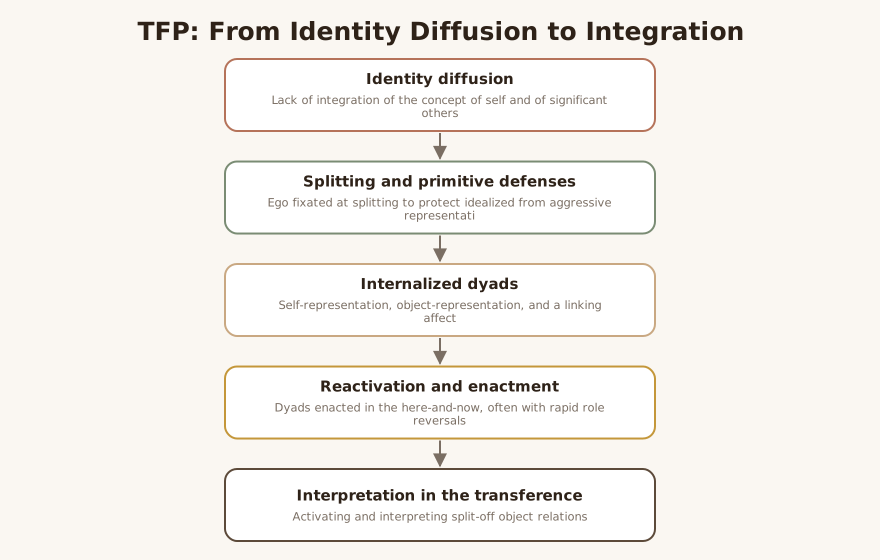
TFP rests on a conflict model, not a deficit model, of borderline pathology 3. The central assumption is that patients with borderline personality organization suffer from identity diffusion — a chronic, stable lack of integration of the concept of self and of significant others — caused by a failure of psychological integration in which aggressive internalized object relations predominate over idealized ones 3. To protect the idealized representations from the aggressive ones, the patient’s ego remains fixated at the level of splitting and related primitive defenses: projective identification, omnipotent control, devaluation, denial, and primitive idealization 3.
The internal world is conceived as composed of dyads — each a self-representation, an object-representation, and a dominant affect linking them — derived from early affectively intense experiences 3. In treatment these dyads are reactivated and enacted, often with rapid role reversals: a patient may, within minutes, shift from playing a powerless child who projects an indifferent mother onto the therapist, to enacting the indifferent mother while the therapist (via projective identification) feels like the impotent child 3. The deeper split is not within a dyad but between dyads — all-good idealized ones kept rigidly separate from all-bad persecutory ones to avoid intolerable anxiety 3. The goal of treatment is to integrate these split-off representations so the patient can achieve a coherent, nuanced sense of self and others, resolving identity diffusion 3. A clinical marker of progress is the emergence of appropriate depressive affect — the capacity to own previously projected aggression with concern, guilt, and the wish to repair 3.
Interventions & Techniques
TFP organizes practice into three levels: strategies (long-range goals, pursued through transference analysis), tactics (how each session is managed), and techniques (the consistent analytic instruments) 3.
The treatment contract and frame. Treatment opens with an explicit contract delineating patient and therapist responsibilities — attendance, modified free association, payment — and crucially, arrangements that eliminate the secondary gain of treatment 3. For example, the patient agrees to call 911 or go to the emergency room if at risk of self-destructive action, so that crisis does not become a route to increased therapist contact 3. TFP is conducted face-to-face, a minimum of two and usually no more than three sessions per week 3.
The three-step interpretive process. Interpretation proceeds characteristically in three steps: (1) formulating the total object relationship currently activated, using metaphor and clarifying who is enacting which role; (2) observing the interchange of roles, helping the patient recognize identification with both the self- and object-representation; and (3) interpretively linking the dissociated positive and negative transferences to integrate the split idealized and persecutory segments of experience 3.
The core analytic instruments are clarification, confrontation, interpretation, transference analysis, and technical neutrality, supplemented by countertransference analysis 3. Clarification explores the patient’s subjective experience; confrontation tactfully draws attention to inconsistencies — between statements, between verbal and nonverbal behavior, or between what the patient says and what is evoked in the therapist 3. Interpretation generates hypotheses about unconscious meaning, emphasizing the “here-and-now” present unconscious rather than genetic (childhood) reconstructions, which become relevant only in advanced phases 3. Technical neutrality is the default stance but is deliberately and temporarily suspended when limit-setting is required to protect the patient’s life or the treatment — after which the therapist analyzes the transference consequences of the deviation and works to restore neutrality 3. Countertransference is used as a diagnostic source about the dominant affect, but is not communicated directly to the patient; it is worked silently into transference interpretations 3.
Affect dominance and the priority hierarchy. The governing tactical rule is that interpretation goes “where the affect is most intense” — affect dominance, read across the patient’s verbal report, nonverbal behavior, and the countertransference, determines the focus 3. Certain content takes priority regardless of affect, in this order: (a) suicidal or homicidal behavior, (b) threats to the continuity of treatment, (c) severe acting out, (d) dishonesty, (e) trivialization of the hour, and (f) pervasive narcissistic resistances 3.
LLM-generated illustrative example (not a guideline): A patient with BPD spends a session in rapid, pressured speech that leaves the therapist no room to speak. Reading the countertransference (feeling controlled and shut out), the therapist names the enactment: “I notice you fill the session in a way that leaves me no room — as if you need to control me so I can’t act freely.” The patient replies, “If I didn’t control you, you’d leave me, like everyone else.” The therapist has clarified the dominant dyad (a devalued self relating to an abandoning, critical other) without offering reassurance, opening it for interpretation LLM.
Evidence Base
The maturity of TFP’s evidence base is best characterized as established: it is one of the more empirically studied psychodynamic treatments for BPD and is catalogued among the recognized treatments for borderline personality disorder by the APA Division 12 Society of Clinical Psychology 1. The development program was theory-driven and staged from process research through controlled trials 3.
An early within-subject study found that after one year of TFP, 52.9% of patients no longer met criteria for BPD, with significant reductions in suicide attempts, the medical risk of parasuicidal acts, emergency-room visits, and hospitalizations 3. The pivotal randomized controlled trial by Clarkin and colleagues compared TFP against dialectical behavior therapy (DBT) and a psychodynamically oriented supportive psychotherapy (SPT), in both men and women, with treatment delivered by community clinicians 3. Across six outcome domains, TFP predicted significant improvement in 10 of 12 variables, compared with 5 of 12 for DBT and 6 of 12 for SPT 3. The Personality Disorders Institute summarizes the trial’s finding that TFP “was better than a standard cognitive-behavioral treatment, and better than a structured supportive treatment” 5.
A distinctive mechanism finding comes from Levy and colleagues: using the Adult Attachment Interview, only TFP significantly improved reflective functioning, which did not change with DBT or SPT, and only TFP was associated with change in the internal working model of attachment 35. This is among the few demonstrations that a BPD treatment changes an underlying psychological process, not just symptoms 5.
The independent Doering et al. multi-site RCT (Munich and Vienna) compared TFP with treatment by experienced community psychotherapists in 104 female outpatients over one year 2. TFP showed significantly lower dropout (38.5% vs. 67.3%), fewer suicide attempts, and superiority on borderline symptomatology, psychosocial functioning, personality organization, and psychiatric hospitalizations 2. Notably, self-harming behaviour did not change in either group, and depression/anxiety improved comparably across groups — an honest reminder that TFP is not uniformly superior on every measure 2. Supporting neuroscience identified fronto-limbic (ventromedial prefrontal and amygdalar–striatal) dysregulation in BPD under negative emotion, offering a plausible biological target 35.
Populations & Indications
The broadest indication is borderline personality organization — patients with severe identity diffusion and significant breakdown in work, intimate relationships, and social life, plus the specific symptoms of their particular personality disorder 3. This includes BPD proper, more severe histrionic presentations, paranoid and schizoid personality disorders, and narcissistic personality disorder functioning at an overt borderline level 3. Patients with aggressive, provocative, or irresponsible behavior who nonetheless retain some capacity for loyalty, friendship, and work investment are considered optimal candidates 3. Cases complicated by alcoholism, drug dependency, or severe eating disorders may be appropriate if and when those complications can first be controlled 3.
Problems-for-Work
TFP is organized around clinical problems that recur in severe personality pathology, with the treatment frame and interpretive sequence applied to each 3:
- Chronic, characterological suicidality and self-harm. TFP targets suicidal behavior that is a “way of life” rather than a symptom of major depression, handling it through the contract (e.g., crisis routed to emergency services, not the therapist) and through interpreting the transference meaning of any limit-setting 3.
- Identity diffusion and splitting. The core work — naming activated dyads and integrating idealized and persecutory representations — directly addresses the fragmented sense of self and others 3.
- Interpersonal dysfunction. Enactments in the room are treated as live samples of the patient’s relationship patterns, made observable through clarification and confrontation 3.
- Affective instability and impulsivity. Locating interpretation at the point of maximal affect helps the patient connect dysregulated states to the underlying object relation, with controlled-trial evidence of improvement in anger, irritability, and attention impulsivity 3.
- Narcissistic resistances. Pervasive grandiosity is addressed by consistently analyzing the relationship between a pathological grandiose self and the devalued, inferior part projected onto the therapist 3.
Contraindications, Cautions & Cultural Humility
The developers are explicit about contraindications. Antisocial personality disorder proper has no indication for psychotherapeutic treatment in this model, and chronic dishonesty severe enough to corrupt verbal communication (e.g., pervasive pseudologia fantastica) makes the psychopathic transference very difficult to resolve 3. Overwhelming secondary gain of illness — where a parasitic, dependent lifestyle has become a life-sustaining goal — is a major contraindication, as is a configuration in which self-destruction operates as a dominant life aim outweighing the wish to live and be treated 3. Patients should optimally have a normal IQ, and severely socially isolated patients carry a guarded prognosis, though many can still be treated with an adequate contract 3. Many patients unsuitable for TFP may be appropriate for supportive psychotherapy instead 3.
Cautions for the clinician: the developers found that some therapists could not maintain the appropriate tempo of intervention, and others were tempted to shift to supportive techniques during crises — which reinforced acting out 3. Severely narcissistic patients can provoke intense countertransference, pulling the therapist toward inhibition, arguing, or premature pessimism 3.
LLM-generated illustrative example (not a guideline): Cultural humility is not detailed in the cited primary sources; clinically, the model’s emphasis on “honest communication” and a normative reading of affect can be misread if a clinician treats culturally shaped reticence, indirectness, or distrust born of justified experiences of marginalization as “dishonesty” or “resistance.” The reasonable stance is to hold the object-relations formulation lightly and check it against the patient’s lived context before interpreting LLM.
Treatment-Plan Suggestions & SMART Objectives
| Goal | SMART objective (example) | Mechanism |
|---|---|---|
| Establish and maintain the treatment frame | Patient and clinician finalize a written treatment contract within the first 4 sessions and review adherence monthly | Eliminates secondary gain and creates conditions for transference to activate 3 |
| Reduce characterological suicidal/self-harm behavior | Over 12 months, route 100% of self-harm urges through the agreed crisis plan (e.g., ER/911) rather than session contact | Limit-setting plus interpretation of its transference meaning 3 |
| Improve recognition of split self/other representations | Within 6 months, patient can name at least one recurring dyad (self-role, other-role, affect) in 3 consecutive sessions | Three-step interpretation builds the observing ego 3 |
| Reduce reactive anger and impulsivity | Decrease clinician-rated irritability and verbal-assault frequency by a meaningful margin over 12 months | Interpreting at the point of affect dominance links affect to the activated object relation 3 |
| Increase reflective functioning | Demonstrate improved capacity to reflect on own and others’ mental states over 12 months (e.g., AAI-based or clinician rating) | TFP uniquely raised reflective functioning in RCT data 35 |
| Improve interpersonal/occupational functioning | Sustain one stable work or relational commitment for ≥3 months by end of treatment | Integration of representations resolves identity diffusion 3 |
| Integrate idealized and persecutory views | By late phase, patient tolerates ambivalence (sees self/therapist as neither all-good nor all-bad) within sessions | Interpretive linking of dissociated transferences; emergence of depressive concern 3 |
Common Misconceptions
- “TFP just digs into childhood.” In fact, interpretation emphasizes the “here-and-now” present unconscious; genetic (childhood) interpretation becomes relevant only in advanced phases 3.
- “It’s classical psychoanalysis with a new name.” TFP modifies the analytic instruments: it is less frequent (two to three sessions weekly, face-to-face), continuously scans the patient’s external life, and modifies technical neutrality for life-protecting limit-setting 3.
- “The therapist shares their countertransference with the patient.” TFP systematically does not communicate countertransference directly; it is used internally and folded into transference interpretation 3.
- “BPD is a deficit to be repaired with support and skills.” TFP is built on a conflict model and deliberately avoids supportive techniques during the work so that the transference can fully develop; shifting to support in crises was found to reinforce acting out 3.
- “It only suits compliant, high-functioning patients.” The target population is precisely severe personality disorder, including overtly borderline-level narcissistic patients 3.
- “It’s just MBT.” The phases overlap, but TFP holds that early interpretation of split-off states is helpful rather than dangerous, in contrast to MBT’s caution about early interpretation 3.
Training & Certification
TFP is manualized, but the developers stress it “cannot be learned only from a book”; ongoing supervision is described as “the essence” of acquiring competence 3. The detailed clinical manual and contract-setting procedures are documented in the published treatment guide 43. The International Society of Transference-Focused Psychotherapy (ISTFP), founded in 2011, organizes structured training at basic, advanced, and specialized levels (covering the structural interview, treatment contract, and transference patterns), provides supervision programs, and maintains a directory of certified TFP teachers and supervisors and multiple certification levels 7. ISTFP operates internationally with regional groups and provides translated manuals, diagnostic instruments, and a peer-reviewed library 7.
Key Terms
- Identity diffusion — chronic, stable lack of integration of the concepts of self and of significant others; the core target of treatment 3.
- Borderline personality organization — Kernberg’s structural diagnosis encompassing severe personality disorders marked by identity diffusion, primitive defenses, and (usually) intact reality testing 3.
- Splitting — the primitive defense keeping all-good and all-bad representations rigidly separate to manage intolerable anxiety 3.
- Object-relations dyad — a unit of self-representation, object-representation, and linking affect; the building block of the internal world 3.
- Projective identification — projecting a self- or object-representation onto the therapist and then unconsciously pressuring them to enact it 3.
- Technical neutrality — the therapist’s non-aligned stance, temporarily suspended for limit-setting and then analyzed and restored 3.
- Affect dominance — the rule that interpretation targets the moment/channel of most intense affect 3.
- Reflective functioning — capacity to understand mental states in self and others; an empirically demonstrated outcome of TFP 35.
Resources & Further Reading
▶ Watch — a video introduction to this concept:
- Society of Clinical Psychology (APA Division 12) — Transference-Focused Therapy for BPD 1
- Doering et al. (2010), British Journal of Psychiatry — TFP vs. community psychotherapists RCT 2
- Kernberg, Yeomans, Clarkin & Levy (2008) — Transference Focused Psychotherapy: Overview and Update (PDF) 3
- Yeomans, Clarkin & Kernberg — TFP for Borderline Personality Disorder: A Clinical Guide (APP) 4
- Personality Disorders Institute — TFP Research 5
- Dr. Otto Kernberg — TFP & Personality Disorders (video) 6
- International Society of Transference-Focused Psychotherapy (ISTFP) 7
Reflective / Supervision Questions
- When my patient’s affect spikes, am I reliably following affect dominance to the activated object relation, or am I steering toward the content I find safest? LLM
- Did I shift into reassurance or advice during the last crisis — and if so, did that reinforce acting out rather than open it for interpretation? 3
- Which dyad am I being recruited into right now, and am I using that countertransference internally rather than disclosing it? 3
- Have I genuinely re-established technical neutrality after my last limit-setting, including analyzing its transference meaning? 3
- Is my formulation of “dishonesty” or “resistance” a clinical observation, or could it be a culturally shaped or trauma-rooted stance I have not yet understood? LLM
- Where is this patient on the path from split, extreme representations toward integrated, ambivalent ones — and what would the next increment of integration look like? 3
- Am I getting the supervision the model considers essential, or am I relying on the manual alone? 3