
Type & Discipline
Personal Construct Theory (PCT) is a comprehensive theory of personality and a clinical framework situated within clinical and cognitive psychology 2. Some scholars classify it not as an ordinary theory but as a metatheory — a theory about how theories function — because its subject matter is cognition about cognition itself 2. It is most precisely described as the original clinical constructivist theory within the broader cognitive movement, and it is the acknowledged basis for numerous postmodern approaches in constructivism, social constructivism, and narrative therapy 3. For the practicing clinician, PCT operates on two levels at once: a model of how any person makes meaning, and a set of techniques for helping a client revise meanings that no longer serve them 4. LLM
Creators & Lineage
PCT was developed by the American psychologist George Kelly (1905–1967), who articulated it fully in his 1955 two-volume work The Psychology of Personal Constructs 1. Kelly grew up on a Kansas farm with erratic early schooling and trained across physics, mathematics, sociology, and psychology before turning to clinical work 4. Teaching during the Depression at Fort Hays, Kansas, he built a travelling clinical service for struggling farming families, and it was this applied work — not the laboratory — that generated his theory 4. He began with Freudian methods but noticed that clients improved regardless of whether his interpretations were accurate, which led him to conclude that people primarily need a coherent way to construe their experience rather than any one correct doctrine 4.
The lineage flowing forward from Kelly is substantial: PCT is the original clinical constructivist theory and a direct intellectual ancestor of cognitive therapy, of constructivism and social constructivism, and of narrative therapy 3. Its signature assessment tool, the repertory grid, became a method used well beyond the clinic, including in organizational decision-making, employee evaluation, and market research 2. More than half a century after publication, the theory is still described in the literature as “radical,” precisely because its view of the person as an active constructor of reality continued to challenge mainstream, mechanistic psychology 1. LLM
Core Principles
The philosophical foundation of PCT is constructive alternativism: the position that although one reality exists, people experience it through different constructions, and that there are an infinite number of alternative constructions one may take toward the world 4. No single construction is complete or perfect, yet each holds value within its context — which is also the clinical promise of the theory, because if a construction can be built it can be rebuilt 4. LLM
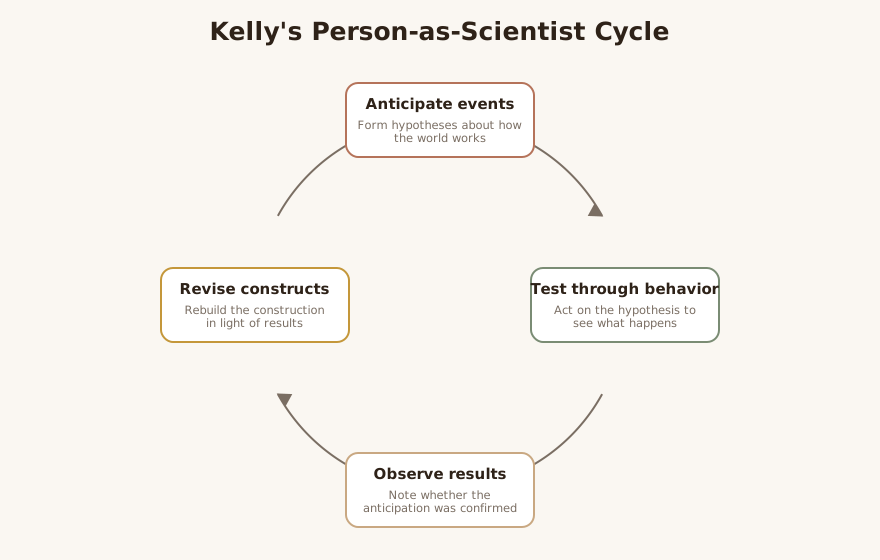
Kelly captured the model in a single metaphor: every person is, in their own particular way, a scientist 2. People form hypotheses about how the world works, test those hypotheses through behavior, and revise their understanding based on the results 4. The formal core is Kelly’s fundamental postulate: “A person’s processes are psychologically channelized by the ways in which he anticipates events” 4. Anticipation, not drive or reinforcement, is the engine of personality 2.
The postulate is elaborated through a set of corollaries that are worth knowing by name 3:
- Construction — we anticipate events by detecting repeated patterns in past experience 4.
- Individuality — each person construes reality uniquely, with their own system of constructs 2.
- Organization — constructs are arranged hierarchically, with some more central to identity than others 2.
- Dichotomy — constructs are inherently bipolar, defined by a similarity pole and a contrast pole such as “kind–cruel” or “safe–dangerous” 2.
- Choice — a person selects the pole of a construct that they expect will best extend and elaborate their understanding 2.
- Range — every construct has a limited range of convenience and applies only within a finite domain, not universally 2.
- Experience — when reality contradicts a prediction, the construct system is revised; matches strengthen it 2.
- Modulation — some constructs are permeable and admit new elements, while others are impermeable and closed 4.
- Fragmentation — a person may hold contradictory subsystems without integrating them 2.
- Commonality — similar constructions, not merely similar experiences, make two people psychologically similar 4.
- Sociality — to play a genuine role with another person, you must construe their construing rather than impose your own 2.
Notably, Kelly replaced Freud’s dynamic unconscious with levels of awareness, ranging from articulate “construing” at the highest level to preverbal constructs that operate below conscious words, like an infant’s intuitive grasp of cause and effect 2. This distinction matters clinically because much of what drives a client may be construed but not yet spoken 2.
Interventions & Techniques
PCT therapy is fundamentally non-directive in spirit: the therapist facilitates the client in discovering and testing their own constructs rather than installing the clinician’s interpretation 2. The therapeutic process deliberately mirrors scientific method — the client organizes personal experience, acts to test the construct system, then refines it according to results 2. The aim Kelly named is movement: opening alternatives, revealing the client’s own agency, and enabling fuller realization of potential 4.
Kellian clinicians work through a recognizable sequence of moves 4:
- Loosening constructs during early exploration, so that a rigidly held meaning becomes provisional enough to examine 4.
- Testing alternative perspectives the client had not previously entertained 4.
- Tightening the promising constructions so they can guide reliable prediction and action 4.
- Role-play to increase perspective-taking and to rehearse new construing in safety 4.
- Homework, most distinctively fixed-role therapy 4.
Fixed-role therapy is Kelly’s best-known intervention. The client first writes a third-person character sketch describing themselves as they currently construe themselves 4. The therapist then composes a fixed-role sketch of an alternative character, built from constructs set “at right angles” to the client’s own — independent of, rather than merely opposite to, the original 4. The client then lives as that character across all of daily life for roughly one to two weeks, as an experiment, with the explicit understanding that it is a role to try on, not a verdict on who they must become 4. The purpose is to demonstrate the client’s own capacity for change and their freedom to reconstrue themselves 4. LLM
The repertory grid (the Role Construct Repertory Test, or “rep grid”) is Kelly’s signature assessment 2. The clinician identifies a set of significant elements — typically specific people such as the client’s mother, a close friend, a feared figure, and the self 2. Three elements are presented at a time, and the client is asked which two are alike and how they differ from the third; the two labels that result become the poles of a construct 4. Repeated across triads, the procedure yields a map of constructs the client had not fully articulated consciously, and — unlike most psychometric tests — invites the client to revise responses at any time 4.
LLM-generated illustrative example (not a guideline): In an early session, a clinician lays out cards for “my father,” “my partner,” and “my closest friend” and asks how two are alike and one is different. The client says, “My father and my partner both need to be in control — my friend just lets things be.” The clinician has now surfaced a live bipolar construct — controlling versus lets things be — that may organize the client’s relationship distress, without having proposed it themselves. LLM
Evidence Base
The honest appraisal is that PCT is established as theory and assessment but thin in contemporary controlled-trial evidence 1. Its maturity rests on longevity, coherence, and influence: more than fifty years after publication the framework is still active in the literature and is repeatedly characterized as a serious, even radical, alternative to mainstream psychology 1. It is studied by academics and used by practitioners in contemporary settings, and it is credited as the foundational clinical constructivist theory beneath several modern approaches 3. LLM
The deeper part of the evidence story is indirect rather than tabular. PCT’s central claims — that people actively construct and anticipate their worlds, that changing construal changes experience, and that meaning-making is individual — were absorbed into the cognitive and narrative therapies whose outcome literatures are now extensive 1. A clinician should therefore treat PCT as a generative meta-framework with strong face validity and a modest direct trial base, rather than as a manualized, RCT-validated protocol 1. The repertory grid in particular has an established methodological track record as a measurement device, which is a different and stronger evidentiary claim than the efficacy of PCT psychotherapy as a whole 2. LLM
Populations & Indications
PCT was forged in general adult clinical practice and remains best suited to verbal, reflective adults who can engage with their own meaning-making 4. It is naturally indicated for individuals in identity transitions, because constructive alternativism gives explicit permission to rebuild a self-construction 4. It speaks directly to clients with rigid or maladaptive belief systems, since Kelly defined disorder precisely as a construction used repeatedly despite consistent invalidation 4. The sociality corollary makes the approach apt for couples and other relational work, where understanding the partner’s construing — not just one’s own — is the therapeutic task 2. People presenting with anxiety are a core indication, given Kelly’s specific construal of anxiety as a failure of the construct system to anticipate events 4. LLM
Problems-for-Work
PCT reframes presenting problems as features of a construct system, which generates concrete avenues for work 4:
- Anxiety — construed by Kelly as being “caught with your constructs down,” when events fall outside the range of what the system can anticipate; work targets extending or revising the relevant constructs 4.
- Rigid / maladaptive belief systems — addressed by loosening over-tight constructs so alternatives can be tested rather than defended 4.
- Identity disturbance and low self-understanding — addressed through self-characterization sketches and fixed-role experiments that reveal the self as constructed and therefore revisable 4.
- Difficulty adapting to change — reframed as impermeable constructs that cannot admit new elements; modulation work increases flexibility 4.
- Relationship conflict — approached through the sociality corollary and rep-grid mapping of how each partner construes the other 2.
- Hostility and interpersonal conflict — understood as the client insisting their construct remain valid in the face of contradictory evidence, often by trying to force the world to confirm it 4.
- Depression and phobias — engaged by identifying the constructions that are being used despite repeated invalidation and supporting reconstruction toward more workable anticipations 4.
LLM-generated illustrative example (not a guideline): A client repeatedly enters new jobs convinced “if I am not the best, I am worthless,” and each non-promotion confirms a sense of failure. Rather than disputing the belief, the clinician treats it as a construct used despite invalidation and helps the client test a previously unavailable pole — “competent and still growing” — through small behavioral experiments. LLM
Contraindications, Cautions & Cultural Humility
PCT is verbally and cognitively demanding, and its reliance on articulating constructs makes it a poor first fit for clients in acute crisis, in florid psychosis, or with significant cognitive or language limitations that preclude reflective construing 4. LLM Because the approach is non-directive and experimental, it presumes a client with enough stability and curiosity to tolerate loosening cherished constructs, which can transiently raise anxiety, threat, or guilt as Kelly defined them 4. The clinician should pace loosening carefully when a construct is core — that is, identity-defining — since challenging it is by definition threatening 4. LLM
The theory also contains a built-in caution that doubles as a cultural-humility commitment: organizing constructs too tightly can itself generate problematic constructions such as prejudice and stereotyping 3. The sociality corollary requires the clinician to construe the client’s construing on the client’s own terms rather than imposing the clinician’s cultural frame, which is constructive alternativism applied to the therapeutic relationship itself 2. LLM Constructive alternativism is, in this sense, a structural antidote to assuming one’s own worldview is the only valid one — but only if the clinician practices it reflexively rather than merely teaching it 4. LLM
Treatment-Plan Suggestions & SMART Objectives
| Goal | SMART objective (example) | Mechanism |
|---|---|---|
| Increase awareness of one’s own construct system | Within 4 sessions, client will complete a repertory grid identifying at least 6 personal constructs and name 2 that drive current distress | Repertory grid surfaces unarticulated bipolar constructs 2 |
| Loosen a rigid, over-applied construct | Within 6 weeks, client will identify 3 situations where a habitual construct did not fit and articulate one alternative each | Loosening makes a defended meaning provisional and testable 4 |
| Expand behavioral flexibility | Over 2 weeks, client will complete a fixed-role experiment, living as a written alternative character daily and reviewing it weekly | Fixed-role therapy demonstrates capacity to reconstrue the self 4 |
| Reduce anxiety tied to unanticipated events | Within 8 sessions, client will report a 30% reduction in distress when facing 2 previously “unconstruable” situations | Extending constructs restores the ability to anticipate 4 |
| Improve relational understanding | Within 5 sessions, couple will each describe the partner’s view of one recurring conflict using the partner’s own constructs | Sociality corollary: construing the other’s construing 2 |
| Strengthen identity coherence in transition | Within 8 weeks, client will revise a self-characterization sketch to integrate a valued new role | Constructive alternativism permits an authored self-revision 4 |
| Reduce hostility / forcing reality to fit | Within 6 sessions, client will identify 2 instances of insisting a construct hold despite disconfirming evidence and trial an alternative response | Naming hostility as Kelly defined it opens reconstruction 4 |
Common Misconceptions
A frequent misreading is that PCT is simply early cognitive therapy under another name; in fact it is the original clinical constructivist theory and is better understood as an ancestor of, not a synonym for, the cognitive and narrative approaches that followed 3. LLM A second misconception is that “constructs” are just attitudes or opinions, when Kelly defined them strictly as bipolar discriminations, each specifying both how two things are alike and how a third differs 2. A third error is treating constructive alternativism as relativism — the claim that any view is as good as any other — whereas Kelly held that one reality exists and constructions are judged by how well they let a person anticipate events 4. A fourth is assuming Kelly relied on an unconscious; he deliberately replaced it with graded levels of awareness down to the preverbal 2. Finally, the rep grid is sometimes mistaken for a fixed psychometric test, when it is an open, revisable mapping tool the client may amend at any time 4. LLM
Training & Certification
PCT does not operate through a single mandatory licensing body in the way some branded modalities do; it is transmitted primarily through the academic and practitioner community that continues to study and apply it 3. Foundational competence begins with Kelly’s 1955 The Psychology of Personal Constructs and the corollary structure built upon the fundamental postulate 1. Practical skill centers on two trainable competencies — administering and interpreting the repertory grid, and designing and supervising fixed-role experiments — both of which reward supervised practice rather than reading alone 4. LLM Clinicians already trained in cognitive or narrative therapies will find much of PCT’s meaning-making stance familiar and can layer its specific techniques onto existing practice 3. LLM
Key Terms
- Construct — a bipolar dimension of meaning with a similarity pole and a contrast pole, used to discriminate among events 2.
- Constructive alternativism — the philosophy that one reality can always be construed in alternative ways, none final or complete 4.
- Fundamental postulate — the claim that a person’s processes are channelized by how they anticipate events 4.
- Range of convenience — the limited domain within which a given construct usefully applies 2.
- Permeability — the degree to which a construct can admit new elements; permeable constructs adapt, impermeable ones do not 4.
- Core constructs — identity-defining constructs whose disruption produces threat 4.
- Anxiety — the experience of events falling outside the range of one’s construct system 4.
- Threat — anxiety involving core, identity-defining constructs 4.
- Guilt — behaving inconsistently with one’s core construct of self 4.
- Hostility — insisting a construct remain valid despite contradictory evidence 4.
- Aggression — actively remaking circumstances to fit one’s constructs, including assertive, non-violent forms 4.
- Fixed-role therapy — a structured experiment in living as a written alternative self 4.
- Repertory grid — the matrix method for eliciting and mapping personal constructs 2.
Resources & Further Reading
▶ Watch — a video introduction to this concept:
- Still radical after all these years: George Kelly’s The Psychology of Personal Constructs (PubMed)
- Personal construct theory (Wikipedia)
- Personal construct theory (EBSCO Research Starters)
- George Kelly (Dr. C. George Boeree, Personality Theories)
- Personal Construct Theory — an overview (ScienceDirect Topics)
- Chapter 14: Kelly – Personal Construct Theory (Bay Path open textbook)
Reflective / Supervision Questions
- When a client states a belief, do I reflexively reach for my construct of the situation, or do I first try to construe their construing as the sociality corollary requires? LLM
- Which of this client’s constructs appear core, and am I pacing any challenge to them with adequate care for the threat that produces? LLM
- Where might my own tightly held constructs be functioning as stereotype or cultural assumption in this case, rather than as accurate anticipation? 3
- Have I identified a construction this client uses repeatedly despite consistent invalidation, and what alternative pole has never been available to them to test? 4
- Is this client verbal and stable enough for loosening work right now, or would a more directive, stabilizing approach better serve the presenting crisis? LLM
- If I proposed a fixed-role experiment, what construction of mine about who this client “is” might it usefully unsettle in me as well? LLM