
Type & Discipline
Object relations theory is a theory of mind and development within psychoanalysis, not a single branded treatment protocol 1. It belongs to the broader discipline of clinical psychology and psychoanalysis and represents a decisive shift away from classical Freudian drive theory: where Freud emphasized instinctual drives seeking discharge, object relations theorists argue that the fundamental human motivation is the seeking of relationships, and that the psyche is built from internalized representations of those relationships 13. The word “object” is a term of art that can disorient clinicians new to the literature. An “object” is not a thing but a mental representation of a person (or part of a person, such as a comforting voice or a withholding breast) toward whom feelings and behavior are directed 13. The “self” likewise refers to an internal representation, and the basic unit of mental life is taken to be a self-representation linked to an object-representation by an affect 5.
As a family of ideas, object relations sits alongside ego psychology, self psychology, and attachment theory under the umbrella of relational and developmental psychoanalysis 1. Clinically, it functions less as a manual and more as a lens: a way of formulating why a patient’s inner world keeps reproducing the same painful relational templates LLM. Its most operationalized and testable expression is Transference-Focused Psychotherapy (TFP), a manualized treatment for personality pathology that translates object relations concepts into a structured clinical method 6.
Creators & Lineage
The theory has no single author; it emerged from several thinkers, primarily within the British psychoanalytic tradition, who diverged from and extended Freud 1. Melanie Klein is usually credited as the originator, developing her ideas through pioneering work with children and emphasizing the infant’s earliest fantasy life, the role of aggression and envy, and primitive defenses such as splitting and projective identification 27. Klein proposed that the infant moves between two organizing positions: the paranoid-schizoid position, in which experience is split into all-good and all-bad part-objects, and the depressive position, in which the child achieves the more integrated, ambivalent recognition that the loved and hated objects are the same person 27.
Ronald Fairbairn radicalized the framework by asserting that libido is object-seeking rather than pleasure-seeking, making the drive for relationship primary rather than derivative 17. Donald Winnicott contributed the developmental and environmental dimension, with enduring clinical concepts such as the “good-enough mother,” the holding environment, the transitional object, and the true and false self 17. Otto Kernberg later integrated object relations with ego psychology into a systematic theory of personality organization and a clinical model of borderline and narcissistic pathology, providing the bridge from theory to treatment that culminated in TFP 567.
The lineage runs in both directions. Upstream, object relations grows out of classical psychoanalysis 1. Alongside and downstream, it is closely allied with attachment theory, informs self psychology, and provides the conceptual scaffolding for Transference-Focused Psychotherapy 16.
Core Principles
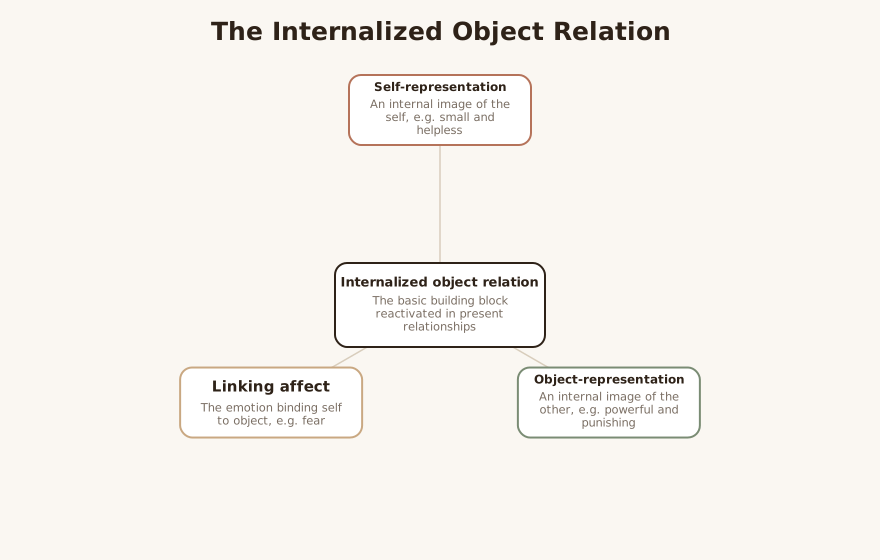
The central claim is that early relationships are internalized as enduring mental structures that shape perception, expectation, and behavior in present relationships, including the relationship with the therapist 13. These internalized object relations are not accurate recordings of real caregivers but representations colored by the child’s own affects, fantasies, and defenses 5. The basic building block is a triad: a representation of the self, a representation of an object, and the affect linking them, for example a small, helpless self bound by fear to a powerful, punishing other 5.
A second principle is that early experience is organized through splitting. Before the child can tolerate ambiguity, experience is divided into all-good and all-bad to protect the loving relationship from being contaminated by hatred and frustration 23. Healthy development involves integrating these split representations into whole, ambivalently held objects, a maturational achievement Klein located in the depressive position 2. When integration fails, the adult continues to experience self and others in polarized, unstable terms, a hallmark of severe personality pathology 56.
A third principle is projective identification: a process by which a person unconsciously externalizes an unwanted internal state into another person and then experiences that person as if they embodied it, often subtly pressuring the other to enact the projected role 2. Clinically this is why therapists working with these patients feel powerful, sometimes uncharacteristic, pulls to behave in particular ways. A fourth principle is that the therapeutic relationship is the primary arena of change. Because internal object relations are reenacted in the transference, the consulting room becomes the place where they can be observed, named, and revised 56.
Interventions & Techniques
Object relations theory does not prescribe a fixed set of exercises in the way a skills-based therapy does; its interventions are interpretive and relational LLM. The clinician’s core tools are clarification, confrontation, and interpretation, deployed to make the patient’s implicit relational templates explicit 6. Clarification invites the patient to articulate confusing or contradictory material; confrontation (non-aggressively) points to discrepancies the patient has not noticed, such as praising the therapist while behaving with contempt; and interpretation links present experience to the underlying self-object-affect configuration being enacted 56.
In TFP, the manualized application, these techniques are organized around a treatment frame and contract, prioritization of material (threats to life and treatment first), and systematic attention to the dominant object relation active in the room moment to moment 6. The therapist tracks which role the patient is occupying and which role is being assigned to the therapist, noting that these roles frequently flip, with patient and therapist trading the positions of victim and victimizer, or needy child and depriving parent 6. Naming these reversals helps the patient observe a split that was previously lived out blindly 6.
Winnicott’s tradition contributes a different emphasis: the therapeutic relationship as a holding environment that provides a reliable, attuned, “good-enough” presence within which arrested development can resume 17. Across traditions, countertransference is treated as data rather than contamination, because the feelings stirred in the clinician often reveal the projected object the patient cannot yet hold 5.
LLM-generated illustrative example (not a guideline): A patient arrives 20 minutes late, then accuses the therapist of not caring. The object relations clinician notices the countertransference pull to defend or to apologize, and instead reflects: “It seems that right now I’ve become someone who is neglectful and uncaring, and you are left feeling small and unimportant. I wonder if that pairing feels painfully familiar.” This names the active self-object-affect dyad rather than litigating the lateness LLM.
Evidence Base
Honesty about the evidence requires a distinction between the theory and its clinical derivatives. As a theory, object relations is well-established and historically influential within psychoanalysis and developmental thinking, but its core constructs (internal objects, splitting, projective identification) are inferential and difficult to operationalize for direct empirical test 13. The theory’s maturity is best described as established and foundational rather than as an evidence-based intervention in its own right 1.
The empirical credibility of the framework rests largely on Transference-Focused Psychotherapy, the manualized treatment derived from Kernberg’s object relations model of personality organization 56. TFP has been developed and studied as a structured psychodynamic treatment for borderline personality disorder, with a published clinical manual and a research program supporting its use 6. This gives clinicians a defensible position: the parent theory supplies the formulation, and the manualized child provides the outcome evidence for severe personality pathology 6. Object relations concepts have also been adapted into adjacent fields, including rehabilitation psychology, as a way to understand patients’ relational responses to disability and treatment 4. Clinicians should not overstate the case; for many object relations propositions the support is conceptual and clinical-observational rather than from randomized trials 13.
Populations & Indications
The framework is most useful for patients whose presenting difficulties are fundamentally relational and characterological rather than circumscribed and symptomatic 5. Its clearest indication is adults with personality disorders, particularly borderline and narcissistic organizations, where splitting, identity disturbance, and unstable relationships are central 56. It is also widely applied with people carrying attachment trauma, survivors of early childhood adversity, and individuals whose chief complaint is recurrent relationship difficulty 13.
Patients with identity disturbance, who experience a shifting, poorly integrated sense of self, are a natural fit because the theory directly addresses the integration of self-representations 56. Couples can be understood through the lens of mutual projective identification, in which each partner recruits the other to enact a feared or wished-for internal object LLM. People with chronic emptiness and interpersonal instability, often overlapping with the borderline range, are similarly well served by a treatment that targets the underlying object world rather than only the surface symptom 6.
Problems-for-Work
Splitting and idealization-devaluation. When a patient oscillates between viewing the therapist (or a partner) as wholly wonderful and wholly worthless, the work is to hold up both poles as belonging to the same relationship and to tolerate the ambivalence integration requires 26.
LLM-generated illustrative example (not a guideline): A patient who called the therapist “the only person who has ever understood me” returns the next week describing the same therapist as “cold and useless.” The clinician gently holds both: “Last week I was your rescuer; today I’m a disappointment. Both feel completely true to you, and the person in between, who is just an ordinary, imperfect helper, seems to disappear” LLM.
Borderline personality disorder and interpersonal instability. Here the formulation centers on un-integrated, polarized object relations enacted in the transference, the explicit target of TFP 6. Narcissistic personality disorder is approached through the rigid grandiose self-structure that defends against a devalued, needy self-representation 5. Identity disturbance is reframed as a failure to consolidate contradictory self-representations into a coherent whole 56. Relationship conflict and attachment difficulties are worked by tracing the recurring relational template the patient brings to each new bond 13. Chronic emptiness and low self-esteem are understood as the felt absence of stable, sustaining internal objects 35. For complex post-traumatic stress disorder, the theory contributes a way of understanding how abusive early relationships become internalized as persecutory internal objects, though trauma-specific safety and stabilization must take precedence LLM.
Contraindications, Cautions & Cultural Humility
Interpretation-heavy, transference-focused work is not a first-line choice during acute crisis, active psychosis, or when basic safety and stabilization have not been established; uncovering and confrontation can be destabilizing if the therapeutic frame is not secure 6. TFP itself is delivered within an explicit treatment contract precisely because patients in the borderline range require structure around safety, suicidality, and treatment-destroying behaviors before deeper work proceeds 6. Clinicians should be cautious about applying primitive-defense language (“splitting,” “projective identification”) in ways that pathologize or that the patient experiences as blaming LLM.
Cultural humility is essential. The theory was developed within early-twentieth-century European psychoanalysis, and its assumptions about the “good-enough mother,” normative caregiving, and family structure reflect a specific cultural and historical context 17. What looks like an internalized “bad object” or insecure relational pattern may instead reflect culturally normative interdependence, adaptive responses to discrimination or migration, or family arrangements that differ from the clinician’s expectations LLM. Countertransference, which this framework treats as essential data, can also carry the clinician’s own cultural bias, so clinicians should hold their formulations as provisional hypotheses rather than facts about the patient’s inner world 57.
Treatment-Plan Suggestions & SMART Objectives
| Goal | SMART objective (example) | Mechanism |
|---|---|---|
| Reduce splitting in close relationships | Within 12 weeks, patient will identify, in session, at least 2 instances per week where they viewed someone as all-good or all-bad and articulate a more integrated view | Integration of split self- and object-representations toward whole-object relating 26 |
| Stabilize identity | Within 16 weeks, patient will describe a consistent self-narrative across 3 different relational contexts without contradiction | Consolidation of contradictory self-representations 56 |
| Improve interpersonal stability | Over 8 weeks, patient will reduce relationship-ending episodes from baseline by maintaining one conflict without abruptly cutting contact | Tolerating ambivalence rather than enacting devaluation 6 |
| Recognize projective identification | Within 10 weeks, patient will name, in 3 sessions, a feeling they “put into” another person before acting on it | Re-owning projected affect and self-states 2 |
| Increase reflective distance in transference | By session 20, patient will observe and label one in-session role-reversal with the therapist | Making enacted object relations explicit 6 |
| Reduce chronic emptiness | Within 12 weeks, patient will report 2 experiences per week of feeling internally “held” or soothed without external reassurance | Strengthening stable, sustaining internal objects 35 |
| Improve affect tolerance | Over 8 weeks, patient will remain in session through 3 episodes of intense affect without leaving or dissociating | Holding environment supports affect regulation 7 |
Common Misconceptions
The most common error is reading “object” as referring to a literal thing rather than a mental representation of a person or part-person; the term names an internal image, not an inanimate object 13. A second misconception is conflating object relations with classical Freudian drive theory; the whole point of the school was to relocate primary motivation from instinctual discharge to relationship-seeking 17. A third is treating “splitting” as a synonym for ordinary dishonesty or manipulation, when it denotes an unconscious defensive division of experience into all-good and all-bad 23.
Clinicians also sometimes assume the theory is purely historical and untestable; while many constructs are inferential, the framework has yielded a manualized, studied treatment in TFP 6. Finally, object relations is not the same as attachment theory, although the two are closely related and mutually informing; they arose from different methods and emphasize different levels of analysis 1.
Training & Certification
There is no certification in “object relations theory” as such, because it is a body of theory rather than a credentialed protocol LLM. Foundational learning comes through reading the primary literature, including Kernberg’s integration of object relations with clinical psychoanalysis, and through accessible secondary explainers and introductory overviews of the major figures 57. Encyclopedic and academic primers, including adaptations for allied fields such as rehabilitation psychology, offer efficient orientation for clinicians new to the framework 34.
For clinicians who wish to practice an empirically grounded application, formal training in Transference-Focused Psychotherapy is the most concrete pathway, supported by a published clinical manual and structured supervision in the method 6. As with all psychodynamic work, competence depends heavily on ongoing supervision and attention to the clinician’s own reactions, since countertransference is a primary working instrument 5.
Key Terms
- Object: an internal mental representation of a person or part of a person toward whom feelings and behavior are directed 13.
- Self-representation / object-representation: the internalized image of oneself and of the other, linked by an affect to form the basic unit of mental life 5.
- Splitting: a primitive defense that divides experience into all-good and all-bad to keep love and hate separate 23.
- Projective identification: externalizing an unwanted internal state into another and unconsciously pressuring them to enact it 2.
- Paranoid-schizoid / depressive position: Klein’s two organizing modes of experience, the latter marking integration of split objects into whole, ambivalently held people 27.
- Good-enough mother / holding environment: Winnicott’s terms for ordinary, reliable caregiving that supports healthy development 17.
- Transference: the reactivation of internalized object relations in the relationship with the therapist 56.
Resources & Further Reading
▶ Watch — a video introduction to this concept:
- Object relations theory (Wikipedia) 1
- Object Relations Theory | Melanie Klein (Simply Psychology) 2
- Object Relations Theory (Encyclopedia.com) 3
- Object Relations Theory: A Primer for Rehabilitation Psychologists (Thomas, Zhou & Rosenthal) 4
- Object Relations Theory and Clinical Psychoanalysis (Otto Kernberg) 5
- Transference-Focused Psychotherapy for Borderline Personality Disorder (American Psychiatric Association Publishing) 6
- Introduction to Object Relations Theory: Klein, Winnicott, Kernberg, Fairbairn (video) 7
Reflective / Supervision Questions
- When working with this patient, which self-object-affect dyad do I most often find myself pulled into, and what role am I being assigned 56?
- Am I treating my countertransference as data about the patient’s inner world, or am I at risk of enacting the projected object 5?
- Where might my formulation of a “bad object” or insecure relational pattern actually be reflecting cultural difference rather than pathology LLM?
- Has the treatment frame and safety contract been established firmly enough to support interpretive, transference-focused work, or does stabilization need to come first 6?
- Am I documenting observable, functional change for billing and accountability, or drifting into abstract metapsychological language that the record cannot support 6?