
Type & Discipline
Affect Regulation Theory (ART) is a theory, not a manualized treatment package, situated within developmental affective neuroscience and the broader interdisciplinary field of interpersonal neurobiology 4. It is a biopsychosocial model that integrates attachment theory, developmental psychology, neurobiology, and psychoanalytic clinical observation into a single account of how the emotional self forms, dysregulates, and can be repaired 1. Its central claim is that the implicit, emotional, “core” self is organized in the early-maturing right brain, and that this self is shaped through emotional transactions with a primary caregiver who functions as an external regulator of the infant’s still-immature nervous system 1.
Because it is a theory of mechanism rather than a discrete protocol, ART operates at the level that explains why relationally oriented therapies work, rather than prescribing a fixed sequence of sessions 3. Clinicians most often encounter it as a conceptual lens layered onto existing modalities — attachment-based, psychodynamic, somatic, and trauma-focused work — supplying a neurobiological rationale for attunement, co-regulation, and the nonverbal dimensions of the therapeutic relationship 3. This distinction matters for treatment planning: ART informs how you deliver an evidence-based therapy, but it is not itself a billable modality LLM.
Creators & Lineage
ART is primarily associated with Allan N. Schore, whose 1994 volume Affect Regulation and the Origin of the Self: The Neurobiology of Emotional Development synthesized then-disparate literatures into a unified developmental model 4. The book has been described as a foundational text that helped catalyze the contemporary integration of neuroscience with attachment and developmental psychology 5. Schore subsequently extended the framework across multiple volumes and articles, and his program of work is sometimes referred to collectively as “regulation theory” 4.
The lineage of ART runs directly through Bowlby’s attachment theory, which Schore recast in explicitly neurobiological and regulatory terms — what he and others have called a “modern attachment theory” centered on the enduring impact of early right-brain development 6. It draws on affective neuroscience for its account of emotion as a bodily, autonomically grounded process, and on the developmental tradition of affect attunement and vitality affects — the moment-to-moment matching of an infant’s emotional intensity and timing by a caregiver 1. These threads converge in Schore’s signature proposal: that attachment is, at its core, the dyadic regulation of emotion, encoded in the maturing right hemisphere during a critical early period 1.
Core Principles
The first principle is right-brain dominance for early emotional life. Schore argues that the right hemisphere matures earlier than the left in the first two to three years and is dominant for processing emotion, attachment communications, the bodily-based self, and the regulation of affect 1. The implicit self that forms here is nonverbal and operates largely outside conscious awareness 3.
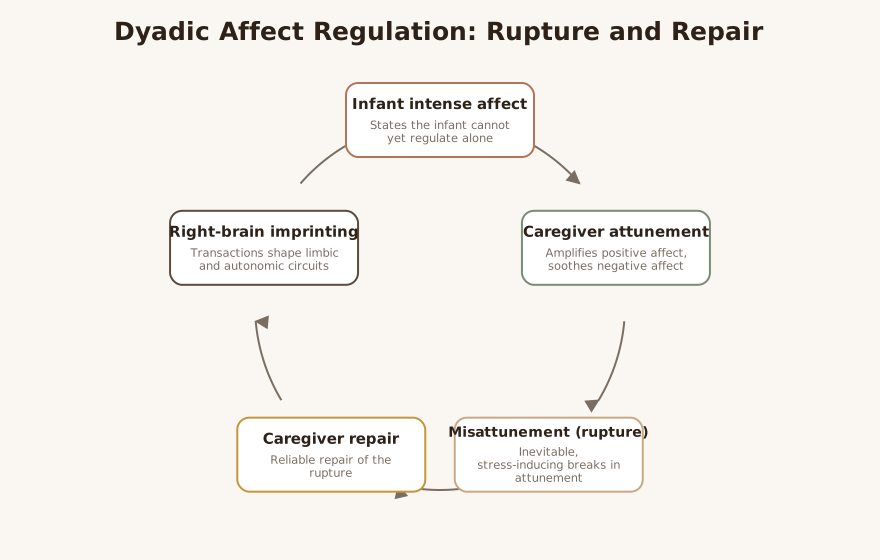
The second principle is interactive (dyadic) regulation. The infant cannot yet regulate its own intense states, so the caregiver acts as an external regulator — amplifying positive affect through attuned, high-arousal play and dampening negative affect by soothing distress 1. These repeated transactions are imprinted into the developing right-brain limbic and autonomic circuits, shaping the child’s emerging capacity for self-regulation 1.
The third principle is that attachment communications are predominantly right-brain to right-brain and nonverbal — conveyed through face, voice prosody, gaze, and gesture rather than words 3. The fourth is the centrality of rupture and repair: misattunements are inevitable, and the caregiver’s reliable repair of these stress-inducing ruptures is what builds resilience and the expectation that dysregulation can be recovered from 1. Optimal development is therefore not the absence of negative affect but the dyadic capacity to transition flexibly between states 1.
A fifth, clinically pivotal principle is continuity into adulthood: the right-brain regulatory systems laid down early continue to operate beneath verbal cognition throughout life, which is why Schore reframes psychotherapy itself as a fundamentally right-brain, affect-regulating, relational process 3.
Interventions & Techniques
ART does not supply a discrete technique manual; it reframes the implicit, relational substrate of whatever modality the clinician already practices 3. Its principal “intervention” is the therapist’s regulated, attuned presence — using the therapeutic relationship as a context for the implicit co-regulation of the patient’s affective and autonomic states 3.
Schore emphasizes attending to the nonverbal, right-brain channel: facial expression, eye contact, the prosody and rhythm of voice, posture, and the felt sense of the moment-to-moment emotional exchange, rather than focusing exclusively on verbal content 3. The clinician tracks shifts in the patient’s arousal — toward hyperarousal or toward dissociative hypoarousal — and uses their own regulated nervous system to help the patient stay within a tolerable window 3.
Affect attunement and synchrony are core techniques: matching the intensity and timing of the patient’s affect, then gradually guiding it toward regulation, mirrors the caregiver’s developmental role 1. Equally central is the disciplined, sensitive handling of misattunements and ruptures, since interactive repair within sessions is theorized to recapitulate and strengthen regulatory capacity 1. With children specifically, Schore frames the adult’s role as helping the child regulate emotional states through the relationship rather than through instruction 7.
LLM-generated illustrative example (not a guideline): A patient describing a shaming memory begins speaking faster, breaks eye contact, and flattens vocally — early signs of escalating arousal collapsing toward shutdown. Rather than pursuing more narrative detail, the clinician slows their own cadence, softens prosody, and names the present-moment shift (“something just changed in the room”), helping the patient’s autonomic state settle before continuing LLM.
Evidence Base
ART is best characterized as an established and influential theory whose foundational text has been widely cited and credited with shaping the field of interpersonal neurobiology 5. The original 1994 synthesis and the 2000/2001 attachment-and-right-brain papers entered the peer-reviewed and academic literature and remain reference points for relationally oriented and trauma-focused practice 24. Schore’s 2022 Annals of General Psychiatry article surveys what he frames as recent scientific and clinical advances supporting a right-brain-to-right-brain model of psychotherapy 3.
Honesty about maturity is warranted. The theory is “established” in the sense of being well-developed, broadly disseminated, and integrated across disciplines 5. It is not, however, an empirically validated standalone treatment with its own randomized controlled trial base; it is a mechanistic framework that draws together neuroscience, attachment research, and clinical observation 3. Many of its neurobiological claims — right-hemisphere dominance for early affect regulation, the imprinting of dyadic regulation into limbic-autonomic circuits — are synthesized interpretations of developmental and neuroimaging findings rather than effects demonstrated by direct outcome trials of an “ART protocol” 3. Clinicians should therefore treat ART as a powerful explanatory and organizing model, while grounding measurable claims of efficacy in the evidence-based therapies through which its principles are delivered LLM.
Populations & Indications
ART is most directly relevant to the infant-caregiver dyad, where it describes the normative developmental process it seeks to explain and, by extension, informs early-intervention and parent-guidance work 1. Schore’s child-focused material speaks specifically to helping parents and caregivers support children in regulating emotional states 7.
In adult clinical work, the framework is indicated for survivors of early and developmental trauma, where Schore argues that relational trauma and chronic misattunement in infancy disrupt right-brain regulatory development 1. It is frequently applied to individuals with personality disorders, particularly those whose presentations center on affect dysregulation and unstable attachment 4. More broadly, Schore positions the theory as relevant to adults in psychotherapy generally, given his claim that the change process in any relational therapy operates through right-brain affect regulation 3. Parents are an explicit secondary population, since strengthening the caregiver’s own regulatory capacity is framed as the lever for the child’s development 7.
Problems-for-Work
ART is organized around affect dysregulation as the core clinical problem — the inability to flexibly modulate the intensity and duration of emotional states 1. It addresses developmental and complex trauma, conceptualized as relational injury to the early right-brain regulatory system 1.
For borderline personality disorder, ART offers a developmental account of the affective instability and attachment disturbance that characterize the presentation, locating them in early dyadic dysregulation 4. Attachment disorders are addressed directly, given the theory’s roots in modern attachment theory 6. Dissociation and the hypoaroused, shut-down states seen in trauma are understood as right-brain regulatory collapse under overwhelming affect 3. PTSD, emotional numbing and alexithymia, and difficulty self-soothing all map onto the same underlying disturbance in right-brain affect processing and the implicit capacity to recover from dysregulation 3.
LLM-generated illustrative example (not a guideline): For a client who reports feeling “nothing” after recounting a frightening event (a numbing/alexithymic pattern), an ART-informed clinician would attend less to extracting an emotion label and more to the autonomic shutdown in the room — gently increasing relational contact and present-moment safety to bring the client back into a connected, feeling state LLM.
Contraindications, Cautions & Cultural Humility
ART is a conceptual lens rather than a procedure, so it carries no formal contraindications of its own; cautions instead attach to how it is used LLM. The most important caution is overreach: the framework should not be presented to clients or in records as an empirically validated standalone treatment, because it is a mechanistic theory delivered through other modalities 3. Deep, affect-focused relational work can be destabilizing for clients with limited regulatory capacity, so titrating arousal and avoiding premature exposure to overwhelming affect is essential LLM.
A neurobiological theory built on early developmental “norms” also risks importing culturally specific assumptions about caregiving, eye contact, emotional expression, and dyadic interaction styles. Norms for gaze, touch, and affect display vary substantially across cultures, and clinicians should hold the model’s developmental claims with humility rather than treating one pattern of attunement as universally correct LLM. Right-brain attunement is also expressed through nonverbal channels that are culturally and individually patterned, so therapists must read each client’s cues rather than impose a template LLM. Finally, ART’s emphasis on early caregiving should not be used to assign blame to families or to obscure structural and contextual contributors to dysregulation LLM.
Treatment-Plan Suggestions & SMART Objectives
| Goal | SMART objective (example) | Mechanism |
|---|---|---|
| Improve affect regulation | Within 8 weeks, client identifies early bodily cues of escalating arousal in 4 of 5 sessions and applies one co-regulation/grounding strategy | Strengthening right-brain awareness of autonomic shifts; interactive regulation 3 |
| Expand window of tolerance | Over 12 weeks, client tolerates discussion of a distressing memory for 10 minutes without dissociating or shutting down | Titrated affect exposure within a co-regulated relationship 3 |
| Reduce dissociation/numbing | Within 90 days, client reports remaining present and “feeling” during 3 of 4 affect-laden sessions | Bringing hypoaroused states back into relational contact 3 |
| Build rupture-repair capacity | Each month, client and therapist explicitly name and repair at least one in-session misattunement | Recapitulating developmental rupture-and-repair 1 |
| Increase self-soothing | Within 6 weeks, client demonstrates 2 independent self-soothing skills outside session, logged 4x/week | Internalizing dyadic regulation into self-regulation 1 |
| Strengthen caregiver attunement (parent work) | Over 10 weeks, parent identifies and responds to child’s distress cues with a soothing response in 3 of 4 observed interactions | Caregiver as external regulator of the child’s states 7 |
| Reduce alexithymia | Within 12 weeks, client links a bodily sensation to an emotion in 4 of 5 sessions | Right-brain integration of bodily affect into awareness 3 |
Common Misconceptions
A frequent misconception is that ART is a brand of therapy you can be “certified in” and bill as such; it is a developmental-neuroscience theory that informs practice rather than a packaged protocol 3. Another is that “right-brain to right-brain” means cognition or language is unimportant — the claim is about the primacy of nonverbal, affective communication in attachment and in the change process, not the elimination of verbal work 3.
A third error is treating the model as fully validated by outcome trials; its strength lies in synthesis and explanatory power, and its specific neurobiological claims are interpretive rather than products of dedicated efficacy studies 3. A fourth is reading optimal development as the suppression of negative emotion, when the theory actually emphasizes the dyadic capacity to move flexibly between states and to repair distress 1. Finally, ART is sometimes misused to attribute all dysregulation to “bad parenting,” which oversimplifies a biopsychosocial model and ignores temperament, context, and structural factors LLM.
Training & Certification
There is no single credentialing body or formal certification in Affect Regulation Theory, consistent with its status as a theory rather than a manualized treatment 3. Clinicians typically acquire it through primary reading — most directly Schore’s Affect Regulation and the Origin of the Self — alongside his subsequent books and peer-reviewed articles 45. Schore’s official site curates his books and writings as a starting point 5.
Accessible secondary learning includes recorded lectures and interviews in which Schore presents modern attachment theory and the role of early right-brain development, as well as applied material on helping children regulate emotional states 67. In practice, therapists integrate ART through training in the relationally oriented modalities that operationalize its principles — attachment-based, psychodynamic, somatic, and trauma-focused therapies — and through clinical supervision focused on attunement, arousal regulation, and the use of self in the room LLM.
Key Terms
- Right-brain dominance: The proposal that the earlier-maturing right hemisphere is dominant for emotion, attachment, the bodily self, and affect regulation in early development 1.
- Interactive (dyadic) regulation: The caregiver functioning as an external regulator of the infant’s affective and autonomic states 1.
- External regulator: The caregiver’s role in amplifying positive and dampening negative affect before the child can self-regulate 1.
- Affect attunement / vitality affects: Matching the intensity, timing, and contour of an infant’s emotional state 1.
- Rupture and repair: The cycle of inevitable misattunement followed by reliable repair, theorized to build resilience and regulatory capacity 1.
- Right-brain-to-right-brain communication: Predominantly nonverbal, affect-based exchange between caregiver-infant and, by extension, therapist-patient 3.
- Implicit self: The nonverbal, emotional core self organized in the early right brain 3.
Resources & Further Reading
▶ Watch — a video introduction to this concept:
- Schore, A.N. (2000/2001). Attachment and the regulation of the right brain (author PDF)
- Attachment and the regulation of the right brain (PubMed record)
- Right brain-to-right brain psychotherapy: recent scientific and clinical advances (Annals of General Psychiatry, 2022)
- Affect Regulation and the Origin of the Self: The Neurobiology of Emotional Development (Routledge)
- Affect Regulation and the Origin of the Self (Dr. Allan N. Schore — official site)
- Dr. Allan N. Schore — Modern attachment theory; the enduring impact of early right-brain development (YouTube)
- VIDEO: Dr. Allan Schore on How to Help Children Regulate Their Emotional States (PsychAlive)
Reflective / Supervision Questions
- When I notice my own arousal shifting in a session, am I using it as clinical data about the dyad’s regulatory state, or letting it go unexamined? LLM
- How do I track and respond to a client’s nonverbal, right-brain cues — prosody, gaze, posture — versus defaulting to verbal content? LLM
- Do I attend to rupture and repair as an active therapeutic process, or do I avoid or smooth over misattunements? 1
- Where might my assumptions about “attuned” caregiving reflect culturally specific norms rather than universals? LLM
- Am I representing ART honestly in my case formulation — as a mechanistic rationale delivered through an evidence-based modality, rather than as a validated standalone treatment? 3
- For clients with limited regulatory capacity, how am I titrating affect to keep the work within a tolerable window? LLM