
Type & Discipline
Child-Parent Psychotherapy (CPP) is a manualized, dyadic, relationship-based treatment for young children from birth to age 5 and their primary caregivers, drawn from clinical psychology and the field of infant and early childhood mental health 2. Unlike treatments that work with the child or the parent in isolation, CPP treats the caregiver-child relationship itself as the patient, holding that for a very young child the relationship is the primary vehicle of both injury and repair LLM. It is best understood as a dyadic, attachment-based intervention that integrates psychodynamic, attachment, trauma, developmental, and social-learning theory into one relational frame 2. The model is intended for children who have experienced trauma — including direct maltreatment, exposure to family or domestic violence, traumatic loss, or other adverse events — and whose mental health and development have been disrupted as a result 2. CPP situates the dyad within its broader ecology, attending explicitly to culture, socioeconomic context, and historical trauma as forces shaping the relationship 3.
Creators & Lineage
CPP grew directly out of infant-parent psychotherapy (IPP), a psychoanalytic approach developed by Selma Fraiberg, whose enduring metaphor of the “ghosts in the nursery” described how a parent’s unresolved past intrudes upon and distorts the present relationship with their child 7. The model was formalized beginning in 1996 at the Child Trauma Research Program at the University of California, San Francisco, where Alicia Lieberman and colleagues set out to build an evidence-based, culturally informed adaptation of Fraiberg’s principles for trauma-exposed young children 7. With federal funding from the National Institute of Mental Health beginning in 1998, the team developed the treatment manual and conducted the rigorous research that anchors the model today 7. The foundational manual, Don’t Hit My Mommy!, authored by Lieberman, Ghosh Ippen, and Van Horn, codified the approach for young children exposed to violence and other trauma 8. The lineage is thus a synthesis: attachment theory and infant mental health provide the developmental spine, psychodynamic and object relations theory supply the “ghosts” framework, and trauma-focused theory orients the work toward processing frightening experience LLM.
Core Principles
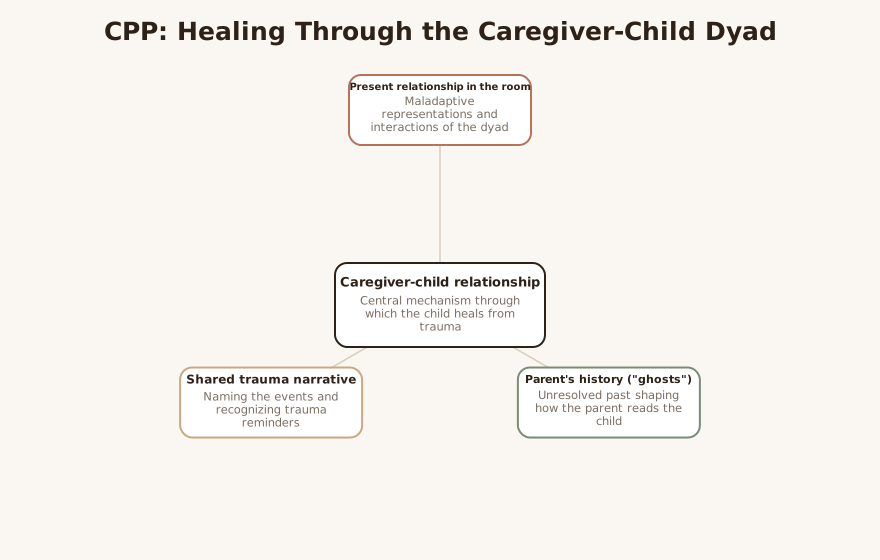
The organizing premise of CPP is that the caregiver-child relationship is the central mechanism through which a young child heals from trauma, so strengthening that relationship is the route to restoring the child’s mental health 2. A core clinical focus is the dyad’s maladaptive representations — the distorted ways parent and child have come to see themselves and each other — together with the interactions and behaviors that flow from those representations and interfere with the child’s wellbeing 3. CPP works simultaneously on two timelines: the present relationship in the room and the parent’s own history, on the assumption that the parent’s unresolved past (“ghosts”) shapes how they read and respond to their child 7. The model is explicitly culturally informed, treating the family’s cultural values, socioeconomic realities, and experiences of historical trauma as material to be understood rather than background to be ignored 3. A further principle is that the trauma must be named and made bearable: therapist and dyad construct a shared narrative of the frightening events and learn to recognize the trauma reminders that drive dysregulated behavior 2.
Interventions & Techniques
CPP is delivered in joint sessions with the child and primary caregiver, with siblings or additional caregivers included when clinically indicated 2. The work proceeds across three broad phases: a foundational assessment and engagement phase, a core intervention phase of typically weekly sessions lasting about one to one-and-a-half hours, and a closing or consolidation phase 3. A central technique is the co-construction of a trauma narrative within the relationship, helping the dyad develop a shared story of what happened so the events can be understood rather than re-enacted 2. The therapist helps the family identify trauma reminders — the cues, places, sounds, or interactions that trigger fear and behavioral dysregulation — and supports new, regulated responses to them 2. Much of the in-session work uses the moment-to-moment interactions and play of the dyad as the material, with the therapist speaking for the baby or young child, naming affect, and ” porting” meaning between parent and child LLM. The model addresses the parent’s own affect and history when it intrudes on caregiving, linking past and present so the parent can respond to the actual child rather than to a ghost 7.
LLM-generated illustrative example (not a guideline): A 3-year-old freezes and then hits his mother whenever a man raises his voice nearby, a pattern that began after the family fled domestic violence. In session, the therapist names the child’s fear aloud (“That loud voice was scary — your body remembered”), helps the mother recognize the raised voice as a trauma reminder rather than defiance, and supports her in offering a steadying, protective response, gradually building a shared story that the danger is past LLM.
Evidence Base
CPP’s evidence base is established and is among the strongest in the infant and early childhood field 1. The California Evidence-Based Clearinghouse assigns CPP a Scientific Rating of 1 — its highest, “well-supported” tier — for infant and early childhood mental health programs (birth to 5), with a “high” relevance rating for the child welfare system 3. The foundational randomized controlled trial enrolled 75 multiethnic preschool-age mother-child dyads exposed to marital violence, comparing weekly CPP over one year against case management plus community referral; it found significant group-by-time effects on children’s total behavior problems, traumatic stress symptoms, and diagnostic status, plus reductions in maternal avoidance symptoms 4. A 6-month follow-up of that trial demonstrated durability, with sustained gains for children’s behavior problems and, among completers, mothers’ general distress 5. The broader research program reports additional RCTs in maltreated and anxiously attached samples, with documented effects on attachment security, trauma symptoms, and even biological stress regulation such as cortisol 1. The model continues to be disseminated and scaled with attention to fidelity 6. Honest appraisal, however, notes that much of the primary evidence comes from the developers’ own research groups and that the landmark dyadic-violence trials date to the mid-2000s, so independent replication and generalizability remain appropriate caveats LLM.
Populations & Indications
CPP is indicated for infants, toddlers, and young children from birth through age 5 and their caregivers, treated together in dyadic sessions 2. The strongest indication is early childhood trauma — children who have experienced or witnessed frightening events and whose development or relationships have been affected 2. It is well suited to dyads exposed to domestic or family violence, the population in which the foundational efficacy trial was conducted 4. The model fits trauma-exposed families broadly, families involved with child protective services, and situations where a parent’s own trauma history is intruding on caregiving 3. Because CPP works on the parent’s representations and affect as well as the child’s, it is relevant when caregiver depression, anxiety, or perinatal mental illness is shaping the relationship, and when the concern is the intergenerational transmission of trauma 1. Its explicit attention to culture and socioeconomic context makes it appropriate for diverse, multiethnic, and under-resourced families, consistent with the populations in which it was developed and tested 3.
Problems-for-Work
CPP targets a defined set of clinical problems in the dyad. Early childhood trauma and PTSD are addressed through the shared narrative and trauma-reminder work, helping a frightened child and caregiver make the experience bearable together 2. Disrupted attachment is a core target, with trials showing improvements in attachment security 1. Behavioral and emotional dysregulation in young children is treated by linking the behavior to its relational and trauma meaning rather than managing it as an isolated symptom 4. Caregiver-child relationship problems are the explicit unit of treatment, reframing distorted mutual representations 3. Exposure to domestic violence is a primary indication backed by the foundational RCT 4. Parental depression and anxiety affecting caregiving and the intergenerational transmission of trauma are engaged through the “ghosts in the nursery” lens, working the parent’s own history where it disrupts the relationship 7.
LLM-generated illustrative example (not a guideline): A mother with untreated postpartum depression experiences her infant’s crying as a personal rejection and withdraws, and the baby’s bids for connection have begun to flatten. CPP sessions help the mother notice how her own early experience of an unavailable caregiver colors her reading of the baby, while the therapist amplifies the infant’s positive bids, supporting a more attuned, responsive exchange LLM.
Contraindications, Cautions & Cultural Humility
CPP requires the child and caregiver to be seen together, so it presupposes an available, non-perpetrating caregiver who can safely participate in dyadic work LLM. Where the caregiver is the active source of ongoing danger, where there is unresolved acute domestic violence, or where a parent’s psychiatric instability or substance use precludes safe joint sessions, clinicians should stabilize safety first and may need adjunctive or alternative care before dyadic treatment is appropriate LLM. Because the model deliberately surfaces the parent’s own trauma history, clinicians should titrate that exploration to the parent’s capacity and the protective frame of the work, attending to the risk of overwhelming a fragile caregiver LLM. Cultural humility is not an add-on but a structural commitment of the model: CPP explicitly incorporates the family’s culture, socioeconomic context, and experiences of historical and intergenerational trauma into the clinical formulation 3. Clinicians should hold the family’s meanings, child-rearing values, and lived adversity as central data rather than deviations, and reflective supervision is built into the model partly to keep the therapist’s own assumptions in view 3.
Treatment-Plan Suggestions & SMART Objectives
| Goal | SMART objective (example) | Mechanism |
|---|---|---|
| Reduce child traumatic stress symptoms | Over 6 months of weekly dyadic sessions, reduce caregiver-reported trauma symptoms on a standardized measure to below clinical cutoff 4 | Shared trauma narrative and processing of frightening experience within the relationship 2 |
| Improve attachment security | Within the treatment course, increase observed proximity-seeking and comfort-taking between child and caregiver in three consecutive sessions 1 | Repairing distorted dyadic representations and supporting attuned responses 3 |
| Decrease behavioral dysregulation | Reduce frequency of caregiver-reported aggressive/dysregulated episodes by half over 12 weeks 4 | Linking behavior to trauma reminders and building regulated responses 2 |
| Increase caregiver recognition of trauma reminders | Caregiver independently identifies at least three of the child’s trauma reminders and a planned response by mid-treatment 2 | Psychoeducation and in-session identification of reminders 2 |
| Address caregiver’s intruding history (“ghosts”) | Caregiver articulates one link between their own early experience and a present reaction to the child within the first phase 7 | Working the parent’s representations and unresolved past 7 |
| Build a shared trauma narrative | Dyad co-constructs and can retell a coherent account of the index event by the closing phase 2 | Co-construction of meaning within the dyad 2 |
| Reduce caregiver distress affecting caregiving | Decrease caregiver general-distress score by a clinically meaningful margin and sustain at follow-up 5 | Relationship-focused processing with durability over time 5 |
Common Misconceptions
A frequent misconception is that CPP is parent training or behavior management; it is not, because the unit of treatment is the relationship and its underlying representations rather than a set of discipline techniques 3. A second is that very young children, including preverbal infants, are “too young” for trauma treatment — CPP is designed precisely for birth-to-5 and uses the dyadic relationship and play, not verbal insight, as its medium 2. Another is that the trauma should be avoided to protect the child; in CPP the trauma is deliberately named and a shared narrative is built so the events become bearable rather than silently re-enacted 2. Some assume CPP treats the child alone with the parent merely observing, when in fact the caregiver is an active participant and frequently a focus of the work through their own history 7. Finally, the cultural and contextual attention in CPP is sometimes read as optional sensitivity, whereas it is a structural part of the model’s formulation 3.
Training & Certification
CPP is delivered by master’s-level (or higher) clinicians, and the model places strong emphasis on reflective supervision as part of competent practice 3. The standard pathway to fidelity is an intensive Learning Collaborative spanning roughly 18 months, structured around an initial multi-day training workshop, periodic follow-up workshops, and ongoing twice-monthly consultation calls with an approved trainer 3. Supervisors are expected to hold a relevant master’s degree and to have completed model training, typically with at least a year of experience in the approach 3. This collaborative, consultation-heavy structure is part of how CPP is scaled across systems while maintaining fidelity to the manualized model 6. The foundational manual, Don’t Hit My Mommy!, is the core text supporting training 8. Clinicians should consult the official Child-Parent Psychotherapy program for current rosters of approved trainers and collaboratives rather than assuming self-study confers fidelity LLM.
Key Terms
Dyadic treatment — therapy in which the caregiver-child pair is treated together as the unit of care 2. Ghosts in the nursery — Fraiberg’s metaphor for the way a parent’s unresolved past intrudes on and distorts the present relationship with their child 7. Representations — the internalized, often distorted, ways parent and child see themselves and each other, a core focus of intervention 3. Trauma reminders — the cues that trigger fear and behavioral dysregulation in a traumatized child, which the dyad learns to recognize 2. Shared narrative — the co-constructed account of the traumatic event(s) the dyad develops in treatment 2. Reflective supervision — the supervisory practice, built into the model, that supports the clinician’s capacity to hold the dyad’s affect and their own reactions 3. Infant-parent psychotherapy (IPP) — the psychoanalytic precursor, developed by Fraiberg, from which CPP evolved 7.
Resources & Further Reading
▶ Watch — a video introduction to this concept:
- Child-Parent Psychotherapy — Research 1
- CPP — NCTSN Fact Sheet 2
- Child-Parent Psychotherapy — California Evidence-Based Clearinghouse (CEBC) 3
- Lieberman et al. (2005), CPP with preschoolers exposed to marital violence 4
- Lieberman et al. (2006), 6-month follow-up of a randomized controlled trial 5
- Engaging the child-parent relationship to treat early trauma: scaling with fidelity (2024) 6
- History — Child-Parent Psychotherapy (origins / Fraiberg) 7
- Don’t Hit My Mommy! A Manual for Child-Parent Psychotherapy (Lieberman, Ghosh Ippen, Van Horn) 8
Reflective / Supervision Questions
- When I observe a dyad, am I attending to the relationship and its representations, or am I quietly defaulting to assessing the child or coaching the parent in isolation? LLM
- Whose “ghosts” am I encountering in this case, and how is the parent’s history shaping the way they read this particular child? 7
- Have I helped this family name the trauma and build a shared narrative, or am I colluding with avoidance to keep sessions comfortable? 2
- How are this family’s culture, socioeconomic reality, and any historical trauma showing up in the room, and am I treating those as central clinical data? 3
- Is the caregiving environment safe enough for dyadic work right now, and what would tell me stabilization or an alternative is needed first? LLM
- What am I bringing to this dyad — my own reactions, assumptions, and history — and how is reflective supervision helping me see it? 3