
Type & Discipline
Circle of Security (COS) is a manualized, attachment-based parenting intervention that sits at the intersection of clinical psychology and infant and early-childhood mental health 2. It is not a child-directed therapy but a caregiver-focused one: the unit of treatment is the caregiving relationship rather than the child’s symptoms in isolation 2. The original protocol was a 20-week, group-based parent-education and psychotherapy intervention that combined structured psychoeducation with video review of each caregiver’s own interactions with their child 2. Over the past two decades the model has been packaged into several delivery formats and disseminated internationally through a training and certification organization, so it now functions as a recognizable branded program rather than a single fixed protocol 1. Clinicians most often encounter it as either an intensive clinician-delivered protocol or a shorter, more scalable group curriculum 3.
Creators & Lineage
COS was developed in the late 1990s by a clinical team — Glen Cooper, Kent Hoffman, and Bert Powell — working with developmental researcher Robert Marvin, who brought the empirical attachment-assessment tradition to the project 2. The foundational peer-reviewed description appeared in 2002 and laid out both the conceptual model and the intervention design 2. The model’s intellectual roots are explicit: it draws on Bowlby and Ainsworth’s attachment theory, the Strange Situation classification system, and object-relations and self-psychology ideas about how a caregiver’s internal representations shape relational behavior 2. The developers later consolidated the clinician-facing protocol in a Guilford Press volume that remains the primary clinical text 4. Lineage-wise, COS belongs to the broader family of video-feedback parenting interventions and shares conceptual territory with infant mental health approaches such as dyadic and child-parent psychotherapy, while its emphasis on the caregiver’s own defensive processes reflects its object-relations heritage 4. The program’s history — including the move from an intensive clinical protocol toward a more accessible parenting-education format — is documented in the developers’ own retrospective account 6.
Core Principles
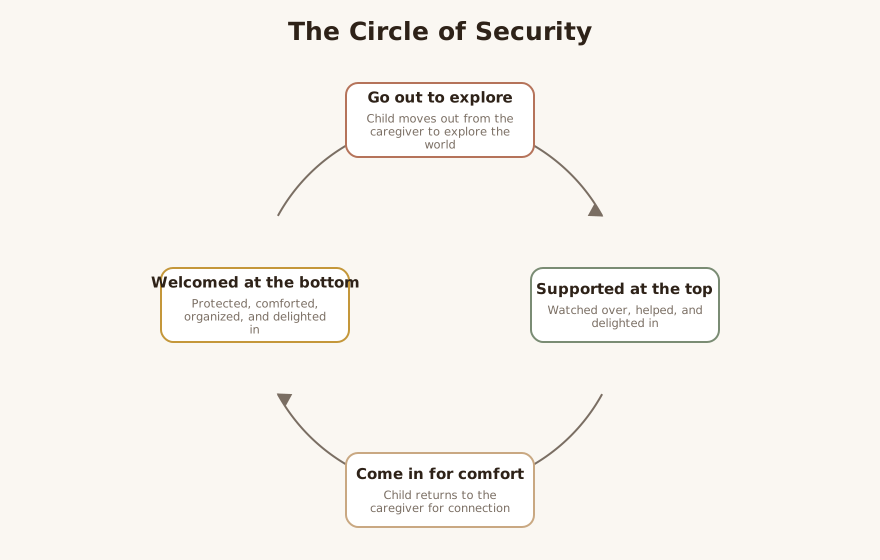
The organizing image is the “Circle of Security” itself: a graphic showing a child moving out from the caregiver to explore the world and coming back in for comfort and connection 1. The caregiver’s hands anchor the circle, and the program frames the secure caregiver as being “bigger, stronger, wiser, and kind” — available to support exploration at the top of the circle and to welcome the child’s return at the bottom 3. At the top, the child’s needs are to be watched over, helped, and delighted in; at the bottom, the needs are to be protected, comforted, organized, and delighted in 3. A central tenet is that security comes not from perfection but from a caregiver who is reliably present across both halves of the circle 4.
The model assumes that most caregivers can meet their child’s needs on most of the circle but have a region where their own history makes them uncomfortable — a place where they reflexively redirect the child away from a need they find threatening LLM. COS names this defensive steering “miscuing” and treats it as a learned, self-protective pattern rather than a deficit of love 4. The deepest level of the model concerns what the developers call the caregiver’s core sensitivities and the relational struggle that drives the work, which the next sections address 5.
Interventions & Techniques
The signature technique is structured review of edited video clips of the caregiver interacting with their own child, used to help caregivers see relational moments they would otherwise miss 2. Clips are chosen and sequenced deliberately: some highlight the caregiver’s existing strengths to build a working alliance, and others gently surface the moments of struggle that are the focus of change 4. This staging is intentional — affirming competence before exploring difficulty is what makes the harder material tolerable LLM.
Several constructs structure the clinical conversation. “Shark music” is the program’s metaphor for the caregiver’s own anxiety or dread that surfaces when the child expresses a need the caregiver finds threatening, distorting their reading of the moment 4. “Being-with” describes the caregiver’s capacity to stay emotionally present with the child’s feeling rather than fixing, dismissing, or escalating it 4. When a caregiver consistently struggles with one region, the dyad operates on a “limited circle,” and a goal is to restore full circular movement LLM. The model also normalizes “rupture and repair,” teaching that breaks in connection are inevitable and that repair, not the absence of rupture, builds security LLM.
A distinctive clinical layer is the use of differential treatment. The developers argue that interventions should be tailored to the caregiver’s core sensitivity — broadly, a sensitivity organized around separation, around esteem, or around safety — because the same surface behavior carries different meaning depending on which threat the caregiver is defending against 5. Clinically, the work converges on a “linchpin”: the specific point at which the caregiver’s defensive process blocks the child’s need, which becomes the focus of reflective dialogue 5.
LLM-generated illustrative example (not a guideline): A mother repeatedly hands her toddler a toy the instant he reaches up to be held. On video review the clinician slows the clip and asks what she notices; she sees his arms up and then her own quick pivot to the toy. Exploring her “shark music,” she connects the pull-away to having been called “needy” as a child. The work then targets the linchpin — letting herself stay with his bid for comfort long enough to “be with” it — rather than coaching a generic skill LLM.
Evidence Base
The honest summary: COS is established as a widely disseminated, manualized program, but its controlled-efficacy evidence is more modest and mixed than its reach would suggest LLM. The foundational 2002 publication was a conceptual and design paper built around a high-risk sample and an illustrative case, not a randomized controlled trial; it did not include a control group or report comparative outcome statistics 2. That paper established the model’s logic and feasibility rather than its efficacy 2.
Because the program now exists in multiple formats delivered by providers of varying training levels, the body of outcome research is heterogeneous, and clinicians should be cautious about treating “COS” as a single, uniformly validated entity LLM. The most defensible claim is that COS is a theoretically coherent, attachment-informed intervention with promising signals for caregiver sensitivity and reflective functioning, whose strongest empirical footing is conceptual fidelity to attachment theory rather than a deep base of replicated randomized trials LLM. Within the constraint of the sources cited here, no specific efficacy statistics can be asserted; clinicians wanting effect sizes should consult the primary trial literature directly LLM.
Populations & Indications
COS was designed for and tested with caregivers of infants and young children, originally in a high-risk sample 2. It is indicated wherever the caregiving relationship is the leverage point for the child’s emotional development: parents and caregivers of infants and preschoolers, at-risk and high-stress families, and perinatal and early-childhood populations 2. The model is frequently applied with foster and adoptive parents, where building security under disrupted attachment histories is central, and with caregivers who carry their own insecure attachment histories that intrude on present-day parenting 4. It is also used in child-welfare contexts, both as a relationship-strengthening service and as a reflective frame for caregivers involved with protective systems 3. The common thread across indications is a caregiver who is motivated, capable of some reflective engagement, and parenting a young child within the developmental window where attachment patterns are most malleable LLM.
Problems-for-Work
COS is most directly aimed at insecure and disorganized attachment patterns and at parent-child relationship problems where the caregiver’s responses are inadvertently maintaining the difficulty 2. It targets caregiver reflective functioning deficits — the limited capacity to hold the child’s inner experience in mind — which the model treats as a primary mechanism of change 2.
Applied examples follow.
- Child behavioral and emotional dysregulation: reframing tantrums or shutdowns as bids on the circle that are being miscued, then helping the caregiver “be with” the affect rather than suppress it LLM.
- Childhood anxiety and disruptive behavior in young children: shifting the caregiver from a behavior-management stance to a security stance, so the child’s exploration and comfort-seeking both find a reliable base LLM.
- Parenting stress: normalizing rupture-and-repair so caregivers stop pursuing an unattainable standard of constant attunement, which often lowers reactive escalation LLM.
- Intergenerational attachment difficulties: using video moments and core-sensitivity work to make visible how the caregiver’s own attachment history is being re-enacted, then loosening that pattern at the linchpin 5.
Contraindications, Cautions & Cultural Humility
COS is a reflective intervention and is not a substitute for safety planning when there is active abuse, untreated severe parental psychopathology, current substance dependence interfering with caregiving, or acute risk to the child — these require their own pathways before or alongside relationship work LLM. Video review can be activating; clinicians should be prepared for caregivers whose “shark music” is intense enough that pacing, stabilization, or individual treatment must come first LLM. Caregivers with very limited capacity for reflection, or who are mandated and minimally engaged, may need a longer alliance-building phase, and the intervention should not be wielded as a compliance test in child-welfare settings LLM.
Cultural humility is essential because the circle’s norms around exploration, autonomy, and comfort-seeking are not culturally neutral; expectations about closeness, independence, and how emotion is expressed vary across families and communities LLM. The “bigger, stronger, wiser, and kind” frame should be offered as a flexible scaffold, not a prescriptive parenting ideal, and clinicians should invite caregivers to translate it into their own family and cultural language 3. Practitioners should also remain alert to power dynamics, especially where the work is court-involved, and avoid pathologizing caregiving practices that are adaptive within a family’s context LLM.
Treatment-Plan Suggestions & SMART Objectives
| Goal | SMART objective (example) | Mechanism |
|---|---|---|
| Increase caregiver awareness of the child’s cues | Within 6 sessions, caregiver names the child’s top-of-circle (exploration) and bottom-of-circle (comfort) bids in 2 of 3 video clips reviewed | Observation and reflective dialogue on edited video 2 |
| Identify the caregiver’s region of struggle | Within 8 sessions, caregiver verbally identifies the part of the circle that activates discomfort (“shark music”) in 80% of review sessions | Externalizing the defensive process as a learnable pattern 4 |
| Strengthen “being-with” capacity | Over 10 sessions, caregiver demonstrates staying present with the child’s distress without redirecting in at least 2 observed instances | Affect tolerance and co-regulation 4 |
| Reduce miscuing on the limited circle | By session 12, caregiver responds to the previously avoided need (e.g., comfort) in 1 video-documented interaction | Restoring full movement around the circle 4 |
| Build reflective functioning | Within the protocol, caregiver describes a child behavior in terms of the child’s underlying feeling/need in 3 of 4 sessions | Mentalization of the child’s inner experience 2 |
| Tailor work to core sensitivity | Caregiver and clinician collaboratively name the caregiver’s core sensitivity (separation/esteem/safety) by mid-protocol | Differential treatment at the linchpin 5 |
| Normalize rupture and repair | Caregiver reports initiating one repair after a relational break each week for 4 consecutive weeks | Security through reliable repair, not perfection LLM |
Common Misconceptions
COS is not a behavior-management program that teaches discipline techniques; its mechanism is caregiver reflection and security, not contingency control 4. It is not child therapy — the child is rarely the direct client, and the leverage point is the caregiver’s representations and responses 2. It does not ask caregivers to be perfectly attuned; the model explicitly centers rupture and repair and “good enough” presence rather than flawless responsiveness 4. It is not a single fixed treatment — multiple delivery formats with different intensities and training requirements now exist under the COS umbrella, which is why evidence and fidelity vary 1. Finally, “shark music” is not a label for the child’s behavior; it names the caregiver’s internal anxiety that distorts their reading of the child 4.
Training & Certification
COS is delivered by trained facilitators, and the developers’ organization provides the official training, registration, and certification pathways for the various program formats 1. Different formats carry different prerequisites — the more clinically intensive protocol generally presumes a mental-health background, while shorter group-parenting curricula are designed to be facilitated more broadly after specific training 3. Clinicians intending to use COS should complete the relevant program-specific training rather than improvising from the published texts alone, both for fidelity and because the brand and materials are managed by the developing organization 1. The Guilford clinical volume is the standard reference text that complements, but does not replace, facilitator training 4.
Key Terms
- Circle of Security: the core graphic depicting the child going out to explore (top) and coming in for comfort (bottom), with the caregiver as the secure base and safe haven 1.
- Bigger, stronger, wiser, and kind: the program’s shorthand for the caregiver’s stance — taking charge with warmth across both halves of the circle 3.
- Shark music: the caregiver’s own anxiety or dread, evoked by a child’s need they find threatening, that distorts their perception of the moment 4.
- Being-with: the caregiver’s capacity to stay emotionally present with the child’s affect rather than fix, dismiss, or escalate it 4.
- Miscuing: the caregiver’s defensive redirection of the child away from a need the caregiver cannot comfortably meet 4.
- Limited circle: a dyadic pattern in which the child can use the caregiver on only part of the circle LLM.
- Core sensitivities: the caregiver’s organizing relational vulnerability (broadly separation, esteem, or safety) that guides differential treatment 5.
- Linchpin: the specific point where the caregiver’s defensive process blocks the child’s need and on which the intervention converges 5.
Resources & Further Reading
▶ Watch — a video introduction to this concept:
- Circle of Security International — official site, training and program formats
- Marvin, Cooper, Hoffman & Powell (2002) — The Circle of Security project (PubMed)
- The Circle of Security Network — About the Circle of Security
- Powell, Cooper, Hoffman & Marvin — The Circle of Security Intervention (Guilford Press)
- Powell et al. — The Circle of Security Intervention: Differential Diagnosis and Differential Treatment
- Circle of Security International — The Making of the Circle of Security Parenting Program
Reflective / Supervision Questions
- Where on the circle does this caregiver move most fluidly, and where do you see them miscue — and can you describe it without judgment? LLM
- What “shark music” might this caregiver carry, and how is your own activation shaping what you select on the video and what you avoid? LLM
- Which core sensitivity (separation, esteem, or safety) best organizes this caregiver’s struggle, and how would that change your linchpin? LLM
- Are you using COS as a relationship-building, security-oriented intervention, or have you slid into behavior coaching — and what would the caregiver say? LLM
- How are this family’s cultural expectations about closeness, autonomy, and emotion shaping the circle, and have you invited the caregiver to translate the model into their own language? LLM
- In court-involved or mandated work, how do you protect the reflective stance from becoming a compliance test? LLM