
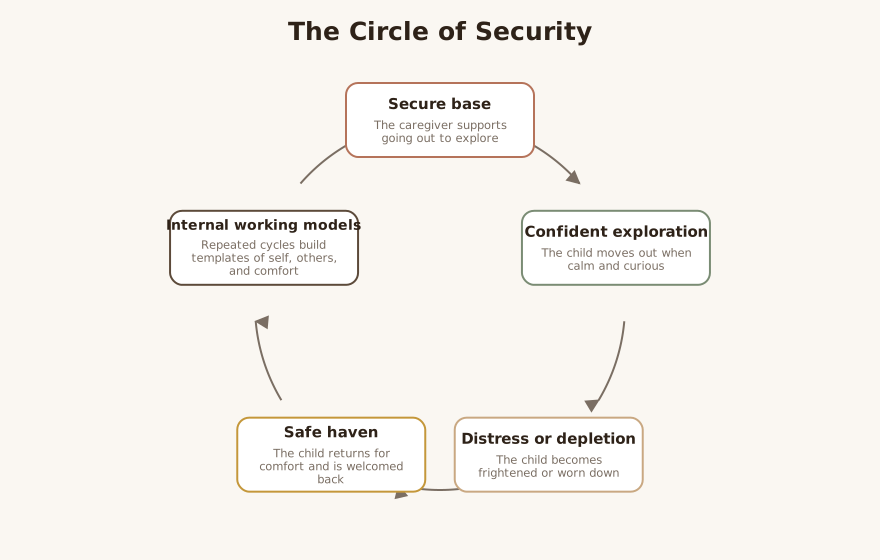
Secure base and safe haven are the two complementary functions an attachment figure performs in a child’s life, and together they form the operational heart of attachment theory 1. A safe haven is the figure the child retreats to for comfort, reassurance, and protection under distress, fear, or threat; a secure base is the same figure functioning as a launch point that allows the child to explore the world with confidence, knowing return and repair are available 1. The elegance of the construct is that both functions reside in the same relationship and alternate fluidly with the child’s internal state, and understanding that alternation is what makes the idea clinically useful rather than merely descriptive LLM.
Type & Discipline
Secure base and safe haven is a construct within developmental psychology, situated in the family of attachment theory 1. It is not itself a therapy or a technique; it is a description of a relational process that organizes how proximity-seeking and exploration trade off against one another across development 1. Because it describes the function of a caregiving relationship rather than a discrete behavior, it travels well across the lifespan and across modalities, surfacing in parent-child work, couples therapy, and individual adult treatment alike 4. Clinically, it is best held as a lens for reading relational behavior, not as a diagnosis or a fixed trait of any one person LLM.
Creators & Lineage
The construct originates with John Bowlby, who framed attachment as an evolved behavioral system and distinguished the caregiver’s dual role as both a base for exploration and a haven for retreat 1. Mary Ainsworth operationalized and extended Bowlby’s ideas, most influentially through the Strange Situation procedure, which exposed infants to brief separations and reunions and revealed organized patterns in how they used the caregiver under stress 6. Ainsworth’s work supplied the empirical evidence that sensitive, responsive caregiving tends to produce secure attachment while inconsistent care correlates with insecure patterns 1. The lineage of the construct runs from these origins into internal working models, object relations theory, and the relationship-focused therapies — most directly Emotionally Focused Therapy, which treats safe-haven and secure-base provision between partners as a core mechanism of change 4. Contemporary attachment scholarship, such as Thompson and colleagues’ review, situates secure base and safe haven as the central organizing idea of the whole tradition 7.
Core Principles
The first principle is that the two functions are reciprocal and state-dependent: a child moves out from the base to explore when calm and curious, and moves back to the haven for comfort when frightened or depleted 5. The second principle is that this cycle is continuous and circular rather than a one-time event — the Circle of Security model renders it literally as a circle the child travels, with the caregiver’s hands at the top supporting going out and at the bottom welcoming the return 5. The third principle is that what gets internalized is a representation: through repeated cycles, the child builds internal working models — cognitive-emotional templates of self, others, and the availability of comfort — that increasingly operate outside awareness and shape later relationships 1. Thompson and colleagues describe these as “secure base scripts,” mental templates of seeking and receiving comfort, while noting that direct evidence of how such models form in infancy remains limited 7. A fourth principle, easy to miss, is that security is not the absence of distress but the workability of distress: secure functioning means a person can both seek comfort and explore, flexibly, as conditions change LLM.
Interventions & Techniques
Because the construct is a process rather than a protocol, interventions tend to target the caregiver’s or partner’s capacity to provide the two functions reliably. The Circle of Security is the most direct example: it gives caregivers a visual map of attachment and builds “specific relationship capacities rather than… techniques to manage behavior,” helping them recognize when a child needs base support versus haven comfort 5. In adult and couples work, the therapeutic move is to help one person become a felt safe haven for the other — a reliable source of “support, comfort, reassurance, and relief” under threat — and then a secure base that encourages autonomy when stress is low 3. A related family of techniques uses attachment security priming, experimentally evoking a sense of a supportive relationship; in laboratory work this has produced measurable physiological effects, including reduced salivary cortisol when the prime followed a stressor 3.
LLM-generated illustrative example (not a guideline): A clinician helps a couple notice that when one partner withdraws after a hard day, what he is signaling is a haven bid, not rejection. They rehearse a small, concrete repair — turning toward, naming the need — so the bid is met rather than missed LLM.
The common thread across these methods is sequencing: meet the haven need first, and the base function (encouraging exploration, autonomy, risk) becomes accessible afterward LLM.
Evidence Base
The evidence base for secure base and safe haven is established and broad, though it is the evidence base of attachment theory generally rather than of a single branded protocol 7. Ainsworth’s Strange Situation provided validated assessment and revealed reliably organized attachment classifications with documented behavioral correlates and predictive validity 7. The dual-function distinction has experimental support: security priming produces context-dependent physiological outcomes — cortisol reduction after a stressor versus mobilization before one — consistent with the haven-versus-base split 3. Qualitative work across cultural settings, such as a study of Nairobi children, finds that secure attachment depends on parental responsiveness, sensitivity, and emotional availability, and that the same parent functions as both base and haven 2. Two honest caveats temper the picture. First, the “transmission gap” shows that maternal sensitivity alone does not fully explain how attachment representations pass from parent to infant — the mechanism is more complex than early models assumed 7. Second, early attachment “is not expected to be perfectly predictive of later outcomes”; insecurity is a risk factor, not deterministic pathology, and is moderated by cumulative risk, context, and individual susceptibility 7.
Populations & Indications
The construct applies most natively to infants and children and to the parents and caregivers who serve as their attachment figures 1. It extends readily to couples, where partners function as one another’s haven and base, and to adults with attachment difficulties whose internal working models shape current relationships 4. It is especially salient for foster and adoptive families, where the establishment of a new haven and base is the central developmental task, and for trauma survivors, for whom a reliable safe haven is often a precondition for any other therapeutic work LLM. Across these populations the indication is the same: relational distress in which the availability or reliability of comfort and the freedom to explore have become disrupted LLM.
Problems-for-Work
The construct maps onto a wide set of presenting problems. With attachment difficulties and insecure attachment patterns, the work is restoring a predictable cycle of going-out and coming-back so the internal working model can update toward “comfort is available” 1. With reactive attachment disorder and parent-child relational problems, intervention focuses on rebuilding the caregiver’s capacity to be both base and haven, as the Circle of Security explicitly aims to do 5. With separation anxiety disorder, the lens reframes clinginess as a haven bid under threat and graded autonomy as base-supported exploration LLM. With relationship conflict, partners are coached to read withdrawal or protest as bids for safe-haven contact rather than as attacks 4. With emotional dysregulation, the haven function is the external co-regulator the person has not yet internalized LLM. With posttraumatic stress disorder, establishing a felt sense of safety mirrors the haven function and supports the down-regulation seen in security-priming studies 3.
LLM-generated illustrative example (not a guideline): A foster parent learns to stay physically and emotionally available during a child’s tantrum rather than withdrawing, gradually becoming the haven the child returns to and, over months, the base from which the child ventures to make friends LLM.
Contraindications, Cautions & Cultural Humility
There are no contraindications to the construct itself, but there are cautions in how it is applied. Attachment classifications should not be wielded as fixed verdicts on a parent or child, because attachment shows only moderate stability and remains open to change through later experience and intervention 7. Clinicians should resist the temptation to read a single attachment pattern as a prediction of a person’s fate, given the explicit warning against treating early insecurity as deterministic 7. Cultural humility is essential: caregiving behaviors carry different meanings across contexts. In the Nairobi study, corporal punishment was often understood by children as parental concern rather than hostility, and securely attached children accepted discipline proportional to their actions — a reminder that the function of base and haven can be expressed through culturally specific forms that a clinician must not pathologize on sight 2. The construct should be used to understand a family’s own relational logic, not to impose a single normative template LLM.
Treatment-Plan Suggestions & SMART Objectives
| Goal | SMART objective (example) | Mechanism |
|---|---|---|
| Strengthen caregiver’s safe-haven response | Within 8 weeks, caregiver will respond to child’s distress bids with comfort in 4 of 5 observed instances | Reliable haven response updates the child’s internal working model toward “comfort is available” 1 |
| Support secure-base exploration | Within 6 weeks, caregiver will encourage and tolerate child’s independent exploration in 3 logged situations per week | Base support promotes autonomy and confident engagement under low stress 3 |
| Build partner’s haven availability in couples work | Within 10 sessions, partner will turn toward the other’s bid for reassurance in 3 of 4 rehearsed interactions | Felt safe-haven contact reduces threat-driven conflict cycles 4 |
| Reduce separation-related distress | Within 8 weeks, child will tolerate graded separations of increasing length without dysregulation in 4 of 5 trials | Base-supported exploration paired with predictable reunion lowers separation anxiety 5 |
| Establish felt safety in trauma work | Within 6 weeks, client will use one identified safe-haven relationship or image to down-regulate during 3 distress episodes | Security cues lower physiological arousal, paralleling cortisol reduction after a prime 3 |
| Map and recognize the cycle | Within 4 weeks, caregiver will accurately identify whether the child needs base support or haven comfort in 4 of 5 reviewed clips | Explicit relationship-capacity building, as in the Circle of Security map 5 |
| Improve emotion co-regulation | Within 8 weeks, dyad will complete a soothing-and-return sequence without escalation in 3 of 4 observed conflicts | External co-regulation by the haven figure scaffolds later self-regulation 2 |
Common Misconceptions
A frequent misconception is that secure base and safe haven are two different relationships or two different people; in fact they are two functions of the same attachment figure, alternating with the child’s state 1. Another is that a secure child does not get distressed — the construct is about the workability of distress and the reliable return to comfort, not its absence 5. A third is that attachment patterns are fixed for life; the evidence describes moderate stability with genuine openness to change through caregiving and intervention 7. A fourth is that maternal sensitivity straightforwardly “causes” secure attachment in the child — the transmission gap shows the pathway is more complex than sensitivity alone 7. Finally, clinicians sometimes treat an insecure classification as a diagnosis; it is more accurately a risk factor whose influence is moderated by many other variables 7.
Training & Certification
The construct itself requires no certification — it is foundational knowledge taught within any attachment-informed training LLM. Structured programs that operationalize it do offer training: the Circle of Security provides parent-education and intervention curricula designed to build caregivers’ relationship capacities around the going-out and coming-back cycle 5. Clinicians seeking to apply the construct in couples work typically pursue training in Emotionally Focused Therapy, where safe-haven and secure-base provision is an explicit target of intervention 4. Familiarity with Ainsworth’s Strange Situation paradigm is part of standard graduate coursework in developmental and clinical psychology and grounds clinical observation of attachment behavior 6.
Key Terms
Safe haven — the attachment figure as a source of comfort, reassurance, and protection when the person is distressed, afraid, or threatened 1. Secure base — the same figure functioning as a confident launch point for exploration of the world 1. Internal working model — the cognitive-emotional template of self, others, and the availability of comfort, built from repeated attachment experiences and operating largely unconsciously 1. Secure base script — a mental template of seeking and receiving comfort, described as a building block of internal working models 7. Strange Situation — Ainsworth’s procedure of structured separations and reunions used to classify infant attachment 6. Security priming — experimentally evoking a sense of a supportive attachment relationship, which can shift physiological stress responses 3. The Circle — the visual map depicting the child’s continuous movement out to explore and back for comfort, with the caregiver supporting both 5.
Resources & Further Reading
▶ Watch — a video introduction to this concept:
- John Bowlby’s Attachment Theory (Simply Psychology)
- ‘Haven of safety’ and ‘secure base’: a qualitative inquiry (PMC)
- The Dual Function Model of Attachment Security Priming (PMC)
- What Is the Safe Haven and Secure Base in Attachment Theory? (Empathi / Figs O’Sullivan)
- What is the Circle of Security (Circle of Security International)
- Attachment theory: Strange Situation - Mary Ainsworth (YouTube)
- Contributions of Attachment Theory and Research (PMC, Thompson et al.)
Reflective / Supervision Questions
- For a given client, can I clearly distinguish when they are making a safe-haven bid for comfort versus seeking secure-base support for exploration, and am I responding to the right one? LLM
- Where in my caseload have I been reading an attachment pattern as a fixed trait rather than a modifiable risk factor, and what would change if I held it more provisionally? 7
- How do the families I serve express base and haven functions in culturally specific ways that I might be at risk of pathologizing? 2
- In my own role with clients, when do I function as a secure base versus a safe haven, and do I sequence these well — meeting distress before encouraging exploration? LLM
- What evidence would actually tell me a client’s internal working model is updating, rather than assuming it from a single calmer session? 7