
Type & Discipline
Career adaptability is a construct — a psychological capacity, not a manualized therapy — drawn from vocational and developmental psychology 1. It is defined as a set of self-regulatory psychosocial resources that an individual draws on to manage current and anticipated career transitions, occupational developmental tasks, and work traumas 1. Crucially, these resources are framed as more changeable than personality traits: they develop through interactions between the inner and outer worlds of the person and are therefore conditioned by culture and context 1. For the practicing clinician, this matters because it positions career adaptability as a modifiable target — something a course of counseling can plausibly strengthen — rather than a fixed disposition LLM.
The construct sits within career construction theory, which views a career as a series of attempts to implement a self-concept in work roles, with adaptation indicated by success, satisfaction, and development 1. It is operationalized chiefly through self-report and is widely used in both research and applied vocational practice 3.
Creators & Lineage
Career adaptability is most closely associated with Mark Savickas, who developed career construction theory and, with Erik Porfeli, constructed the Career Adapt-Abilities Scale (CAAS) 1. The lineage runs back to Donald Super’s life-span, life-space developmental theory of vocational behavior; Savickas explicitly built on Super’s tradition, including borrowing the five-item subscale design from Super’s Adult Career Concerns Inventory when constructing the CAAS 1.
Conceptually, the construct overlaps with adjacent frameworks the clinician may already know. Savickas himself drew an explicit parallel to psychological capital (psycap) — confidence, optimism, hope, and resilience — as “even closer” to the view of adaptability as a developable resource 1. It is also routinely discussed alongside self-determination theory and social cognitive career theory in the broader vocational literature 3. In applied coaching and life-design settings, adaptability is paired with narrative methods such as the Career Construction Interview, which surfaces recurring life themes to give coherence across transitions 6.
Core Principles
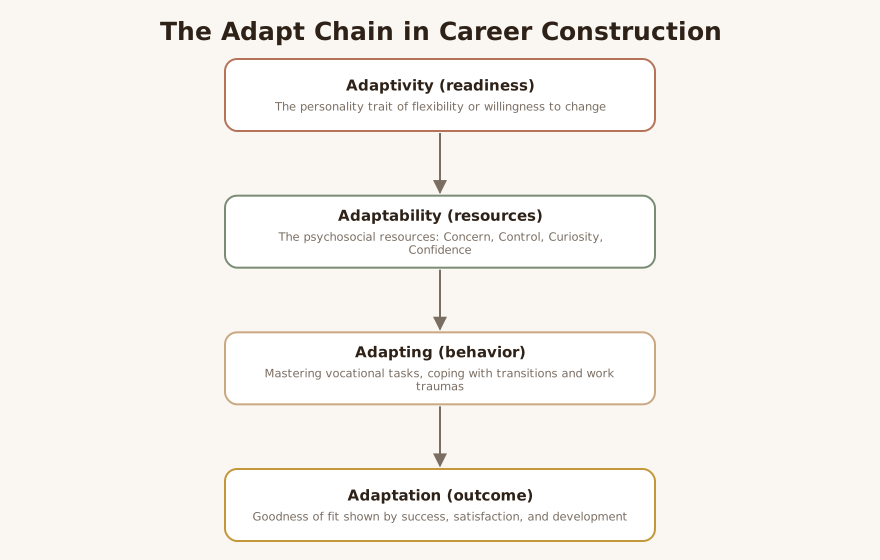
Career construction theory organizes the territory with four “adapt” terms that the clinician should keep distinct, because conflating them muddies case formulation LLM:
- Adaptivity is the personality trait of flexibility or willingness to change — the readiness to meet disequilibrium 1.
- Adaptability comprises the psychosocial resources a person can deploy — the four C’s described below 1.
- Adapting is the behavior — mastering vocational tasks, coping with transitions, and adjusting to work traumas through orientation, exploration, establishment, management, and disengagement 1.
- Adaptation is the outcome — goodness of fit or harmony, indicated by success, satisfaction, and development 1.
Savickas captures the readiness-versus-resources distinction with an analogy: flight attendants ask exit-row passengers whether they are “willing and able” to assist, because some people are willing yet unable and others able yet unwilling 1. Higher adaptation is expected when a person is both willing (adaptive) and able (adaptability) to perform the behaviors (adapting) that address changing conditions 1.
The four adaptability resources — the “four C’s” — are defined as follows in the original construction:
- Concern means the extent to which an individual is oriented to and involved in preparing for the future 1. The animating question is “do I have a future?” 3.
- Control means the extent of self-discipline shown by being conscientious and responsible in making decisions 1. Its question is “who owns my future?” 3.
- Curiosity means the extent to which an individual explores circumstances and seeks information about opportunities 1.
- Confidence means the extent of certitude that one has the ability to solve problems and do what needs to be done to overcome obstacles 1.
These are framed not as innate qualities but as capacities that can be developed over time 6.
Interventions & Techniques
Career adaptability is a target, not a protocol, so “interventions” means structured activities that strengthen one or more of the four C’s LLM. The dominant applied approach is narrative and constructionist. The Career Construction Interview helps clients uncover recurring life themes that lend coherence across roles and transitions, working from the premise that careers are authored rather than found 6.
Practitioners operationalize each C through targeted reflective questions — for example, asking what meaningful future appeals to the client (Concern), where they feel decision-making power (Control), which roles spark genuine interest (Curiosity), and how they have previously handled uncertainty successfully (Confidence) 6. The emphasis is on meaning-making and intentional identity construction rather than reactive pivoting, treating transitions as opportunities for narrative revision 6.
In the research literature, dedicated career adaptability training programs have been delivered and evaluated; participants receiving such training have shown enhanced Control and Curiosity and higher employment quality relative to controls 3. Life-design interventions are also used, though, as noted below, their effects on measured adaptability are inconsistent 3.
LLM-generated illustrative example (not a guideline): A 34-year-old laid off from a manufacturing role presents with rumination and avoidance of any job search. A clinician might begin with Concern — building a concrete near-future timeline — before moving to Curiosity (structured exploration of two adjacent occupations) only once future orientation is re-established, since exploration tends to stall when a client cannot picture a future at all. LLM
Evidence Base
The honest summary: the construct and its measurement are established, while much of the outcome and intervention evidence is weaker than the construct’s popularity suggests 3.
On the strong side, the CAAS is the field’s primary instrument — a 24-item self-report scale with four six-item subscales corresponding to the four C’s, validated across 13 countries (Belgium, Brazil, China, France, Iceland, Italy, Korea, the Netherlands, Portugal, South Africa, Switzerland, Taiwan, and the United States) 1. Reliabilities for the subscales and the combined adaptability score range from acceptable to excellent in the pooled data, and the scale demonstrated metric invariance across countries 1. The field has developed consistent theory and validated measurement since roughly 2010 3.
Career adaptability correlates positively with job and life satisfaction, subjective wellbeing, employability and employment quality, job performance, and both subjective and objective career success 3. Notably, it has been shown to predict subjective career success above and beyond personality and core self-evaluations — evidence of incremental validity beyond what stable traits already explain 5.
The cautions are real. Most outcome findings are correlational and cross-sectional, so causal claims must be hedged 3. Career adaptability training shows promise, but life-design interventions produce mixed results, with some studies reporting negligible change in measured adaptability after the intervention 3. Measurement is not uniform: in the original validation, the Control subscale was the most problematic, with alphas below 0.70 in the China and France samples, and the scale did not achieve scalar or strict invariance — meaning cross-cultural mean comparisons should be made with care 1. The literature also notes underrepresented qualitative work, inconsistently documented gender and age effects, and inadequately explored cultural differences 3.
Populations & Indications
Career adaptability has been studied across a broad range of groups: university students, adolescents, refugee and immigrant populations, corporate employees, and special-education populations, with geographic coverage spanning Europe, North America, Asia, and Australia 3. The original CAAS validation explicitly sampled both students and adult workers 1.
For the clinician, the construct is most indicated when the presenting concern centers on a vocational transition or developmental task LLM. Apt populations include adolescents and young adults negotiating school-to-work entry, college students facing major and career decisions, workers in voluntary or involuntary transition, the unemployed and job seekers, mid-career adults reconsidering direction, and workers facing displacement 3. The transition need not be voluntary — the framework explicitly covers disengagement that is forced by organizational change 1.
Problems-for-Work
Career adaptability is a useful organizing lens for several clinical problems-for-work, particularly where vocational disruption drives or maintains distress LLM.
- Career indecision maps most directly onto deficits in Curiosity and Confidence; structured exploration plus mastery experiences are the natural levers 3.
- Unemployment-related distress and demoralization often co-occur with collapsed Concern (no felt future) and eroded Control; rebuilding future orientation and decisional agency is the entry point 1.
- Low career self-efficacy is, almost by definition, low Confidence — certitude about solving problems and overcoming obstacles 1.
- Occupational stress and work-related anxiety can be reframed as an adapting demand the person feels unequal to; the four-C audit clarifies which resource is the bottleneck LLM.
- Identity confusion dovetails with the narrative work of career construction, where recurring life themes are surfaced to restore coherence across roles 6.
LLM-generated illustrative example (not a guideline): A college junior with diffuse anxiety and chronic major-switching scores high on Curiosity but low on Control on an informal four-C review. Rather than adding more exploration, the clinician focuses sessions on decisional structure — values clarification, a decision deadline, and tolerating the closure of foreclosed options — to convert open-ended searching into commitment. LLM
Contraindications, Cautions & Cultural Humility
Career adaptability is a framework, not a treatment, so there are no formal contraindications; the cautions concern misuse LLM. The chief caution is scope: adaptability work is not a substitute for treating a primary mood, anxiety, trauma, or substance disorder, and a vocational lens should not be used to bypass acute clinical risk LLM. Where unemployment-related distress shades into a major depressive episode or active suicidality, the disorder is treated first LLM.
Cultural humility is built into the theory itself. Savickas is explicit that adaptability develops through person-environment interaction and that culture and context place boundary conditions around it — countries differ in the opportunities and imperatives they provide for developing these resources 1. The CAAS construction surfaced concrete cross-cultural pitfalls: “keeping upbeat” had no meaning in Portugal, and in Iceland “concerned about my career” carried a negative, worry-laden connotation, requiring careful re-translation 1. Because the scale did not achieve scalar invariance, comparing raw adaptability scores across cultural groups can mislead 1. The broader literature flags cultural differences in adaptability as inadequately explored, which is a reason for the clinician to treat the four C’s as a conversation structure rather than a normed verdict 3.
A further caution: framing adaptability as a personal resource risks individualizing what may be structural LLM. A displaced worker in a collapsing local labor market is not short on Confidence; the clinician should hold the resource frame lightly enough not to pathologize realistic appraisals of a constrained environment LLM.
Treatment-Plan Suggestions & SMART Objectives
| Goal | SMART objective (example) | Mechanism |
|---|---|---|
| Rebuild future orientation | Within 4 weeks, client will articulate a written 12-month vocational direction and review it weekly | Strengthens Concern — orientation to and involvement in preparing for the future 1 |
| Restore decisional agency | Within 6 weeks, client will make and commit to one bounded career decision by a set deadline | Strengthens Control — self-discipline and responsible decision-making 1 |
| Expand structured exploration | Over 3 weeks, client will conduct two informational interviews and log opportunities identified | Strengthens Curiosity — exploring circumstances and seeking information 1 |
| Build problem-solving certitude | Within 8 weeks, client will complete two graded job-search tasks and rate self-efficacy before and after | Strengthens Confidence — certitude in solving problems and overcoming obstacles 1 |
| Reduce avoidance of the transition | Within 4 weeks, client will reduce days of search avoidance from 5 to 2 per week, self-monitored | Activates adapting behaviors that move toward adaptation 1 |
| Restore narrative coherence | Over 5 sessions, client will identify two recurring life themes linking past and intended roles | Uses career-construction narrative method to integrate identity across transitions 6 |
| Improve subjective wellbeing tied to work | Within 8 weeks, client will report a measurable rise on a brief wellbeing check-in | Adaptability is associated with higher satisfaction and wellbeing 3 |
| Sustain gains beyond traits | Across treatment, client will maintain adaptability practices independent of baseline disposition | Adaptability predicts career success above and beyond personality and core self-evaluations 5 |
Common Misconceptions
“Adaptability is just flexibility or personality.” No — career construction theory distinguishes adaptivity (the trait of willingness to change) from adaptability (the psychosocial resources), and the resources are framed as more changeable than traits 1. The construct’s incremental validity over personality and core self-evaluations underscores that it is not a relabeling of disposition 5.
“The four C’s are independent skills you can train in any order.” They are an aggregate, hierarchical construct, and clinically they interact — exploration (Curiosity) tends to be unproductive when future orientation (Concern) has collapsed 1.
“High adaptability scores are always good across groups.” Because the CAAS lacks scalar invariance and is culturally bounded, raw cross-cultural comparisons can mislead, and high scores in an objectively constrained environment should be interpreted with humility 1.
“Building adaptability reliably fixes outcomes.” The outcome links are largely correlational, and intervention effects are mixed, with some life-design studies showing negligible change in measured adaptability 3.
Training & Certification
There is no licensure or certification in career adaptability per se; it is a construct embedded within career construction theory and vocational counseling practice LLM. Clinicians typically encounter it through career counseling and career construction training, where the applied skill is the narrative method — most prominently the Career Construction Interview and life-design counseling that surface life themes and author coherence across transitions 6. Familiarity with the CAAS as a self-report measure is the practical entry point for assessment 1. Practitioners seeking depth generally pursue continuing education in career development within their existing professional scope rather than a standalone credential LLM.
Key Terms
- Career adaptability — psychosocial resources for managing transitions, tasks, and work traumas 1.
- The four C’s — Concern, Control, Curiosity, Confidence; the four adaptability resources 1.
- Adaptivity — the trait-level readiness or willingness to change 1.
- Adapting — the behaviors (orientation, exploration, establishment, management, disengagement) that address changing conditions 1.
- Adaptation — the outcome of goodness of fit, indicated by success, satisfaction, and development 1.
- CAAS — the Career Adapt-Abilities Scale; 24 items, four six-item subscales, validated in 13 countries 1.
- Career construction theory — the parent theory framing careers as the implementation of a self-concept in work roles 1.
- Career Construction Interview — a narrative method surfacing recurring life themes to build coherence 6.
Resources & Further Reading
▶ Watch — a video introduction to this concept:
- Savickas & Porfeli (2012), Career Adapt-Abilities Scale: Construction, reliability, and measurement equivalence across 13 countries
- Career Adaptability Research: A Literature Review with Scientific Knowledge Mapping (PMC)
- Career adaptability predicts subjective career success above and beyond personality and core self-evaluations (Journal of Vocational Behavior)
- Career Adaptability: Thriving Through Change with Mark Savickas’ Insights
Reflective / Supervision Questions
- For this client, which of the four C’s is the actual bottleneck, and what evidence — not assumption — points there? LLM
- Am I treating low adaptability as a personal deficit when the labor-market environment is objectively constrained? LLM
- Have I confused the client’s trait-level willingness to change (adaptivity) with their available resources (adaptability), and does my plan target the right one? LLM
- Where a vocational concern coexists with a mood, anxiety, or trauma disorder, have I sequenced clinical risk and primary-disorder treatment before adaptability work? LLM
- If I am using the four C’s cross-culturally, am I treating them as a conversation structure rather than a normed verdict, given the construct’s cultural boundary conditions? 1
- What would tell me, in this case, that strengthened adaptability has actually translated into adapting behavior and adaptation, rather than just better self-report? 3