
Type & Discipline
Subjective wellbeing (SWB) is a psychological construct rather than a therapy or a discrete technique 2. It belongs to positive psychology and, more specifically, to the hedonic tradition of wellbeing, which defines a good life in terms of pleasant experience and personal satisfaction 5. The American Psychological Association frames it as the way a person experiences and evaluates the quality of their own life, weighting that person’s first-hand appraisal above any external or expert standard 2. Because it is subjective, the unit of measurement is the individual’s report, not an observer’s rating or a checklist of objective circumstances 3.
The construct is typically decomposed into three dimensions: an evaluative component (overall life satisfaction), an experienced affective component (the frequency and intensity of pleasant and unpleasant feelings), and—in some frameworks—a eudaimonic component concerning sense of purpose and worthwhileness 4. Clinically, SWB is useful precisely because it sits orthogonal to symptom counts: a client can be free of diagnosable pathology yet report low satisfaction, or carry a chronic condition yet report high wellbeing 3. This decoupling is what makes it a distinct treatment target rather than a synonym for “absence of disorder” LLM.
Creators & Lineage
The modern construct is most associated with Ed Diener, whose 1984 Psychological Bulletin review consolidated scattered “happiness” research into a coherent, measurable framework 1. Diener’s contribution was to insist that wellbeing be defined from the inside—by the person living the life—and to specify that this judgment has both an emotional and a cognitive face 3. His later writing popularized the working definition of SWB as people’s cognitive and affective evaluations of their lives, a phrasing still used across the literature 5.
SWB anchors the hedonic branch of positive psychology, in contrast with the eudaimonic tradition that emphasizes meaning, growth, and the realization of potential 5. In practice the two traditions are complementary rather than rival, and contemporary positive-psychology frameworks such as PERMA-style models fold both hedonic and eudaimonic elements together 4. The construct’s lineage also runs into population science: bodies such as the OECD and national statistics offices adopted SWB as a societal indicator, treating it as a complement to economic measures like GDP 4. That migration from clinic to policy is a useful reminder that SWB scales were built to be brief, comparable, and repeatable LLM.
Core Principles
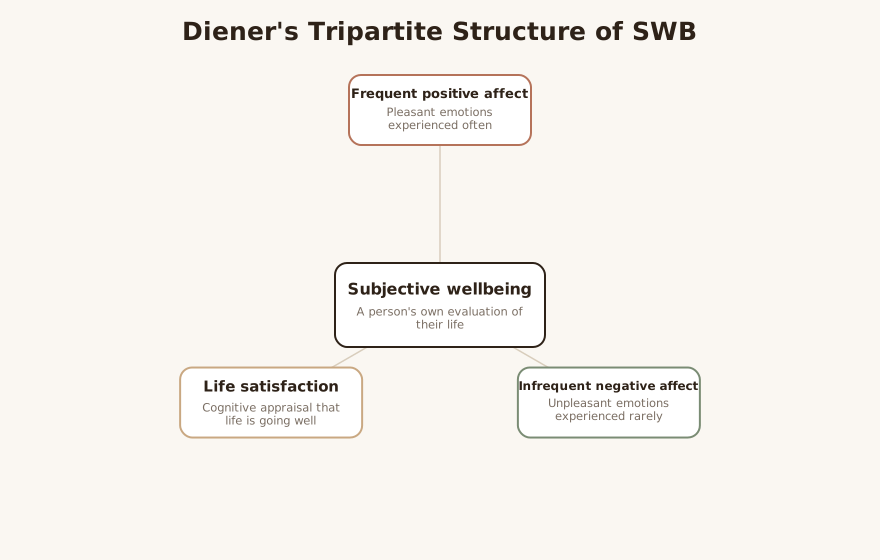
The first principle is the tripartite structure: SWB is high when positive affect is frequent, negative affect is infrequent, and the cognitive appraisal of life is satisfied 5. Diener stressed that these components have somewhat different causes, so “there is no magic single cure-all that creates all forms of SWB” 3. A clinician should therefore expect a client to be uneven across the three—high satisfaction with frequent worry, or pleasant daily mood paired with a sense that life is not going well overall 3.
A second principle is adaptation, sometimes called the hedonic treadmill or set-point 3. Diener’s data show strong adaptation to both good and bad events: even dramatic positive news produces only a temporary mood spike before the person drifts back toward their baseline 3. Importantly, adaptation is not total—some circumstances, such as sustained unemployment, show incomplete recovery, which means baselines can in fact shift 3. For therapy this cuts two ways: it tempers expectations that any single life change will permanently lift wellbeing, while also justifying durable, repeated practices over one-off fixes LLM.
A third principle is separation of affect from satisfaction. The evaluative judgment (“how satisfied am I with life as a whole?”) is partly independent of moment-to-moment feeling, and the two can move in opposite directions 4. A fourth principle is the primacy of self-report: because the construct is defined as the person’s own appraisal, the measurement strategy is to ask, using validated scales, rather than to infer wellbeing from external facts 4.
Interventions & Techniques
SWB is a target, not a manualized treatment, so “interventions” here means evidence-informed practices that raise its components rather than a proprietary protocol LLM. Commonly cited practices include cultivating gratitude, strengthening positive relationships, and setting and pursuing meaningful goals 5. A representative structured exercise is the “Have a Good Day” task, in which a client identifies which daily activities reliably lift mood and then deliberately increases them 5. These are typically delivered as between-session behavioral assignments and reviewed for what actually moved the needle LLM.
Because adaptation pulls wellbeing back toward baseline, sustainable-happiness logic favors variety and intentional repetition over a single grand change 3. Diener’s framework implies that, since the three components have distinct causes, the practitioner should match the practice to the deficit: affect-building activities for flat or low positive affect, distress-reduction and emotion regulation for high negative affect, and values or life-review work for low life satisfaction 3.
LLM-generated illustrative example (not a guideline): A client reports near-normal daily mood but rates life satisfaction at 3/10, tracing it to a stalled career. Rather than adding more pleasant-activity scheduling (which the affect data don’t call for), the clinician shifts to a values-and-goals review aimed at the evaluative component. LLM
Measurement-as-intervention is itself a technique here: repeated brief assessment (for example, end-of-day affect ratings or weekly satisfaction checks) functions as both feedback to the client and progress data for the clinician 4.
Evidence Base
The maturity of SWB as a construct is established: it has a multi-decade measurement literature, validated scales, and consistent links to health and longevity 1. Diener’s 1984 review is the foundational synthesis, and the construct has since been operationalized in instruments with strong psychometric pedigree 1. Self-report scales have been validated against biological measures and informant reports, which addresses the obvious worry that “just asking people” is unreliable 3.
The health evidence is substantial. The 2015 Lancet review by Steptoe and colleagues describes a bidirectional relationship between physical health and subjective wellbeing, and reports striking longitudinal data: in the English Longitudinal Study of Ageing, adults in the lowest quartile of eudaimonic wellbeing had a mortality rate of 29.3% over an average 8.5-year follow-up, versus 9.3% in the highest quartile 7. Population-level work similarly indicates that positive affect predicts response to illness and survival in older adults 4.
Honesty about limits matters. The same Lancet authors caution that, although the association between wellbeing and survival looks protective, “alternative explanations cannot be ruled out at this stage”—causality is not settled 7. So while SWB is a mature and well-measured construct, the claim that raising it causes better health outcomes should be made cautiously rather than asserted as fact LLM.
Populations & Indications
SWB applies broadly across the general adult population, where it serves as a baseline outcome and a target for growth-oriented work 3. It is especially well-studied in older adults, in whom it relates to health, illness response, and survival, making it a meaningful focus in later-life and geriatric care 7. It is relevant to people with chronic illness, given that conditions such as coronary heart disease, arthritis, and chronic lung disease are associated with depressed mood and diminished emotional and purposeful wellbeing 7.
The construct extends to adolescents, for whom life-satisfaction and affect-balance measures track adjustment and risk LLM. It also operates at the level of couples and communities: relationship quality is among the most-cited correlates of wellbeing, and SWB is collected as a community- and nation-level indicator alongside economic data 4. Across these populations the indication is similar—use SWB when the goal includes not just symptom reduction but the client’s own sense that life is going well LLM.
Problems-for-Work
SWB is a natural framing for problems where the felt quality of life, not a discrete symptom, is the presenting concern LLM. With low life satisfaction, the evaluative component is the direct target, and values-based goal work addresses the cognitive appraisal head-on 5. With negative affect and stress, the work centers on reducing the frequency and intensity of unpleasant emotion, one of the three SWB dimensions 4.
With anhedonia and the flat positive affect seen in major depressive disorder and dysthymia, behavioral practices that reliably generate pleasant experience target the positive-affect component, while the clinician stays alert to adaptation pulling gains back toward baseline 3. With adjustment disorder and grief, the framework helps distinguish a temporary, expected dip from a durable shift in set-point, since adaptation is real but sometimes incomplete 3. With low self-esteem, life-satisfaction and relationship-strengthening practices supply a constructive, non-pathologizing target 5.
LLM-generated illustrative example (not a guideline): A client with adjustment disorder after a relocation rates both mood and satisfaction as low. The clinician normalizes this as expected adaptation, tracks weekly satisfaction ratings, and uses relationship-building tasks to rebuild positive affect while watching whether the baseline recovers. LLM
Contraindications, Cautions & Cultural Humility
SWB is a construct, so it has no formal contraindications, but several cautions apply LLM. The first is toxic positivity: framing therapy around “more positive affect” can invalidate a client whose distress is appropriate to their circumstances, and the adaptation literature warns that some hardships do not simply wash out 3. Pursuing happiness as a goal in the wake of trauma, abuse, or acute loss can feel dismissive, and affect-building should not crowd out grief or safety work LLM.
A second caution concerns measurement. Self-report is the defining method, but it is sensitive to current mood, response style, and the framing of the question, so a single low score should be interpreted in context rather than reified 4. Cultural humility is essential here: what counts as a satisfying life, and how openly positive or negative affect is expressed, varies across cultures, and SWB norms developed in one population do not transfer uncritically LLM. Population-level scales were standardized for comparability, which is a strength for surveys but a reason for caution when applying group norms to an individual 4. Finally, because the wellbeing–health link is correlational and possibly confounded, clinicians should not imply that “thinking positively” will cure or prevent medical illness 7.
Treatment-Plan Suggestions & SMART Objectives
| Goal | SMART objective (example) | Mechanism |
|---|---|---|
| Raise overall life satisfaction | Client will increase Satisfaction With Life Scale score by 4 points within 12 weeks, reviewed every 4 weeks | Targets the evaluative/cognitive component of SWB 5 |
| Reduce negative affect | Client will lower weekly self-rated stress from 8/10 to 4/10 over 8 weeks | Reduces frequency/intensity of unpleasant emotion, one SWB dimension 4 |
| Increase positive affect | Client will complete the “Have a Good Day” exercise daily and report 3 mood-lifting activities each week for 6 weeks | Builds frequent positive affect via identified activities 5 |
| Strengthen relationships | Client will initiate two meaningful social contacts per week for 8 weeks | Leverages relationships as a robust wellbeing correlate 4 |
| Cultivate gratitude | Client will record three specific gratitudes 5 nights per week for 6 weeks | Evidence-informed practice linked to higher SWB 5 |
| Restore sense of purpose | Client will define one valued goal and complete one weekly step toward it for 10 weeks | Targets the eudaimonic/purpose component associated with health 7 |
| Sustain gains against adaptation | Client will rotate among three wellbeing practices weekly to counter habituation for 12 weeks | Addresses hedonic adaptation toward baseline 3 |
| Track wellbeing as feedback | Client will complete an end-of-day affect rating ≥5 days/week for 4 weeks | Repeated self-report provides feedback and progress data 4 |
Common Misconceptions
A first misconception is that SWB just means “feeling happy all the time”; in fact it is a structured construct combining cognitive satisfaction with a balance of positive over negative affect, and the components can diverge 5. A second is that self-report makes it scientifically worthless—yet SWB scales have been validated against biological measures and informant reports and predict meaningful outcomes 3.
A third misconception is that wellbeing is fixed by a genetic set-point and therefore unchangeable; the adaptation literature shows powerful pull toward baseline, but also documents incomplete adaptation, meaning durable change is possible 3. A fourth is that high wellbeing simply reflects good objective circumstances; the construct is defined as the person’s own appraisal, which is only partly tied to external conditions 2. A fifth, important for clinicians, is that raising wellbeing has been proven to improve physical health—the strongest data are correlational, with causality still unresolved 7.
Training & Certification
There is no certification in “subjective wellbeing,” because it is a measurement construct rather than a licensed modality LLM. Competence comes instead from familiarity with the foundational literature—Diener’s review and accessible summaries such as the Noba module—and from learning the standard instruments and their proper administration 3. Practitioners should know the major scales (for example, the Satisfaction With Life Scale for the evaluative component and the PANAS or SPANE for affect) well enough to choose, administer, and interpret them appropriately 5.
Broader training in positive-psychology interventions, available through graduate coursework and continuing-education programs, provides the practice repertoire (gratitude, relationship, and goal-based exercises) that operationalizes the construct in session 5. Familiarity with population-level frameworks, such as the OECD measurement guidelines, is useful for clinicians who work with outcome data or organizational and community settings 4.
Key Terms
Subjective wellbeing (SWB): a person’s own cognitive and affective evaluation of the quality of their life 2. Tripartite structure: the decomposition of SWB into frequent positive affect, infrequent negative affect, and life satisfaction 5. Life satisfaction (evaluative wellbeing): the cognitive judgment of how satisfied one is with life as a whole, often measured by the Satisfaction With Life Scale 4. Experienced wellbeing: the frequency and intensity of emotional states such as joy, stress, and worry 4. Eudaimonic wellbeing: the sense that life is purposeful and worthwhile, distinguished from the hedonic focus on pleasant feeling 4. Hedonic adaptation (set-point / hedonic treadmill): the tendency to return toward a baseline level of wellbeing after positive or negative events 3. Positive and negative affect: the two affective channels of SWB, often assessed with the PANAS or SPANE 5.
Resources & Further Reading
▶ Watch — a video introduction to this concept:
- Diener, E. (1984). Subjective well-being. Psychological Bulletin, 95, 542-575
- Subjective well-being (APA Dictionary of Psychology)
- Diener, E. — Happiness: The Science of Subjective Well-Being (Noba Project)
- Subjective Well-Being: Introduction (NCBI Bookshelf / NIH)
- Subjective Wellbeing in Positive Psychology (PositivePsychology.com)
- Subjective well-being (Wikipedia)
- Steptoe, A., Deaton, A., & Stone, A. (2015). Subjective wellbeing, health, and ageing
Reflective / Supervision Questions
- When a client presents with “I’m just not happy,” which of the three SWB components are they actually describing, and how would you confirm it? LLM
- How do you hold space for appropriate distress and grief without sliding into toxic positivity when wellbeing is the stated goal? 3
- Given hedonic adaptation, how will you design practices that produce durable rather than transient gains for this particular client? 3
- How might your own cultural assumptions about “a satisfying life” shape the goals you co-construct, and how would you check that with the client? LLM
- When you discuss the wellbeing–health link with clients, how do you convey the evidence honestly without overstating causation? 7
- What role should repeated brief self-report measurement play in this client’s plan, and how will you guard against over-interpreting a single low score? 4