
Type & Discipline
Career decision-making self-efficacy (CDMSE) is a psychological construct — a measurable belief, not a therapy or a diagnosis — that sits within counseling psychology and the broader field of career and vocational psychology 5. It belongs to a family of related constructs and instruments that together let clinicians distinguish several different reasons a person can be “stuck” about career: normal developmental indecision, chronic indecisiveness as a trait, and low confidence in one’s ability to carry out the tasks of choosing 5LLM. The flagship operationalization is the Career Decision Self-Efficacy Scale (CDSE), which measures the degree to which a person believes they can successfully complete the tasks necessary to make significant career decisions 4.
For a practicing therapist, the practical value is precision: rather than treating “I don’t know what to do with my life” as a single undifferentiated complaint, this construct family points to where the confidence deficit lives — in self-knowledge, in gathering information, in choosing, in planning, or in problem-solving 4LLM. That mapping is what makes the construct clinically actionable rather than merely descriptive LLM.
Creators & Lineage
The Career Decision Self-Efficacy Scale was developed by Karen M. Taylor and Nancy E. Betz, who applied Albert Bandura’s self-efficacy theory to the domain of career decision-making 5. The instrument is published with copyright dates of 1993 and 2012 and is authored by Betz and Taylor 4. Its content was built on John O. Crites’ model of career maturity, which defines career maturity through a set of competencies and attitudes 5.
Two theoretical lineages converge here. The first is Bandura’s self-efficacy theory, which holds that confidence in one’s ability to execute a specific class of tasks predicts whether a person will approach or avoid those tasks and how they persist 5LLM. The second is the counseling-psychology career-maturity tradition exemplified by Crites, from which Taylor and Betz drew the five competence domains that became the scale’s subscales 5. The construct is also a recognizable ancestor and companion of Social Cognitive Career Theory, which extends Bandura’s framework across interest development, choice, and performance, and it is frequently read alongside Career Construction Theory, though those are theoretical frameworks rather than the construct itself LLM. Darrell Anthony Luzzo contributed influential early psychometric and criterion-related validity work on the scale 3.
Core Principles
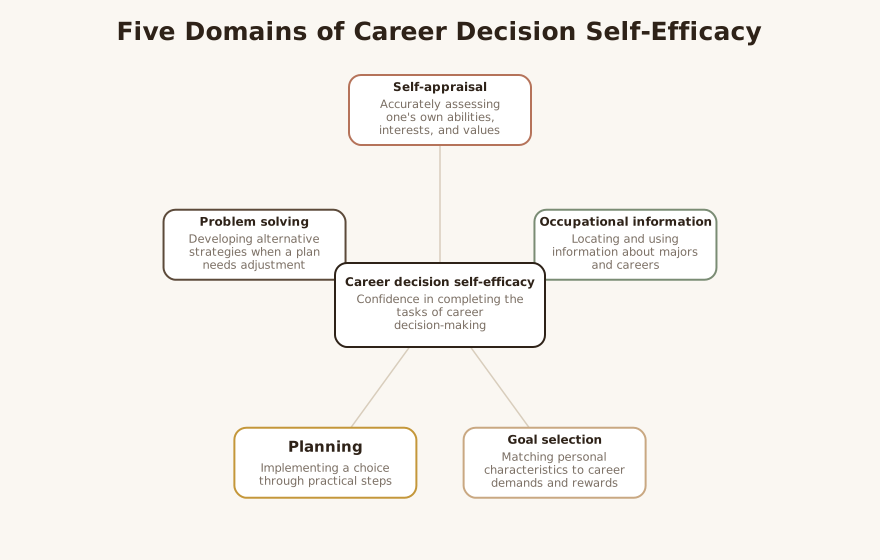
The organizing idea is task-specific confidence. CDMSE is not global self-esteem and not general optimism; it is a person’s confidence that they can perform the concrete behaviors that making a career decision requires 4LLM. The scale operationalizes this across five competence domains drawn from Crites’ career-maturity model 5:
- Self-Appraisal — accurately assessing one’s own abilities, interests, and values for career decisions 4.
- Occupational Information — locating and using information about majors and careers, including researching employment trends 45.
- Goal Selection — matching personal characteristics to career demands and rewards, i.e., choosing among options 45.
- Planning — implementing an educational or career choice through practical steps, such as establishing multi-year objectives 45.
- Problem Solving — developing alternative strategies when a plan needs adjustment 45.
A second core principle is the inverse relationship between confidence and indecision. Career decision self-efficacy shows consistent, theory-consistent relationships with adaptive outcomes: it is inversely related to career indecision and to fear of career commitment, and positively related to vocational identity, constructive career beliefs, and exploratory behavior 5. This is the empirical hinge that makes the construct clinically useful — low confidence and high indecision travel together, so raising the former is a plausible lever on the latter 5LLM.
A third principle, central to differential clinical assessment, is the separation of indecision from indecisiveness. Career indecision is often a normal, transient developmental state — the expected uncertainty of someone who has not yet explored — whereas chronic indecisiveness is a more pervasive, trait-like difficulty making decisions across domains, frequently entangled with anxiety and perfectionism 5LLM. The CDMSE construct family helps separate the two because a young person with low confidence but intact decision-making capacity looks different on the subscales and in interview than someone whose indecisiveness generalizes well beyond career LLM.
Interventions & Techniques
This is a construct and a measurement family, not a stand-alone treatment, so “intervention” here means how the construct informs and is embedded within career counseling and self-efficacy-based work LLM. Three uses dominate practice.
First, measurement-as-intervention-guidance. The CDSE and its short form can be administered to identify confidence patterns across the five competencies, to screen for at-risk students, to determine intervention needs, and to evaluate program effectiveness as a pre/post outcome measure 4. Scores have been shown to increase for students receiving career counseling or computer-assisted guidance programs, which makes the scale a natural index of whether an intervention is working 5.
Second, targeting the four sources of efficacy. Because the construct derives from Bandura, the practical levers are Bandura’s four sources of efficacy information, applied to the career domain: structured mastery experiences (small, completable decision-tasks such as one informational interview or one drafted plan), vicarious learning (peer and near-peer models who have navigated similar choices), verbal persuasion (specific, credible encouragement tied to demonstrated competence), and management of physiological and affective arousal (reducing the anxiety that masquerades as “not knowing”) 5LLM.
LLM-generated illustrative example (not a guideline): A first-generation college sophomore scores low on Occupational Information and Self-Appraisal but mid-range elsewhere. Rather than “explore careers” broadly, the clinician assigns one bounded mastery task — interview one professional and write three things learned — and processes the anxiety that arises. The narrow, completable success raises domain-specific confidence more reliably than a generic pep talk. LLM
Third, subscale-guided focus. Because the instrument yields a profile rather than a single number, clinicians can direct sessions toward the specific weak domain — information-gathering skills for a low Occupational Information score, values-clarification for low Self-Appraisal — instead of treating all indecision identically 4LLM.
Evidence Base
The honest summary is that the measures are established and well-validated, and that the construct’s correlates are robust; this is distinct from claiming that raising CDMSE causally produces downstream career success 5LLM. The original CDSE comprised 50 items, 10 per subscale, rated on a 0–9 confidence continuum 5. A 25-item short form (CDSE-SF) was developed in 1996 from the strongest items and demonstrated comparable reliability and validity, and a five-level response format was later shown to perform as well as the ten-level version, making the short form with the simplified response scale the recommended configuration 5. The development and evaluation of that short form is documented by Betz, Klein, and Taylor 2.
Criterion and construct validity have been examined in independent psychometric work, including Luzzo’s evaluation, which supports the scale’s relationships with theoretically relevant variables 3. Betz and Luzzo’s treatment situates the scale within career assessment practice and its evidence base 1. Across this literature, career decision self-efficacy is consistently inversely related to career indecision and fear of commitment and positively related to vocational identity and exploratory behavior — a stable nomological pattern rather than an isolated finding 5. The scale is also responsive to intervention, with scores rising after counseling or computer-assisted programs 5.
Where the evidence is thinner and clinicians should stay cautious: the construct is correlational in much of its base, and the leap from “higher confidence” to “better real-world career outcomes” is not as firmly established as the measurement properties themselves 5LLM. Group differences across gender and ethnicity have been specifically studied in relation to career commitment, underscoring that scores must be interpreted in cultural context rather than against a single normative ideal 6.
Populations & Indications
The instrument is intended for individuals aged 16 and older 4. Clinically, the construct is most useful with adolescents and young adults and with college students, where developmental career indecision is normative and confidence is still consolidating 4LLM. It is equally apt for adults in career transition and for unemployed individuals and job seekers, for whom a confidence collapse — not a knowledge gap — is often the real barrier 5LLM.
Two populations deserve special attention. People with anxiety frequently present with career indecision that is downstream of avoidance and intolerance of uncertainty, and the subscale profile helps separate skill deficits from anxiety-driven paralysis 5LLM. First-generation and underserved students are a high-yield group because they may have intact ability but low confidence in domains like Occupational Information, where access — not aptitude — has been the limiting factor; here the construct can prevent a clinician from misreading an opportunity gap as a personal deficit 4LLM.
Problems-for-Work
- Career indecision and decision-making difficulties: the core indication; low total CDMSE with a normal interview suggests confidence-building rather than psychopathology 5LLM.
- Chronic indecisiveness: when indecision generalizes beyond career and is trait-like, the construct helps flag that broader decisional anxiety may need its own focus 5LLM.
- Low self-efficacy: the subscale profile localizes the deficit so intervention is specific rather than diffuse 4LLM.
- Generalized anxiety and perfectionism: career “stuckness” is often the visible edge of intolerance of uncertainty and fear of making the wrong choice; the confidence frame reframes the task as approachable 5LLM.
- Procrastination and avoidance: low confidence predicts avoidance of career tasks, so mastery-experience assignments directly address the behavior 5LLM.
- Identity confusion and vocational impairment: low Self-Appraisal confidence often co-occurs with unclear vocational identity, linking this construct to identity-focused work 5LLM.
LLM-generated illustrative example (not a guideline): An unemployed adult in their forties scores low across all five subscales after a layoff. The clinician frames the goal not as “find a job” but as rebuilding decision confidence in stages — one self-appraisal exercise, one information task, one small plan — to interrupt the avoidance-and-procrastination cycle that the low scores predict. LLM
Contraindications, Cautions & Cultural Humility
There are no medical contraindications to a self-report confidence measure, but there are real interpretive cautions LLM. First, do not read low CDMSE as a stand-alone diagnosis; a low score is a starting hypothesis, not a verdict, and must be integrated with interview, history, and the indecision-versus-indecisiveness distinction 5LLM. Second, the construct can be confounded by anxiety and depression, which lower self-reported confidence globally; treating those may raise scores without any career-specific work LLM.
Cultural humility is essential. Gender and ethnic differences in career decision-making self-efficacy and career commitment have been specifically examined, which means scores cannot be interpreted against a single universal norm 6. For first-generation and underserved clients, a low Occupational Information score may reflect structural lack of access rather than a personal confidence trait, and pathologizing that gap would be a clinical error 4LLM. The construct’s implicit value — confident, autonomous, individual choice — also carries Western assumptions; in collectivist or family-centered contexts, “indecision” may reflect appropriate deference to family and community rather than a deficit to be fixed LLM. The clinician’s task is to hold the measure lightly and the person’s context closely LLM.
Treatment-Plan Suggestions & SMART Objectives
| Goal | SMART objective (example) | Mechanism |
|---|---|---|
| Increase overall career decision confidence | Client will raise CDSE short-form total score by a clinically meaningful margin over 8 sessions, re-measured at session 8 4LLM | Pre/post measurement guides and demonstrates change in task-specific self-efficacy 4 |
| Build Self-Appraisal confidence | Client will complete one structured values-and-interests exercise and articulate three career-relevant strengths within 2 weeks 5LLM | Mastery experience in self-knowledge, a Bandura efficacy source 5 |
| Build Occupational Information confidence | Client will conduct one informational interview and summarize findings before the next session 4LLM | Bounded mastery task converts an access gap into a completed success 4LLM |
| Reduce anxiety-driven avoidance of career tasks | Client will use a brief arousal-regulation skill before each career task and rate distress for 3 weeks 5LLM | Managing physiological arousal lowers the affective barrier to action 5LLM |
| Strengthen Goal Selection confidence | Client will narrow options to two viable choices and list trade-offs within 3 sessions 5LLM | Practiced decision behavior builds confidence in choosing 5LLM |
| Strengthen Planning confidence | Client will draft a concrete 6-month action plan with three milestones by session 6 4LLM | Implementation steps create mastery and reduce abstractness 4LLM |
| Distinguish indecision from indecisiveness | Clinician and client will review decisional patterns across non-career domains within 2 sessions 5LLM | Differential assessment routes care to the correct target 5LLM |
Common Misconceptions
A first misconception is that CDMSE is general self-confidence or self-esteem; it is specifically confidence in the tasks of career decision-making, and a person can be globally confident yet low on this construct 4LLM. A second is that all career indecision is pathological; much of it is normal developmental uncertainty, and the construct exists partly to separate that from genuine chronic indecisiveness 5LLM. A third is that a single total score tells the whole story; the instrument is most useful as a five-domain profile that localizes where confidence is lacking 4LLM. A fourth is that raising CDMSE guarantees better career outcomes; the measure’s validity and its inverse link to indecision are well-established, but the causal chain to long-term success is weaker and should not be oversold 5LLM.
Training & Certification
There is no clinical certification in “CDMSE.” The relevant competency is graduate-level training in counseling psychology, career assessment, and the responsible use of psychometric instruments 5LLM. The CDSE and CDSE-SF are published, copyrighted instruments distributed through a test publisher, so appropriate licensed access and adherence to the publisher’s qualification and use terms are required for formal administration 4. Familiarity with Bandura’s self-efficacy framework and Crites’ career-maturity model is the conceptual foundation that lets a clinician interpret the subscales meaningfully rather than mechanically 5LLM.
Key Terms
- Career decision-making self-efficacy (CDMSE): belief in one’s ability to complete the tasks needed to make career decisions 4.
- CDSE / CDSE-SF: the 50-item Career Decision Self-Efficacy Scale and its 25-item short form 5.
- The five competencies: Self-Appraisal, Occupational Information, Goal Selection, Planning, Problem Solving 4.
- Career indecision: typically transient, developmental uncertainty about career direction 5LLM.
- Chronic indecisiveness: trait-like, cross-domain difficulty making decisions 5LLM.
- Career maturity: Crites’ framework of competencies and attitudes underlying the subscales 5.
Resources & Further Reading
▶ Watch — a video introduction to this concept:
- Career assessment and the Career Decision-Making Self-Efficacy Scale (Betz & Luzzo, 1996)
- Evaluation of a Short Form of the Career Decision-Making Self-Efficacy Scale (Betz, Klein & Taylor, 1996)
- A Psychometric Evaluation of the Career Decision-Making Self-Efficacy Scale (Luzzo, 1996)
- Career Decision Self-Efficacy Scale (CDSE) — Mind Garden (test publisher)
- Career Decision Self-Efficacy Scale — iResearchNet encyclopedia entry
- Career Decision-Making Self-Efficacy and Career Commitment: Gender and Ethnic Differences (Journal of Career Development)
Reflective / Supervision Questions
- For this client, am I seeing normal developmental indecision, low task confidence, or trait indecisiveness — and what evidence distinguishes them? 5LLM
- Which of the five competence domains is actually weak, and am I targeting that domain or treating indecision generically? 4LLM
- Am I confounding low career confidence with underlying anxiety, depression, or perfectionism that needs its own focus? 5LLM
- For a first-generation or underserved client, am I reading a structural access gap as a personal confidence deficit? 4LLM
- Do my interventions deliberately use Bandura’s four efficacy sources, or am I relying on encouragement alone? 5LLM
- Whose definition of a “good decision” am I working from, and does it honor this client’s cultural and family context? 6LLM