
Type & Discipline
Life-Design Counseling is a framework within vocational and constructivist counseling, situated in the family of career construction and narrative career counseling LLM. It was articulated as a paradigm for career construction in the 21st century, intended to respond to the destabilization of work brought about by the global, digital economy 1. Rather than treating career as a single occupational choice fixed at one developmental moment, the paradigm treats career as a lifelong, co-constructed process of building a self and a working life through language and narrative 1. Its epistemology is social constructionist: it assumes that identities, meanings, and futures are constructed in social and dialogical context rather than discovered as pre-existing traits 2.
The approach is best understood as a meta-framework that integrates Savickas’s Career Construction Theory, Guichard’s self-construction work, and an international synthesis of constructivist career thought 1. It is therefore broader than a single set of techniques; it is a stance about how counselors and clients work together on the problem of designing a life in conditions of uncertainty 2.
Creators & Lineage
The life-design paradigm was formally introduced in a 2009 collaborative paper authored by an international group of vocational scholars, including Mark Savickas, Laura Nota, Jérôme Rossier, María Eduarda Duarte, Jean Guichard, and Annelies van Vianen, among others 1. The two most prominent theoretical anchors are Mark Savickas, who developed Career Construction Theory, and Jean Guichard, whose work on self-construction informs the model’s account of identity 1. Savickas’s Career Construction Theory provides the core machinery for understanding how individuals impose meaning on their vocational behavior and build careers through stories and adaptation 3.
The intellectual lineage runs through several streams: developmental and vocational psychology, social constructionism as an epistemology, and narrative therapy as a clinical sensibility 2. From narrative therapy the model inherits the practice of working with the client’s own story, externalizing problems, and authoring preferred identities LLM. From social constructionism it inherits the premise that the self is made, not found, and that meaning emerges in dialogue 2. The paradigm was offered explicitly as a successor to twentieth-century models built on assumptions of stable jobs, predictable trajectories, and trait-matching 4.
Core Principles
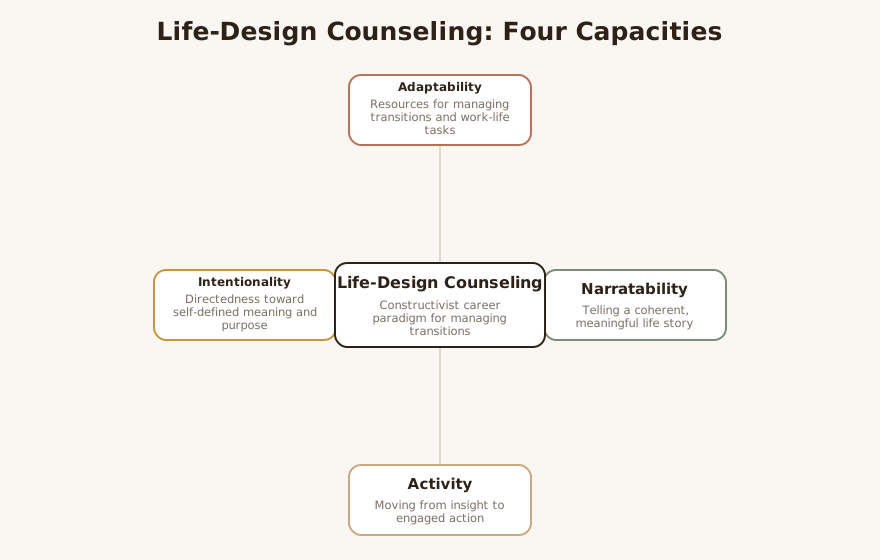
The paradigm rests on a small set of organizing ideas. First, careers are constructed rather than found: clients author working lives by interpreting experience and projecting future selves through narrative 1. Second, the aim of counseling is to cultivate a set of capacities for navigating change, often summarized as adaptability, narratability, activity, and intentionality LLM.
Adaptability refers to the resources a person brings to managing transitions, occupational traumas, and the developmental tasks of work life 1. Narratability is the capacity to tell a coherent, meaningful life story that integrates past, present, and imagined future into a usable identity narrative 2. Activity captures the move from insight to engaged action in the world, and intentionality describes the directedness that lets a person act in line with self-defined meaning and purpose LLM.
Third, the model is intentionally holistic. It addresses “life,” not merely “occupation,” recognizing that work problems are embedded in relationships, roles, and broader life themes 2. Fourth, the counseling relationship is dialogical and collaborative: meaning is co-constructed in conversation rather than delivered as expert advice 2. Fifth, the approach is contextual and reflexive, attending to the social, economic, and cultural conditions that shape what futures are even imaginable for a given client 5.
Interventions & Techniques
In practice, life-design work proceeds through a structured narrative interview in which the counselor elicits “micro-narratives,” helps the client reconstruct them into a “macro-narrative” or life portrait, and then supports a turn toward action 2. The signature instrument associated with the model is the Career Construction Interview (within Career Construction Theory), which gathers stories around a set of prompts and then mines them for a life theme 3.
Typical prompts in this tradition include questions about early role models, favored media and environments, favorite stories, mottos, and earliest recollections; the counselor listens for recurring themes of preoccupation that can be reframed as occupation 3. The work then moves from deconstruction of constraining stories, to reconstruction of an identity narrative, to co-construction of a forward-looking plan, and finally to action and reflection 2. Reflexivity, the client’s capacity to examine and revise their own story, is treated as both a method and an outcome 2.
LLM-generated illustrative example (not a guideline): A 38-year-old facing a layoff describes admiring a childhood teacher who “made hard things feel possible,” favoring documentaries about people rebuilding after disaster, and the motto “start where you are.” The clinician reflects these back as a recurring theme of guiding others through difficulty, which helps the client reframe an unwanted ending as material for a next chapter centered on coaching or training roles LLM.
Across techniques, the counselor’s role is less to assess and prescribe than to facilitate the client’s authorship of a coherent, agentic story 2. Tools from cognate constructivist methods, such as the use of narratives and self-construction tasks, are folded in to support identity work and the move toward intentional action 6.
Evidence Base
The maturity of life-design counseling is best characterized as established as a theory and a teaching paradigm, but still consolidating its controlled outcome evidence LLM. The 2009 paradigm paper is among the most cited contributions in modern vocational psychology and has organized a large international research program 1. A 2022 review surveys the model’s theory, methodology, challenges, and future trends, indicating an active and self-critical literature rather than a settled, closed one 2.
The strongest claims to date concern conceptual coherence, breadth of adoption, and the accumulation of qualitative and process research demonstrating that narrative interventions can shift identity narratives and adaptability 2. Work on innovating counseling for self- and career construction situates the approach within a network of theoretical premises and associations, reflecting ongoing efforts to specify mechanisms and link constructs to measurable antecedents and outcomes 6.
At the same time, the literature is openly critical of itself. Critical perspectives note tensions in the life-design paradigm, including questions about how well its individual-narrative emphasis accounts for structural and material constraints on clients’ options 5. Reviews flag methodological challenges and the need for more rigorous outcome studies as a future priority 2. Clinicians should therefore present life-design counseling as theoretically robust and clinically generative, while being candid that large randomized comparisons against other career interventions remain a developing area LLM.
Populations & Indications
The paradigm was designed for a labor market in which transitions are frequent and trajectories non-linear, so its natural indications cluster around change and identity 1. It is commonly applied with adults in career transitions and people in midlife transition who need to re-author a working identity after a disruption LLM. It fits young adults and emerging adults negotiating first vocational identities, and students approaching education-to-work passages LLM.
It is also indicated for people facing job loss, where the task is not only re-employment but restoring a coherent and agentic self-narrative after an “occupational trauma” 1. The holistic, contextual stance makes it relevant for people with disabilities navigating work, where the design of a life must integrate accommodation, identity, and meaning rather than slot a person into a fixed role LLM. Across these groups, the common indication is a client for whom the central difficulty is constructing meaning and direction, not merely selecting among known options 2.
Problems-for-Work
The model maps onto a recognizable set of presenting problems. Career indecision and occupational identity confusion are core targets: the narrative interview is used to surface a life theme that can convert diffuse uncertainty into a directional story 3. Life transitions and adjustment difficulties are addressed by building adaptability and narratability so the client can metabolize change 1.
Meaning and purpose concerns are central rather than peripheral; the work explicitly aims to help a client articulate what matters and act intentionally on it 2. Job loss and unemployment distress are reframed from a static deficit into a chapter that can be authored forward, restoring activity and agency 1. Work-related stress and low self-efficacy are engaged indirectly by strengthening the client’s sense of authorship over their working life LLM.
LLM-generated illustrative example (not a guideline): A recent graduate paralyzed by career indecision is asked for three favorite stories and a personal motto; the recurring theme of “fixing broken systems quietly” gives the client a usable frame for narrowing options and committing to an internship, converting indecision into a small intentional action LLM.
Contraindications, Cautions & Cultural Humility
Life-design counseling is a meaning-and-narrative intervention, not a substitute for treatment of acute psychiatric conditions; when a client presents with untreated depression, severe anxiety, active suicidality, or acute crisis, stabilization and appropriate clinical care take precedence over career-narrative work LLM. The approach assumes a client with sufficient cognitive and emotional capacity to engage in reflective storytelling, so it should be paced or adapted when that capacity is compromised LLM.
The most substantive caution comes from within the field. Critical analyses warn that a paradigm centered on individual narrative and self-authorship can underweight the structural, economic, and material realities that constrain real options, and can implicitly place responsibility for systemic problems on the individual 5. Practiced naively, this risks asking a client to “re-narrate” their way out of barriers that are actually about discrimination, poverty, disability access, or labor-market scarcity 5.
Cultural humility is therefore essential. The social constructionist premise means that what counts as a “good life” or a “coherent identity” is culturally situated, so counselors must avoid imposing individualistic, Western career narratives on clients from collectivist or differently structured contexts 2. The contextual sensitivity the model espouses should be enacted, not just professed, by holding the client’s structural reality alongside their story 5.
Treatment-Plan Suggestions & SMART Objectives
| Goal | SMART objective (example) | Mechanism |
|---|---|---|
| Reduce career indecision | Within 6 sessions, client will complete a narrative interview and name one life theme guiding a short list of 3 viable directions | Narratability; theme as decision frame 3 |
| Build career adaptability | Over 8 weeks, client will identify and rehearse 2 concrete coping strategies for an upcoming work transition | Adaptability resources for transition 1 |
| Restore agency after job loss | Within 4 sessions, client will reframe the layoff into a coherent “next chapter” narrative and state one next action | Activity and intentionality after occupational disruption 1 |
| Clarify meaning and purpose | By session 5, client will articulate a personal motto and 2 core values, and connect them to one work option | Self-construction of meaning 2 |
| Strengthen occupational identity | Over 6 weeks, client will draft a 1-page life portrait integrating past, present, and a projected future self | Reconstruction of identity narrative 2 |
| Increase intentional action | Within 3 weeks, client will take 2 small, scheduled steps consistent with the chosen direction and review outcomes | Move from insight to engaged action 2 |
| Improve self-efficacy for transition | Over 8 sessions, client will report increased confidence on a brief self-rating tied to 3 completed micro-tasks | Reflexivity and mastery experiences 6 |
Common Misconceptions
A first misconception is that life-design counseling is simply a new name for trait-and-factor matching or interest testing; in fact it is a constructivist paradigm that treats career as authored meaning rather than as a fit between fixed traits and fixed jobs 1. A second is that it ignores assessment; it does use structured inquiry, but the “data” are narratives mined for themes rather than scores read off an inventory 3.
A third misconception is that it is a settled, fully evidence-validated protocol; the literature itself frames it as a maturing paradigm with acknowledged methodological challenges and open future questions 2. A fourth is that, because it emphasizes personal storytelling, it must be apolitical or individualistic; critical scholarship within the tradition explicitly engages structural constraints and warns against ignoring them 5. A fifth is that it applies only to “career counselors”; the holistic, life-themed focus means many of its narrative methods are relevant to general clinicians working on identity, meaning, and transition LLM.
Training & Certification
There is no single mandatory license specific to “life-design counseling”; competence is typically built on top of existing counseling or psychology credentials through specialized training in career construction methods LLM. Foundational learning comes from the primary literature, especially the 2009 paradigm paper and Savickas’s writings on Career Construction Theory, which lay out the interview structure and theoretical rationale 1. The creator’s own materials on Career Construction Theory are a direct route to the method’s logic and prompts 3.
Beyond reading, practitioners generally develop skill through supervised practice in conducting and interpreting narrative interviews, since the craft lies in eliciting micro-narratives and reconstructing them into a usable life theme 2. Review articles that map methodology and future trends are useful for situating one’s practice within current standards and debates 2. Clinicians should treat ongoing engagement with the critical literature as part of training, not an optional add-on, given the model’s own emphasis on reflexivity 5.
Key Terms
- Career construction: the lifelong process of building a working life by imposing meaning on vocational behavior, rather than discovering a pre-set career 3.
- Adaptability: the psychosocial resources for managing transitions, occupational traumas, and developmental tasks of work 1.
- Narratability: the capacity to tell a coherent, integrative life story that yields a usable identity 2.
- Activity and intentionality: the move from reflective insight to directed, self-defined action in the world LLM.
- Life theme: a recurring preoccupation, identified across a client’s stories, that can be transformed into an occupational direction 3.
- Social constructionism: the epistemology that identities and meanings are built in social and dialogical context rather than found as fixed facts 2.
- Reflexivity: the client’s capacity to examine and revise their own story, treated as both method and outcome 2.
Resources & Further Reading
▶ Watch — a video introduction to this concept:
- Savickas et al. (2009), Life designing: A paradigm for career construction in the 21st century (Journal of Vocational Behavior)
- Life Design Counseling: Theory, Methodology, Challenges, and Future Trends (Frontiers in Psychology, 2022)
- Career Construction Theory (CCT) — Mark Savickas
- Life Designing: A Paradigm for Career Construction in the 21st Century (ERIC abstract)
- Contemporary Approaches to Career Counseling: Critical Perspectives on the Life-Design Paradigm
- Innovating Counseling for Self- and Career Construction (PMC)
Reflective / Supervision Questions
- When a client’s career problem is partly structural (discrimination, scarcity, disability access), how do I hold their story and their material reality at once, rather than asking them to narrate their way past real barriers 5?
- Whose definition of a “coherent identity” or a “good working life” am I implicitly using, and does it fit this client’s cultural and economic context 2?
- Am I eliciting genuine micro-narratives, or am I steering the client toward a theme I have already decided on 2?
- How do I judge when career-narrative work should pause for clinical stabilization of an underlying condition LLM?
- Where in my own practice am I claiming more outcome certainty for this paradigm than the current evidence supports 2?