
Type & Discipline
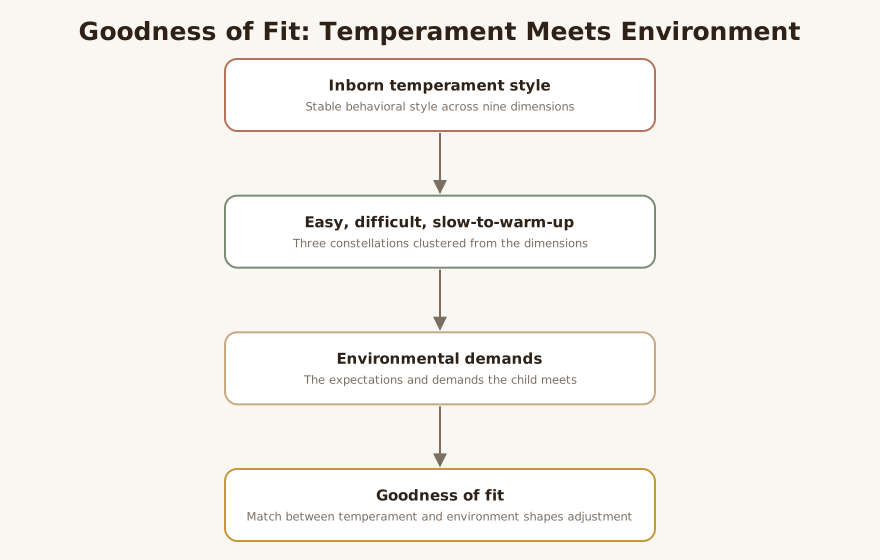
Thomas and Chess’s temperament theory is a foundational framework in developmental psychology and child psychiatry rather than a treatment modality in its own right 3. It describes how children behave — their characteristic style, pace, and intensity of responding — as distinct from what they do (content) or why they do it (motivation) 4. The theory’s central clinical contribution is the construct of goodness of fit: the degree to which a child’s temperament matches the expectations, demands, and responsiveness of the caregiving environment 1. Because the theory locates adjustment in the interaction between child and context, it sits at the interface of constitutional/biological psychiatry and relational developmental science 3. For practicing clinicians, it functions less as a protocol and more as an organizing lens that reframes “problem children” as children whose style is poorly matched to their setting 5.
Creators & Lineage
The theory was developed by Alexander Thomas and Stella Chess, psychiatrists at New York University, working with psychologist Herbert Birch 4. They launched the New York Longitudinal Study (NYLS) in 1956, following 138 infants from middle-class families through direct observation and structured parent interviews over several decades 14. Thomas and Chess articulated the theory most fully in their 1977 volume Temperament and Development and later in Temperament: Theory and Practice 62.
The work was, in part, a deliberate corrective. Prevailing psychoanalytic and behaviorist frameworks of the mid-twentieth century tended to attribute children’s difficulties to parenting — particularly maternal — failure 1. By demonstrating that infants arrive with stable, individual behavioral styles, Thomas and Chess advanced a bidirectional, transactional view in which the child actively shapes the caregiving relationship rather than being a passive product of it 1. This lineage connects the theory to behavioral genetics (constitutional contributions to behavior), to attachment theory (the relational quality of the dyad), and to later parent-child interaction models that operationalize fit as something clinicians can adjust 35. LLM
Core Principles
The empirical heart of the theory is a set of nine temperament dimensions, each rated low, medium, or high through observation and caregiver report 4:
- Activity level — amount of motor activity 4
- Rhythmicity (regularity) — predictability of biological functions: sleep, hunger, elimination 4
- Approach/withdrawal — initial response to novelty (new people, foods, situations) 4
- Adaptability — ease of adjusting to change over time 4
- Sensory threshold — level of stimulation needed to evoke a response 4
- Intensity of reaction — energy level of responses, positive or negative 4
- Quality of mood — balance of pleasant versus unpleasant affect 4
- Distractibility — ease with which ongoing behavior is interrupted 4
- Attention span and persistence — duration and continuation of an activity despite obstacles 4
From clusters of these dimensions, Thomas and Chess derived three temperament constellations 14:
- Easy (~40% of the sample): regular biological rhythms, positive mood, ready approach to novelty, and high adaptability 4.
- Difficult (~10%): irregular rhythms, withdrawal from novelty, slow adaptation, intense reactions, and frequent negative mood 4.
- Slow-to-warm-up (~15%): mild initial withdrawal and slow adaptation, but gradual acceptance with repeated, low-pressure exposure 4.
Roughly 35% of children showed mixed profiles that did not fit a single category cleanly — an important caution against rigid typing 4. Crucially, temperament categories are descriptive, not diagnostic; “difficult” is a behavioral-style label, not a value judgment or a disorder 5. LLM
The theory’s pivotal principle is that no temperament is pathological in itself. Adjustment outcomes flow from goodness of fit — the congruence between the child’s capacities and style and the environment’s demands and expectations 1. When demands and temperament are consonant, development proceeds optimally; poorness of fit — excessive or mismatched demands — generates strain and predicts maladaptive functioning 1. The same trait can be an asset or a liability depending on context: a persistent child is a frustrating one to redirect away from a forbidden object but an advantaged one at sustained academic tasks 5.
Interventions & Techniques
Because the theory is a framework rather than a manualized treatment, its clinical translation centers on modifying the environment and the dyadic relationship to improve fit, not on changing the child’s temperament 5. Core techniques include:
- Temperament assessment and psychoeducation. Mapping a child across the nine dimensions and sharing the profile with caregivers reframes behavior as style, not defiance or character flaw 5. This reattribution is often itself therapeutic, reducing caregiver blame and guilt 1.
- Caregiver “reading and responding.” The clinician coaches parents to anticipate and accommodate temperamental tendencies — packing extra activities for a high-activity child facing a wait, or building in transition time for a slow-to-warm-up child before new settings 5.
- Demand-shaping. Adjusting environmental expectations (routines, pacing, sensory load) so they fall within the child’s current adaptive range rather than chronically exceeding it 15.
- scaffolding self-regulation. A re-examination of goodness of fit argues the goal is not merely to match the environment to the child but to expand the child’s emotional, attentional, and behavioral capacities through graded support, so the child can tolerate a wider range of demands over time 1. This shifts fit from a static accommodation to an active developmental project 1.
LLM-generated illustrative example (not a guideline): A 4-year-old withdraws and cries at every new daycare activity (slow-to-warm-up profile). Rather than pushing immediate participation, the clinician coaches staff to let the child observe from the periphery, narrate what peers are doing, and invite participation only after several low-pressure exposures — converting a “poor fit” classroom routine into a graded approach plan. LLM
Evidence Base
The maturity here is established as a developmental theory, with emerging evidence for derived interventions 1. The NYLS is one of the most influential longitudinal studies in developmental psychiatry, and the nine dimensions and three constellations are durably replicated descriptive findings woven into standard pediatric and child-psychiatry training 42. The theory’s reframing of behavior as constitutionally rooted style — and of adjustment as transactional — is well validated and broadly accepted 12.
Honesty requires several qualifications. The original NYLS sample was small (138 infants) and drawn largely from middle-class families, limiting generalizability across culture and class 4. Temperament classification has historically relied heavily on parent report, which is vulnerable to caregiver bias and to the very attributions the theory seeks to neutralize 1. “Goodness of fit” is intuitively powerful but has been criticized as difficult to operationalize and measure prospectively; a re-examination of the construct calls for grounding intervention in empirical literature, assessing cultural appropriateness, and using experimental designs to demonstrate efficacy rather than assuming fit-based logic works 1. Manualized, temperament-based programs (for example, school-based approaches building on these dimensions) represent the frontier where controlled evidence is still accumulating 1. Clinicians should treat the theory as a robust heuristic and the specific intervention packages as promising but not yet definitively established. LLM
Populations & Indications
The framework was developed with and is most directly applicable to infants and toddlers, children, and the parents and caregivers who shape their environments 45. It is especially useful at the level of the parent-child dyad and the broader family, since fit is a property of the relationship, not the individual 15. Although temperament tends toward stability, the dimensions and the fit logic extend usefully into work with adolescents, where mismatch between a teen’s style and family, school, or peer expectations can drive conflict 3. LLM
Indications cluster where a constitutional behavioral style is colliding with environmental demands: highly reactive or irregular infants whose caregivers feel overwhelmed, withdrawn children facing high-novelty settings, and families locked in escalating cycles attributed to “willful” misbehavior that is better understood as temperamental 15.
Problems-for-Work
- Difficult temperament / irritability. Reframing intense, irregular, negatively toned reactivity as a recognized style guides caregivers toward predictable routines and low-stimulation recovery time 45.
- Parent-child relational problems & parenting stress. Attributing strain to fit rather than to a bad child or a bad parent lowers blame and opens collaborative problem-solving 1.
- Behavioral inhibition & childhood anxiety. Slow-to-warm-up and high-withdrawal profiles map onto graded-exposure planning that respects the child’s adaptation pace 45.
- Oppositional behavior. Apparent defiance is reassessed as low adaptability or high persistence colliding with rigid demands, redirecting intervention toward demand-shaping 5.
- Emotional dysregulation. High intensity plus low adaptability is targeted through environmental pacing and scaffolded self-regulation rather than punishment 1.
- Adjustment disorder & attachment difficulties. Poorness of fit during transitions or in a strained dyad is addressed by improving caregiver reading-and-responding 15.
Contraindications, Cautions & Cultural Humility
Temperament theory is a lens, not a stand-alone treatment, and it has no formal “contraindications” — but it carries real misuse risks. The gravest is using temperament to explain away pathology or maltreatment: framing a child’s distress as mere “difficult temperament” can mask abuse, neglect, trauma, medical conditions, or a diagnosable disorder that requires its own assessment 2. Labels like “difficult” can become stigmatizing and self-fulfilling if used carelessly with caregivers, hardening negative attributions rather than dissolving them 5. LLM
Cultural humility is essential and is built into the theory’s own logic: which temperamental traits constitute a “good fit” is culturally and socioeconomically determined 1. A high-activity, low-rhythmicity style penalized in one cultural or family context may be neutral or valued in another 1. The original sample’s narrow demographic base underscores that the categories may travel better than the valuations attached to them 14. Responsible practice assesses cultural appropriateness explicitly before importing any temperament-based intervention, ideally informed by the family’s and community’s own norms 1. LLM
Treatment-Plan Suggestions & SMART Objectives
| Goal | SMART objective (example) | Mechanism |
|---|---|---|
| Reduce caregiver blame and reframe behavior | Within 4 sessions, caregiver will describe the child’s behavior using temperament-style language (e.g., “slow-to-warm-up”) in 3 of 4 reported incidents | Psychoeducation and reattribution lower hostile attributions 15 |
| Improve goodness of fit at transitions | Over 6 weeks, caregiver will implement a pre-transition warm-up routine for 80% of novel activities, logged in a home diary | Demand-shaping matched to slow adaptability 5 |
| Lower parenting stress | Within 8 weeks, caregiver-reported parenting-stress rating will drop by at least one band on a self-anchored scale | Predictable routines reduce dyadic strain from poorness of fit 1 |
| Expand child’s tolerance of novelty | Over 8 weeks, child will participate in a new activity after ≤2 graded exposures in 3 successive instances | Scaffolded self-regulation expands adaptive range 1 |
| Decrease conflict around persistence/redirection | Within 6 weeks, caregiver will use advance warnings before transitions in 4 of 5 observed instances, reducing meltdowns by half | Accommodating low distractibility/high persistence 5 |
| Strengthen dyadic attunement | Across 6 sessions, caregiver will correctly anticipate the child’s response to a novel stimulus in 3 of 4 in-session trials | Improved “reading and responding” raises fit 5 |
| Reduce situational anxiety/withdrawal | Over 8 weeks, child will enter the classroom without distress on 4 of 5 mornings using an observe-then-join plan | Graded approach respecting withdrawal tendency 45 |
Common Misconceptions
- “Temperament is destiny.” The theory holds the opposite: outcomes hinge on fit with the environment, and the same trait can be asset or liability by context 15. LLM
- “A ‘difficult’ child is a disordered or bad child.” “Difficult” is a descriptive behavioral-style label, not a diagnosis or a moral verdict 5. LLM
- “Parents must match the child’s temperament.” Caregivers do not need a matching style; the work is adjusting strategies to read and respond to the child’s style 5. LLM
- “Goodness of fit means accommodating the child indefinitely.” A re-examination reframes the aim as expanding the child’s regulatory capacities, not permanently shrinking demands 1. LLM
- “The categories are fixed bins.” A large share of NYLS children showed mixed profiles, so rigid typing distorts the data 4. LLM
Training & Certification
There is no certification in “Thomas-Chess temperament theory” because it is a body of developmental knowledge, not a licensed modality 3. Familiarity is acquired through standard graduate and residency training in developmental psychology and child psychiatry, and through the primary texts — Temperament and Development and Temperament: Theory and Practice 62. Clinicians seeking applied skill typically train in the temperament-based and parent-coaching interventions that operationalize the framework, several of which provide their own structured training and fidelity guidance 1. Competent use also requires grounding in measurement: knowing the strengths and limits of parent-report temperament instruments and selecting tools appropriate to the population and culture 1. LLM
Key Terms
- Temperament — characteristic style of behaving (the how), distinct from content and motivation 4.
- Goodness of fit — congruence between the child’s capacities/style and the environment’s demands and expectations 1.
- Poorness of fit — dissonance between temperament and environmental demands, predicting maladaptive functioning 1.
- Nine dimensions — activity, rhythmicity, approach/withdrawal, adaptability, threshold, intensity, mood, distractibility, attention/persistence 4.
- Easy / Difficult / Slow-to-warm-up — the three temperament constellations derived from the dimensions 14.
- Transactional (bidirectional) development — the child and caregiver mutually shape one another over time 1.
- New York Longitudinal Study (NYLS) — the 1956 longitudinal study of 138 infants that generated the theory 14.
Resources & Further Reading
▶ Watch — a video introduction to this concept:
- Temperament-Based Intervention: Re-examining Goodness of Fit (PMC)
- Temperament: Theory and Practice — American Journal of Psychiatry review
- Temperament and the Concept of Goodness of Fit (Springer chapter)
- The New York Longitudinal Study by Thomas, Chess & Birch
- Goodness of Fit (Infant and Toddler Care textbook, LibreTexts)
- Thomas, A. & Chess, S. (1977). Temperament and Development. Brunner/Mazel
Reflective / Supervision Questions
- When I label a child’s behavior, am I describing a temperamental style or smuggling in a moral or diagnostic judgment? LLM
- Whose expectations define the “demands” in this case — and are those expectations culturally specific to one family or community? 1 LLM
- Am I working to accommodate the environment to the child, to expand the child’s capacities, or both — and is that explicit in the plan? 1 LLM
- What am I missing if I attribute this child’s distress to temperament alone — trauma, a treatable disorder, a medical cause, or maltreatment? 2 LLM
- How might my own temperament be shaping the “fit” I perceive between this caregiver and child? LLM