
Type & Discipline
Career Construction Theory (CCT) is a theory of vocational behavior and an accompanying model of career counseling situated in vocational psychology and the constructivist tradition 3. It belongs to the narrative/vocational family: it treats a career less as a sequence of jobs and more as a story a person authors and revises over time 3. Methodologically it rests on an epistemology of social constructionism, “that asserts individuals construct representations of reality, yet they do not construct reality itself” 3. From this contextualist position, CCT “conceptualizes development as driven by adaptation to an environment rather than by maturation of inner structures” 3.
CCT is best understood as the theoretical engine, and the life-design paradigm as the broader discourse it lives within 3. Savickas describes three historical paradigms of career intervention: vocational guidance based on inventory scores, career education based on developmental stages, and postmodern career construction based on autobiographical stories 3. Life design is the third paradigm — “subsequent to vocational guidance and career education” — and CCT supplies its working theory 53. The clinical method it generates is called career construction counseling (CCC), which Savickas notes he has at times loosely called life-design counseling 3.
Creators & Lineage
The principal architect is Mark L. Savickas, whose 2021 chapter consolidates the contemporary statement of the theory and its counseling model 3. The life-design framework itself was articulated collaboratively by an international group (Savickas and colleagues) in a 2009 paper that set out the paradigm for the 21st century 1.
CCT is explicitly integrative, drawing three viewpoints into one framework: the differential tradition of individual differences, the developmental tradition of life-span change, and the narrative tradition of meaning-making through stories 3. Its lineage is correspondingly layered. The developmental backbone comes from Donald Super, whose stage model of career maturity CCT reworks into the more dynamic construct of career adaptability 53. The differential layer reflects the vocational-personality tradition associated with Holland, repositioned by CCT not as fixed traits but as resemblances a person uses to navigate the work world 3. The narrative layer connects CCT to narrative psychology and to constructivism and social constructionism 3. Commentators also note an Adlerian (Individual psychology) grounding, especially in the use of early recollections to surface a person’s guiding line of movement 5.
Core Principles
CCT frames the self as something built “from the outside in, not from the inside out as personality trait theorists would have it” 3. The self forms as a person reflects on actions and experiences, using language to “both construct and constitute social realities” 3. Three functions of the self frame the theory: the self as a social actor (observable reputation and characteristics), the self as a motivated agent (goals and strivings), and the self as an autobiographical author (the meaning-making narrator) 3.
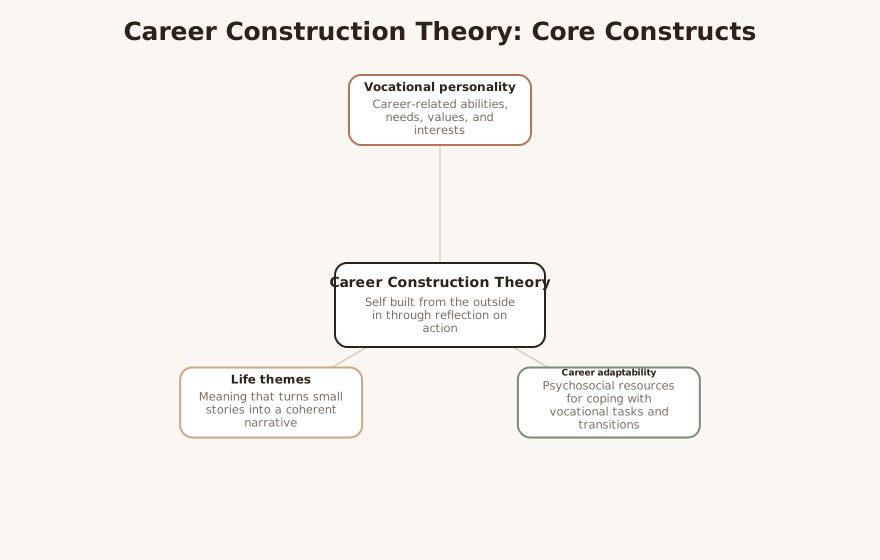
These map onto three core constructs:
- Vocational personality — a person’s career-related abilities, needs, values, and interests, understood as resemblances rather than rigid types 3.
- Career adaptability — the psychosocial resources for coping with the developmental tasks, occupational transitions, and work traumas that careers impose 3.
- Life themes — the meaning that holds a career together; the pattern that turns a string of small stories into a coherent narrative with a guiding preoccupation 3.
Career adaptability is the theory’s clinical workhorse, and Savickas distinguishes four moments along it: adaptivity (the trait-like readiness and willingness to meet change), adaptability (the psychosocial resources), adapting (the actual coping behaviors), and adaptation (the resulting fit and integration over time) 3. The four adaptability resources — often called the four C’s — are:
- Concern — a future orientation; “a sense that it is important to prepare for tomorrow,” expressed through planfulness and optimism; its deficit is career indifference 3.
- Control — “being conscientious, deliberate, organized, and decisive”; its opposite “is confusion, not dependence,” and its deficit is career indecision 3.
- Curiosity — “an inclination to explore and learn about the fit between oneself and the work world”; its deficit produces unrealism 3.
- Confidence — self-efficacy that “arises from solving problems encountered in daily activities”; its deficit can yield career inhibition 3.
Interventions & Techniques
The signature intervention is the Career Construction Interview (CCI) — a structured set of five questions that elicit micronarratives, the short self-defining stories from which a career is built 32. Each question targets a different function of the self:
- Role models (“Whom did you admire growing up?”) — reveals the social actor and the self the client is trying to build 3.
- Favorite magazines, TV shows, or websites — surfaces manifest interests and preferred occupational environments 3.
- Favorite story (book or movie) — offers a script for the client’s next move 3.
- Favorite saying or motto — captures the advice the client gives the self 3.
- Earliest recollections (with a self-authored “headline”) — names the client’s perspective on the current career problem 3.
Counseling proceeds in phases. After collaboratively formulating the problem and agreeing on goals, the counselor conducts the CCI to elicit micronarratives 3. The counselor then works with the client to reconstruct these small stories into a macronarrative — “a large story that binds them together with a career theme that invests meaning in the occupational plot” 3. Where micronarratives carry self-negating ideas, confining roles, or cultural barriers, the counselor helps the client think differently so as to “access new meanings that open possibilities and restart stalled initiatives” 3. The product is a life portrait the client can use to choose priorities, form intentions, and “envision the next scene” before sketching concrete plans 3.
Allied tools include the My Career Story (MCS) workbook — organized as “Telling My Story,” “Listening to My Story,” and “Enacting My Story” for individual or group use — and the Career Adapt-Abilities Scale (CAAS), the quantitative adaptability measure used as the primary outcome in most studies 2. Beyond individual counseling, CCT-based work is delivered through group counseling, seminars and workshops, and online/digital-storytelling formats 2.
Evidence Base
The theory’s maturity is established: CCT is a widely taught, internationally developed framework with a coherent counseling model and validated assessment instruments such as the CAAS 23. Its conceptual standing is strong LLM.
The evidence for its interventions is best described as emerging and mixed 2. A 2024 review of 22 studies from 2013-2023 found that some interventions significantly improved career adaptability while others showed no effect, indicating that effectiveness “varies by group and context” 2. Participants were predominantly secondary-school students and young adults, with some unemployed adults 2. Developmental readiness appears to matter: ninth graders improved less than twelfth graders 2. The review called for standardized assessment combining quantitative and qualitative methods, research into which interventions help which groups under which conditions, and expanded online delivery with shorter CCI formats 2. The honest clinical takeaway is that CCT offers a robust map of the territory, but practitioners should hold modest, context-specific expectations about any single protocol’s outcomes LLM.
Populations & Indications
CCT was designed for use “in multicultural societies and a global economy” 3. It is well suited to adolescents and young adults forming a first vocational identity, college students, and workers navigating transition 32. The 2009 life-design paper frames the approach as a response to precarious, destandardized 21st-century work, where careers no longer follow a single stable trajectory 1. Savickas underscores this empirically: median job tenure in the United States is roughly four years, so people “must adapt to an individualized work life with destandardized trajectories” 3. This makes CCT relevant to adults in career transition, the unemployed and job seekers, mid-career and mid-life adults reappraising direction, and workers facing precarious employment 31.
LLM-generated illustrative example (not a guideline): A 34-year-old laid off from a contract role arrives demoralized and “unable to decide” between retraining options. CCT reframes the indecision as a normal adapting task in a precarious labor market rather than a personal defect, and uses the CCI to recover a life theme that can guide the next choice LLM.
Problems-for-Work
CCT speaks directly to several presenting concerns clinicians encounter when work bleeds into mental health:
- Career indecision — reframed as low control (confusion, procrastination), addressed by strengthening conscientious, deliberate decision-making 3.
- Identity confusion — addressed by reconstructing micronarratives into a coherent vocational identity, “a narrative about the self in a social role” 3.
- Lack of meaning and purpose — the macronarrative re-invests vocational behavior with a life theme 3.
- Occupational stress, life transitions, and demoralization — situated within the adaptivity-adaptability-adapting-adaptation sequence so the client can locate where coping has stalled 3.
- Vocational impairment and adjustment difficulties — worked through the life-portrait process so the client can “envision the next scene” and form actionable plans 3.
LLM-generated illustrative example (not a guideline): A college junior with an adjustment reaction to academic pressure says she “has no idea who she is.” Her CCI role models (characters who set goals and acted with integrity) and motto (“do it well”) are mirrored back as evidence of an already-present identity, reducing the felt confusion and the catastrophic self-narrative LLM.
Contraindications, Cautions & Cultural Humility
CCT is a meaning-intensive, time-intensive method. As one practitioner reference cautions, it “is not an approach that can easily be applied in environments where a career professional has limited time or opportunity” 5. In acute clinical states — active suicidality, acute psychosis, severe untreated depression — narrative reconstruction is not a substitute for stabilization and standard psychiatric care, and life-design work is better sequenced after safety is established LLM.
The early-recollection technique can surface emotionally charged or traumatic material; clinicians should be prepared to contain it and not push interpretation 3LLM. Cultural humility is intrinsic to the theory rather than an add-on: because the self is “culturally shaped, socially constituted, and linguistically narrated,” the client — not the counselor — is the authority on what their stories mean 3. Savickas explicitly flags that “mistaken beliefs about gender, race, and social roles often produce internal and external barriers that constrain the development of confidence,” so the work must attend to structural constraint, not just individual agency 3. Reframing should “open possibilities” the client recognizes, never impose the counselor’s preferred plot 3LLM.
Treatment-Plan Suggestions & SMART Objectives
| Goal | SMART objective (example) | Mechanism |
|---|---|---|
| Reduce career indecision | Within 6 sessions, client completes the 5-question CCI and names two prioritized options with stated decision criteria | Builds control: conscientious, deliberate decision-making 3 |
| Clarify vocational identity | By session 5, client articulates a one-sentence life theme drawn from role-model and early-recollection stories | Reconstructs micronarratives into a coherent identity narrative 3 |
| Increase future orientation | Over 4 weeks, client lists three concrete preparatory steps for an imminent transition and logs progress weekly | Builds concern: planfulness and optimism 3 |
| Expand realistic options | Within 8 weeks, client conducts two informational interviews and updates a self-knowledge/occupation map | Builds curiosity: exploring self-to-work fit 3 |
| Strengthen self-efficacy | Across 6 sessions, client completes three graded career tasks (e.g., resume, application, mock interview) and rates confidence before/after | Builds confidence through successful problem-solving 3 |
| Restore meaning/purpose | By termination, client states how the next career step expresses their life theme in their own words | Macronarrative invests the occupational plot with meaning 3 |
| Reduce demoralization in transition | Within 4 sessions, client reframes a “failure” micronarrative into a learning episode and identifies one preserved strength | Reflexive reframing accesses new meanings that restart stalled initiative 3 |
Common Misconceptions
- “CCT is just career advice or job matching.” It is the opposite of a static match: it treats career as an authored, revisable story and centers meaning-making over inventory scores 3. Matching belongs to the older vocational-guidance paradigm CCT moves beyond 3.
- “Adaptability is a fixed trait.” CCT separates trait-like adaptivity from the malleable psychosocial resources of adaptability and the adapting behaviors that can be coached 3.
- “Lack of control means dependence.” In CCT the opposite of control “is confusion, not dependence” — a distinction that reframes indecision as a coping problem rather than a character flaw 3.
- “It’s a quick technique.” It is a meaning-intensive method that demands time and a working alliance 53.
- “More tools mean better outcomes.” The intervention evidence is mixed and context-dependent, not uniformly positive 2.
Training & Certification
There is no single licensing body that “certifies” a CCT therapist; the method is learned through Savickas’s primary texts and counseling model, supported workbooks (My Career Story), and the validated CAAS instrument 32. The author’s official site curates the canonical materials — the theory, the career-style/construction interview, and adaptability resources — for practitioners learning the approach 4. Introductory overviews and mini-lectures are also available as orienting resources 6. Clinicians already trained in narrative or CBT modalities can integrate the CCI and life-portrait process into existing practice; competent use depends on supervised practice in eliciting and reconstructing client stories rather than a credential LLM.
Key Terms
- Life design — the third paradigm of career intervention, the discourse within which CCT and its counseling model sit 35.
- Career adaptability — psychosocial resources for managing vocational tasks, transitions, and traumas 3.
- Four C’s — concern, control, curiosity, confidence 3.
- Adaptivity / adaptability / adapting / adaptation — readiness, resources, behaviors, and resulting fit 3.
- Micronarrative / macronarrative — the small self-defining stories and the integrating life story built from them 3.
- Career Construction Interview (CCI) — the five-question protocol eliciting role models, manifest interests, favorite story, motto, and early recollections 3.
- Life theme — the meaning that holds a career narrative together 3.
- Vocational identity — “a narrative about the self in a social role” enacted in work 3.
- Biographicity — the two-stage process of retrospective reflection and prospective reflexivity used to author a career narrative 3.
Resources & Further Reading
▶ Watch — a video introduction to this concept:
- Life designing: A paradigm for career construction in the 21st century (Savickas et al., 2009, Journal of Vocational Behavior)
- Career construction theory: tools, interventions, and future trends (Frontiers in Psychology, 2024)
- Career Construction Theory and Counseling Model (Savickas, 2021 book chapter PDF)
- Career Construction Theory (CCT) — Mark Savickas official site
- Career Construction Theory & Life Design (Marcr career-professionals reference)
- Mini Lecture 4.4 — Career Construction Theory of Mark Savickas (video)
Reflective / Supervision Questions
- When a client presents as “indecisive,” do I assess for confusion (a control deficit) versus indifference (a concern deficit) versus unrealism (a curiosity deficit) — and does my intervention match? 3LLM
- Am I listening for the client’s story (actively shaping it with them) or merely listening to it? 3
- Where might I be imposing my own preferred plot when reframing a client’s micronarrative, rather than opening possibilities the client recognizes? 3LLM
- How do structural barriers — gender, race, class, precarious labor markets — shape this client’s confidence, and am I naming them rather than locating the problem solely inside the individual? 31LLM
- When occupational distress co-occurs with a billable condition, am I clearly documenting the clinical target that CCT technique is serving? LLM
- Given the mixed intervention evidence, what outcome am I actually tracking with this client, and how will I know if the approach is helping? 2LLM