
Type & Discipline
Super’s life-span, life-space theory is a developmental theory of career, situated within vocational/career counseling and developmental psychology rather than within a clinical treatment model 4. Its central claim is that a career is “the roles played by a person during a lifetime,” not a single occupational choice made at one point in time 1. The theory integrates developmental psychology with vocational behavior, treating career progression as continuous adaptation rather than a static matching of person to job 4. For a practicing therapist, this matters because it reframes “what should I do for work?” as a developmental and identity question that unfolds across the whole life course LLM. That reframe lets clinicians fold career material into broader work on identity, transition, and role functioning rather than treating it as a separate, purely informational task LLM.
Two organizing metaphors anchor the discipline of the theory. The “life-span” dimension describes how vocational behavior changes across developmental stages, and the “life-space” dimension describes the simultaneous, interacting roles a person occupies at any given time 3. Together they give the theory its name and its dual lens: development over time, and roles across contexts LLM.
Creators & Lineage
The theory is principally the work of Donald Super, whose 1980 paper formalized the life-span, life-space approach and introduced the life-career rainbow as a tool for representing careers’ multidimensional nature 1. Super’s broader contribution was to move vocational psychology away from one-shot “trait-and-factor” matching toward a developmental, self-concept-driven account of how careers form and change 4. His framework deliberately integrated psychological, sociological, and economic perspectives rather than treating vocational choice as a purely individual act 4.
The theory sits alongside, and in productive tension with, Holland’s career typology, which emphasizes matching personality types to congruent work environments; Super’s model is developmental and longitudinal where Holland’s is more cross-sectional and typological LLM. Super drew heavily on self-concept theory, making the implementation and refinement of self-concept the engine of career behavior 4. Contemporary career theory extends Super through the construct of career adaptability, articulated as the dimensions of concern, control, curiosity, and confidence, which reframes his older “career maturity” idea for less predictable modern labor markets 4. Clinicians encountering newer “career construction” or adaptability language should recognize it as a direct descendant of Super’s stages and self-concept work LLM.
Core Principles
The first principle is that career development is a lifelong process of implementing one’s self-concept through work roles 4. Career choices, on this view, are not isolated decisions but reflect a person’s broader attempt to express who they believe themselves to be 3. The vocational self-concept encompasses beliefs about one’s abilities, interests, values, and personality, and it is dynamic: it evolves through work experiences and feedback, which in turn reshape the career trajectory 4.
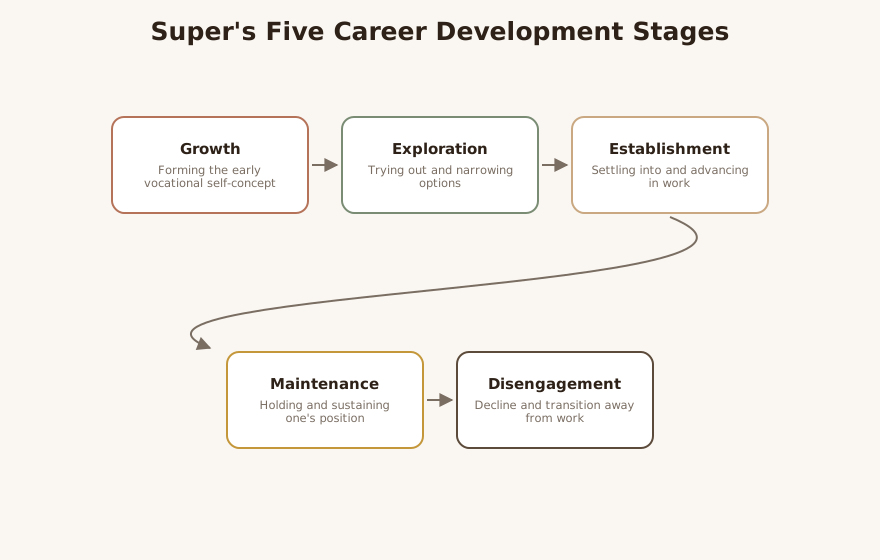
The second principle is developmental staging. Super described five major stages: growth, exploration, establishment, maintenance, and disengagement (sometimes called decline) 3. Each stage carries characteristic developmental tasks, and readiness to meet those tasks—rather than chronological age—is what the theory calls career maturity 4. Career maturity was operationalized through planning attitudes, exploration, decision-making skills, knowledge of the world of work, and awareness of occupational groups 4.
The third principle is the life-space, captured by the life-career rainbow. Super held that people simultaneously occupy multiple roles—he named child, student, leisurite, citizen, worker, spouse, homemaker, parent, and pensioner—that wax and wane in importance across the lifespan 4. “Role salience” is the relative importance a person attaches to each role, and it explains why two people in the same job may experience it completely differently 4. The rainbow illustrates that career development is embedded within a broader life context rather than existing in isolation 4.
A fourth, integrative principle is the archway model, which depicts the self-concept as a keystone resting on two pillars: a psychological pillar (abilities, interests, values, personality) and a biographical-social-economic pillar (family background, socioeconomic status, labor market, cultural values) 4. The keystone—individual agency interpreting both internal and external factors—is where the person actively builds a career out of given materials 4.
Finally, the theory allows recycling. Although the stages progress sequentially, people may “recycle” through earlier stages—re-entering exploration or establishment—when transitions, economic disruption, or major life events demand it, producing mini-cycles within the larger life cycle 4. This makes the model far more flexible than a rigid age-graded ladder and directly relevant to adult clients who feel “behind” LLM.
Interventions & Techniques
Super’s framework is realized clinically less through scripted protocols than through a set of assessment-and-reflection practices LLM. The core counseling move is self-concept clarification: helping clients articulate abilities, interests, and values through reflective exercises and structured assessment so that career choices can become deliberate expressions of self rather than reactive defaults 4. A second move is staged, developmental exploration—occupational research, informational interviewing, and structured decision-making skill-building matched to the client’s current stage 4. A third is role-conflict resolution, using the life-space lens to surface competing demands across roles and to renegotiate their salience 4.
Several instruments operationalize the theory. The Career Development Inventory measures career maturity across planning, exploration, decision-making, world-of-work information, and occupational-group knowledge 4. The Adult Career Concerns Inventory assesses concerns across the adult stages of exploration, establishment, maintenance, and disengagement, helping the clinician locate a client’s current developmental focus 4. The Salience Inventory measures the relative importance a client places on different life roles, making role priorities and potential role conflict explicit 4. Values-focused instruments assess the work values that form a core component of self-concept 4. Group and organizational programs apply the same stage framework to deliver developmentally appropriate support at scale 4.
LLM-generated illustrative example (not a guideline): A clinician working with a 38-year-old in midlife transition uses a salience exercise to map current role importance. The client discovers that the “parent” and “worker” roles have both intensified while the “leisurite” role has collapsed to zero, clarifying that the presenting “career dissatisfaction” is partly a role-balance problem rather than a wrong-job problem LLM.
Evidence Base
The maturity of this theory is best described as established but uneven LLM. Super’s life-span, life-space approach is a foundational, widely taught framework in vocational and counseling psychology, and its assessment instruments have decades of use behind them 4. The developmental stages, the self-concept mechanism, and the life-role/salience constructs are durable and have generated a large body of measurement and applied work 4.
Honesty requires noting the limits. Critics observe that the stage model may not adequately capture nonlinear career paths, collectivist cultures, or contemporary gig-economy dynamics 3. Practice sources note the theory does not fully account for external forces such as economic change or cultural difference, and that its everyday usage has diminished as more flexible, adaptability-based models have gained ground 6. In other words, the framework’s descriptive and heuristic value is strong, while rigorous causal evidence that stage-matched interventions outperform alternatives is thinner than the theory’s prominence might suggest LLM. Clinicians should treat it as a reliable organizing lens, not as an evidence-graded treatment protocol with controlled outcome trials LLM.
Populations & Indications
The theory is well suited to clients whose presenting concerns intersect with work, role, and developmental identity LLM. Adolescents and students fall largely in the growth and exploration stages, where forming attitudes, interests, and initial self-concepts and then tentatively examining options are the central tasks 3. Young adults navigating the exploration-to-establishment transition—crystallizing, specifying, and implementing a direction—are a natural fit for the stage-and-task framework 4. Career changers and adults in midlife transition are well served by the recycling concept, which normalizes returning to exploration without pathologizing it 4.
Adults in the maintenance stage, working to preserve position while updating skills and managing plateaus, and retirees moving through disengagement (deceleration, retirement planning, transition to post-career life) are also explicitly addressed by the model 4. Because the theory centers role salience, it is particularly indicated when a client’s distress appears bound up with shifting or competing life roles rather than with a single occupational decision LLM.
Problems-for-Work
The framework maps onto several clinically familiar problems-for-work LLM. Career indecision is a primary indication: a young adult stuck between options can be located within the crystallization/specification tasks of exploration and supported with stage-appropriate decision-making work 4. Life transitions and developmental crises are addressed through the stage and recycling concepts, which give both clinician and client a developmental vocabulary for “where I am” and “what this stage asks of me” 4.
Role conflict and occupational stress are directly illuminated by the life-space lens and the salience construct—naming which roles are overloaded and which have been crowded out 4. Low self-efficacy can be reframed through the self-concept and (in extended versions) the confidence dimension of adaptability, building the client’s sense of capacity to solve career problems 4. Identity disturbance intersects with the self-concept engine of the theory, since career behavior is treated as an implementation of self-concept, and adjustment disorder presentations tied to a job change, layoff, or retirement can be organized around the relevant developmental stage and its tasks 4.
LLM-generated illustrative example (not a guideline): A recently laid-off client presenting with adjustment-related anxiety is helped to see the layoff as a forced “recycle” into exploration. Framing the next months as legitimate exploratory developmental work—rather than as failure—reduces shame and supports concrete next steps LLM.
Contraindications, Cautions & Cultural Humility
The most important caution is cultural and structural LLM. The model was built around a largely linear, individual-agency view of career and has been criticized for not adequately addressing collectivist cultures or contemporary, precarious labor markets 3. Practitioners are reminded that it does not fully account for economic change or cultural difference, so applying its stages prescriptively across all clients risks distorting their lived reality 6. The archway model’s own biographical-social-economic pillar is the corrective: socioeconomic status, family background, labor-market conditions, and cultural values are part of the theory and must be weighted, not bracketed 4.
A second caution is that the theory is descriptive, not a stand-alone clinical treatment; it should not displace evidence-based care for the mental-health conditions (anxiety, depression, trauma) that often accompany career distress LLM. The age bands attached to each stage are approximate and were never meant as rigid norms—using them to tell an adult client they are “off-schedule” would misapply the recycling principle that the theory itself supplies 4. Cultural humility here means holding role salience as the client defines it, rather than assuming the “worker” role is or should be central LLM.
Treatment-Plan Suggestions & SMART Objectives
| Goal | SMART objective (example) | Mechanism |
|---|---|---|
| Clarify vocational self-concept | Over 4 sessions, client will articulate at least three core work values and three self-identified strengths in writing | Self-concept clarification as the basis for career choice 4 |
| Reduce career indecision | Within 6 weeks, client will narrow options from an open field to two researched alternatives with stated pros/cons | Crystallization and specification tasks of the exploration stage 4 |
| Resolve role conflict | Within 4 sessions, client will complete a role-salience map and rank current roles by importance and time demand | Life-space / role salience analysis 4 |
| Build decision-making capacity | Over 8 weeks, client will use a structured decision framework to reach one concrete next-step commitment | Developmental decision-making skill-building 4 |
| Normalize a forced transition | Within 3 sessions, client will reframe a recent job loss as a recycling into exploration and identify two exploratory actions | Recycling / mini-cycle concept 4 |
| Increase career self-efficacy | Over 6 weeks, client will complete two informational interviews and report change in confidence ratings | Self-concept and confidence in problem-solving 4 |
| Plan a stage-appropriate transition | Within 5 sessions, a client near retirement will draft a phased disengagement plan with three post-career role goals | Disengagement-stage developmental tasks 4 |
Common Misconceptions
A first misconception is that Super’s stages are strictly age-locked and one-directional LLM. In fact, career maturity is a function of readiness and developmental task, not chronological age, and the theory explicitly allows recycling back through earlier stages 4. A second misconception is that the theory is only about picking a job; its actual unit of analysis is the lifelong implementation of self-concept across roles, of which paid work is only one 4.
A third misconception is that “career counseling” using this model is purely informational—handing clients labor-market data LLM. The core mechanism is psychological: clarifying and implementing self-concept, which is closer to identity work than to information delivery 4. A fourth is that the framework is value-neutral and universally applicable; it carries assumptions about linear, individual careers that do not transfer cleanly to all cultural and economic contexts 3. Finally, some treat “career maturity” and “career adaptability” as the same thing; adaptability (concern, control, curiosity, confidence) is a later, more flexible reformulation rather than a synonym 4.
Training & Certification
There is no single proprietary certification gatekeeping use of Super’s theory; it is a foundational framework taught within graduate counseling psychology, vocational counseling, and career-development training 4. Competent application draws on familiarity with its associated instruments—such as the Career Development Inventory, Adult Career Concerns Inventory, and Salience Inventory—and on supervised practice in interpreting them 4. National career-practice bodies present the theory as part of a “best practice” toolkit for practitioners, indicating it is embedded in applied career-practitioner training rather than reserved to clinicians alone 6. Therapists incorporating it should ensure any use of formal inventories falls within their assessment competence and scope of practice LLM.
Key Terms
- Self-concept (vocational self-concept): the evolving set of beliefs about abilities, interests, values, and personality that a person implements through work roles 4.
- Life-span: the developmental dimension—change in vocational behavior across stages over the life course 3.
- Life-space: the dimension of simultaneous, interacting life roles a person occupies at any time 3.
- Five stages: growth, exploration, establishment, maintenance, and disengagement/decline 3.
- Career maturity: readiness to make developmentally appropriate career decisions, independent of age 4.
- Career adaptability: the contemporary reformulation comprising concern, control, curiosity, and confidence 4.
- Life-career rainbow: the visual model showing how multiple life roles wax and wane in salience across the lifespan 1.
- Role salience: the relative importance a person attaches to each life role 4.
- Archway model: self-concept as a keystone resting on psychological and biographical-social-economic pillars 4.
- Recycling / mini-cycles: revisiting earlier stages during transitions rather than progressing only once and linearly 4.
Resources & Further Reading
▶ Watch — a video introduction to this concept:
- Super, D.E. (1980). A Life-Span, Life-Space Approach to Career Development. Journal of Vocational Behavior, 16, 282-298 (ERIC abstract)
- Donald Super’s Life-Span, Life-Space Approach (Self-Concept) — Grinnell College PDF
- Donald Super’s Theory of Career Development — iResearchNet (Counseling Psychology)
- Donald Super’s life-span, life-space theory — Tāhatū (NZ Govt Career Practice Hub)
- Life-span, life-space theory — Wikipedia
Reflective / Supervision Questions
- For a given client, which of the five stages best describes their current developmental tasks, and where might recycling be at play LLM?
- How is this client implementing—or struggling to implement—a self-concept through their work and non-work roles 4?
- Which life roles carry the most salience for this client, and where do those roles conflict or crowd one another out 4?
- Am I weighting the biographical-social-economic pillar (culture, class, labor market) as heavily as the psychological pillar, or defaulting to individual agency 4?
- Where might this client’s cultural context make a linear, individualistic career narrative a poor fit, and how do I adapt 3?
- Is career material in this case standing in for, or co-occurring with, a clinical condition that needs its own evidence-based treatment LLM?