
Type & Discipline
The Career Construction Interview (CCI) is a structured qualitative assessment and counseling technique within vocational psychology, belonging to the family of narrative career counseling 2. It is the signature interview protocol of Career Construction Theory, which holds that people do not merely match traits to occupations but actively construct careers through narrative meaning-making 1. My Career Story (MCS) is the self-guided workbook adaptation of the same method, designed for use independently or with counselor support 3.
The technique sits at the intersection of constructivist career counseling and the broader life-design paradigm, which positions people as “social actors, motivated agents, and autobiographical authors” who continually negotiate work-life transitions rather than make a single, fixed occupational choice 6. As a counseling tool it is most accurately described as a structured narrative method rather than a free-standing psychotherapy; clinicians typically embed it inside a recognized therapeutic or counseling modality when working with clients who present with diagnosable conditions LLM.
Creators & Lineage
The CCI was developed by Mark Savickas, who formalized Career Construction Theory and its counseling model over several decades 1. The interview is the operational heart of that theory, translating its abstract constructs into a repeatable sequence of questions 2.
The method draws on at least three intellectual lineages. First, it inherits from Individual Psychology (Adlerian) (Adlerian) the use of early recollections as projective material that reveals a person’s guiding perspective and core preoccupation 2. Second, it is allied with narrative therapy’s premise that identity is authored through stories that can be re-told and re-scripted 6. Third, it converges with Jean Guichard’s self-construction theory, which frames life as “life-long self-construction” through reflection and reflexivity, and with the life-design paradigm that the two traditions jointly anchor 6. An earlier articulation, the Career Style Interview, presented a contextualized version of the same approach to career counseling before the constructs were consolidated under Career Construction Theory 4.
Core Principles
Career Construction Theory rests on three organizing constructs. Vocational personality describes a person’s career-related abilities, needs, values, and interests; career adaptability describes the psychosocial resources for managing transitions; and life themes describe the personal meaning that unifies vocational behavior across a lifespan 2. The CCI is built to surface the third of these, the life theme, because theme is what converts disconnected choices into a coherent direction 2.
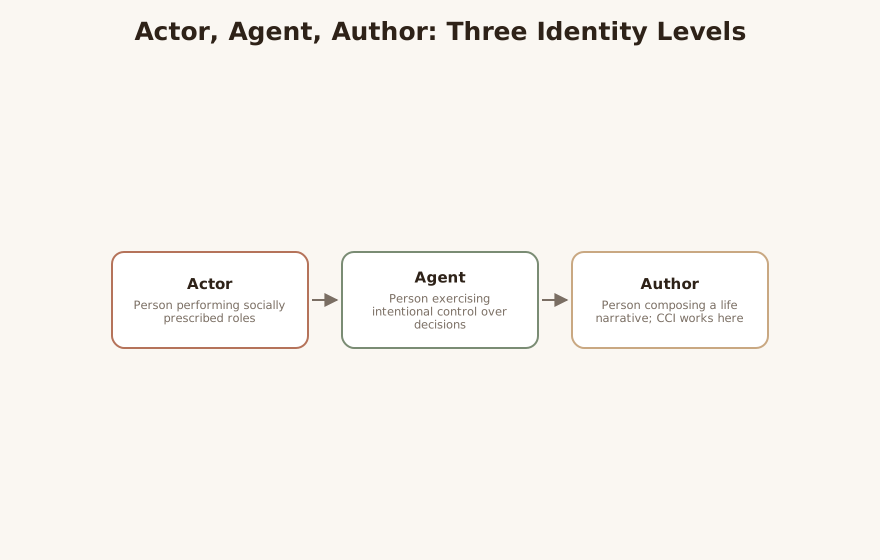
The theory layers identity into three perspectives: the person as actor performing socially prescribed roles, as agent exercising intentional control over decisions, and as author composing a life narrative 2. Career counseling using the CCI works primarily at the author level, helping clients integrate discrete micronarratives (specific stories about role models, media, and memories) into a macronarrative or “life portrait” that gives identity and direction 2.
Career adaptability is further specified as four resources, the “four C’s“: concern (awareness of the vocational future), control (agency over one’s direction), curiosity (exploration of possibilities), and confidence (belief in one’s ability to enact plans) 2. A central clinical move is the reframing of suffering into purpose: the theory holds that themes often originate in early pain, and that counseling can help clients achieve “active mastering of passive suffering” by turning a private problem into a public, vocational contribution 6.
Interventions & Techniques
The CCI follows a fixed sequence that opens with a goal-setting question — in one protocol, “How can I be most useful to you in constructing your career?” — which orients the work to the client’s stated agenda 5. The interviewer then moves through five thematic prompts 3.
- Role models. The client names admired figures (excluding parents) and describes what they admire and how they are similar to and different from each model 5. Role models reveal self-construction: the qualities the client is assembling into an ideal self, and the solution they are reaching toward 2.
- Favorite media. The client names the newsfeeds, websites, magazines, or TV shows they regularly consume and why 5. Media preferences reveal manifest interests and the environments in which the client wants to operate 2.
- Favorite story. The client describes a favorite movie or book 5. The favorite story functions as a script — a template for how the client expects their own narrative to unfold, and the self-advice embedded in it 2.
- Motto. The client offers a favorite saying or motto 5. The motto is the client’s own explicit advice to self, often the headline of the emerging life portrait 2.
- Early recollections. The client recounts three earliest memories, typically from ages three to six 5. Early recollections expose the client’s perspective, central preoccupation, and the core problem that the career may be organized to solve 2.
Some protocols add prompts about leisure activities and favorite and least-favorite school subjects to enrich interests and environment data 5. After collection, the counselor reconstructs the micronarratives into a macronarrative, links the early-recollection “problem” to the role-model “solution,” and co-authors a life portrait the client can act on 2. My Career Story operationalizes this in three workbook sections — “Telling My Story” (problem definition), “Listening to My Story” (integrating narratives into a coherent identity), and “Enacting My Story” (action planning) — usable with or without a counselor 3.
Evidence Base
The maturity of this evidence base is best characterized as established: the method is decades old, theoretically articulated, and supported by a substantial intervention literature, though outcome findings are mixed rather than uniformly strong 3. The CCI shows moderate correlations with quantitative career-interest inventories, indicating that its qualitative output is compatible with, rather than contradictory to, traditional psychometric assessment 3.
Meta-analytic findings on life-design and career-construction interventions are mixed regarding which modality is superior, but they converge on five elements that drive effective career counseling: written exercises and workbooks, individualized explanations and feedback, career-world information, role modeling, and building support 3. Life-design interventions have been associated with improved career adaptability, and online delivery has shown outcomes comparable or superior to face-to-face counseling for career decision self-efficacy 3. Developmental fit matters: ninth graders showed more difficulty than twelfth graders in recounting their own experiences, suggesting the full narrative method is more demanding for younger or less verbally elaborated clients 3.
Honest limitations include inconsistent results across studies on career-adaptability gains, limited cross-cultural validation, and the practical burden of the traditional format, which can require two 90-minute sessions 3.
Populations & Indications
The CCI and its variants have been studied across high-school students (grades 9-12), college and university students, unemployed young adults, mid-to-late-career unemployed adults, at-risk student populations, and urban youth of color 3. This maps closely onto the populations clinicians most often bring it to: adolescents and young adults, college students, adults in career transition, job seekers, mid-life career changers, and clients explicitly seeking meaning in work LLM.
It is indicated when the presenting concern is vocational rather than purely symptomatic — career indecision, identity confusion, a felt lack of meaning and purpose, or difficulty navigating a life transition — and when the client has enough verbal and reflective capacity to recount autobiographical material 3. The reframing of suffering into purpose makes it particularly apt for demoralized clients whose self-esteem has been damaged by job loss or perceived failure, provided the work stays oriented to construction rather than re-traumatization 6.
Problems-for-Work
- Career indecision and identity confusion. The role-model and media questions surface an ideal self and preferred environments, giving an undecided client concrete coordinates rather than an open-ended “what should I do” 2.
- Lack of meaning and purpose / demoralization. Linking the early-recollection problem to a vocational solution helps clients convert “passive suffering” into an active sense of contribution 6.
- Life transitions and adjustment difficulties. The four C’s of adaptability give a structured way to assess and build the concern, control, curiosity, and confidence a client needs to move through change 2.
- Occupational stress and vocational impairment. Clarifying the life theme can reveal whether a current role is misaligned with the client’s authored identity, informing whether the work is to adapt the role or change it LLM.
LLM-generated illustrative example (not a guideline): A 34-year-old client laid off from a logistics job presents demoralized and “directionless.” Her role models are all teachers and coaches; her favorite show is a medical drama centered on mentoring; her earliest memory is of helping a younger sibling who was lost. The clinician reflects a candidate theme — “turning being-lost into helping-others-find-their-way” — and the client begins exploring training and patient-navigation roles. LLM
Contraindications, Cautions & Cultural Humility
The CCI is not a treatment for acute psychiatric crisis, active suicidality, or untreated trauma; early-recollection work can activate painful material, so it should be paced and contained, and deferred when stabilization is the priority LLM. Because the method is verbally and autobiographically demanding, it can be a poor fit for clients with significant cognitive, language, or expressive limitations, and the documented difficulty younger adolescents have recounting their own experiences should lower expectations about depth with that group 3.
Cultural humility is essential. The evidence base has limited cross-cultural validation, so the theme a clinician hears in role models, media, and mottos must be checked against the client’s own cultural framing rather than imposed 3. Media and role-model prompts assume access and exposure that vary by class and culture, and the individualistic “author your own career” framing may not match clients whose vocational decisions are collective or family-embedded; the opening goal question is the place to negotiate that fit LLM.
Treatment-Plan Suggestions & SMART Objectives
| Goal | SMART objective (example) | Mechanism |
|---|---|---|
| Reduce career indecision | Within 6 sessions, client completes the full CCI and names at least 3 concrete options aligned to identified interests/environments | Manifest interests surfaced via media and role-model prompts 2 |
| Articulate a life theme | By session 4, client states a one-sentence life theme in their own words and rates its fit 7+/10 | Micronarratives integrated into a macronarrative/life portrait 2 |
| Convert demoralization into direction | Within 8 weeks, client reframes the early-recollection “problem” into one vocational “contribution” statement | Active mastering of passive suffering 6 |
| Build career adaptability | Over 8 sessions, client demonstrates one concrete action per “C” (concern, control, curiosity, confidence) | Strengthening the four adaptability resources 2 |
| Increase exploratory action | Within 4 weeks, client conducts 2 informational interviews in a preferred environment | Curiosity and career-world information 3 |
| Translate insight into a plan | By termination, client completes the “Enacting My Story” action plan with 3 dated next steps | My Career Story action-planning section 3 |
| Sustain motivation/support | Within 6 weeks, client identifies and contacts 2 support figures matched to role-model qualities | “Building support” as a core effective element 3 |
Common Misconceptions
- “It’s a personality test.” The CCI is a narrative method that surfaces life themes, not a psychometric type instrument, although its output correlates moderately with interest inventories 3.
- “More data means better matching.” Career Construction Theory deliberately moves away from trait-and-factor matching toward authored meaning; the goal is a coherent theme, not an optimized fit score 1.
- “Early recollections are diagnostic facts.” Memories are treated as projective material revealing perspective and preoccupation, not as accurate historical records 2.
- “It’s quick.” The traditional format can require two 90-minute sessions, and rushing it undermines the reconstruction step 3.
- “It works the same at any age.” Younger adolescents may struggle to recount autobiographical material, so the method needs developmental tailoring 3.
Training & Certification
There is no single licensure for the CCI; it is a technique learned and practiced by counselors and psychologists already credentialed in their disciplines LLM. Training has historically been disseminated directly by Savickas and through Career Construction Theory materials, with practitioners reporting having received model-specific training before applying it 5. Clinicians typically build competence by studying the foundational theory and counseling model, practicing the question sequence and reconstruction, and supervising early cases 2. The My Career Story workbook lowers the entry barrier for clients and offers a structured scaffold for clinicians newer to the method 3.
Key Terms
- Vocational personality — career-related abilities, needs, values, and interests 2.
- Career adaptability — psychosocial resources for managing transitions, specified as the four C’s: concern, control, curiosity, confidence 2.
- Life theme — the unifying personal meaning that gives coherence to vocational behavior 2.
- Actor / agent / author — three perspectives on identity, from role-performer to intentional decision-maker to narrator 2.
- Micronarrative / macronarrative (life portrait) — discrete stories integrated into a coherent identity narrative 2.
- Early recollections — earliest memories used projectively to reveal perspective and preoccupation 2.
- Active mastering of passive suffering — converting early pain into a vocational contribution 6.
- Life-design paradigm — framing people as actors, agents, and authors negotiating ongoing work-life transitions 6.
Resources & Further Reading
▶ Watch — a video introduction to this concept:
- The Theory and Practice of Career Construction (Savickas, 2005, in Brown & Lent, eds.)
- Career Construction Theory and Counseling Model (Savickas, 2021 book chapter PDF)
- Career construction theory: tools, interventions, and future trends (Frontiers in Psychology, 2024)
- Career Style Interview: A Contextualized Approach to Career Counseling (Savickas)
- Career Construction Interview — Process & Instructions
- Innovating Counseling for Self- and Career Construction (PMC)
Reflective / Supervision Questions
- When you hear a client’s life theme emerging, how do you check that it is theirs and not a story you find compelling? LLM
- How do you decide whether a client’s vocational distress is best treated within psychotherapy versus referred to dedicated career counseling? LLM
- The method asks clients to author their own careers; how do you adapt it for clients whose vocational decisions are collective or family-embedded? 3
- Early recollections can open painful material — what are your criteria for pausing the CCI and prioritizing stabilization? LLM
- How will you document the medical-necessity link when delivering this technique inside a billable therapy? LLM
- With younger adolescents who struggle to recount their experiences, what scaffolding do you add before attempting the full interview? 3