
Type & Discipline
Social Cognitive Career Theory (SCCT) is a theory of career and educational development drawn from counseling and social-cognitive psychology 1. It belongs to the broader family of vocational psychology theories, where it was conceived as a unifying framework meant to complement and link foundational approaches to career development 1. SCCT is not itself a standalone psychotherapy; it explains and predicts how people develop interests, make career choices, perform, and adjust at work 5. For clinicians, its value is as an organizing model for the occupational dysfunction that accompanies many billable presentations rather than as a reimbursable treatment in its own right LLM. Its constructs are deliberately domain-specific and potentially modifiable, which makes the theory translate readily into intervention targets 1.
Creators & Lineage
SCCT was articulated by Robert W. Lent, Steven D. Brown, and Gail Hackett in their 1994 monograph, which has since accrued over 6,000 citations 1. Its conceptual roots lie in Albert Bandura’s social cognitive theory, including his triadic reciprocal causation framework in which person, behavior, and environment mutually influence one another 1. The pivotal translation step came earlier, when Hackett and Betz (1981) first applied Bandura’s self-efficacy construct to career choice, proposing that low self-efficacy could explain the restricted range of women’s career options 5. SCCT incorporates traditional “work personality” variables such as interests and values but offers a novel account of where those variables come from and how they change through experience and counseling 1. It sits alongside and complements trait-and-factor approaches such as Holland’s vocational theory and developmental career theories 6.
Core Principles
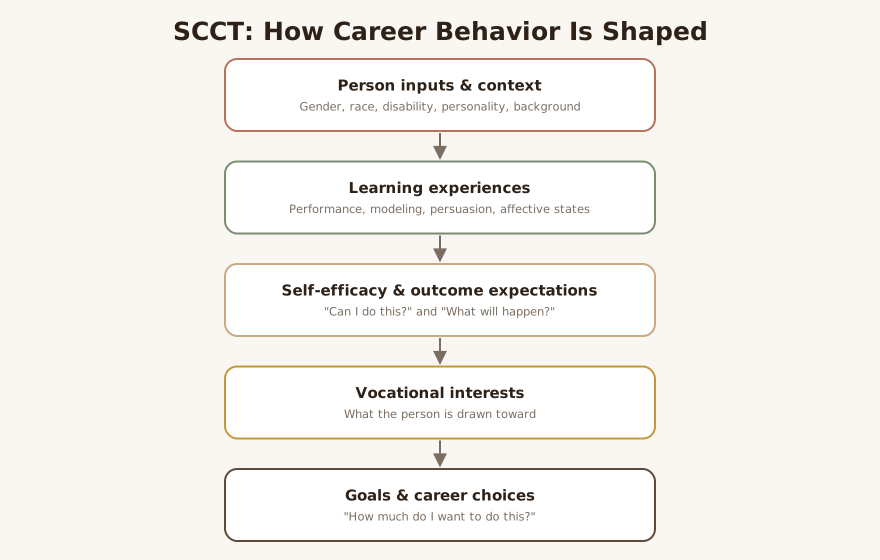
Three social-cognitive variables form the engine of the theory: self-efficacy (“Can I do this?”), outcome expectations (“What will happen if I do this?”), and personal goals (“How much do I want to do this?”) 3. Self-efficacy beliefs are people’s appraisals of their capability to plan and execute the steps needed to attain specific goals 6. Bandura distinguishes self-efficacy from outcome expectations, noting that a person may believe an action produces a desired outcome yet not act because they doubt they can execute it 5. Crucially, these are perceptions of reality, and in decision-making they are hypothesized to be greater determinants of behavior than objective reality itself 5.
Self-efficacy develops from four experiential sources, collectively termed learning experiences: personal performance accomplishments, vicarious learning (modeling), social persuasion, and physiological and affective states 1. Across these models, person inputs such as gender, race/ethnicity, disability, and personality interact with background context to shape the learning experiences that form self-efficacy and outcome expectations 5. Contextual influences, termed contextual affordances, are divided into distal background factors (for example, gender-role socialization or impoverished learning environments) and proximal supports and barriers that operate at the point of choice (for example, financial support to attend college, or anxiety about relocating) 5. What matters most is the individual’s perception of a barrier, which may be objective or subjective 5.
Interventions & Techniques
SCCT’s four experiential sources double as an organizing structure for psychoeducational and clinical intervention 2. Personal performance accomplishments are the most potent target, and incrementally graded success experiences can build efficacy at specific tasks 2. Because objective successes may not raise self-efficacy if the client attributes them to luck or ease, cognitive restructuring of performance attributions is often added so that clients credit success to developing personal capability 2. Modeling exposes clients to domains they have not considered, and clients identify most with role models they perceive as similar to themselves 2. Social persuasion and support are used to encourage clients to attempt new tasks and to interpret their performances favorably by focusing on skill growth rather than ultimate success 2. Where task-related anxiety is depressing self-efficacy, relaxation and other cognitive-behavioral strategies can reduce debilitating arousal 2.
For clients who feel stifled by a constricted range of options, SCCT supplies two concrete assessment strategies 2. The first examines aptitude–interest and value–interest discrepancies on standardized measures: aptitude without interest may signal unrealistically low self-efficacy, while value-compatibility without interest may signal inaccurate outcome expectations 2. The second uses a modified vocational card sort in which clients re-sort “would not choose” and “in question” occupations into subcategories such as “might choose if I thought I had the skills” or “might choose if it offered things I value,” surfacing efficacy and expectation barriers for further work 2. Practitioners also use decisional balance sheets to contextualize the consequences of choices, and explicit goal-setting support for clients low in conscientiousness 6. Broader intervention targets include expanding career options, fostering realistic outcome expectations, setting specific goals, and coping with barriers while building supports 5.
LLM-generated illustrative example (not a guideline): A client with adjustment disorder following a layoff has stopped applying for jobs. The clinician uses graded mastery (drafting one application section per day), restructures the attribution “I only got my last job by luck,” and rehearses naming concrete supports, raising job-search self-efficacy before tackling the search itself LLM.
Evidence Base
SCCT is an established theory: roughly 20% of vocational-psychology articles over a recent decade have emphasized some aspect of it, and its predictions have been examined in numerous meta-analyses 5. The interest and choice models enjoy the strongest support. Across Holland themes, self-efficacy and outcome expectations together account for between 37% and 67% of the variance in interests, and the social-cognitive predictors account for 46% to 75% of the variance in choice goals 1. In a large STEM meta-analysis, self-efficacy and outcome expectations explained 46% of the variance in interests, and the full set of predictors accounted for 43% of the variance in choice actions 1. Choice goals are reliably the strongest predictor of choice actions, consistent with the motivational role of goals 1.
The performance model has more modest support, with the predictors accounting for roughly 19–20% of variance in academic and work performance and 28% in persistence 1. The newer satisfaction model fit the data well in a recent meta-analytic test across academic and work settings 2. The career self-management model has begun to attract applications, but its literature is generally still too modest to warrant extensive meta-analytic synthesis 2. Honest caveats remain: the meta-analyses are mainly cross-sectional, certain path coefficients (such as the direct path from self-efficacy to goals) are more modest than expected, and some anomalous, statistically suppressed paths have appeared 1. Methodological critiques note inconsistent findings across quantitative meta-analyses and a lack of uniform criteria for qualitative evaluation 3.
Populations & Indications
SCCT was distinctive from its inception for its concern with groups historically understudied by career researchers 1. Early and ongoing work has extended the theory to women of color, sexual-minority workers, people with disabilities, first-generation college students, people from lower-income backgrounds, and racial/ethnic minorities 1. The choice and source models tend to fit the data well across gender, race/ethnicity, and nationality, though the strength of particular relationships can vary by group 2. SCCT is especially apt for college students, adolescents, people in career transition, women in STEM, and unemployed adults navigating job loss and re-entry 1. Hackett and Betz’s original application to women’s restricted career options remains a paradigmatic indication 5.
Problems-for-Work
SCCT maps cleanly onto a range of presentations clinicians see when occupational functioning is impaired LLM. Career indecision and goal-setting difficulties are addressed through the choice model’s emphasis on clarifying goals, expanding foreclosed options, and strengthening decision-making skills 2. Low self-efficacy and the demoralization that can accompany repeated failure are addressed through graded mastery and attributional restructuring 2. Occupational stress and dissatisfaction map onto the satisfaction model’s malleable targets: involvement in valued activities, perceived goal progress, and access to supportive supervision and mentoring 2. Performance anxiety, which can depress self-efficacy and disrupt performance, is targeted with anxiety-reduction strategies 2.
LLM-generated illustrative example (not a guideline): A graduate student presents with procrastination and identity confusion about her career direction. Using a modified card sort, the clinician finds she has discarded research roles she has the aptitude for, driven by the belief “I’m not really a scientist,” and works to correct that inaccurate self-efficacy appraisal LLM.
Contraindications, Cautions & Cultural Humility
SCCT itself raises the question of how adequately it addresses health conditions, disabilities, and cultural variation, and whether occupational planning is always goal-oriented 6. Clinicians should not assume the model generalizes uniformly; meta-analyses show that the strength of certain relationships does vary by group, so parameter estimates from majority samples may not transfer 1. Barriers are partly subjective, so dismissing a client’s perceived barrier as “not real” misreads the theory, which holds that perception drives behavior 5. There remains a genuine need for more research on how social-cognitive variables operate together with culture, ethnicity, socioeconomic status, sexual orientation, and disability status 2. SCCT also recognizes that some outcomes depend on factors beyond the individual’s control, such as the number of job openings or discriminatory hiring practices, so interventions that locate all responsibility in the client’s cognitions risk obscuring structural barriers 2. Where systemic disadvantage predominates, developmental interventions, social advocacy, and collective action may be more appropriate than individual efficacy work alone 2.
Treatment-Plan Suggestions & SMART Objectives
The table below illustrates how SCCT constructs can be operationalized LLM.
| Goal | SMART objective (example) | Mechanism |
|---|---|---|
| Raise task self-efficacy | Client completes three graded job-search tasks per week for 4 weeks, logging each | Performance accomplishments are the most potent source of self-efficacy 2 |
| Correct attributions | By session 6, client reframes two “luck/ease” attributions into capability attributions | Cognitive restructuring of performance attributions 2 |
| Expand foreclosed options | Client re-sorts five discarded occupations by efficacy vs. outcome barriers within 2 sessions | Modified vocational card sort surfaces inaccurate self-efficacy/expectations 2 |
| Build realistic outcome expectations | Client gathers accurate information on two occupations by week 3 | Information-gathering corrects biased outcome expectations 2 |
| Set specific career goals | Client states one concrete, time-bound choice goal by session 8 | Goals are the strongest predictor of choice actions 1 |
| Cope with barriers, build supports | Client names three supports and a plan for one barrier within 3 weeks | Proximal supports/barriers shape choice implementation 5 |
| Reduce performance anxiety | Client uses a relaxation strategy before two anxiety-provoking tasks weekly | Affective states are a source of self-efficacy; CBT lowers arousal 2 |
| Increase goal progress at work | Client identifies and pursues one valued work activity weekly for a month | Goal progress and valued involvement drive satisfaction 2 |
Common Misconceptions
A frequent error is treating self-efficacy as global self-confidence; SCCT’s construct is situation- and domain-specific, so high efficacy in one area does not imply it in another 5. Another is conflating self-efficacy with objective ability: SCCT holds that the relation of ability to interest is largely mediated by self-efficacy, meaning it is confidence in one’s ability, not measured ability alone, that most drives interests 1. A third misconception is that self-efficacy and outcome expectations are interchangeable; Bandura explicitly distinguished them, since a person can expect an action to work yet doubt they can perform it 5. Finally, SCCT is sometimes read as a purely individual, cognitive model, but it always situates the person within distal and proximal contextual affordances and acknowledges outcomes beyond personal control 2.
Training & Certification
There is no certification in SCCT as such; it is a theoretical framework taught within counseling psychology, vocational psychology, and career-counseling curricula rather than a credentialed treatment protocol LLM. Clinicians most often encounter it through graduate coursework and texts such as Career Development and Counseling, where Lent presents the full framework and its practice applications 2. Because its intervention elements (graded mastery, cognitive restructuring, anxiety reduction, goal-setting) overlap heavily with cognitive-behavioral methods, practitioners already trained in CBT can adopt SCCT-informed techniques with relatively little additional training 2. Familiarity with Bandura’s social cognitive theory and self-efficacy construct is the prerequisite conceptual foundation 5.
Key Terms
Self-efficacy — domain-specific beliefs about one’s capability to plan and execute the steps needed to attain particular goals 6. Outcome expectations — beliefs about the consequences of performing a behavior, distinct from whether one can perform it 5. Personal goals — the determination to engage in an activity or attain an outcome, which organize and direct behavior 6. Learning experiences — the four sources of self-efficacy and outcome expectations: performance accomplishments, vicarious learning, social persuasion, and physiological/affective states 1. Contextual affordances — background and contextual variables, divided into distal influences and proximal supports/barriers, that facilitate or constrain choice 5. Adaptive career behaviors — process behaviors in the career self-management model such as career exploration, decision-making, job searching, skill updating, networking, and retirement planning 2. Triadic reciprocal causation — Bandura’s framework in which person, behavior, and environment mutually influence one another 1.
Resources & Further Reading
▶ Watch — a video introduction to this concept:
- Lent & Brown (2019), Social cognitive career theory at 25 (Journal of Vocational Behavior)
- Lent (2021), Career development and counseling: A social cognitive framework (Chapter 5)
- The perspectives of social cognitive career theory approach in current times (PMC)
- Social Cognitive Career Theory (SCCT) — EBSCO Research Starters
- Fouad (2014), SCCT Introductory Review (National Academy of Engineering)
- Social Cognitive Career Theory (SCCT) — Marcr
Reflective / Supervision Questions
- When a client reports a career barrier, how do I distinguish an objective constraint from a subjective perception, and does my treatment plan honor both without dismissing the client’s lived experience? 5
- Am I targeting the most potent source of self-efficacy by building in genuine, graded mastery experiences, or am I relying mainly on verbal reassurance? 2
- When I attribute a client’s stuckness to “low confidence,” have I specified which domain of self-efficacy is involved, rather than treating it as a global trait? 5
- For clients from groups SCCT was extended to serve, am I checking my assumptions about how the model’s relationships apply, or importing parameters from majority samples? 1
- When occupational dysfunction is part of a billable presentation, can I articulate clearly how my SCCT-informed work maps onto the cognitive-behavioral mechanisms of the modality I am documenting? LLM