
Type & Discipline
Values-Based Practice (VBP) is best understood not as a treatment in its own right but as a structured framework — a primarily skills-based process for working with complex and conflicting values in healthcare decisions 4. It sits within the philosophy of psychiatry and the broader field of clinical decision-making, and it was developed explicitly as the “partner” discipline to evidence-based practice: just as evidence-based medicine offers a process for handling complex evidence, values-based practice offers a process for handling complex and conflicting values 4. The defining move is to treat values not as soft preferences managed around the edges of “real” clinical work, but as a legitimate and unavoidable input that every clinical decision rests upon 2.
The discipline is simultaneously philosophical and practical LLM. It is grounded in the analytic tradition of ordinary-language philosophy, which it uses to show how value judgments are woven into apparently factual clinical language, and it is a teachable set of skills for eliciting and balancing those values in the consulting room 4. What makes VBP a framework rather than a branded therapy is that it is method- and outcome-agnostic by design: it does not prescribe which value should win, but a process by which legitimately different values can be surfaced and balanced across diagnosis, consent, risk, and care planning — always alongside, never displacing, the best available evidence 24.
Creators & Lineage
Values-based practice is associated above all with K.W.M. (Bill) Fulford, the philosopher-psychiatrist who articulated its ten principles and co-led its translation into healthcare training and policy 1. Fulford co-edits the Cambridge University Press Values-Based Practice book series with Ed Peile, both of the University of Warwick, a series that has carried the framework across medicine, psychiatry, psychology, primary and social care, and health policy 3. Fulford’s signature claim is that psychiatry, in being first to develop policy, training, and research in values-based practice, is “leading the way towards a medicine for the 21st century that is both firmly science-based and also genuinely patient-centred” 4.
The intellectual lineage is explicitly philosophical rather than clinical 4. The most proximate root is ordinary-language philosophy, in particular R.M. Hare’s analysis of value terms as prescriptive or action-guiding, together with J.L. Austin’s attention to how words function in use rather than in dictionary definition 4. From this tradition Fulford draws the fact/value distinction at the heart of the framework: that a clinical judgment “depends not only on the facts … but also on a number of value judgments,” which language analysis can make visible 4.
Fulford’s distinctive contribution was to invert the field’s default relationship between facts and values LLM. Where evidence-based medicine had treated values as a residual category to be settled by quasi-legal bioethics, VBP treats them as a routine, pervasive, and tractable feature of every decision — supplying a process that mirrors, rather than competes with, the process for working with evidence 4. The Cambridge series and the surrounding training programs mark the maturation of that argument from a philosophical proposal into a practiced clinical method 3.
Core Principles
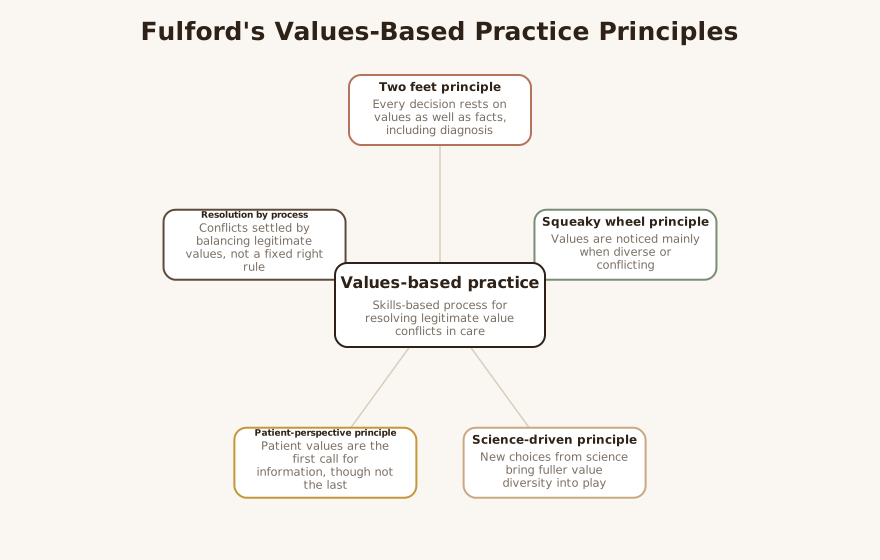
Fulford organizes the framework as ten principles, the first of which is the “two feet” principle: all decisions stand on two feet, on values as well as on facts, including decisions about diagnosis 2. The second, the “squeaky wheel” principle, observes that we tend to notice values only when they are diverse or conflicting — and therefore problematic — which is why values can seem absent in routine practice when in fact they are simply unexamined 5. The third, the “science-driven” principle, holds that scientific progress, by opening up new choices, is increasingly bringing the full diversity of human values into play across all areas of healthcare 5.
The fourth principle establishes the patient-perspective as the “first call” for information in any given decision — the values of the patient or patient group are where values-based reasoning begins, though not where it ends, since other stakeholders’ values are also legitimate parameters 2. The fifth and pivotal principle concerns resolution: conflicts of values are resolved primarily “not by reference to a rule prescribing a ‘right’ outcome, but by processes designed to support a balance of legitimately different perspectives” 2. This is the framework’s decisive break from rule-based ethics — it seeks a good process, not a single correct answer 2.
The remaining principles specify the clinical skills and the partnership model that make the process work 5. Careful attention to language is one of the most powerful methods for raising awareness of values and differences of values; a rich resource of empirical and philosophical methods is available for improving knowledge of other people’s values; ethical reasoning is employed to explore differences of values rather than, as in quasi-legal bioethics, to determine “what is right”; and communication skills carry a substantive rather than a merely executive role 5. The tenth principle returns decision-making “where it belongs, with users and providers at the clinical coalface,” with ethicists and lawyers as partners rather than arbiters 5.
Interventions & Techniques
Because VBP is a process rather than a protocol, its “techniques” are a set of four core clinical skills plus a service-design orientation LLM. The first skill is awareness — recognizing the values, often implicit, that are at play in a clinical encounter, frequently surfaced through careful attention to the language clinicians and patients actually use 4. The second is reasoning — drawing on the philosophical traditions of ethics (principles reasoning, casuistry, utilitarianism, deontology) not to settle a dilemma but to widen the range of values brought into view 4.
The third skill is knowledge of values: just as one must “listen to the evidence,” one must listen for values, using phenomenology, hermeneutics, and empirical methods to find out what a person actually values rather than assuming it 4. The fourth is communication, which VBP treats as central to effective decision-making — the means by which evidence and values are brought together and by which value conflicts are explored and balanced 4. Beyond these four skills, VBP is operationalized through person-centred and genuinely multidisciplinary service design, where the team draws not only on a diversity of professional skills but on a diversity of values 5.
The practical aim is to convert an apparent stand-off between “the evidence” and “the patient’s wishes” into a negotiable conversation between two sets of values 1. A clinician practicing this way reframes a refusal of recommended treatment not as non-compliance but as the surfacing of a legitimate value (such as day-to-day quality of life) to be balanced against another (such as reduced long-term risk) 1.
LLM-generated illustrative example (not a guideline): A client with bipolar disorder declines a recommended mood stabilizer, saying the medication flattens the creative drive that gives his life meaning. Rather than recording “poor insight” and pressing the evidence harder, the clinician treats this as the squeaky-wheel moment where a value has surfaced. Using the four skills, she names the values in play (long-term stability versus felt vitality and identity), listens for what “creativity” means to him, and frames the decision as a balance between two legitimate goods. The conversation yields a monitored trial with agreed early-warning signs and an explicit plan to revisit the trade-off — a balanced process, not a winner LLM.
Evidence Base
The honest label for VBP’s maturity is established — but established as a decision-making framework, not as an outcome-validated treatment LLM. It is a mature body of work with a sustained scholarly footprint: a dedicated Cambridge University Press book series spanning multiple healthcare domains, a canonical ten-principles formulation, and uptake in psychiatry’s training and policy infrastructure that Fulford characterizes as a “first” for the field 34.
What VBP is not is a manualized intervention with a randomized-controlled-trial outcome literature, and this is by design rather than by neglect LLM. The framework’s central claim is about process — that surfacing and balancing values produces better, more genuinely patient-centred decisions — and its strongest support is conceptual, illustrative, and case-based rather than trial-based 4. The primary-care and applied literatures show the approach is teachable and changes how clinicians construe value conflicts, more than they demonstrate superiority over usual care on hard endpoints 1.
The fair summary is that VBP is a conceptually rigorous, philosophically grounded, and institutionally adopted framework whose value lies in how it structures decisions rather than in a packaged effect size 4. A careful clinician should adopt the stance — that every decision rests on values as well as facts, and that conflicting values deserve a fair process — on solid philosophical and professional grounds, while recognizing that “does VBP improve outcomes?” is not the question the framework was built to answer 2LLM.
Populations & Indications
VBP was developed as a general framework for any clinical decision in which values legitimately differ, rather than for a particular diagnostic group, and is especially apt wherever the “right” course of action is genuinely contestable 4LLM. Psychiatric and mental health populations are the signature indication, because diagnosis itself in psychiatry is unusually value-laden and because decisions about risk, autonomy, and treatment so often turn on values rather than on facts alone 4.
Patients facing preference-sensitive decisions — where two reasonable people with the same evidence would choose differently — are a natural fit; the framework’s own example is dementia screening, where an identically informed population split almost evenly, 51% unwilling and 49% willing 1. Patients whose values diverge from guideline-concordant care, such as a person with diabetes who values day-to-day quality of life over a reduced risk of complications, are exactly the cases VBP is built to hold without defaulting to a “non-compliant” label 1. Multidisciplinary teams are themselves an intended “population,” since the framework treats team value-diversity as a resource rather than a problem to suppress 5. The general indication is any decision a clinician would otherwise be tempted to settle by appeal to evidence or rule alone, across medicine, psychiatry, psychology, and primary and social care 23.
Problems-for-Work
In treatment refusal and non-adherence, VBP’s central advantage is that it reframes the impasse: a refusal is read as the surfacing of a legitimate competing value rather than as a failure of insight, opening a balanced conversation rather than an escalation 1. For preference-sensitive decisions such as screening, prophylaxis, or elective treatment, the framework directs the clinician to elicit the patient’s values as the “first call” and to treat divergence as expected rather than aberrant 12.
LLM-generated illustrative example (not a guideline): A clinician and a client with obsessive-compulsive disorder disagree about whether to taper an SSRI the client experiences as “numbing.” The evidence favors continuation; the client values feeling fully present with her children. Treating this as a two-feet decision, the clinician names both values, maps the trade-offs, and they co-design a slow, monitored taper with agreed relapse-warning signs — resolving the conflict through a balanced process rather than by overriding either the evidence or the value LLM.
For diagnostic disagreement, VBP’s two-feet principle helps a clinician see where a diagnostic boundary (for instance, what counts as “disordered” mood or behavior) rests on value judgments that the patient and clinician may not share, making the disagreement discussable 2. In risk and involuntary-treatment decisions, the framework’s insistence on surfacing all stakeholders’ legitimate values — patient, family, clinician, society — gives structure to choices that would otherwise be made by professional fiat 2LLM. For culturally divergent value frameworks, the squeaky-wheel and patient-perspective principles together prompt the clinician to notice and prioritize values that a guideline-driven default would silently override 5LLM.
Contraindications, Cautions & Cultural Humility
The central caution is that VBP is a process for balancing values, not a method for determining the right answer, and it must be presented as such LLM. Where the law, safeguarding duties, or capacity legislation set a binding outcome — for example, an emergency intervention for an incapacitated patient at imminent risk — the values process informs how the decision is made and communicated but does not displace the legal and clinical obligation 2LLM. VBP is a partner to ethics and law, returning routine decisions to the clinical coalface, not a license to negotiate away non-negotiable duties 5.
A related caution is that a poorly executed “values” conversation can become a vehicle for the clinician’s own preferences dressed up as process LLM. The framework’s discipline — beginning from the patient’s perspective as the first call, listening for values with the rigor one brings to evidence, and aiming at a genuine balance of perspectives rather than a foregone conclusion — is what separates principled values-based work from persuasion 24.
Cultural humility is not an add-on to VBP but close to its core motivation LLM. The squeaky-wheel principle reminds the clinician that values feel “absent” mostly when everyone in the room shares them — exactly the condition under which a dominant cultural frame becomes invisible and overrides a client’s divergent values unnoticed 5. The framework’s empirical and philosophical methods for knowing another’s values are how a clinician surfaces a client’s cultural, spiritual, or community values rather than assuming them — treating the client’s value-world as the first call, not as deviation from a guideline-defined norm 4LLM.
Treatment-Plan Suggestions & SMART Objectives
| Goal | SMART objective (example) | Mechanism |
|---|---|---|
| Surface the values in a contested decision | Within one session, clinician and client jointly name at least two competing values bearing on the decision and record them | The two-feet principle makes the value basis of the decision explicit 2 |
| Establish the patient’s values as the first call | Clinician elicits and documents the client’s stated values before recommending a course of action, in 100% of preference-sensitive decisions | The patient-perspective principle prioritizes the client’s values at the outset 2 |
| Reframe non-adherence as a value conflict | For one identified “refusal,” clinician reformulates it in writing as a balance between two legitimate values within two weeks | Reframing converts an impasse into a negotiable conversation 1 |
| Build a balanced decision process | Client and clinician agree a written plan that documents the trade-off and a date to revisit it, within three sessions | Resolution by process, not by rule, supports legitimately different perspectives 2 |
| Strengthen values-awareness skill | Clinician reviews one recent session transcript and identifies the value-laden language used, monthly | Attention to language raises awareness of values and value differences 5 |
| Improve knowledge of the client’s values | Clinician uses an open values-eliciting question and reflects the client’s values back for confirmation each session | Listening for values, as one listens for evidence, improves knowledge of them 4 |
| Integrate evidence and values in one plan | The care plan states, for each major choice, both the relevant evidence and the relevant values, by the planning session | Evidence-based and values-based practice operate as partners in the decision 4 |
| Involve the wider team’s values | In a multidisciplinary review, at least two team members’ differing value perspectives are recorded and weighed | Extended multidisciplinary work draws on a diversity of values 5 |
Common Misconceptions
The first misconception is that values-based practice is the opposite of, or a replacement for, evidence-based practice; in fact Fulford designed it as the explicit partner to evidence-based practice — two processes for two kinds of complexity, facts and values, meant to operate together 4. A second is that VBP is simply a rebranding of medical ethics; it differs sharply in that ethical reasoning is used here to explore differences of values rather than, as in quasi-legal bioethics, to determine “what is right” 5. A third is that “values” means only the patient’s values; the patient’s perspective is the first call, but the values of providers, families, and society are also legitimate parameters in the decision 2.
A fourth misconception is that VBP tells you the right answer; its fifth principle is precisely that conflicts are resolved by a process that balances legitimately different perspectives, not by a rule that prescribes a correct outcome 2. A fifth is that values only matter in dramatic ethical dilemmas; the squeaky-wheel principle holds that values are present in every decision and merely become visible when they conflict 5. A sixth is that VBP downgrades science; its science-driven principle holds the opposite — that scientific progress, by multiplying choices, is what brings the full diversity of values into play 5.
Training & Certification
There is no single licensing board that “owns” values-based practice; it is offered to already-qualified health and social care professionals as a way to work with the value dimension of decisions they already make 3. The framework was developed with an explicit emphasis on training, which Fulford cites as one of the areas in which psychiatry was “first in the field,” alongside policy and research 4. The principal scholarly infrastructure is the Cambridge University Press Values-Based Practice series edited by Fulford and Peile, whose volumes carry the approach into specific domains from dementia care to recovery and commissioning 3.
Because VBP is fundamentally skills-based, training centers on the four clinical skills — awareness, reasoning, knowledge, and communication — taught through exercises that surface the values embedded in everyday clinical language and materials 4. The practical path for a licensed clinician is to study the ten principles and the foundational papers, practice eliciting and balancing values in supervised cases, and develop the habit of construing every decision as standing on two feet 24. Introductory orientations to the framework, including Fulford’s own, are available to clinicians beginning this work 6.
Key Terms
Values-Based Practice (VBP) — a primarily skills-based process for working with complex and conflicting values in healthcare, designed as the partner to evidence-based practice 4. Two-feet principle — the premise that every decision rests on values as well as facts, including diagnosis 2. Squeaky-wheel principle — the observation that values are noticed mainly when they are diverse or conflicting, and so seem absent in routine practice 5. Science-driven principle — the idea that scientific progress, by opening up choices, brings the full diversity of human values into play 5. First call — the patient’s or patient group’s values as the starting point for values-based reasoning 2. Dissensus / balanced process — resolution of value conflict by a process that supports a balance of legitimately different perspectives rather than by a rule prescribing the “right” outcome 2. Fact/value distinction — the ordinary-language-philosophy insight, drawn from Hare and Austin, that clinical judgments carry value commitments alongside factual ones 4. Four clinical skills — awareness, reasoning, knowledge of values, and communication, the teachable competencies that operationalize VBP 4.
Resources & Further Reading
▶ Watch — a video introduction to this concept:
- Fulford, K.W.M. — Facts/Values: Ten Principles of Values-Based Medicine (APA PsycNet record)
- Petrova, Dale & Fulford — Values-based practice in primary care: easing the tensions between individual values, ethical principles and best evidence (PMC)
- Cambridge University Press — Values-Based Practice book series (Fulford & Peile, eds.)
- Fulford — Values-Based Practice: A New Partner to Evidence-Based Practice and A First for Psychiatry? (PMC)
- Fulford — Ten Principles of Values-Based Medicine (VBM) (De Gruyter chapter)
- Antonia Cook and Prof. Bill Fulford — Introduction to Values Based Practice (video)
Reflective / Supervision Questions
- When you next reach an impasse over a patient’s refusal of recommended care, what changes if you treat it as the surfacing of a legitimate competing value rather than as a problem of insight or adherence? LLM
- In your own diagnostic formulations, where do the value judgments hide inside language that feels purely factual, and how would you make them discussable with the client? LLM
- When a values conversation goes “smoothly,” how do you tell the difference between genuine agreement and the squeaky wheel staying quiet because a dominant frame went unexamined? LLM
- Whose values, beyond the patient’s, are legitimate parameters in a given decision, and how do you weigh them without letting professional or institutional values quietly override the first call? LLM
- Given that VBP aims at a balanced process rather than a “right” answer, how do you hold that stance honestly in a case where the law or a safeguarding duty does set a binding outcome? LLM
- How would you actually elicit a client’s cultural or spiritual values with the same rigor you bring to “listening to the evidence,” rather than assuming them? LLM
- What would it take, in your setting, for evidence-based and values-based practice to function as genuine partners in a single care plan rather than as competing demands? LLM