
Type & Discipline
Evidence-Based Therapy Relationships and Responsiveness is a framework within clinical psychology rather than a discrete, manualized treatment package LLM. It sits in the psychotherapy-integration and common-factors tradition, asking not “which brand of therapy works?” but “which elements of the therapeutic relationship demonstrably contribute to outcome, and how should treatment be adapted to the individual client?” 6. The framework was produced by an interdivisional task force jointly sponsored by APA Division 12 (Society of Clinical Psychology) and Division 29 (Society for the Advancement of Psychotherapy) 1. Its central claim is empirical and transdiagnostic: the therapy relationship makes substantial and consistent contributions to psychotherapy outcome independent of the specific type of treatment 1. As such, it functions as a meta-framework that any modality-trained clinician can layer onto CBT, IPT, psychodynamic, or family work rather than a competitor to those approaches LLM. It is descriptive of what effective clinicians already do and prescriptive about doing it more systematically LLM.
Creators & Lineage
The task force and its successive evidence syntheses were chaired and edited by John C. Norcross, whose name anchors the published conclusions and the two-volume compendium Psychotherapy Relationships That Work 1. The third edition divides the evidence into two volumes: Volume 1 catalogues evidence-based therapist contributions and relationship elements, and Volume 2 catalogues evidence-based responsiveness — the tailoring of treatment to client characteristics 23. Bruce Wampold is closely associated with the program through the contextual model of psychotherapy and the co-authored argument for “a new therapy for each patient” built on relationships and responsiveness 6. Michael J. Lambert’s work on routine outcome monitoring and systematic client feedback is a natural lineage partner, since collecting client feedback emerged as a demonstrably effective relationship element LLM. The intellectual roots reach back to person-centered therapy’s emphasis on empathy and unconditional positive regard, to Bordin’s working-alliance theory of bond, goal, and task, and to the broader common-factors literature LLM. The program can be read as the modern, meta-analytically disciplined heir of that common-factors lineage LLM.
Core Principles
The organizing principle is that the relationship and the treatment method both matter, and that the relationship accounts for why clients improve or fail to improve at least as much as the particular method 1. A second principle is responsiveness: effective therapists do not deliver a fixed protocol identically to everyone but adjust their stance, pacing, and structure to the person in the room 6. A third principle is that these relational and adaptational behaviors are measurable and gradable by the same evidentiary standards applied to techniques 1. The framework deliberately reframes the sterile “relationship versus technique” debate as a false dichotomy, arguing both are necessary and interdependent in practice 6. A fourth principle is that the relationship is co-created: it is a property of the dyad, not a fixed trait the therapist either has or lacks LLM. Finally, it treats the client as an active agent whose preferences, culture, and resistance level are not noise to be controlled but data that should shape the treatment 1. Taken together, these principles position the therapist as a flexible decision-maker who continuously reads the relationship and recalibrates LLM.
Interventions & Techniques
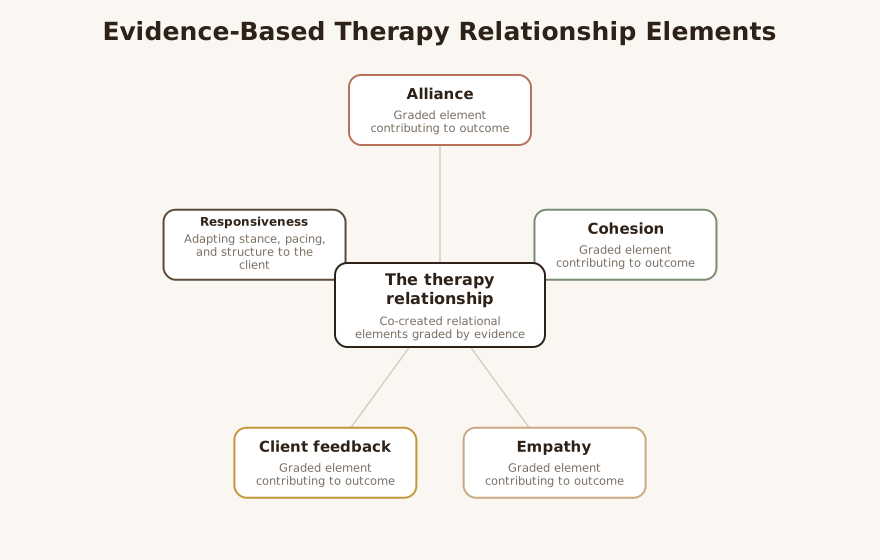
The task force graded specific relationship elements by strength of evidence 1. Rated demonstrably effective were the alliance in individual, youth, and family psychotherapy; cohesion in group therapy; empathy; and collecting client feedback 1. Rated probably effective were goal consensus, collaboration, and positive regard 1. Rated promising but with insufficient research to judge were congruence/genuineness, repairing alliance ruptures, managing countertransference, expectations, and attachment style 1. Alongside these elements sit the responsiveness “adaptation” methods: matching the treatment to a client’s reactance/resistance level, preferences, culture, and religion/spirituality were rated demonstrably effective, while adapting to stage of change and coping style were rated probably effective 1. In practice this means a clinician actively cultivates the bond, repeatedly negotiates explicit goals and tasks, monitors the alliance with brief session-by-session measures, and watches for ruptures so they can be named and repaired LLM. It also means deciding how directive to be, how much to self-disclose, and how to frame interventions based on who the client is LLM. Volume 2 compiles the meta-analytic evidence supporting these adaptational moves 3.
LLM-generated illustrative example (not a guideline): A therapist notices a high-reactance client bristling at homework assignments. Rather than pressing the protocol, she offers two options and lets the client choose the order — leveraging preference-matching and reducing reactance while keeping the CBT frame intact LLM.
Evidence Base
The maturity of this framework is best described as established but with contested mechanisms LLM. The associations are robust and widely replicated: across hundreds of studies and many meta-analyses, the alliance and related elements correlate reliably with outcome, which is why the task force could grade several elements “demonstrably effective” 1. The grading itself encodes a transparency about evidence quality, separating elements supported by multiple meta-analyses from those resting on thinner or mixed findings 1. The strongest single conclusion — that the relationship contributes substantially and consistently to outcome independent of treatment type — rests on a large, mature evidence base 1. The honest caveat is that most of this evidence is correlational, not experimental LLM. The alliance–outcome correlation does not by itself prove the alliance causes improvement; reverse causation is plausible, in that early symptom relief may strengthen the alliance rather than the reverse LLM. A published set of reservations about the task force conclusions argued that the causal inferences drawn were stronger than the correlational data warranted and questioned treating the relationship as cleanly separable from technique 5. The fair reading is that the relationship’s predictive value is well established, while the precise causal weight and mechanism remain actively debated LLM. Clinicians should therefore hold the conclusions as strong clinical guidance, not as settled causal law LLM.
Populations & Indications
The framework is explicitly transdiagnostic and pan-theoretical, intended to apply to psychotherapy clients across diagnoses rather than to a single disorder 1. The graded elements span individual adult work, youth and family therapy, and group therapy, with cohesion carved out as the group-specific analogue of the alliance 1. It is indicated wherever a therapeutic relationship exists, which in practice means nearly all psychotherapy formats including adults, adolescents, couples, and groups 1. The responsiveness arm is especially relevant for diverse and multicultural clients, since adapting to culture and to religion/spirituality were both rated demonstrably effective 1. Conditions commonly treated in these formats — major depressive disorder, generalized anxiety disorder, and PTSD — fall squarely within scope because the framework operates regardless of the presenting diagnosis LLM. The framework is best understood as a layer applied to whatever diagnosis-specific protocol is indicated, not as a substitute for matching treatment to disorder LLM.
Problems-for-Work
Several recurring clinical problems map directly onto the framework’s elements LLM. Treatment dropout and premature termination are central targets, because a strong alliance and explicit goal consensus are among the most reliable predictors of staying in treatment 1. Alliance ruptures are addressed directly through the rupture-repair element, which the task force flagged as promising and clinically important even where the research base is still maturing 1. Resistance and poor engagement are reframed through reactance-matching, where adapting structure and directiveness to the client’s resistance level was rated demonstrably effective 1. Low treatment response can be caught earlier through routine collection of client feedback, the demonstrably effective monitoring element 1.
LLM-generated illustrative example (not a guideline): A clinician using a brief alliance measure sees a sudden drop after session four. She raises it openly — “I sensed some distance last week; did something I said land wrong?” — names the rupture, and renegotiates the task, converting a likely dropout into a repaired alliance LLM.
Contraindications, Cautions & Cultural Humility
There are no contraindications to attending to the relationship itself, but there are real cautions in how the framework is applied LLM. Responsiveness must not become an excuse for abandoning effective techniques or drifting aimlessly to please the client; the data support adapting the delivery of evidence-based treatment, not discarding it 6. Because adaptation to culture and to religion/spirituality is itself an evidence-based move, cultural humility is not optional decoration but part of the demonstrated mechanism 1. Clinicians should avoid stereotyped “matching,” instead treating culture as something to be assessed with each individual rather than assumed from group membership LLM. A further caution from the critical literature is that overstating the causal power of the relationship risks underweighting technique and structure 5. Underweighting procedural interventions can in turn disadvantage clients who genuinely need specific structured techniques LLM. Self-monitoring of countertransference remains a flagged, still-maturing area where consultation and supervision are the appropriate safeguards 1.
Treatment-Plan Suggestions & SMART Objectives
| Goal | SMART objective (example) | Mechanism |
|---|---|---|
| Strengthen early alliance to reduce dropout | Client and therapist will collaboratively agree on written treatment goals by session 2, reviewed monthly | Alliance; goal consensus 1 |
| Detect and repair ruptures | Client will complete a 4-item alliance measure each session for 8 weeks; any score drop triggers an explicit rupture discussion | Alliance; repairing ruptures 1 |
| Catch non-response early | Therapist will review session-by-session outcome data weekly and adjust the plan if no improvement by session 4 | Collecting client feedback 1 |
| Increase engagement in a high-reactance client | Client will select task order and homework format in 3 of the next 4 sessions | Reactance/resistance adaptation 1 |
| Improve felt understanding | Client will rate “feeling understood” at 4/5 or higher on a session-end check by week 6 | Empathy; positive regard 1 |
| Tailor treatment to cultural context | Therapist will complete a cultural-context discussion and integrate at least one client-identified value into the plan by session 3 | Culture adaptation 1 |
| Build group cohesion | Group members will report belonging at 4/5 or higher on a cohesion check by session 5 | Group cohesion 1 |
Common Misconceptions
A frequent misconception is that this framework says technique does not matter; in fact it argues relationship and method are both necessary and interdependent 6. A second is that “being relational” means being uniformly warm and nondirective, whereas responsiveness sometimes means becoming more structured and directive for a low-reactance client 1. A third is that the elements are soft or unmeasurable, when each was graded by the same meta-analytic standards used to evaluate techniques 1. A fourth is that the strong language (“demonstrably effective”) implies proven causation; the evidence is largely correlational, and the causal weight is debated 5. A final misconception is that responsiveness is purely intuitive and untrainable, when in fact specific behaviors — soliciting feedback, negotiating goals, repairing ruptures — can be taught and rehearsed LLM.
Training & Certification
There is no certification or credential in “evidence-based therapy relationships,” and none is needed, because the framework is meant to be absorbed into existing modality training rather than practiced under a separate license LLM. The primary training resources are the two volumes of Psychotherapy Relationships That Work, which compile the graded elements and the responsiveness evidence with explicit practice recommendations 23. The peer-reviewed conclusions and the open clinical summary provide a concise entry point for clinicians and supervisors 1. Skill acquisition is best pursued through supervised practice in alliance monitoring, rupture repair, and feedback-informed treatment, supported by routine outcome measurement systems LLM. Continuing-education workshops on the alliance and on feedback-informed treatment are widely available and map directly onto these elements LLM.
Key Terms
Alliance: the bond plus agreement on goals and tasks between client and therapist, rated a demonstrably effective relationship element 1. Cohesion: the group-therapy analogue of the alliance, also rated demonstrably effective 1. Responsiveness: adapting the treatment to the individual client’s characteristics rather than delivering a fixed protocol 6. Reactance/resistance level: the client’s sensitivity to perceived loss of autonomy, used to calibrate therapist directiveness; a demonstrably effective adaptation 1. Rupture repair: the process of recognizing and resolving strains in the alliance, a promising but still-maturing element 1. Collecting client feedback: routine measurement of progress and alliance to inform treatment, a demonstrably effective element 1.
Resources & Further Reading
▶ Watch — a video introduction to this concept:
- Conclusions and Recommendations of the Interdivisional (APA Divisions 12 & 29) Task Force on Evidence-Based Therapy Relationships 1
- Psychotherapy Relationships That Work, Vol. 1: Evidence-Based Therapist Contributions, 3rd ed. (Oxford UP) 2
- Psychotherapy Relationships That Work, Vol. 2: Evidence-Based Therapist Responsiveness (Oxford UP) 3
- Psychotherapy Relationships That Work: Volume 1 (Oxford Academic) 4
- Reservations about the Conclusions of the Interdivisional Task Force (Kazantzis et al., 2015, J. Clinical Psychology) 5
- A new therapy for each patient: Evidence-based relationships and responsiveness (Norcross & Wampold) 6
Reflective / Supervision Questions
- How do you currently know whether your alliance with a given client is strengthening or fraying, and would a brief measure tell you sooner? LLM
- When a client resists a task, do you reflexively press the protocol, or do you treat the resistance as data about how to adapt? LLM
- Which of the demonstrably effective elements — alliance, cohesion, empathy, feedback — is least systematically present in your practice? LLM
- How do you distinguish responsive adaptation from technique drift in your own caseload? LLM
- In what concrete way did your last cross-cultural case shape the treatment plan rather than just the rapport? LLM
- When did you last name and repair a rupture out loud, and what stopped you on the occasions you did not? LLM