
Type & Discipline
Narrative Medicine is a framework and pedagogy rooted in the medical humanities rather than a discrete psychotherapy modality 4. Its founder, Rita Charon, defines it as “clinical practice fortified by narrative competence—the capacity to recognize, absorb, metabolize, interpret, and be moved by stories of illness” 3. The discipline sits at the intersection of literary studies and clinical care, applying skills of literary analysis to the patient encounter and treating the patient’s account of illness as a text with plot, character, metaphor, and temporal structure 4. It is sometimes summarized as “the medicine practiced with the narrative competence to recognize, absorb, interpret, and be moved by the stories of illness” 6.
For psychotherapists, Narrative Medicine is best understood as a competence and a stance that can be layered onto any treatment, not a standalone protocol LLM. It supplies a disciplined way of attending to the form and texture of a client’s story—what is said, what is withheld, and how the telling is shaped—and pairs naturally with relational and trauma-informed work LLM. Where evidence-based medicine asks what is true of populations, Narrative Medicine asks what is true of this person’s singular experience of their illness 1.
Creators & Lineage
Narrative Medicine was pioneered in the 1990s by Rita Charon, an internist who also holds a doctorate in English literature, working alongside the physician Rachel Naomi Remen; Charon coined the term “Narrative Medicine” around 2000 4. Charon articulated the field in a landmark 2001 JAMA article, “Narrative Medicine: A Model for Empathy, Reflection, Profession, and Trust,” which positioned narrative competence as a bridge across the divides separating physician from patient, self, colleagues, and society 1. She established the Program in Narrative Medicine at Columbia University, which in 2009 created the first Master of Science degree in the field, and her 2006 book Narrative Medicine: Honoring the Stories of Illness remains the foundational text 42.
The lineage draws on the broader medical humanities movement, with historical roots traced to the 1910 Flexner Report’s call for humanistic preparation alongside scientific training 4. Charon’s theoretical scaffolding incorporates phenomenology, psychoanalytic theory, trauma studies, aesthetics, and film theory 3. The collaborator Sayantani DasGupta contributed the concept of narrative humility, which positions patients as teachers rather than texts to be mastered 3. The field is conceptually adjacent to Narrative Therapy and to patient-centered and biopsychosocial models of care, sharing their emphasis on meaning, context, and the person behind the diagnosis 4LLM.
Core Principles
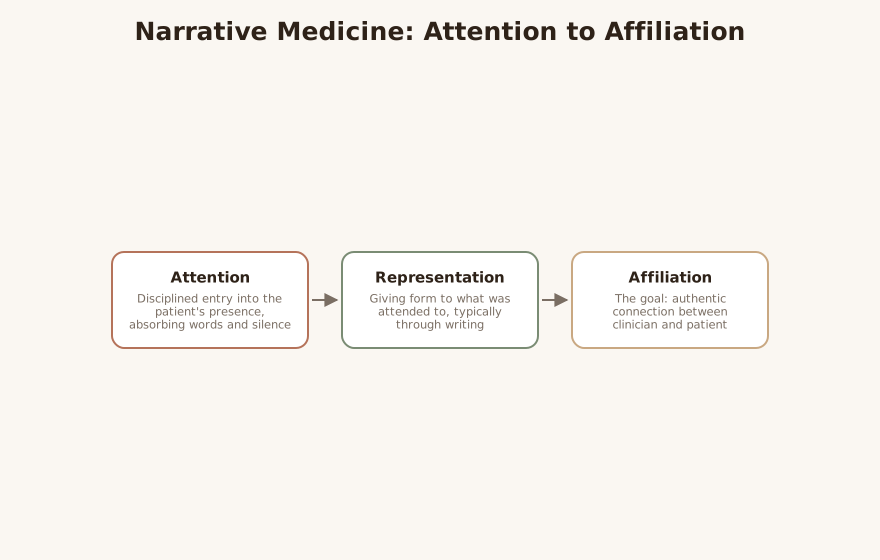
Charon organizes the practice around three movements: attention, representation, and affiliation 3. Attention is the clinician’s disciplined entry into the patient’s presence, absorbing “what the patient emits in words, silence, and physical state”; Charon links it to contemplative practice and to Freud’s notion of “evenly hovering attention” 3. Representation is the act of giving form to what was attended to—typically through writing—because writing “makes audible and visible that which otherwise would pass without notice” 3. Affiliation is the goal: “authentic and muscular connections between doctor and patient” and among caregivers, countering the isolation of both clinician and patient 3.
A second organizing idea is narrative competence itself—the trained ability to acknowledge, absorb, interpret, and act on the stories of others 5. Charon frames its clinical payoff across four domains: empathy, reflection, profession, and trust 1. The premise is that illness is lived as a story, and that a clinician who can follow the form of that story—its temporality, its singularity, its causal logic—understands the patient more fully than one who extracts only data 41.
Interventions & Techniques
The signature pedagogical method is close reading: the careful, critical study of a text for its information, ambiguity, complexity, texture, and mood, transferred from literature to the patient’s narrative 4. Examining textual features—genre, figurative language, temporal structure, the narrator’s stance, and allusion—is held to reveal meaning that a checklist history would miss 3.
The second core technique is reflective writing. Trainees document clinical encounters and process the emotional experience of care, sometimes at substantial length, and may also produce creative work such as essays, poetry, or fiction 5. A specific clinical device associated with the field is the parallel chart: a separate record in which the clinician writes what cannot go in the standard medical chart—the human dimensions of the encounter and of the clinician’s own response 4. Close reading of trainees’ own reflective writing, discussed in groups, completes the loop 4.
LLM-generated illustrative example (not a guideline): In a therapy session, a clinician notices a client repeatedly shifting verb tense when describing a recent diagnosis—narrating the past in the present and the future in the conditional. Reading the client’s account closely, the clinician reflects this back: “I notice the diagnosis seems to live in the present for you, while the future has gone uncertain.” The observation, drawn from the form of the telling rather than its content alone, opens a conversation about anticipatory grief that the client had not named LLM.
Evidence Base
The maturity of Narrative Medicine as a field and pedagogy is established: it has a named founder, a foundational literature, a graduate degree program, and adoption across many medical schools 45. Its maturity as an outcome-validated intervention, however, is considerably thinner, and this distinction matters for honest practice LLM.
Charon reports that “students and clinicians who have undergone narrative training with us strengthen their therapeutic alliances with patients and deepen their ability to adopt or identify others’ perspectives,” but her foundational writings are explicitly theoretical and offer limited empirical detail 3. Coverage of the field acknowledges that key publications reference the conceptual model—narrative competence as essential to practice—without providing outcome studies or quantitative data 5. The plausible mechanisms (empathy, reflection, trust) are articulated and intuitive, but rigorous controlled trials demonstrating changes in patient or clinician outcomes remain sparse 1LLM. Clinicians should therefore present Narrative Medicine to clients and colleagues as a well-developed, theoretically grounded humanistic practice whose proximal benefits—feeling heard, relational depth—are better documented than distal clinical endpoints 5LLM.
Populations & Indications
Narrative Medicine is most clearly indicated where the experience of illness, rather than its acute biomedical management, dominates the clinical picture LLM. This includes patients with chronic illness, for whom adjustment is an ongoing, meaning-laden process, and people with serious or terminal illness, where accompaniment matters as much as technique 6. Charon stresses that patients “need physicians who can understand their diseases, treat their medical problems, and accompany them through their illnesses”—accompaniment being the operative word 6.
The framework also explicitly addresses healthcare providers themselves, who use reflective writing to process the emotional burden of care, and it extends naturally to hospitalized patients and caregivers whose stories are often unheard 5LLM. In a behavioral health setting, the indicated populations broaden to anyone navigating illness-related distress, loss of meaning, or a frayed relationship with the medical system LLM.
Problems-for-Work
Narrative Medicine maps onto several presenting problems familiar in therapy:
- People with chronic illness adjustment and illness-related distress. Close reading of how a client narrates their condition can surface the meaning they have assigned to it—villain, test, punishment, companion—and open space to revise that meaning 4LLM.
- Grief and end-of-life concerns. Representing the experience through writing can give form to losses that have not yet been spoken, supporting anticipatory and complicated grief work 3LLM.
- Provider burnout. Reflective practice reminds clinicians that “there’s a story to be had everywhere,” restoring meaning to work that has become monotonous 5.
- Patient-provider communication problems. Narrative humility and attentive listening help repair encounters in which a client felt reduced to a diagnosis 35.
- Loss of meaning and suffering. The affiliative goal of “authentic and muscular connections” directly addresses the isolation that compounds suffering 3LLM.
Contraindications, Cautions & Cultural Humility
Narrative Medicine has no formal contraindications as a stance, but several cautions apply LLM. Reflective writing and the deep retelling of illness can re-expose clients to traumatic material; in trauma survivors, pacing and titration matter, and the work should not be pushed faster than a client can tolerate LLM. The framework is not a substitute for indicated biomedical or evidence-based psychological treatment, and treating a client’s story as the whole picture risks neglecting symptoms that require structured intervention 1LLM.
The concept of narrative humility is itself the field’s built-in cultural-humility corrective: it casts the patient as the authority on their own experience and the clinician as a learner, guarding against the clinician imposing a literary or diagnostic interpretation on a story that belongs to someone else 3. Stories are culturally shaped—idioms of distress, metaphors for illness, and norms about disclosure vary widely—so a clinician must read each narrative within the client’s own frame rather than a default one LLM. There is also a documentation caution: the parallel chart contains candid, personal reflection and is distinct from the formal record, so confidentiality and boundaries around such writing deserve care 4LLM.
Treatment-Plan Suggestions & SMART Objectives
| Goal | SMART objective (example) | Mechanism |
|---|---|---|
| Strengthen the therapeutic relationship | Within 4 sessions, client reports feeling “heard and understood” on a session-rating measure in 3 of 4 sessions | Attention and affiliation 35 |
| Process illness-related distress | Over 6 weeks, client completes 3 reflective writing pieces about their illness experience and reviews them in session | Representation 3 |
| Revise the meaning assigned to chronic illness | Within 8 sessions, client identifies and names the dominant metaphor in their illness story and articulates one alternative framing | Close reading / narrative competence 4 |
| Support anticipatory grief | Over 5 sessions, client narrates and gives written form to two anticipated losses, rating distress before and after | Representation and affiliation 3LLM |
| Reduce isolation in serious illness | Within 6 weeks, client identifies two relationships in which to share part of their illness story and reports back | Affiliation 3 |
| Improve patient-provider communication | Before the next specialist visit, client drafts a one-page narrative summary of their concerns to bring to the appointment | Narrative competence 15 |
| Restore meaning / reduce burnout (clinician self-work) | Over 4 weeks, clinician maintains a parallel chart entry after 3 emotionally salient encounters | Reflection 45 |
Common Misconceptions
A frequent misconception is that Narrative Medicine simply means “listening to patients” or being a nice, attentive clinician; in fact it specifies trainable skills—close reading, reflective writing, and the disciplined movements of attention, representation, and affiliation—not merely a kind disposition 34. A second is that it is a form of psychotherapy or a manualized treatment; it is a competence and pedagogy that augments care across settings rather than a standalone modality 4LLM.
A third misconception is that it is “soft” or anti-scientific; Charon frames narrative competence as a rigorous discipline with theoretical roots in phenomenology, psychoanalysis, and aesthetics, intended to complement rather than replace biomedical reasoning 31. Finally, some assume the patient’s story is to be analyzed like a literary specimen; narrative humility explicitly resists this, holding the patient as teacher and the clinician as the one who must learn 3.
Training & Certification
The field has a defined training pathway centered at Columbia University, which since 2009 has offered the only graduate degree—a Master of Science in Narrative Medicine—and embeds required narrative seminars in its medical curriculum 45. Numerous other institutions have established programs, including Temple University’s Lewis Katz School of Medicine (2016), the University of Southern California, and the University of Nevada, Reno, with offerings ranging from workshops to scholarly concentrations and electives 45. The first textbook, The Principles and Practice of Narrative Medicine, appeared in 2016 4.
There is no single licensing body or required certification to practice with a narrative-medicine sensibility; training is most often pursued through degree programs, workshops, and the foundational texts 4LLM. Charon’s 2006 book and 2001 JAMA article are the standard entry points to the literature 21.
Key Terms
- Narrative competence — the capacity to recognize, absorb, interpret, and be moved by stories of illness, and to act on them 35.
- Attention — disciplined, mindful presence with the patient, absorbing words, silence, and physical state; linked to “evenly hovering attention” 3.
- Representation — giving form to what was attended to, typically through writing, to make the unnoticed audible and visible 3.
- Affiliation — the “authentic and muscular” connection between clinician and patient that counters isolation 3.
- Close reading — careful, critical analysis of a text (or a patient’s story) for information, ambiguity, complexity, texture, and mood 4.
- Parallel chart — a separate record for the human dimensions of care that do not belong in the standard medical chart 4.
- Narrative humility — DasGupta’s stance positioning the patient as teacher and the clinician as learner 3.
Resources & Further Reading
▶ Watch — a video introduction to this concept:
- Charon R. Narrative Medicine: A Model for Empathy, Reflection, Profession, and Trust. JAMA. 2001;286:1897-1902 (reference)
- Charon R. Narrative Medicine: Honoring the Stories of Illness. Oxford University Press; 2006
- Charon R. What to do with stories: the sciences of narrative medicine (PMC)
- Narrative medicine — Wikipedia
- Narrative Medicine: Every Patient Has a Story — AAMC
- Narrative Medicine: Listening to Patients’ Stories — IBSA Foundation
Reflective / Supervision Questions
- When a client tells the story of their illness, do I attend to its form—tense, metaphor, what is omitted—or only extract its content? 3LLM
- Where in my caseload have I treated a client’s narrative as data to be processed rather than a story I am privileged to receive? 3LLM
- How might a parallel-chart practice change my relationship to emotionally difficult encounters, and what would I do with what I write? 4LLM
- Am I claiming more for narrative work than the evidence supports, and how do I hold its theoretical depth alongside its thin outcome base when I describe it to clients? 5LLM
- Whose narrative frame am I reading within—the client’s, or my own cultural and professional default? 3LLM