
Type & Discipline
Shared decision-making (SDM) is a framework for clinical decision-making rather than a treatment modality in its own right LLM. It originated in general medicine and medical ethics and has since been adapted across mental health services, where it intersects with recovery-oriented and patient-centered care 6. At its core, SDM defines how a clinician and a patient arrive at a choice among reasonable options, not which option they should choose LLM. It applies most directly to preference-sensitive decisions—situations where more than one defensible course of action exists and the “right” answer depends substantially on what the patient values 1.
For practicing therapists, SDM is the structural backbone underneath much of what we already do informally when we discuss treatment goals, modality choices, medication referrals, frequency of sessions, or whether to involve family LLM. Naming it as a discrete framework helps make that deliberation deliberate, teachable, and auditable rather than left to clinical habit LLM.
Creators & Lineage
The conceptual foundation is usually traced to Cathy Charles, Amiram Gafni, and Tim Whelan, whose 1997 paper “Shared decision-making in the medical encounter: what does it mean? (or it takes at least two to tango)” gave the field its first rigorous definition 1. Charles and colleagues situated SDM as a middle path between two poles: the paternalistic model, in which the clinician decides, and the purely informed model, in which the clinician discloses information and the patient decides alone 1. SDM, by contrast, requires genuine partnership—reciprocal information exchange and joint deliberation toward an agreed action 1.
The intellectual lineage runs back further to the rise of patient autonomy in medical ethics through the 1970s and 1980s, and to Jack Wennberg’s work on unwarranted geographic variation in care, which argued that patient preferences—not provider habit—should drive utilization of preference-sensitive treatments 6. Glyn Elwyn then operationalized SDM into a teachable clinical process, culminating in the 2017 three-talk model and a family of measurement tools 26. Mike Slade and others extended SDM into mental health and recovery contexts, where the stakes, time horizons, and power dynamics differ from acute medicine LLM. The International Patient Decision Aid Standards (IPDAS) Collaboration, associated with Annette O’Connor and Elwyn, later established quality standards for the decision aids that frequently accompany SDM 6.
Core Principles
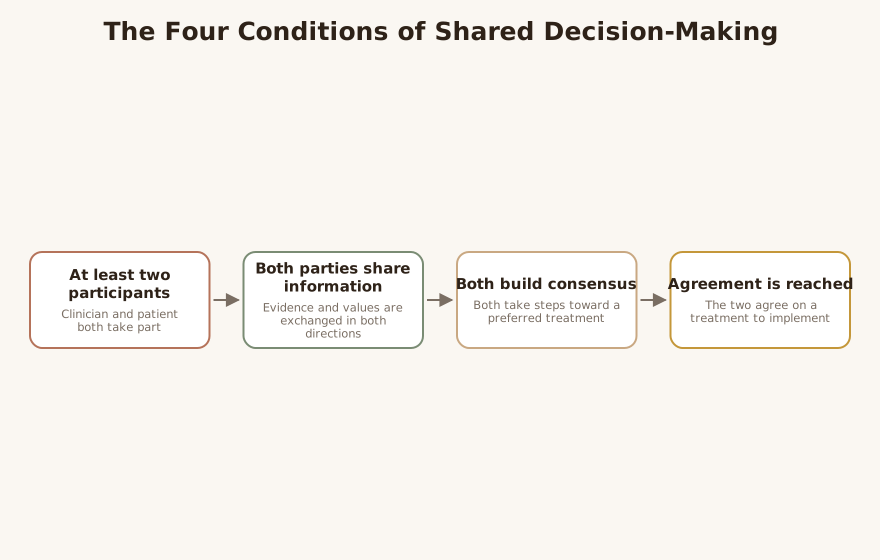
Charles, Gafni and Whelan articulated four conditions that distinguish shared from non-shared decisions 1:
- At least two participants are involved—the clinician and the patient 1.
- Both parties share information 1.
- Both parties take steps to build consensus about the preferred treatment 1.
- An agreement is reached on the treatment to implement 1.
The phrase “it takes at least two to tango” captures the reciprocity that defines the model: a clinician who merely informs, or a patient who merely consents, has not engaged in SDM 1. Crucially, SDM does not mean abandoning clinical expertise or offloading the decision onto the patient; the clinician brings evidence and experience, the patient brings values and lived priorities, and the two are deliberated together 2.
A second principle, developed in mental health and dynamic-model literature, is that SDM is rarely a single event 45. It is better understood as a process distributed across multiple contacts, with room for preparation before a consultation and follow-up afterward 5. This matters acutely in mental health, where a single high-emotion appointment may not be the moment a person can best weigh options 4.
Interventions & Techniques
Elwyn’s three-talk model (2017) is the most widely taught operationalization, breaking SDM into three conversational stages 2:
- Team Talk — establish that choices exist, provide emotional support to a patient facing the responsibility of choosing, and elicit the patient’s goals 2. This stage explicitly addresses the vulnerability and “fear of abandonment” patients can feel when handed a decision 2.
- Option Talk — compare the reasonable alternatives, discussing harms, benefits, and trade-offs using evidence-based communication 2. Patient decision aids fit naturally here, though the model accommodates rather than requires them 2.
- Decision Talk — move toward an informed decision that reflects the patient’s preferences, guided by the clinician’s experience and expertise 2.
Patient decision aids—structured tools that present options and outcomes in a balanced, evidence-based way—are the most studied adjunct technique 6. Cochrane systematic reviews indicate decision aids “probably result in better informed, values-congruent patient decisions” 6.
Risk and benefit communication is a core skill: NICE NG197 dedicates formal recommendation sections to communicating risks, benefits, and consequences, and to using decision aids effectively 3. Mental health users specifically ask for jargon-free language and multiple information formats—verbal, written, visual, and audio 4.
LLM-generated illustrative example (not a guideline): A therapist working with a client weighing whether to add a psychiatric medication referral to ongoing therapy might open with Team Talk—“There are a few directions we could take here, and I want us to decide together”—then move to Option Talk by laying out therapy-alone, combined treatment, and a watchful-waiting period with their respective trade-offs, before Decision Talk: “Knowing how you feel about medication, where does that leave you?” LLM.
Evidence Base
SDM is best characterized as an established framework rather than an experimental one LLM. Its definitions are stable and decades old, it is embedded in formal clinical guidance, and a validated measurement infrastructure exists 136. National-level adoption includes the NICE guideline in the UK and the NHS RightCare SDM Programme, with dedicated research chairs in Canada 36.
The strongest single evidence claim concerns decision aids: Cochrane reviews find they probably improve patient knowledge and produce more values-congruent decisions 6. Cochrane evidence also supports SDM interventions specifically for people with mental health conditions, signaling applicability beyond physical medicine 6.
Measurement is comparatively mature. Validated instruments include the OPTION scale (an observer rating of clinician involvement behaviors, with a five-item version aligned to the three-talk model), the patient-reported SDM-Q-9, the observation-based CollaboRATE, and SURE, a four-item screen for decisional conflict 6.
Honesty about the limits is warranted: a recurrent finding is that real-world implementation is uneven, and that this unevenness reflects systemic and individual barriers more than ignorance of the concept 5. The dynamic-model literature notes it remains “unclear what a shared decision is and how it is practiced,” and that standard models underspecify how evidence, expertise, and patient values are actually integrated in the room 5. So while the framework is established, fidelity in practice is variable 5.
Populations & Indications
SDM is indicated whenever a preference-sensitive decision exists—multiple reasonable options whose best choice depends on the patient’s values 1. In Charles’ original framing this centered on serious illness with uncertain outcomes 1, but the principle generalizes to most therapy decisions: choice of modality, goal prioritization, session frequency, medication referral, level of care, and involvement of family or support networks LLM.
In mental health specifically, adults using community-based services have been studied directly and report clear decisional needs: pre-meeting preparation, comprehensive information about options and risks, unpressured time to deliberate, written summaries, and accessible follow-up 4. People with chronic or recurrent conditions, whose decisions recur over a long arc and span multiple life domains, are particularly well served by a distributed, multi-contact approach 45. Service users also bring experiential expertise—self-developed coping strategies and self-knowledge—that SDM explicitly invites into the deliberation 4.
Problems-for-Work
- Decisional conflict — when a client feels stuck or unsure between options, the SURE screen can surface it and SDM structure can resolve it by clarifying values and trade-offs 6. Application: a client oscillating between two therapy approaches is helped to name what each would cost and gain relative to what matters most to them LLM.
- Treatment non-adherence — decisions reached jointly and aligned to values are more likely to be owned and followed through; SDM targets the disengagement that follows decisions made to rather than with a person LLM6.
- Power imbalance in the clinical relationship — mental health users report being “regarded as untrustworthy as a consequence of being mentally ill,” and SDM directly counters this by structuring respect, equality, and shared authority into the encounter 4. Application: inviting a trusted support person to a session can counterbalance the power asymmetry the client perceives 4.
- Mismatch between treatment and patient values — Option and Decision Talk exist precisely to ensure the chosen path reflects the patient’s informed preferences rather than the clinician’s default 2.
- Disengagement from care — emotional intensity and feeling rushed drive people out; preparation and follow-up phases give them room to stay engaged 4.
Contraindications, Cautions & Cultural Humility
SDM is not universally applicable. NICE explicitly excludes emergencies requiring immediate life-saving care and situations where a patient lacks the mental capacity to make the decision 3. In therapy, acute risk states may temporarily shift the balance toward clinician-led action LLM.
A second caution: not all patients want or can adopt the active role SDM assumes 5. Some prefer to defer to the clinician, some lack awareness of options or sufficient comprehension, and some experience the relationship as too unequal to participate freely 5. Forcing an SDM script onto someone who wants direction can itself be a failure of patient-centeredness LLM. The dynamic model therefore frames decision-making style as something to be calibrated along a continuum, not imposed uniformly 5.
Cultural humility is essential. Eliciting “what matters to you” only works if the clinician can hold values that differ from their own without correcting them LLM. Power, trust, and the experience of being believed are not evenly distributed across populations, and clients who have been historically dismissed by health systems may need explicit, repeated signals of respect and equality before genuine sharing is possible 4. Offering multiple information formats and avoiding jargon are concrete humility practices, not just communication tips 4.
Treatment-Plan Suggestions & SMART Objectives
| Goal | SMART objective (example) | Mechanism |
|---|---|---|
| Reduce decisional conflict | Client will complete a values-clarification exercise on two treatment options and rate decisional conflict (e.g., SURE) by session 3 | Externalizing trade-offs against personal values lowers ambivalence 6 |
| Increase informed participation | Within 4 weeks, client will articulate the harms and benefits of each option presented in Option Talk in their own words | Evidence-based option comparison builds informed preference 2 |
| Rebalance relational power | Across the next 3 sessions, client will set the agenda for at least one decision and bring a support person to one meeting | Structured equality and network involvement counter perceived power imbalance 4 |
| Improve follow-through on the chosen plan | Client will co-author a written summary of each major decision and review adherence at the following session | Values-congruent, documented decisions support ownership 46 |
| Strengthen preparation for high-stakes choices | Before any major treatment decision, client will receive purpose/agenda information at least 48 hours in advance | Preparation phase reduces in-session cognitive overload 4 |
| Distribute deliberation over time | Client will use a 1-week reflection period before finalizing any change in level of care | Multi-contact, distributed decision-making improves quality 5 |
| Surface and respect personal values | By session 5, client will name their top three priorities guiding treatment choices | Goal elicitation in Team Talk anchors subsequent options 2 |
Common Misconceptions
- “SDM means the patient decides alone.” No—Charles’ model requires both parties to share information and build consensus; pure patient-directed choice is the informed model, not the shared one 1.
- “SDM means abandoning clinical expertise.” The clinician’s experience and expertise explicitly guide Decision Talk; SDM integrates expertise with values rather than discarding it 2.
- “SDM requires decision aids.” Decision aids support Option Talk but the three-talk model accommodates rather than mandates them 2.
- “SDM is one conversation.” Particularly in mental health, it is better understood as a distributed process with preparation and follow-up phases 45.
- “Everyone wants to participate equally.” Not all patients want or can adopt the active role, and forcing it is itself a failure of patient-centered care 5.
- “If clinicians don’t do SDM, they don’t understand it.” Variation in practice largely reflects time, systemic, and attitudinal barriers, not conceptual ignorance 5.
Training & Certification
There is no single global certification for SDM; training and adoption vary significantly across jurisdictions 6. National infrastructure includes the UK’s NHS RightCare SDM Programme and dedicated SDM research chairs in Canada 6. The IPDAS Collaboration provides quality standards for the decision aids used within SDM, functioning as a de facto certification standard for those tools 6. NICE NG197 serves as an implementation-level standard for clinicians and organizations in England 3. For skill development, the dynamic-model literature points to communication training, active listening, trust-building, and structured reflection (such as moral case deliberation) as the practical levers 5.
Key Terms
- Preference-sensitive decision — a choice with more than one reasonable option whose best answer depends on patient values 1.
- Three-talk model — Elwyn’s operationalization of SDM into Team Talk, Option Talk, and Decision Talk 2.
- Patient decision aid — a structured, balanced tool presenting options and outcomes to support Option Talk 26.
- Decisional conflict — uncertainty about a course of action, screenable with tools such as SURE 6.
- Distributed / dynamic decision-making — the view that SDM unfolds across multiple contacts rather than a single encounter 5.
- OPTION scale / SDM-Q-9 / CollaboRATE — validated observer- and patient-reported measures of SDM quality 6.
Resources & Further Reading
▶ Watch — a video introduction to this concept:
- Charles, Gafni & Whelan (1997) — Shared decision-making in the medical encounter
- Elwyn et al. (2017) — A three-talk model for shared decision making (BMJ)
- NICE Guideline NG197 — Shared decision making (2021)
- Grim et al. (2016) — Shared decision-making in mental health care: a user perspective on decisional needs
- Shared decision-making and the nuances of clinical work: concepts, barriers and opportunities for a dynamic model
- Shared decision-making in medicine — Wikipedia
Reflective / Supervision Questions
- In your last three treatment-planning conversations, which stage—Team Talk, Option Talk, or Decision Talk—did you spend the least time on, and why? LLM
- How do you distinguish a client who genuinely wants to defer the decision from one who has been conditioned by power imbalance to defer? 5
- When a clinical guideline strongly favors one option, how do you keep Option Talk honest without overriding the client’s values? 5
- What in your setting (time, documentation, format) makes preparation and follow-up phases hard to deliver, and what is one change you could make? 4
- Recall a client who felt “regarded as untrustworthy” by the system—what concrete signals of respect and equality did you offer, and did they land? 4
- How would you know, from the client’s own words, that a decision was genuinely shared rather than merely consented to? 1