
Type & Discipline
Hermeneutics is not a therapy but a branch of Western philosophy — the philosophy of understanding and interpretation.1 Originating in the interpretation of texts (scripture, law, literature), it was universalized in the 20th century into an account of how human beings come to understand anything at all.12 In this wiki it sits as a cross-disciplinary framework: a set of claims about meaning whose stance, rather than any single technique, reshapes how a clinician listens.5 LLM Its central wager is that understanding is never the neutral decoding of a fixed message but a dialogical event in which interpreter and interpreted are both changed.13 LLM
Creators & Lineage
The modern lineage runs from Friedrich Schleiermacher and Wilhelm Dilthey, who sought a rigorous method for the human sciences — a way to reconstruct an author’s or actor’s original intention.24 Martin Heidegger then made hermeneutics ontological: understanding is not a method we apply but the very structure of human existence.2 His student Hans-Georg Gadamer (1900–2002) gave the tradition its decisive clinical-adjacent form in Truth and Method (German 1960; English 1975).14 Gadamer’s move was to break with Dilthey’s methodologism: understanding cannot be reduced to a technique that recovers an author’s “real meaning,” because the interpreter is always already shaped by history, tradition, and language.14 This places hermeneutics squarely in the phenomenological family and connects it downstream to existential therapy, narrative therapy, and the dialogic and constructivist psychotherapies.2 LLM
Core Principles
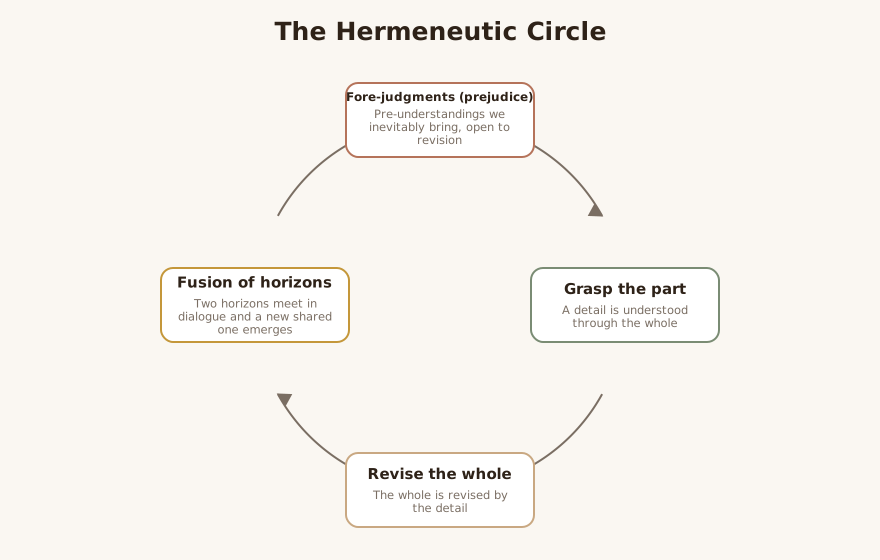
- The fusion of horizons (Horizontverschmelzung). A “horizon” is the whole range of what a person can see and think from where they stand — shaped by history, culture, language, and biography.36 Understanding occurs not when one person adopts the other’s view, but when two horizons meet in dialogue and a new, shared horizon emerges that neither held before.36
- The hermeneutic circle. Understanding moves continually between part and whole: a detail is grasped through the whole, and the whole is revised by the detail.16 “Nothing that needs interpretation can be understood at once.”5
- Prejudice as enabling (Vorurteil). Gadamer rehabilitates “prejudice” as fore-judgment — the pre-understandings we inevitably bring.12 These are not obstacles to be eliminated but the very conditions that open us to meaning, though they remain open to revision.12
- Effective history. We are always “an effect of history”; there is no view from nowhere, no purely objective standpoint outside our situatedness.14
- Application. Interpretation is not first understanding and then applying; understanding is always already an application of meaning to one’s own situation.24
- Language and the question. Understanding is dialogical, structured by question and answer, and oriented to die Sache — the subject matter at issue — rather than to winning.12
Interventions & Techniques
Hermeneutics supplies a stance, not a set of named procedures; its “techniques” are ways of inhabiting the interpretive encounter.5 LLM First, the clinician treats the session as a fusion of horizons: both parties arrive with pre-formed ideas, and the aim is a shared understanding that transforms both, not a diagnosis imposed on the client.5 Second, the clinician works the hermeneutic circle deliberately — letting a single moment (a phrase, a memory, a symptom) and the whole life-narrative reinterpret each other across the arc of treatment.56 LLM Third, the clinician practices owning their own prejudgments: noticing the anticipatory assumptions that shape what they hear, holding them as revisable rather than confirming a predetermined formulation.5 Fourth, the clinician privileges question-and-answer dialogue over interrogation, staying open to being surprised and to reinterpreting initial impressions.25 LLM In practice this looks less like a worksheet than like disciplined, self-aware curiosity. LLM
LLM-generated illustrative example (not a guideline): A clinician notices their own pre-judgment that a client’s stalled grief is “avoidance,” holds it as a fore-judgment rather than a conclusion, and asks what the loss has opened as well as closed — letting the client’s answer revise the whole formulation. LLM
Evidence Base
Honesty here matters. Hermeneutics is established as a philosophical tradition — Gadamer’s Truth and Method is canonical and his concepts are mature and widely taught.14 But it is not a manualized treatment and has no randomized trials, because it is not a therapy.1 LLM Its clinical evidentiary weight is therefore indirect: it provides the interpretive scaffolding behind therapies that do carry evidence — narrative, existential, psychodynamic, and dialogic approaches.2 LLM The most direct clinical literature applies it descriptively to the consultation itself, framing the clinical encounter as a fusion of horizons rather than testing outcomes.5 The defensible framing for clinicians: use hermeneutics as a way of understanding, and deliver change through an evidence-based modality. LLM
Populations & Indications
A hermeneutic stance is most useful where the work is fundamentally about meaning and understanding rather than symptom reduction alone.5 LLM It suits adults in psychodynamic and existential therapy who are reworking the significance of their experience, trauma survivors constructing meaning from what happened, and people exploring identity, spirituality, and life direction.15 LLM It is especially apt for couples and families, where the whole enterprise is mutual understanding across distinct horizons, and for clients in narrative therapy reauthoring a coherent life story.36 LLM It is least relevant where the presenting need is acute stabilization or skills acquisition. LLM
Problems-for-Work
- Identity confusion — moving between particular experiences and an emerging sense of the whole self via the hermeneutic circle.6 LLM
- Meaning-making after trauma — fusing the survivor’s pre-trauma and post-trauma horizons into a revised, livable understanding.35 LLM
- Existential distress and loss of purpose — dialogue oriented to the Sache of what a life is for, rather than to fixing a defect.2 LLM
- Grief and loss — reinterpreting the meaning of a relationship across the whole life-story rather than rushing to “closure.”6 LLM
- Difficulty integrating life narrative — using part/whole movement to weave fragments into coherence.6 LLM
- Relational, cultural, and intergenerational conflict — naming each party’s horizon and seeking a genuine fusion rather than one side prevailing.35 LLM
Contraindications, Cautions & Cultural Humility
Hermeneutics is a stance, so its risks are subtle.5 LLM The first is interpretive imposition: a clinician who forgets that prejudice is revisable can use “understanding” to confirm a predetermined diagnosis rather than meet the client — the opposite of the fusion Gadamer describes.15 The second is drift from clinical priorities: meaning-oriented dialogue must never crowd out risk assessment, stabilization, or evidence-based care when those are indicated. LLM On cultural humility, hermeneutics is unusually well-suited: its core claim — that the clinician’s own horizon is partial and historically shaped — is itself a discipline against ethnocentrism, demanding that the clinician hold their assumptions as revisable when meeting a different cultural horizon.36 LLM The caution is to enact this genuinely rather than treating “another culture” as a text to be decoded from outside.5 LLM
Treatment-Plan Suggestions & SMART Objectives
| Goal | SMART objective (example) | Mechanism |
|---|---|---|
| Integrate a fragmented life narrative | Over 8 sessions, client links 3 disconnected life episodes into a coherent narrative thread, rated for coherence weekly | Hermeneutic circle (part ↔ whole) |
| Make meaning after trauma | Within 10 sessions, client articulates 2 revised meanings the event holds now vs. then | Fusion of pre- and post-trauma horizons |
| Reduce relational misunderstanding | For 4 weeks, in session each partner restates the other’s view to the other’s satisfaction before responding, ≥2×/session | Fusion of horizons in dialogue |
| Loosen a fixed self-judgment | Over 6 weeks, client identifies and tests 1 long-held “fore-judgment” about self per week | Prejudice as revisable pre-understanding |
| Clarify values and purpose | Across 6 sessions, client names 3 questions (not answers) that orient their sense of purpose | Question-answer dialogue toward die Sache |
| Process grief without premature closure | Over 8 sessions, client re-tells the relationship’s meaning across the whole life-story, twice | Part/whole reinterpretation |
| Bridge intergenerational conflict | In a 4-session family arc, each generation articulates the other’s historical horizon once per session | Effective history / horizon-awareness |
Illustrative; deliver via a recognized modality and measure with validated tools. LLM
Common Misconceptions
- “Interpretation means decoding the one true hidden meaning.” Gadamer rejects this; meaning emerges in dialogue and is never finally fixed.14 LLM
- “Prejudice is always bad.” In hermeneutics, prejudice is fore-judgment — a necessary, revisable starting point, not a moral failing.12
- “Objectivity is the goal.” There is no view from nowhere; the clinician’s situatedness is unavoidable and can be made productive rather than denied.14
- “Understanding means I now agree with the client.” Fusion of horizons produces a shared new understanding, not capitulation or sameness.36 LLM
Training & Certification
There is no hermeneutic clinical credential.1 LLM Competent use rests on philosophical literacy — primary engagement with Gadamer’s Truth and Method and reputable secondary sources — combined with formal training in the evidence-based therapies that operationalize the stance, such as narrative, existential, psychodynamic, and dialogic psychotherapies.24 LLM Qualitative-research training in hermeneutic and phenomenological methods is another common route to fluency.6 LLM
Key Terms
- Fusion of horizons (Horizontverschmelzung) — the merging of two perspectives in dialogue into a new shared understanding.3
- Horizon — the totality of what a person can see or think from their historical and cultural standpoint.6
- Hermeneutic circle — the back-and-forth movement of understanding between part and whole.1
- Prejudice / fore-judgment (Vorurteil) — the revisable pre-understandings that make interpretation possible.1
- Effective history (wirkungsgeschichtliches Bewußtsein) — awareness that understanding is shaped by history.4
- Application — understanding as always already applied to the interpreter’s situation.2
Resources & Further Reading
▶ Watch — a video introduction to this concept:
Reference & scholarship - Hans-Georg Gadamer — Stanford Encyclopedia of Philosophy - Gadamer, Hans-Georg — Internet Encyclopedia of Philosophy - Truth and Method — Wikipedia (overview of Gadamer’s 1960 book) - Fusion of horizons — Wikipedia - Fusion of Horizons: Gadamer’s Contribution to Hermeneutical Theory — Philosophy Institute
Hermeneutics & the clinical encounter - Philosophy, understanding and the consultation: a fusion of horizons — Clark (PMC)
Related wiki articles: Existential Psychotherapy · Narrative Therapy · Daseinsanalysis · Collaborative / Dialogic Therapy · Coherence Therapy.
Reflective / Supervision Questions
- What fore-judgments did I bring into this session, and did I hold them as revisable or as confirmed?
- Where am I “decoding” a client’s meaning from the outside instead of letting a shared understanding emerge between us?
- When a client’s horizon differs sharply from mine — culturally, generationally, spiritually — am I genuinely letting my own horizon move?
- Have I let meaning-focused dialogue displace clinical priorities (risk, stabilization, evidence-based care) that the moment actually requires?