
Information-Sheets/Panic-Information-Sheet—05—Progressive-Muscle-Relaxation.pdf tier: T2 - id: 6 cite: ‘Jacobson E. Progressive Relaxation. Chicago: University of Chicago Press; 1938.’ url: https://press.uchicago.edu/ucp/books/book/chicago/P/bo3631946.html tier: T3
Type & Discipline
Progressive Muscle Relaxation (PMR) is a psychotherapeutic technique aimed at achieving deep relaxation through the systematic tensing and releasing of successive muscle groups, undertaken to reduce anxiety and physiological stress 2. It belongs to the broader family of relaxation and self-regulation methods used in behavioral medicine and is among the most-studied of those methods 1. Rather than a freestanding school of therapy, PMR is best understood as a discrete, teachable skill — a component that can stand alone for stress and tension reduction or be embedded within larger anxiety, panic, and stress-management protocols 2. LLM
The procedure works at the level of the body: the client deliberately produces and then releases muscular tension and is coached to attend closely to the contrasting sensations of tension and release 2. This somatic, skills-based focus is what places PMR firmly within behavioral medicine and the cognitive-behavioral tradition rather than within insight-oriented or interpretive therapies 2. LLM
Creators & Lineage
PMR was developed by the American physician and physiologist Edmund Jacobson, whose foundational work Progressive Relaxation was published by the University of Chicago Press in 1938 6. Jacobson built the method on the observation that physical relaxation can promote mental relaxation — that quieting the musculature reliably quiets the mind — and his original program was lengthy and exacting 4. The technique is still sometimes called “Jacobson’s relaxation technique” in his honor 4.
The method’s clinical reach widened considerably when Joseph Wolpe incorporated PMR into systematic desensitization, using relaxation as the response that competes with anxiety and shortening Jacobson’s original program to make it practical for therapy 2. The version most clinicians and researchers use today owes much to Douglas Bernstein and Thomas Borkovec, who in 1973 published a standardized, abbreviated tense-release protocol that became the template for subsequent research and training 2. This lineage — from Jacobson’s exhaustive physiological program, through Wolpe’s behavior-therapy adaptation, to the Bernstein–Borkovec standardization — explains why PMR appears both as a standalone relaxation skill and as a recurring ingredient in exposure-based and anxiety-management treatments 2. LLM
Core Principles
The first principle is that anxiety, stress, and fear are accompanied by muscle tension, and that this tension is not merely a symptom but a sensation the client can learn to detect and reverse 5. The body responds to perceived threat by tensing — clenched jaw, raised shoulders, tightened gut — and over time this tension can produce backaches, tension headaches, and a pervasive sense of being “tensed up” or exhausted 5. PMR begins from the premise that if tension can be noticed, it can be released 5.
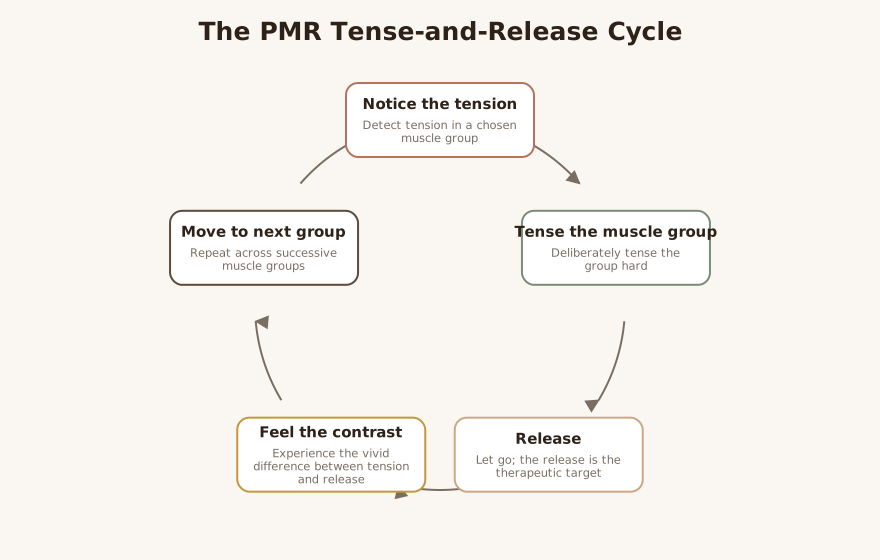
The second principle is the deliberate contrast between tension and release 2. By first tensing a muscle group hard and then letting it go, the client experiences a vivid difference between the two states, which both deepens the relaxation that follows and trains the perceptual skill of recognizing tension early, before it escalates 2. The releasing phase, not the tensing phase, is the therapeutic target 5. LLM
The third principle is reciprocal inhibition: a state of physical relaxation is physiologically incompatible with the arousal that characterizes anxiety, so cultivating relaxation directly counteracts that arousal 2. This is the same counterconditioning logic that Wolpe exploited in systematic desensitization — evoking a relaxation response that competes with, and so weakens, the fear response 2. The fourth principle is simply that PMR is a trained skill: consistent, repeated practice is what allows a person to become aware of their muscles and to relax them on demand, and the technique is best rehearsed during calm periods, not reserved for moments of crisis 45.
Interventions & Techniques
In practice, PMR follows a consistent structure that is easy to teach and to hand off as home practice 5. The clinician first prepares the setting: a comfortable chair that supports the head, loose clothing, soft lighting, and minimized sensory distraction, with practice avoided after heavy meals or alcohol 5. The client slows the breathing and gives themselves permission to relax before beginning 5.
The core move is repeated for each muscle group in sequence 5. The client tenses the target group firmly enough to feel clear tension but not pain, holds it for roughly five seconds, and then releases, letting the muscle stay relaxed for about ten seconds while noticing the sensation — sometimes paired with a silent cue word such as “relax” on the release 5. The Centre for Clinical Interventions sequence works through eighteen groups, beginning with the right hand and forearm, moving up the arm, across to the left side, then through the forehead, eyes and cheeks, mouth and jaw, neck, shoulders, back, chest and stomach, hips and buttocks, and finally down each leg to the feet 5. A common alternative ordering descends from the toes and calves up through the thighs, hands, arms, abdomen, chest, shoulders, and face 4. Breathing is coordinated rather than held — inhaling on the tension, exhaling fully on the release — since holding the breath only adds tension 4. At the end, the client remains seated for a few moments to become fully alert 5.
PMR is also delivered as a component within larger interventions 2. As the relaxation arm of systematic desensitization it is paired with a graded exposure hierarchy, and it is frequently combined with diaphragmatic breathing, music, or cognitive-behavioral techniques, where such combinations have shown superior effects to PMR alone 1. LLM
LLM-generated illustrative example (not a guideline): A client who carries stress in the shoulders and jaw is taught a brief, abbreviated PMR focusing on those groups plus the hands, hold five seconds and release for ten, twice daily at home and once at the first sign of tightening during the workday — the aim being early detection and release rather than a full eighteen-group session each time LLM.
Evidence Base
PMR’s evidence base is mature, which is why it is fairly described as an established technique rather than an experimental one 1. A 2024 systematic review synthesized 46 studies from 16 countries, covering more than 3,400 adults and drawing on randomized controlled and quasi-experimental designs; the authors rated 24 of the included studies as high quality and 22 as moderate quality 1. Across this literature, PMR was found to reduce stress, anxiety, and depression in adults 1.
The size of the effect varies by target 1. Reported effects ranged widely for stress (Cohen’s d ≈ 0.29 to 4.57) and anxiety (d ≈ 0.25 to 2.54), and were medium-to-large for depression (d ≈ 0.58 to 1.95), with stress and anxiety supported by the largest number of studies 1. In a clinical-resource synthesis, PMR has been described as showing effects on generalized anxiety disorder comparable to cognitive behavioral therapy, and as reducing acute stress and anxiety even in psychosis 2.
Honesty about maturity also means naming the limits 1. Several studies in the review found no significant reduction in anxiety, and a few found none for depression, and benefits were less consistent in non-specific general adult samples — suggesting that PMR’s effect may depend on particular demographic, clinical, or psychographic characteristics 1. The review also drew only on English-language databases, which limits cross-cultural generalizability 1. Combined interventions — PMR plus breathing, music, or CBT — tended to outperform PMR delivered alone, so PMR is often best positioned as a reliable component rather than a complete treatment 1. As with all relaxation techniques, it is a complement to, not a substitute for, appropriate medical and psychiatric care 3. LLM
Populations & Indications
PMR has been studied across a broad range of adult populations 1. It has shown consistent benefit for nursing students, healthcare workers, and older adults — groups in whom occupational or age-related stress is prominent 1. It is widely used with medical and surgical patients for stress and procedural anxiety, and a study of burn patients found that practicing PMR for twenty to thirty minutes a day across three consecutive days significantly decreased anxiety and improved sleep quality 4.
The clearest indications are stress reduction and anxiety, including generalized anxiety disorder, where the technique targets the physiological tension that drives and accompanies arousal 2. It is also indicated for insomnia and poor sleep, for tension headaches and muscle-tension complaints, and as the relaxation backbone within exposure-based anxiety and panic protocols 45. Because it is accessible, low-cost, and broadly applicable across diverse client populations, PMR transfers readily to home practice and self-management 2. LLM
Problems-for-Work
PMR is a strong fit for several presenting problems where the body is part of the picture 5.
Muscle tension and tension headaches are the most direct target: the technique trains clients to detect and release the clenching and bracing that produce aches, headaches, and fatigue 5. For example, a client who ends every workday with a tension headache can use abbreviated PMR to interrupt jaw and shoulder bracing across the day LLM.
Generalized and anticipatory anxiety respond to PMR’s reciprocal-inhibition mechanism, in which relaxation competes with physiological arousal, with effects on generalized anxiety reported as comparable to CBT in some sources 2. Acute stress and arousal — including stress in high-demand occupational groups — are reduced by regular practice, with the largest body of supporting studies of any target 1.
Insomnia and poor sleep quality can improve when PMR is practiced consistently, as in the burn-patient study where short daily sessions improved both anxiety and sleep 4. Panic-related bodily tension is addressed when PMR is used within a panic or exposure protocol to give the client a portable down-regulation skill 5. Depressive symptoms showed medium-to-large effects in the review, though PMR here is best framed as an adjunct rather than a primary depression treatment 1. LLM
Contraindications, Cautions & Cultural Humility
PMR is generally low-risk, but several cautions apply 5. Clients with physical injuries or a history of physical problems that may cause muscle pain should consult their doctor before beginning, since deliberately tensing an injured area can aggravate it 5. Certain muscle groups require extra care: the neck should be tensed slowly and gently, and the lower legs slowly to avoid cramps; tension should always be firm enough to feel but never to the point of significant pain 5. Practice should be avoided after heavy meals or after consuming alcohol or other intoxicants 5.
Clinically, PMR is a complement to medical and psychiatric treatment, not a replacement, and clients with significant or complex conditions should be encouraged to keep working with their treating clinicians alongside relaxation practice 3. For a small number of people, deliberately attending to the body can heighten distress rather than reduce it, so clinicians should monitor response and adapt — for instance, shortening the sequence or pairing it with breathing — rather than assume universal benefit LLM. The evidence itself cautions humility: benefits were inconsistent in non-specific adult samples and may hinge on individual and cultural characteristics, and the supporting literature was drawn only from English-language sources 1. What counts as a relaxing posture, an acceptable setting, or a comfortable degree of bodily focus is culturally and individually variable, so the protocol should be introduced collaboratively and adjusted to the client rather than imposed LLM.
Treatment-Plan Suggestions & SMART Objectives
The following goals, SMART-formatted objectives, and mechanisms are illustrative and must be individualized; all rest on PMR’s tense-release and reciprocal-inhibition model 25. LLM
| Goal | SMART objective (example) | Mechanism |
|---|---|---|
| Learn the core skill | Demonstrate the full tense-release sequence (5s tense / 10s release) accurately in session within 2 sessions | Tension–release contrast trains perceptual detection of muscle tension 5 |
| Build a daily practice | Complete a 15–20 minute PMR session on at least 5 of 7 days for 3 weeks | Consistent practice is what makes relaxation available on demand 4 |
| Detect tension early | Identify and rate bodily tension before it escalates at least once daily for 2 weeks | Self-monitoring links arousal to its somatic signature 5 |
| Reduce anxious arousal | Use an abbreviated PMR at the first sign of anxiety on 80% of occasions over 4 weeks | Relaxation reciprocally inhibits anxiety-related arousal 2 |
| Improve sleep onset | Practice a wind-down PMR sequence nightly and log sleep quality for 3 weeks | Lowering pre-sleep tension and arousal supports sleep onset 4 |
| Relieve tension headaches | Apply jaw/shoulder/neck PMR at 3 work breaks daily for 4 weeks, tracking headache frequency | Releasing chronic bracing reduces tension-type pain 5 |
| Generalize the skill | Apply PMR in 2 real-world stressful situations per week for 4 weeks | Practicing in vivo transfers the skill beyond the quiet practice setting 4 |
Common Misconceptions
A common misconception is that the goal of PMR is the tensing — gripping a muscle hard — when in fact the tension is only a setup, and the therapeutic moment is the release and the attention paid to the relaxing sensation that follows 5. A second is that PMR should be deployed only in a crisis; the technique is a trained skill that is best rehearsed during calm periods so it is reliably available when arousal rises 4. LLM
A third misconception is that more is always better — that one must complete the full eighteen-group sequence every time 5. Abbreviated and targeted versions exist precisely so the skill can be used briefly and frequently, and the standardized Bernstein–Borkovec protocol itself shortened Jacobson’s exhaustive original 2. A fourth is that relaxation is a stand-alone cure; the evidence shows PMR works well, and often better, as a component combined with breathing, music, or CBT, and as a complement to medical care rather than a replacement for it 13.
Training & Certification
PMR is intentionally simple to learn and to teach, and there is no single mandatory credential required to deliver it LLM. Standardized protocols — most influentially the Bernstein and Borkovec procedure — provide a reproducible script that clinicians and researchers can follow, and well-developed clinical information sheets walk through the setting, the general procedure, and the muscle-group sequence step by step 25. LLM
For most practitioners, competence is built by learning a standardized sequence, practicing it personally, and then guiding clients through it before assigning structured home practice 5. Because PMR is most often used as one element of a broader treatment, clinicians typically learn it within training in anxiety management, exposure-based therapy, or stress-reduction work rather than as a separate certification track 2. LLM
Key Terms
- Progressive Muscle Relaxation (PMR) — systematic tensing and releasing of muscle groups to achieve deep relaxation and reduce anxiety and stress 2.
- Tense–release cycle — the core unit: tense a muscle group for about 5 seconds, then release and rest it for about 10 seconds while attending to the sensation 5.
- Reciprocal inhibition — the principle that a relaxation response is incompatible with, and so counteracts, anxiety-related physiological arousal 2.
- Counterconditioning — evoking an incompatible (relaxation) response to weaken a fear or stress response, the basis of PMR’s use in systematic desensitization 2.
- Systematic desensitization — Wolpe’s exposure procedure that pairs a graded fear hierarchy with relaxation, into which PMR was incorporated 2.
- Bernstein–Borkovec protocol — the 1973 standardized, abbreviated tense-release procedure widely used in research and practice 2.
- Abbreviated PMR — shortened, targeted versions focusing on selected groups for brief, frequent everyday use 2.
Resources & Further Reading
▶ Watch — a video introduction to this concept:
- Efficacy of Progressive Muscle Relaxation in Adults for Stress, Anxiety, and Depression: A Systematic Review (Khir et al., 2024)
- Progressive Muscle Relaxation — Psychology Tools
- Relaxation techniques: Try these steps to lower stress — Mayo Clinic
- Progressive Muscle Relaxation: Benefits, How-To, Technique — Healthline
- Progressive Muscle Relaxation (information sheet) — Centre for Clinical Interventions (CCI), WA Health (PDF)
- Progressive Relaxation — Edmund Jacobson (1938, University of Chicago Press)
Reflective / Supervision Questions
- For a given client, are you targeting the release and the client’s awareness of it, or have you let the tensing become the focus of the exercise? 5
- How are you helping the client rehearse PMR during calm periods so the skill is available when arousal rises, rather than only teaching it in distress? 4
- Have you screened for injuries, pain history, or muscle groups (neck, calves) that require extra caution before assigning the full sequence? 5
- Where would PMR work better as a component — paired with breathing, exposure, or CBT — than as a stand-alone intervention for this client? 1
- Are you presenting the evidence honestly: well supported for stress and anxiety, more variable in non-specific samples, and a complement to medical care rather than a substitute? 13
- How have you adapted the setting, posture, and degree of bodily focus to fit this client’s comfort, culture, and response, rather than applying one fixed script? LLM