
Type & Discipline
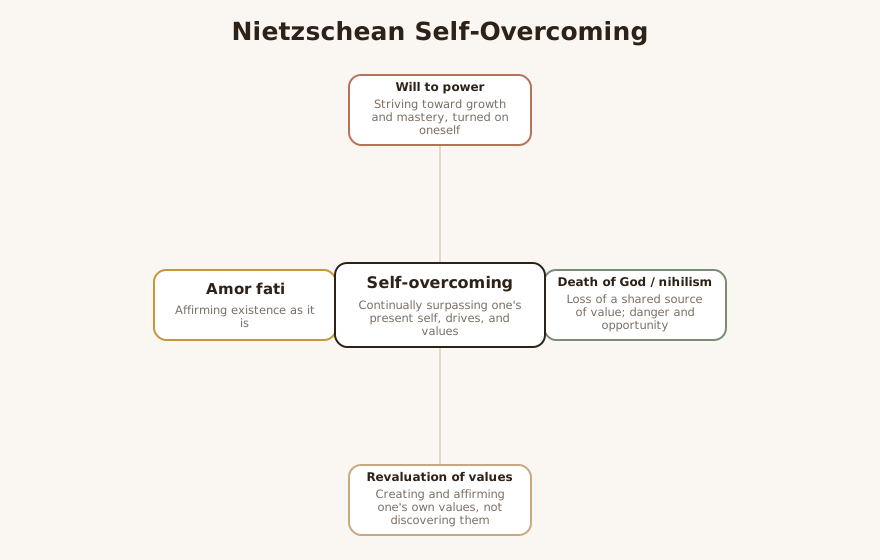
Nietzschean self-overcoming is not a therapy and not a technique; it is a philosophical concept drawn from Western philosophy, specifically from the work of Friedrich Nietzsche (1844–1900), and it belongs to the proto-existentialist current that fed twentieth-century existentialism.24 In Nietzsche’s vocabulary the German term is Selbstüberwindung — the continual surpassing of one’s present self — and it is bound up with three of his most central ideas: the will to power, the creation of new values in the wake of what he called the “death of God,” and amor fati, the affirmation and even love of one’s fate.25 LLM In this wiki it sits as a cross-disciplinary construct: a body of philosophical ideas whose preoccupations — strength out of suffering, the self-authorship of values, the affirmation of a life one did not choose — map directly onto the resilience, meaning-making, and reauthoring work that existential and humanistic psychotherapies pursue. LLM
The clinical reason a busy clinician should care is that Nietzsche names, in unusually vivid terms, a transformation many clients are actually attempting: not the removal of suffering but its metabolization into growth, and not the discovery of a pre-given purpose but the deliberate construction of one’s own. LLM His ideas are notoriously easy to caricature and easy to misuse, so the discipline here is to treat them as a conceptual scaffold delivered through recognized therapy, never as a self-help slogan handed to a vulnerable person. LLM
Creators & Lineage
The concept has a single author. Friedrich Nietzsche was a German philosopher and classical philologist, appointed to a chair at the University of Basel at the age of twenty-four, who resigned for reasons of health in 1879 and produced his most influential work in the following decade before a collapse into incapacitating illness in early 1889.4 His major writings — Thus Spoke Zarathustra, Beyond Good and Evil, On the Genealogy of Morality, The Gay Science, and others — were largely neglected in his lifetime and became enormously influential only posthumously.24 LLM Self-overcoming receives its most concentrated expression in the chapter “On Self-Overcoming” in the second part of Thus Spoke Zarathustra, where it is tied explicitly to the will to power and to the idea that life is “that which must ever surpass itself.”5
Nietzsche’s relationship to the wider tradition is double. Backward, he stands in a line of critique of conventional morality and Christian metaphysics, and the Internet Encyclopedia of Philosophy situates his “death of God” not as a triumphant atheism but as a cultural diagnosis: the collapse of the shared belief that had underwritten European values, leaving a vacuum that threatens nihilism.3 Forward, his emphasis on individual self-creation, the confrontation with meaninglessness, and the demand to affirm existence makes him a recognized forerunner of existentialism, and his influence runs into existential psychotherapy and into Viktor Frankl’s logotherapy, whose “will to meaning” is in dialogue with Nietzsche’s frequently quoted line that one who has a why to live can bear almost any how.23 LLM The contemporary research literature on posttraumatic growth — the finding that some people report positive change in the struggle with adversity — is a distant empirical cousin of the Nietzschean intuition that suffering can be a site of development rather than only of damage, though the two should never be conflated. LLM
A caution about lineage that matters clinically and ethically: Nietzsche’s sister edited and selectively assembled his unpublished notes after his collapse, and his work was subsequently appropriated by German nationalist and Nazi ideologues — an appropriation that contemporary scholarship regards as a distortion of texts that were, among other things, explicitly contemptuous of antisemitism and German nationalism.42 LLM
Core Principles
Several interlocking ideas constitute the concept, and they are best understood together rather than as slogans.2
- Will to power. Nietzsche’s proposed basic drive — not merely a wish to dominate others but a more general striving toward growth, mastery, expansion, and the discharge of strength — which he at times presents as the underlying tendency of life itself.25 Self-overcoming is the will to power turned reflexively on oneself.5
- Self-overcoming (Selbstüberwindung). The continual surpassing of one’s present condition, drives, and even one’s prior values; in Zarathustra life is precisely “that which must ever surpass itself,” so growth is not a stage to be reached but an ongoing activity.5 LLM
- Death of God and the threat of nihilism. The cultural loss of an authoritative, shared source of value, which Nietzsche treats as both a danger (nihilism, the sense that “nothing matters”) and an opportunity (the freedom and responsibility to create values).32
- Revaluation and value-creation. Rather than discovering values that exist independently, the task is to create and affirm one’s own — Nietzsche’s “revaluation of all values” — which requires examining inherited morality critically rather than obeying it by default.13
- Amor fati — love of fate. The aspiration not merely to tolerate but to affirm and even love the whole of one’s life, including its suffering and what one would not have chosen, as the precondition of a wholehearted existence.62
- Eternal recurrence as a test. The thought-experiment of willing every detail of one’s life to return identically and infinitely, offered as a measure of whether one is living a life one could affirm.26
- The Übermensch (“overman”) as an ideal. A figure who creates values and affirms life from his own strength rather than from external authority — an aspirational image, not a literal program for being.24
Britannica and the Stanford Encyclopedia both caution that Nietzsche writes aphoristically and provocatively, and that his terms resist tidy systematization; reading him as a builder of a closed doctrine misses his style and intent.42
Interventions & Techniques
As a philosophy, Nietzschean self-overcoming has no technique set of its own and is not a manualized treatment; what it offers the clinician is a set of organizing questions and a stance, delivered through recognized therapies. LLM The most natural clinical homes are existential psychotherapy and logotherapy, where the confrontation with meaninglessness, the demand to author one’s own values, and the affirmation of a difficult life become the explicit content of the work. LLM
In practice, the concept translates into several recognizable moves. The first is reframing suffering as potential material for growth rather than only as damage to be removed — close in spirit both to logotherapy’s search for meaning in unavoidable suffering and to the narrative-therapy project of reauthoring a life story.3 LLM The second is value-clarification as value-creation: helping a client examine which of their guiding values are genuinely their own and which are inherited and unexamined, then supporting the deliberate, owned construction of values to live by — a direct clinical analogue of Nietzsche’s “revaluation.”1 LLM The third is the use of amor fati as an affirmation stance: not passive resignation, but an active orientation toward accepting and engaging the facts of one’s life, including loss, as the ground on which any meaningful future is built.6 LLM The eternal-recurrence thought-experiment can be adapted, gently, into a clarifying prompt — what in your life, as it is, could you affirm, and what would you want to change? — used to surface values rather than to browbeat a client into approval of their suffering.26 LLM
LLM-generated illustrative example (not a guideline): A client two years into a chronic-pain condition describes herself as “just waiting to get my old life back.” Within existential psychotherapy, the clinician treats the pain as a permanent fact of her situation rather than an interruption, and gently explores an amor-fati-style question — not “be glad this happened,” but “given that this is now part of your life, what would it mean to build a life that includes it rather than one suspended until it ends?” The work becomes value-creation and reauthoring rather than waiting. LLM
Evidence Base
Honesty about maturity is essential, and the maturity label here needs to be read carefully. As a philosophical body of work, Nietzsche’s thought is well-established, influential, and widely taught; it is foundational to existentialism and a recognized antecedent of existential psychotherapy and logotherapy.234 In that sense the concept is “established.” But it is a philosophy, not an empirical claim, and carries no randomized-controlled-trial rating of its own, because a philosophy is not the kind of thing one tests in an outcome study. LLM Its evidentiary weight in the clinic is therefore indirect, carried by the therapies that operationalize its themes. LLM
The honest framing for clinicians is that the philosophy is mature, but its direct clinical derivatives carry limited and largely indirect outcome data. LLM Existential psychotherapy as a standalone, manualized treatment has a thinner trial base than symptom-focused modalities, even as its conceptual influence is enormous; meaning-centered and dignity-oriented descendants developed for serious illness have promising but not yet robust evidence on existential well-being. LLM The resilience and posttraumatic-growth literature lends some empirical plausibility to the intuition that adversity can be a site of development, but posttraumatic growth is a contested construct — much of it rests on retrospective self-report, and growth does not negate distress — so it should be cited as a parallel finding, not as proof of a Nietzschean thesis. LLM The practical conclusion: use Nietzschean self-overcoming as a conceptual scaffold, and produce change through its evidence-based or evidence-developing clinical relatives. LLM
Populations & Indications
Because its concerns are universal, the concept can inform work with many clients, but it gains the most traction where the suffering is about meaning, value, and the affirmation of a hard life rather than reducible to a discrete behavioral target. LLM The clearest indications are adults in existential therapy grappling with the question of how to live without an inherited, ready-made source of meaning, and people facing an existential crisis in which freedom and the absence of fixed values feel like vertigo rather than liberation.3 LLM
People in midlife transition — for whom achieved goals have lost their savor, or for whom a life structure has quietly stopped fitting — encounter the revaluation theme directly, since the task is often to author new values rather than to recover old ones. LLM Bereaved individuals and others confronting losses that cannot be undone are where amor fati is most delicate and most relevant: the question of how to affirm a life that now includes an irreversible absence. LLM People recovering from adversity — illness, trauma, major reversal — may find that the frame of self-overcoming names an aspiration they already hold, provided it is offered as an invitation rather than a demand. LLM The common thread is a presentation in which meaning must be made rather than restored. LLM
Problems-for-Work
Nietzschean self-overcoming is most apt when distress has a clear existential or value dimension that symptom-focused treatment alone does not reach. LLM
- Existential crisis / meaninglessness — the prototypical target: the felt collapse of an authoritative source of value, engaged as an opening for value-creation rather than only as pathology.3 LLM
- Demoralization — the loss of morale and hope (distinct from depressed mood) common in chronic illness and reversal, addressed through meaning and the affirmation of a viable future rather than mood symptoms alone. LLM
- Loss of purpose — worked through value-clarification-as-creation: distinguishing inherited, defunct goals from chosen commitments worth building toward.1 LLM
- Grief — amor fati as the slow, non-coercive movement from “this should not have happened” toward a life that integrates rather than denies the loss; never as pressure to be grateful for it.6 LLM
- Identity disturbance — the self-creation theme supports rebuilding a self through chosen values and projects rather than recovering a supposed fixed “true self.”2 LLM
- Low self-efficacy — the will-to-power frame, used carefully, reframes agency as a capacity to be exercised and grown rather than a fixed trait one lacks.5 LLM
- Posttraumatic growth — supporting, without prescribing, the meaning a client may make of survival, while explicitly validating that growth and continued pain can coexist. LLM
- Value and meaning confusion — examining which values are genuinely one’s own and constructing a coherent, owned set to live by — Nietzsche’s revaluation in clinical form.1 LLM
LLM-generated illustrative example (not a guideline): A recently divorced client in midlife says his whole adult identity was “being a husband and provider” and that without it he is “nothing.” The clinician treats this as identity disturbance and loss of purpose rather than depression alone, working within existential psychotherapy to separate inherited values from chosen ones and to author a self defined by commitments he selects now — while monitoring for, and separately treating, a co-occurring depressive episode. LLM
Contraindications, Cautions & Cultural Humility
This concept is unusually easy to weaponize, and the cautions are not optional. Self-overcoming and amor fati must never be deployed in a way that pressures a client to be glad about, grateful for, or responsible for their own trauma, abuse, or injustice. LLM Amor fati is an affirmation of one’s life as a whole over time, not an instruction to approve of harm done to them or to suppress legitimate grief and anger; misused, it becomes spiritual bypassing.6 LLM Likewise, the language of “strength” and “overcoming” can shade into shaming a client for understandable limits, or into a toxic self-sufficiency that discourages help-seeking. LLM
The work is not a first-line substitute for stabilization. LLM Clients in acute crisis, active suicidality, acute psychosis, or untreated severe depression need safety-oriented, symptom-focused care first; the open, provocative quality of Nietzschean inquiry can destabilize someone who needs containment, and a “death of God” framing of value-collapse can deepen rather than relieve nihilistic hopelessness in a person already there.3 LLM Nietzsche’s own rhetoric is deliberately provocative and elitist in places, and his texts were notoriously distorted after his collapse and appropriated by movements he would have despised — clinicians should be aware of this history so as not to import its connotations into the room.42 LLM
Culturally, the concept is individualistic and post-religious, and its assumptions are not neutral. LLM For clients whose meaning is grounded in faith, community, ancestry, or a collectivist worldview, the framing of a meaningless universe in which the lone individual must create all value may feel alien or even offensive.3 LLM The corrective is to hold the framework lightly, to inquire into the client’s own sources of meaning rather than impose a secular Nietzschean reading, and to remember that “affirming one’s fate” can be done within a religious or communal idiom that the client already trusts. LLM
Treatment-Plan Suggestions & SMART Objectives
The objectives below illustrate how the concept’s targets can be operationalized within ordinary clinical documentation, always as content delivered through a recognized therapy. LLM
| Goal | SMART objective (example) | Mechanism |
|---|---|---|
| Reduce sense of meaninglessness | Client will identify and act on two self-chosen sources of meaning (relationship, contribution, project), engaging one weekly for 6 weeks | Value-creation after the “death of God” LLM |
| Clarify and author personal values | By session 8, client will distinguish three inherited values from three chosen values and name which they wish to live by | Revaluation of values LLM |
| Integrate an irreversible loss | Over 8 weeks, client will articulate one way their life can hold the loss rather than remain suspended until it is undone | Amor fati as affirmation, not resignation LLM |
| Reframe adversity as material for growth | Client will identify two capacities developed through a past hardship without minimizing its cost, within 5 sessions | Self-overcoming; posttraumatic growth LLM |
| Rebuild identity after a lost role | Within 8 weeks, client will describe a self defined by chosen commitments rather than by a lost role | Self-creation LLM |
| Increase sense of agency | Client will set and complete one self-selected, slightly stretching goal per week for 4 weeks, reviewing growth in session | Will to power turned reflexively on the self LLM |
| Address demoralization | By week 6, client will name one affirmable future possibility and one concrete step toward it | Affirmation of life; meaning over mood LLM |
Common Misconceptions
- “Will to power means wanting power over other people.” Nietzsche’s concept is far broader — a striving toward growth, mastery, and the discharge of strength, of which self-overcoming is the reflexive form; reducing it to political domination is a distortion.25 LLM
- “Amor fati means you should be grateful for your trauma.” It is an affirmation of a whole life over time, not approval of specific harms or a demand to suppress grief; used as gratitude-for-abuse it is a misuse, not the concept.6 LLM
- “The death of God is a celebration of atheism.” Nietzsche treats it as a cultural diagnosis and a crisis — the collapse of a shared source of value that risks nihilism — not a triumphant slogan.3 LLM
- “The Übermensch is a master race or a literal superman.” It is an aspirational image of a value-creating, life-affirming individual; the racial-political reading is the product of posthumous distortion and appropriation of his texts.42 LLM
- “Self-overcoming means relentless self-improvement and never resting.” It is about authoring and affirming one’s values and life, which can include acceptance and rest; productivity-cult readings flatten it.56 LLM
- “Nietzsche is a systematic philosopher with a doctrine to apply.” He writes aphoristically and provocatively and resists systematization; treating his lines as protocol misreads both style and intent.42 LLM
Training & Certification
There is no credential in “Nietzschean self-overcoming” and no licensure attached to the philosophy. LLM Competent clinical use rests on two legs: philosophical literacy — reading the primary texts and reputable secondary sources such as the Stanford and Internet Encyclopedias of Philosophy and the Britannica biography — and training in the therapies that operationalize the themes, principally existential psychotherapy and logotherapy.1234 LLM Clinicians wanting to work this way most often pursue supervised training in existential or logotherapeutic practice and continuing education in meaning-centered and values work, rather than any board examination. LLM Given how easily the concept is misused, supervision focused specifically on the ethical line between affirmation and coercion — between amor fati and spiritual bypassing — is more important here than any certificate. LLM
Key Terms
- Self-overcoming (Selbstüberwindung) — the continual surpassing of one’s present self, drives, and prior values; in Zarathustra, life as “that which must ever surpass itself.”5
- Will to power — Nietzsche’s proposed basic striving toward growth, mastery, and the discharge of strength, broader than domination over others.25
- Amor fati — “love of fate”; the aspiration to affirm and even love the whole of one’s life, including its suffering, as the ground of a wholehearted existence.62
- Death of God — the cultural collapse of an authoritative shared source of value, posing both the danger of nihilism and the task of value-creation.3
- Revaluation of values — the critical examination of inherited morality and the deliberate creation of one’s own values.13
- Eternal recurrence — the thought-experiment of willing one’s life to return identically and infinitely, used as a test of life-affirmation.26
- Übermensch (“overman”) — an aspirational image of a self-determining, value-creating, life-affirming individual.24
- Nihilism — the condition, feared by Nietzsche, in which the highest values devalue themselves and nothing seems to matter.3
Resources & Further Reading
▶ Watch — a video introduction to this concept:
- Nietzsche’s Moral and Political Philosophy — Stanford Encyclopedia of Philosophy
- Friedrich Nietzsche — Stanford Encyclopedia of Philosophy
- Friedrich Nietzsche — Internet Encyclopedia of Philosophy
- Friedrich Nietzsche — Encyclopaedia Britannica
- Thus Spoke Zarathustra, “On Self-Overcoming” — Wikisource (full text)
- Amor Fati — The Ecstatic Affirmation of Life (The School of Life) — YouTube
Reflective / Supervision Questions
- When I invoke “affirm your fate” or “grow from this,” am I genuinely supporting the client’s own meaning-making, or am I subtly pressuring them to be grateful for harm they did not choose? LLM
- How do I distinguish amor fati from spiritual bypassing — affirmation of a whole life from suppression of legitimate grief, anger, or the need to change a harmful situation? LLM
- Whose values are operating in the room — the client’s chosen values, or my own secular, individualistic, or achievement-oriented assumptions imported through Nietzsche? LLM
- How do I hold the language of “strength” and “self-overcoming” so that it empowers a client rather than shaming them for limits, distress, or the need for help? LLM
- How do I decide when an existential, value-creation focus is appropriate and when the client first needs stabilization or evidence-based symptom treatment? LLM
- Where in my own life do meaning, mortality, and the affirmation of what I did not choose go unexamined, and how might that shape what I notice — or avoid — in the work? LLM