
Type & Discipline
Stoic and ancient spiritual exercises — askesis — are not a manualized therapy but a set of practical disciplines drawn from Western philosophy, recovered for modern readers by the French historian of philosophy Pierre Hadot.1 In his landmark work Philosophy as a Way of Life, Hadot argued that ancient philosophy was never merely an abstract body of doctrine to be debated; it was a lived practice, a daily training of the self intended to transform one’s whole way of seeing and being in the world.1 The Greek word askesis originally meant “exercise” or “training,” in the sense an athlete trains — and Hadot transposed it to the inner work of becoming wise.2 In this wiki the concept sits as a cross-disciplinary technique: a family of repeatable practices from philosophy whose mechanisms map cleanly onto contemporary clinical work.2 LLM
Hadot’s term “spiritual exercises” deliberately stretches beyond the religious connotations of “spiritual” to name something broader — practices that engage the whole person (thought, imagination, emotion, attention, and will), not just the intellect.1 For clinicians, the value of the framework is that it names, organizes, and gives an honored lineage to techniques we already use: structured journaling, self-monitoring, attention training, perspective-taking, and values clarification.2 LLM
Creators & Lineage
The exercises themselves are ancient. Their two most influential practitioners are the Roman-era Stoics Epictetus (c. 50–135 CE), the formerly enslaved teacher whose Discourses and Enchiridion survive through his student Arrian, and Marcus Aurelius (121–180 CE), the emperor whose Meditations are themselves a record of spiritual exercises performed in writing.1 Marcus did not write the Meditations for publication; the text is a private notebook in which he repeatedly rehearses Stoic principles to himself — making it, in Hadot’s reading, less a treatise than a working logbook of askesis.1 LLM
The decisive modern figure is Pierre Hadot (1922–2010), a scholar of ancient and patristic philosophy at the Collège de France, who reframed the entire ancient tradition — Socratic, Stoic, Epicurean, Skeptic, and Neoplatonic — as oriented toward a “way of life” rather than the construction of systems.2 Hadot’s thesis influenced Michel Foucault’s late work on “the care of the self” and reshaped how scholars read figures from Socrates to the early Christian monastics.2 His work has had a quiet but durable cultural reach, credited by readers with restoring philosophy’s practical, consoling, life-orienting function.3 Through the popular Stoicism revival, these exercises now circulate widely outside the academy in self-help and resilience formats.5 LLM
In therapeutic terms, this lineage runs forward into the cognitive and behavioral traditions: the Stoic claim that we are disturbed not by events but by our judgments of them is the acknowledged philosophical ancestor of cognitive behavioral therapy and rational emotive behavior therapy, and the acceptance-and-present-focus strain rhymes with Acceptance and Commitment Therapy and mindfulness-based interventions. LLM
Core Principles
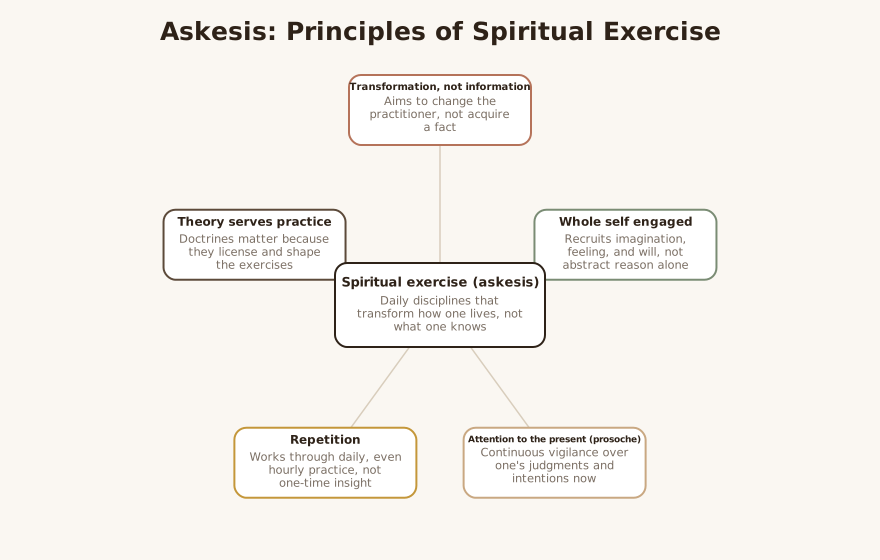
At the heart of Hadot’s account is a single reorientation: philosophy is something you do, not merely something you know.1 Several principles follow from this. LLM
- Transformation, not information. The goal of an exercise is not to acquire a fact but to change the practitioner — to convert attention, loosen attachments, and re-tune the emotions.1
- The whole self is engaged. Exercises recruit imagination, feeling, and will, not abstract reasoning alone; this is why Hadot calls them spiritual rather than merely intellectual.1
- Attention to the present moment (prosoche). A continuous vigilance over one’s judgments and intentions, anchoring the self in what is actually happening now rather than in regret or dread.2
- The exercise must be repeated. Like physical training, askesis works through daily, even hourly, repetition, not a one-time insight.5 LLM
- Theory serves practice. Doctrines (the dichotomy of control, the impermanence of things, the rational order of the cosmos) matter because they license and shape the exercises, not as ends in themselves.1
The animating Stoic doctrine underneath these practices is the distinction between what is “up to us” — our judgments, choices, and responses — and what is not.5 Equanimity comes from investing effort only in the former, a claim the exercises are designed to make habitual rather than merely understood.5 LLM
Interventions & Techniques
Hadot and his interpreters catalogue a recognizable set of exercises, several of which translate almost directly into clinical homework.4 LLM
- Meditation and rehearsal (meletē). Mentally rehearsing principles and likely situations in advance so that one is prepared to meet them — including praemeditatio malorum, the premeditation of adversity, in which one calmly imagines loss or difficulty ahead of time to drain its terror.4
- Examination of conscience. A structured evening (or morning) review of the day’s actions, judgments, and intentions — what did I do well, badly, and what would I do differently — a practice the Stoics inherited and that maps onto self-monitoring.5
- Writing as exercise. Journaling that is itself the practice, not a record of it; Marcus’s Meditations are the paradigm case of writing used to imprint and re-imprint a way of seeing.1
- The “view from above.” Imaginatively rising to a cosmic vantage point from which one’s troubles, status, and conflicts appear small and transient — a perspective-taking and cognitive-distancing exercise.1
- Attention (prosoche). Continuous present-moment vigilance over impressions before assenting to them, inserting a pause between an automatic appraisal and one’s reaction.2
- Contemplation of nature and death. Meditations on impermanence and mortality (memento mori) intended not to depress but to concentrate attention on living well now.1
- Reading, listening, and dialogue. Engaging philosophical texts and conversation as practices that reshape the self rather than as information-gathering.4
LLM-generated illustrative example (not a guideline): A clinician working within CBT assigns a burned-out physician a nightly three-minute “examination” — three lines on what went well, what they handled poorly, and one thing to do differently — reframing it as structured self-monitoring with a 2,000-year lineage rather than “homework,” which improves the client’s buy-in. LLM
Evidence Base
Honesty matters here. The philosophical tradition of askesis is established and ancient — that is the sense in which its maturity is “established.”1 But there is no body of randomized controlled trials testing “Stoic spiritual exercises” as a standalone treatment, and clinicians should not present it as an evidence-based therapy in its own right. LLM Its empirical support is indirect, inherited through the modalities it prefigures and overlaps with: cognitive restructuring (CBT/REBT), acceptance and defusion (ACT), and attention training (mindfulness-based interventions), each of which has substantial trial support that askesis itself does not. LLM
Two caveats keep this accurate. First, the provided sources are works of philosophy and intellectual history, not clinical studies — they establish what the exercises are and where they come from, not that they treat any disorder.2 Second, small contemporary studies of explicitly “Stoic” resilience programs exist in the broader literature, but they are preliminary and outside the scope of these sources. LLM The defensible clinical stance: use askesis as a conceptual and motivational scaffold, and deliver measurable change through its evidence-based descendants. LLM
Populations & Indications
These practices tend to resonate with adults seeking meaning or a coherent personal philosophy, for whom the framing of philosophy-as-a-way-of-life is itself engaging.3 LLM They suit high-stress professionals prone to over-investing in uncontrollable outcomes, and people facing adversity or serious illness, where the contemplation of impermanence and the dichotomy of control can steady rather than frighten.1 LLM Older adults confronting mortality and loss often find the memento mori and “view from above” exercises clarifying rather than morbid.1 LLM
The framework is also a useful bridge for religiously or spiritually identified clients who are wary of “secular therapy”: the language of spiritual exercise can dignify clinical homework, though clinicians should adapt the explicitly Stoic metaphysics (“live according to nature”) to fit, not override, the client’s own faith.1 LLM Indications are strongest where rumination over uncontrollables, rigid “should” judgments, or a loss of a sense of purpose drive distress.2 LLM
Problems-for-Work
- Generalized anxiety and rumination — sorting a worry into “up to me” and “not up to me,” then redirecting effort to a single controllable action, interrupts the loop.5 LLM
- Perfectionism — relocating self-worth from outcomes to character, effort, and one’s response loosens the grip of external standards.1 LLM
- Stress and burnout — a daily examination plus present-moment attention (prosoche) functions as structured self-monitoring and a deliberate recovery ritual. LLM
- Anger and frustration — naming an impression and withholding assent before reacting inserts the appraisal-checking pause that cognitive work depends on.2 LLM
- Existential distress and demoralization — contemplation of nature, mortality, and the “view from above” can restore proportion and a sense of one’s place in a larger order.1 LLM
- Grief and adjustment — premeditation and acceptance of the uncontrollable, used gently and never to rush mourning, can support a client metabolizing loss.1 LLM
- Emotional dysregulation — the prosoche pause and the distinction between impression and assent give a slow, repeatable handle on reactive emotion.2 LLM
LLM-generated illustrative example (not a guideline): A perfectionistic graduate student, in ACT, practices a brief “view from above” before submissions — picturing the work from the scale of a career and a life — to defuse from the thought “this must be flawless,” then commits to one values-based revision rather than endless polishing. LLM
Contraindications, Cautions & Cultural Humility
The central risk is what is colloquially called “toxic stoicism”: mistaking the exercises for emotional suppression, stiff-upper-lip avoidance, or invalidation of legitimate feeling.1 LLM Hadot’s tradition counsels examining and re-judging emotion, not numbing it, and clinicians must carefully distinguish equanimity from alexithymia, avoidance, or defended detachment.1 LLM For clients with trauma histories, deliberate contemplation of adversity (praemeditatio malorum) or death (memento mori) can be activating rather than steadying and should be introduced cautiously, titrated, and skipped where it risks re-traumatization. LLM
The dichotomy of control can shade into victim-blaming when distress stems from real injustice — abuse, discrimination, poverty, or material deprivation. “Focus on what you control” must never become counsel to tolerate harm or a substitute for safety planning and advocacy. LLM Finally, the Stoic metaphysics threaded through these exercises (“live according to nature,” a providentially ordered cosmos) may clash with a client’s religious or cultural worldview; hold the metaphysics lightly, translate the practices into the client’s own frame, and never impose the doctrine.2 LLM
Treatment-Plan Suggestions & SMART Objectives
| Goal | SMART objective (example) | Mechanism |
|---|---|---|
| Reduce uncontrollable-focused worry | For 4 weeks, client completes a daily “up to me / not up to me” sort of one stressor and names one controllable action, ≥5 days/week | Dichotomy of control |
| Build a recovery ritual for burnout | For 6 weeks, client performs a 3-minute evening examination (well / poorly / differently) ≥5 nights/week, logged | Examination of conscience / self-monitoring |
| Reduce anger reactivity | For 6 weeks, before reacting to a provocation, client names the impression and withholds assent ≥3×/week, recorded | Attention (prosoche) and assent |
| Loosen perfectionism | Over 8 weeks, after each perceived “failure,” client re-rates self-worth on effort and response rather than outcome, weekly | Relocating worth from externals |
| Increase distress tolerance for anticipated adversity | Twice weekly for 6 weeks, client practices a brief, titrated premeditation-of-adversity exercise with a coping plan | Meditation / rehearsal (meletē) |
| Restore perspective in existential distress | Daily for 4 weeks, client does a 3-minute “view from above,” rating equanimity 0–10 afterward | Cognitive distancing / perspective-taking |
| Anchor attention in the present | For 4 weeks, client sets 3 daily prosoche check-ins (“what am I assenting to right now?”), logged | Present-moment attention |
Illustrative; deliver via the host modality’s methods and track with measures such as GAD-7 or PHQ-9. LLM
Common Misconceptions
- “Stoicism / askesis means being unemotional.” The tradition targets unhealthy passions rooted in false judgments and endorses re-judging and examining emotion, not suppressing it.1 LLM
- “Spiritual exercises are religious.” Hadot uses “spiritual” to mean engaging the whole person — imagination, feeling, will — not to denote religious belief; the practices are equally available to secular clients.1 LLM
- “Philosophy is just abstract theory.” Hadot’s whole point is that ancient philosophy was a practical discipline for living, with doctrine in service of exercise.1 LLM
- “It’s a freestanding therapy.” It is a scaffold and a source of techniques, to be woven into an evidence-based treatment, not practiced as a standalone clinical intervention. LLM
Training & Certification
There is no clinical credential in Stoic or ancient spiritual exercises, and none should be implied to clients.2 LLM Competent use rests on two legs: philosophical literacy — familiarity with the primary texts (Epictetus, Marcus Aurelius) and reputable secondary scholarship, of which Hadot’s Philosophy as a Way of Life is the touchstone — combined with formal training in the evidence-based therapies that operationalize the exercises (CBT/REBT, ACT, mindfulness-based interventions).1 LLM Open educational resources (the Internet Encyclopedia of Philosophy entry on Hadot, lecture explainers, and practitioner communities) are adequate for grounding; clinical delivery must stay within one’s licensed scope and modality competence.24 LLM
Key Terms
- Askesis — “exercise” or “training”; the practice of working on oneself to become wise.2
- Spiritual exercises — Hadot’s term for practices engaging the whole person, aimed at transforming one’s way of life rather than transmitting information.1
- Prosoche — continuous attention or vigilance over one’s judgments and intentions in the present moment.2
- Praemeditatio malorum — premeditation of adversity; calmly rehearsing possible misfortune in advance.4
- Examination of conscience — a structured review of the day’s actions and judgments.5
- View from above — imaginatively adopting a cosmic vantage to gain proportion and distance.1
- Memento mori — contemplation of mortality intended to concentrate attention on living well now.1
Resources & Further Reading
▶ Watch — a video introduction to this concept:
- Hadot, P. (1995). Philosophy as a Way of Life: Spiritual Exercises from Socrates to Foucault
- Pierre Hadot — Internet Encyclopedia of Philosophy
- The book that changed me: how Pierre Hadot’s Philosophy as a Way of Life taught me to love a few old truths — The Conversation
- Pierre Hadot, Philosophy as a Way of Life | Types of Spiritual Exercises — Philosophy Core Concepts (video)
- Stoic Spiritual Exercises (Episode 7) — Traditional Stoicism
Reflective / Supervision Questions
- When I frame an exercise as “controlling what you can,” am I empowering the client or quietly dismissing a real injustice they face?
- How do I help a client use acceptance of the uncontrollable and contemplation of adversity without sliding into resignation, suppression, or re-traumatization?
- Am I delivering these practices inside a modality I am trained in and documenting the clinical mechanism, or am I drifting into unstructured “philosophy coaching”?
- For a spiritually or religiously identified client, where might the Stoic metaphysics clash with their worldview, and how do I translate the practice into their frame rather than impose mine?