
Type & Discipline
Spiritually Integrated Psychotherapy (SIP) is best understood as an integrative framework and orienting stance rather than a single manualized treatment with a fixed technique set LLM. Its defining commitment is to treat the person as a whole that is at once biological, psychological, social, and spiritual, and to address the spiritual dimension explicitly rather than leaving it at the consulting-room door 2. The framework’s organizing construct is “the sacred,” which in Pargament’s usage spans not only concepts of God, the divine, and transcendent reality but also any aspect of life a person imbues with sacred qualities, such as relationships, work, nature, or the self 1. Its disciplinary home sits at the intersection of clinical psychology and pastoral psychology, drawing on the psychology of religion and spirituality while remaining a secular, clinically governed practice rather than ministry LLM. Because SIP is an umbrella approach, it is delivered through, and layered onto, recognized psychotherapies rather than replacing them LLM.
The professional field has increasingly recognized that spirituality and religion are clinically relevant rather than off-limits, with major organizations affirming that these domains have a legitimate place in therapy when handled competently 4. This represents a deliberate correction to a long-standing tendency in psychology to either ignore religion and spirituality or pathologize them 4. SIP names spirituality as a distinct stream of human functioning worthy of assessment and, where indicated, direct clinical attention 2.
Creators & Lineage
The framework is most closely associated with Kenneth Pargament, a clinical psychologist whose decades of research on the psychology of religion and coping culminated in the 2007 book Spiritually Integrated Psychotherapy: Understanding and Addressing the Sacred, which gives the approach its name and clearest articulation 1. Pargament’s earlier and ongoing program of research established the empirical scaffolding the clinical model rests on, particularly his theory of religious coping, which mapped how people draw on the sacred to understand and respond to stress, trauma, and loss 5. The clinical framework is therefore an extension of an established research tradition rather than a free-standing therapeutic invention LLM.
SIP’s lineage runs through clinical psychology and pastoral psychology, integrating the psychology of religion with mainstream therapeutic methods 2. In practice it is not tied to one school: the framework is designed to be combined with established modalities such as cognitive behavioral therapy and acceptance- and mindfulness-based approaches, importing spiritual content into the change processes those therapies already use LLM. A parallel and complementary development is the articulation of spiritual and religious competencies for psychologists, a set of attitudes, knowledge, and skills proposed to equip clinicians to address these issues responsibly; Pargament was among the authors of that competency framework, linking the clinical model to a professional-development agenda 3.
Core Principles
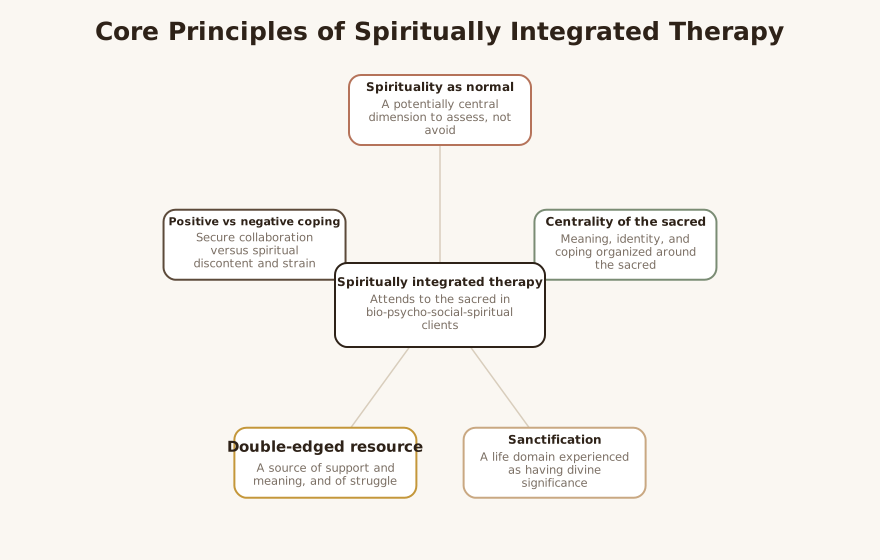
The first principle is that spirituality is a normal, potentially central dimension of human functioning that the clinician should be prepared to assess and engage, not avoid 2. The second is the centrality of the sacred: people organize meaning, identity, and coping around what they hold sacred, and shifts in the perceived status of the sacred are psychologically consequential 1. A related construct is sanctification, the process by which an aspect of life, such as a marriage, the body, or work, comes to be experienced as having divine character or significance, which tends to increase investment in and protection of that domain LLM.
A third principle is that spirituality is a double-edged resource: it can be a profound source of support and meaning, and it can also be a site of distress and struggle 5. Pargament’s coping research distinguishes positive religious coping, marked by a secure relationship with the sacred, collaborative problem-solving with the divine, and benevolent reappraisal of stressors, from negative religious coping, marked by spiritual discontent, reappraisals of a stressor as divine punishment, and a strained or insecure relationship with the sacred 5. Positive religious coping is generally associated with better adjustment, whereas negative religious coping, sometimes called spiritual struggle, is associated with worse outcomes including greater distress and poorer health 5. A fourth principle frames much of the life of the sacred as an ongoing effort first to conserve what is held sacred and then, when conservation fails, to transform one’s relationship to the sacred, a process that can be the engine of both crisis and growth 5.
Interventions & Techniques
In practice, SIP begins with spiritual assessment, an explicit and respectful inquiry into the client’s spiritual and religious history, current beliefs and practices, sense of the sacred, and any spiritual struggles, integrated into the broader clinical assessment LLM. Such inquiry communicates that the topic is welcome and surfaces resources and conflicts that a strictly secular intake would miss 4. The clinician’s stance is one of attunement to the sacred, listening for where the sacred appears in the client’s narrative and tracking how it functions as support or as struggle 1.
When indicated and consonant with the client’s wishes, the clinician may draw on the client’s own spiritual resources as part of treatment, for example by mobilizing supportive religious coping, helping a client reconnect with sustaining practices, or working through a rupture in the client’s relationship with the sacred 5. SIP can incorporate spiritually framed versions of practices the client already values, and it readily combines spiritual content with the methods of established therapies, such as examining a punitive God-image with cognitive methods or holding spiritual pain with acceptance- and mindfulness-based methods LLM. Throughout, the work is collaborative and client-led: the client’s tradition and meaning system set the terms, and the clinician follows rather than imposes 6.
LLM-generated illustrative example (not a guideline): A bereaved client says she “can’t pray anymore” since her husband died and feels God has abandoned her. Rather than reassuring or redirecting, the clinician names the spiritual struggle as real and important, gently explores what her prayer life once gave her, and helps her hold the anger toward God as part of grief rather than a failure of faith – letting the relationship with the sacred be renegotiated rather than abandoned or forced LLM.
Evidence Base
The honest position is that SIP is an established and institutionally recognized framework whose foundational construct – religious coping – has a substantial empirical literature, while its standing as a manualized, trial-validated treatment for specific disorders is still emerging rather than mature LLM. The strongest empirical footing belongs to Pargament’s theory of religious coping, which is supported by an extensive research base linking positive religious coping to better adjustment and negative religious coping, or spiritual struggle, to greater distress and poorer outcomes across stressors such as illness, trauma, and loss 5. This coping research gives the clinical framework a credible mechanistic backbone even where head-to-head outcome trials of “SIP versus standard care” are limited LLM.
The field’s professional consensus has shifted toward affirming that religion and spirituality belong in therapy when addressed competently, and that ignoring them can be a clinical and ethical lapse, which lends the framework professional legitimacy 4. At the same time, the literature emphasizes that most clinicians are under-trained in this area and that the relevant competencies are unevenly distributed, which constrains real-world quality 3. The defensible clinical stance is to use SIP as an integrative lens layered onto evidence-based care: deliver disorder-specific treatments with established trial support, and bring spiritual assessment and the client’s spiritual resources to bear within them, rather than presenting SIP itself as a stand-alone first-line treatment for a diagnosis LLM.
Populations & Indications
The framework is most clearly indicated for religiously or spiritually identified clients who want their faith or spirituality acknowledged and engaged rather than bracketed, and for whom the sacred is a meaningful axis of identity and coping 2. It is well suited to people facing chronic or serious illness, for whom spirituality often becomes a primary means of finding meaning, maintaining hope, and coping with uncertainty and mortality 5. Trauma survivors are a natural population, because trauma frequently shatters assumptions about a benevolent and orderly world and can precipitate spiritual struggle that, unaddressed, complicates recovery 5.
Bereaved individuals are served by attention to how the sacred shapes grief, including struggles with a God experienced as absent or punishing in the wake of loss 5. Older adults, for whom spirituality and religious community are frequently central to well-being and to coping with decline and finitude, are an apt population LLM. Clients in recovery from addiction are commonly engaged through frameworks that include spiritual surrender, meaning, and connection, so explicit attention to the sacred can support that work LLM. Across these groups, the indication is not the diagnosis alone but the salience of the sacred in how the person makes meaning and copes 1.
Problems-for-Work
SIP speaks most directly to problems in which the sacred is implicated. Spiritual distress and the formal religious or spiritual problem category (V62.89) are core targets, encompassing crises of faith, loss of meaning, and conflict between a client’s behavior and their spiritual values 4. Negative religious coping, or spiritual struggle, is itself a problem-for-work, since it predicts worse adjustment and can be reduced through clinical attention 5.
LLM-generated illustrative example (not a guideline): A combat veteran with PTSD describes an act he committed that violates his moral and religious code and says he is “beyond forgiveness.” The clinician treats this moral injury within trauma-focused work, helping him examine the absolute belief that he is unforgivable, reconnect with practices of repair and atonement in his own tradition, and tolerate the grief and shame without collapsing into self-condemnation LLM.
For major depressive disorder and generalized anxiety disorder, SIP supplies meaning-based reappraisal and access to spiritual sources of hope and support that can complement standard treatment LLM. In PTSD and moral injury, it addresses the spiritual and existential wounds – ruptured trust in the sacred, guilt, and shame – that purely symptom-focused protocols may leave untouched 5. For grief, substance use disorders, existential distress, demoralization, adjustment disorder, and low self-esteem, the framework works by mobilizing positive religious coping, repairing the client’s relationship with the sacred, and reconnecting the person to a sustaining source of worth and meaning 5.
Contraindications, Cautions & Cultural Humility
The foremost caution is that spiritual content must always be client-led and consonant with the client’s own beliefs; clinicians must not impose, proselytize, or steer clients toward the clinician’s spiritual views, which would be an ethical violation and a misuse of the therapeutic relationship 6. Working in this domain raises specific boundary, competence, and informed-consent questions, and clinicians should practice within their competence and refer or consult when a client’s tradition or struggle exceeds it 6. A particular risk is countertransference: a clinician’s own faith, loss of faith, or discomfort with religion can distort the work, making self-awareness and supervision essential 3.
SIP is not a substitute for indicated stabilization or evidence-based care in acute crisis, active psychosis, or acute suicidality, where safety, structure, and appropriate treatment take priority and where religious content may itself be entangled with symptoms in ways requiring careful clinical judgment LLM. Cultural humility is intrinsic to competent practice here, because spirituality is deeply embedded in culture and tradition, and the clinician must approach each client’s meaning system as the expert informant rather than assuming familiarity 3. The competency literature frames the necessary stance as attitudes of openness and respect across diverse and non-traditional spiritualities, knowledge of how religion and spirituality affect functioning, and skills to inquire and intervene without imposing the clinician’s worldview 3.
Treatment-Plan Suggestions & SMART Objectives
| Goal | SMART objective (example) | Mechanism |
|---|---|---|
| Complete a respectful spiritual assessment | Within 2 sessions, client and clinician will document the client’s spiritual history, current beliefs/practices, and any spiritual struggles | Spiritual assessment and attunement to the sacred 2 |
| Reduce negative religious coping / spiritual struggle | Over 10 sessions, client will identify 2 spiritual-struggle appraisals (e.g., punishment, abandonment) and articulate an alternative within their own tradition | Shifting from negative to positive religious coping 5 |
| Mobilize supportive spiritual resources | Over 6 weeks, client will re-engage 1 sustaining spiritual practice or community connection and rate its effect on distress | Strengthening positive religious coping 5 |
| Address a rupture in the relationship with the sacred | Within 12 sessions, client will describe the rupture, tolerate the associated affect, and define a desired renegotiated relationship to the sacred | Transformation of the relationship to the sacred 5 |
| Integrate spiritual values into recovery from loss or addiction | Over 8 weeks, client will name 2 sacred values and take 1 weekly value-aligned action | Conserving and acting on the sacred 1 |
| Process moral injury / spiritual guilt | Within 10 sessions, client will examine an absolute self-condemning belief and engage 1 tradition-consistent practice of repair | Reappraisal and spiritual coping 5 |
| Restore meaning and hope in serious illness | Over 6 sessions, client will articulate a meaning-based reframe of the illness and identify 1 source of spiritual support | Meaning-making and benevolent reappraisal 5 |
Common Misconceptions
A frequent misconception is that addressing spirituality in therapy means the clinician shares, endorses, or guides the client toward particular religious beliefs; in fact the work is client-led and the clinician’s task is to engage the client’s meaning system without imposing their own 6. A second is that SIP requires the clinician to be religious or to share the client’s faith, when what it requires is competence – attitudes of openness, relevant knowledge, and skills to inquire respectfully – which non-religious clinicians can hold 3. A third is that spirituality is uniformly beneficial; the coping research is clear that it can also be a source of struggle and worse outcomes, so the framework attends to spiritual harm as well as spiritual support 5.
Another misconception is that engaging religion and spirituality is outside the proper scope of psychology or inherently unscientific; the professional field has moved toward recognizing these domains as legitimate and clinically important when handled competently 4. Finally, SIP is sometimes mistaken for chaplaincy or pastoral counseling, when it is a secular, clinically governed psychotherapy framework that addresses the sacred as a dimension of psychological functioning rather than offering spiritual direction LLM.
Training & Certification
There is no single license or credential called “spiritually integrated psychotherapist”; the framework is practiced by licensed mental health professionals who incorporate spiritual and religious competencies into their existing scope LLM. The field’s clearest competency standard is the set of spiritual and religious competencies for psychologists, which organizes the necessary preparation into attitudes, knowledge, and skills and is intended to guide training and self-assessment 3. That literature also documents that most clinicians receive little formal training in this area, which makes deliberate continuing education, consultation, and supervision important for anyone working in the domain 3.
Pargament’s foundational text functions as a primary clinical training resource, laying out the conceptual model and the practical work of assessing and addressing the sacred 1. Clinicians typically build competence through that literature, focused workshops and continuing education, and supervised practice, integrating the framework into modalities they are already trained in rather than acquiring a separate license LLM.
Key Terms
The sacred – the central organizing construct, encompassing concepts of God, the divine, and transcendent reality, as well as any aspect of life a person imbues with sacred significance 1. Sanctification – the process by which an aspect of life comes to be perceived as having divine character or meaning, increasing investment in it LLM. Religious coping – the use of the sacred to understand and respond to stress, central to the framework’s empirical base 5. Positive religious coping – coping marked by a secure relationship with the sacred, collaborative problem-solving with the divine, and benevolent reappraisal, generally linked to better adjustment 5. Negative religious coping / spiritual struggle – coping marked by spiritual discontent, punitive reappraisals, and a strained relationship with the sacred, linked to greater distress 5. Conservation and transformation of the sacred – the effort to preserve what is held sacred and, when that fails, to change one’s relationship to it 5. Spiritual assessment – structured, respectful inquiry into a client’s spiritual history, beliefs, practices, and struggles LLM. Spiritual and religious competencies – the attitudes, knowledge, and skills proposed to equip clinicians to address these issues responsibly 3. Religious or spiritual problem (V62.89) – a diagnostic category for distressing experiences such as loss of faith or questioning of spiritual values 4.
Resources & Further Reading
▶ Watch — a video introduction to this concept:
- Spiritually Integrated Psychotherapy: Understanding and Addressing the Sacred (Pargament, 2007/2011, Guilford Press)
- Spiritually Integrated Psychotherapy: Overview (kennethpargament.com)
- Spiritual and Religious Competencies for Psychologists (Vieten et al., 2013, APA, full PDF)
- Can religion and spirituality have a place in therapy? Experts say yes (APA Monitor, 2023)
- Pargament’s Theory of Religious Coping: Implications for Spiritually Sensitive Practice (PMC)
- Addressing Religion and Spirituality in Psychotherapy: Ethical and Clinical Perspectives (Society for the Advancement of Psychotherapy)
Reflective / Supervision Questions
- When a client raises spiritual material, am I genuinely following their meaning system, or am I subtly steering toward my own beliefs, disbelief, or discomfort LLM?
- How do I distinguish spirituality that is functioning as a resource for this client from spirituality that has become a site of struggle and distress requiring direct work 5?
- Am I working within my competence here, and where would consultation, supervision, or referral better serve a client whose tradition or struggle exceeds my knowledge 6?
- How does my own religious or spiritual history shape my countertransference with this client, and what am I at risk of missing or over-attending to as a result 3?
- Am I integrating spiritual work with indicated evidence-based care for the client’s diagnosis, rather than letting one displace the other LLM?
- Am I representing this framework honestly – as an established, integrative approach with a strong religious-coping research base but an emerging disorder-specific outcome literature – rather than as a validated stand-alone protocol LLM?