
Few psychological terms have traveled further from their origin than “emotional intelligence.” In the research literature it names a specific, measurable mental ability; in popular usage it has become a near-synonym for being a good, likeable, well-adjusted person 1. For a clinician, the gap matters, because the version that survives scientific scrutiny is the narrow one, and most of what makes emotional intelligence useful in the consulting room follows from treating it as a set of trainable skills rather than a personality verdict LLM. This article keeps the two versions distinct and stays close to what the construct can and cannot do clinically LLM.
Type & Discipline
Emotional intelligence (EI) is a psychological construct, not a therapy, a diagnosis, or a school of practice 1. It belongs to the psychology of individual differences and sits at the intersection of intelligence research and the study of emotion, which is why its founders framed it as a candidate intelligence rather than a trait or a virtue 2. The defining claim is that emotions carry information about relationships and the environment, and that people differ reliably in how well they reason with that information 1.
Within the field, the construct splits into two broad families that a clinician should not conflate. The ability model, developed by John Mayer and Peter Salovey, treats EI as a set of cognitive abilities for processing emotional information, measured with performance tests in the way IQ is measured 2. The mixed or trait models, associated most famously with Daniel Goleman’s popularization, bundle emotional abilities together with motivation, self-control, optimism, and social competencies into a broad portrait of effective functioning 45. The ability model is the version with the strongest claim to being an intelligence in the technical sense, and it is the version this article privileges, while noting where the popular conception diverges 2LLM.
Creators & Lineage
The modern scientific construct was introduced by Peter Salovey and John Mayer in 1990, who first defined emotional intelligence and proposed that it could be studied as an ability 4. They subsequently refined it into the influential four-branch model, which remains the field’s reference framework 3. Their later collaborator David Caruso joined in developing both the theory and its measurement, and the three are the central figures of the ability tradition 26.
The lineage reaches back further than 1990. The idea that there is an intelligence specific to people and feelings draws on earlier notions of social intelligence, the capacity to understand and manage others, which predates EI by decades and supplies one of its conceptual roots 4. EI also connects forward to affective neuroscience, which studies the brain systems underlying emotion, and to social-emotional learning (SEL), the school-based movement that operationalizes emotional skills as teachable curricula, where the four-branch model is catalogued as a foundational framework 3. In the broader culture, the construct’s lineage is inseparable from positive psychology’s interest in strengths and flourishing LLM.
The popular trajectory diverged sharply from the academic one in 1995, when Daniel Goleman published Emotional Intelligence: Why It Can Matter More Than IQ, a bestseller that brought the term to mass audiences and advanced the striking claim that emotional competencies may predict life success better than conventional intelligence 5. Goleman’s synthesis broadened the construct well beyond the ability definition and is the main reason “EQ” entered everyday and workplace vocabulary, but it is also the source of much of the overreach that later research had to discipline 45LLM.
Core Principles
The first principle is that emotions are sources of information, not merely disruptions. The ability model rests on the premise that feelings convey meaningful data about the self, other people, and situations, and that this data can be reasoned about more or less skillfully 1. EI is the competence that does this reasoning 2.
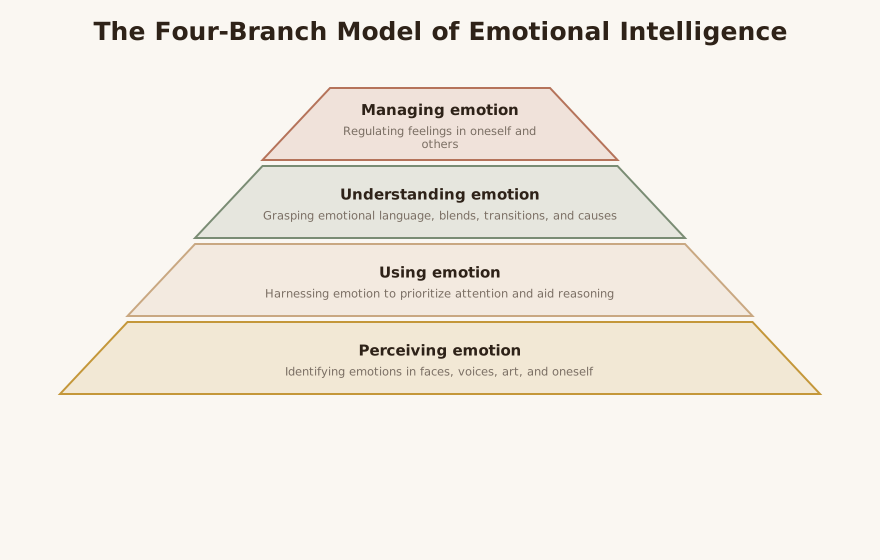
The second principle is the four-branch structure, the model’s organizing spine. Mayer and Salovey arrange emotional abilities into four branches, often described as ranging from more basic to more psychologically integrated 3. Perceiving emotion is the ability to identify emotions in oneself, in others, and in faces, voices, art, and the environment 3. Using emotion to facilitate thought (sometimes called facilitating thought) is the ability to harness emotions to prioritize attention, aid reasoning, and support problem-solving and creativity 3. Understanding emotion is the ability to comprehend emotional language, to grasp how emotions blend and transition, and to recognize the causes and progressions of feelings 3. Managing emotion is the ability to regulate emotions in oneself and others, moderating negative feelings and enhancing useful ones to achieve goals 3.
The third principle is hierarchy and integration. The branches are not a random list; perceiving is comparatively basic, while managing emotion is the most complex and most fully integrated with personality and goals, which means emotion regulation in this model presupposes the more basic skills of accurately perceiving and understanding what one feels 3LLM. A clinician can read this as a sequence: a client who cannot label a feeling accurately is poorly positioned to manage it LLM.
The fourth principle is that, in the ability tradition, EI is an intelligence and behaves like one. It is conceptualized as a mental ability, measured by performance rather than self-report, and expected to show the properties of a standard intelligence, including positive correlations with other cognitive abilities and a developmental rise with age and experience 26. This is the principle that separates the rigorous construct from the popular one, which often measures EI by asking people how emotionally skilled they believe themselves to be 2LLM.
Interventions & Techniques
Emotional intelligence is a construct, so it does not come with a treatment manual; its clinical value is that its four branches name concrete skill targets that can be addressed inside established modalities LLM. The most direct application is emotion labeling and granularity work aimed at the perceiving and understanding branches: helping a client move from “I feel bad” to a precise identification of the emotion, its intensity, and its likely cause draws directly on the abilities the model defines 3LLM. This maps cleanly onto affect-labeling and emotion-monitoring exercises already used across cognitive and behavioral therapies LLM.
A second application targets the using emotion branch by helping clients treat feelings as data that direct attention and signal what matters, rather than as noise to be suppressed, which reframes the goal of treatment from eliminating emotion to reading it 3LLM. A third targets the managing emotion branch, the model’s most complex skill, through the regulation strategies central to emotion-focused and dialectical approaches: down-regulating overwhelming affect and sustaining useful states in service of goals 3LLM. Because the model is hierarchical, the clinical sequence often runs from perceiving and understanding toward managing, so that regulation work is scaffolded on accurate appraisal rather than attempted in isolation 3LLM.
LLM-generated illustrative example (not a guideline): A client who reports “just exploding” at their partner cannot, on questioning, distinguish anger from hurt or fear. Rather than starting with anger-management techniques, the clinician works first on perceiving and understanding, building a vocabulary that separates the felt threat from the surface anger, before introducing regulation strategies that now have something specific to act on LLM.
These are techniques borrowed by other therapies, not an “EI therapy,” and they are most defensible when the clinician frames them as skill-building within an evidence-based modality LLM.
Evidence Base
The honest summary is that emotional intelligence is an established construct with an uneven evidence base, and that the strength of the evidence depends heavily on which version is being discussed 2. The ability model is the best-validated branch: it is operationalized by performance tests, most notably the Mayer-Salovey-Caruso Emotional Intelligence Test (MSCEIT), and studies of that instrument support the claim that emotional intelligence can be measured as an ability with acceptable reliability and a meaningful factor structure 6. Treating EI as an intelligence, rather than a self-reported trait, is what gives the construct its scientific footing 2.
At the same time, the field has had to reckon with substantial challenges and overreach 2. The popular claim, advanced most forcefully in Goleman’s bestseller, that EI matters more than IQ for life success is far stronger than the data warrant, and the broad mixed models that fuel such claims blur the boundary between EI and ordinary personality, making it hard to know what is actually being measured 25LLM. Self-report EI questionnaires in particular overlap heavily with established personality traits, which is a recurring criticism the ability-model proponents themselves acknowledge as a reason to prefer performance measurement 2LLM.
For the clinician, the load-bearing caveats are these: EI is a construct, not a therapy, so there is no “emotional intelligence treatment” with its own outcome trials LLM. Its abilities overlap with capacities that established therapies already train, which means its clinical contribution is best understood as a useful organizing vocabulary and a set of assessment targets rather than an independent intervention with its own evidence of efficacy 2LLM. Claims that an EI program will transform clinical outcomes should be treated with the same skepticism the research literature applies to the “more than IQ” slogan 2LLM.
Populations & Indications
The construct is broad, but several populations are especially apt for EI-informed skill work LLM. Adults with difficulty identifying or regulating affect are a natural fit, since the four branches map onto exactly the appraisal-and-regulation chain that often breaks down in these presentations 3LLM. Adolescents are a core population because emotional abilities are developmentally rising and trainable in this period, and because the SEL movement has built much of its curriculum on the four-branch framework for precisely this group 3LLM. Children are likewise central to SEL applications, where perceiving and understanding emotions are foundational skills taught explicitly 3LLM.
Leaders and professionals are the population most associated with EI in the popular and workplace literature, where the construct is invoked for managing interpersonal demands and stress, though clinicians should hold the more inflated promotional claims at arm’s length 45LLM. Couples are indicated where the presenting difficulty is mutual misreading of emotion and poor co-regulation, areas the perceiving and managing branches speak to directly LLM. People with interpersonal difficulties more generally, where empathy and social reading are part of the problem, are a reasonable indication for targeted skill work LLM. The clearest indication across these groups is a presentation in which a specific emotional ability, naming, understanding, or regulating feelings, is identifiably weak and contributing to distress LLM.
Problems-for-Work
The four branches give clinicians a precise way to locate where an emotional process is failing, which turns vague complaints into targetable problems LLM.
- Emotional dysregulation. This is most often a managing-branch problem, but the model’s hierarchy suggests checking the upstream branches first, since regulation rests on accurate perceiving and understanding 3LLM.
- Low self-awareness. A perceiving-branch deficit, where the client cannot reliably identify what they feel in the moment, which undermines everything downstream 3LLM.
- Anger management problems and impulsivity. Frequently a failure to understand the emotion beneath the anger and to manage the resulting urge; work targets both branches in sequence 3LLM.
- Empathy deficits and social skills deficits. A perceiving-in-others problem, where the client misreads the emotional states of other people, with knock-on effects for relationships 3LLM.
- Interpersonal conflict and relationship difficulties. Often a breakdown in perceiving and managing emotion within an interaction, where neither party reads or regulates the exchange well 3LLM.
- Workplace stress. The domain where EI is most popularly invoked; clinically, the useful angle is using and managing emotion under demand rather than the inflated promise that EI guarantees professional success 45LLM.
LLM-generated illustrative example (not a guideline): A manager referred for “anger at work” is helped to map a recurring incident across the branches: he accurately perceives others’ frustration (intact perceiving) but misunderstands it as personal contempt (a faulty understanding step), which then drives a poorly managed outburst. Locating the failure at the understanding branch, rather than treating it as a generic anger problem, reshapes the intervention LLM.
Contraindications, Cautions & Cultural Humility
The first caution is conceptual: EI is not a measure of a person’s worth, and framing it as such risks turning a skills assessment into a character judgment LLM. Because the popular construct blurs into personality and likeability, a clinician who tells a client they “lack emotional intelligence” can easily deliver what feels like a verdict on who they are rather than a description of a trainable skill, which is clinically counterproductive and potentially shaming 4LLM. The ability framing, EI as a set of skills that develop with experience, is the safer and more accurate clinical stance 2LLM.
A second caution concerns over-claiming. The construct has been marketed, especially in workplace and self-help contexts, as a near-universal predictor of success, and importing that promotional tone into therapy sets up expectations the evidence cannot support 5LLM. Clinicians should be especially careful not to imply that building EI will resolve problems whose drivers are situational, structural, or diagnostic rather than skill-based LLM.
Cultural humility is essential because the display, interpretation, and management of emotion are heavily culturally patterned. What counts as accurately “perceiving” or appropriately “managing” an emotion varies across cultures, and EI measures and curricula developed largely in Western, often North American, contexts encode particular norms about emotional expression that are not universal LLM. A clinician should be wary of scoring a client as low in emotional perception or regulation when the client is in fact skillfully following a different, equally valid set of cultural display rules LLM. The construct should be applied as a flexible lens on a client’s own emotional world, not as a yardstick that pathologizes culturally normative styles of feeling and expression LLM.
Treatment-Plan Suggestions & SMART Objectives
| Goal | SMART objective (example) | Mechanism |
|---|---|---|
| Improve emotional self-perception | Over 6 sessions, client will log one emotion daily with a specific label and intensity rating, raising accuracy of identification | Strengthens the perceiving branch as the basis for all later work 3 |
| Build emotional vocabulary and understanding | Within 4 weeks, client will distinguish at least three emotions they previously merged (e.g., anger vs. hurt vs. fear) in session review | Targets the understanding branch and emotion granularity 3 |
| Use emotions as information rather than noise | By week 6, client will identify what one recurring strong feeling is signaling about a need or value before acting on it | Develops the using emotion to facilitate thought branch 3 |
| Regulate high-intensity affect | Over 8 weeks, client will apply one rehearsed regulation strategy during three real-world emotional spikes and review outcomes | Develops the managing emotion branch, scaffolded on perceiving/understanding 3 |
| Improve reading of others’ emotions | Within 6 sessions, client will describe a recent interaction from the other person’s likely emotional perspective | Targets perceiving emotion in others, addressing empathy deficits 3 |
| Reduce reactive anger and impulsivity | By week 8, client will insert a labeled pause between trigger and response in two logged incidents per week | Sequences understanding before managing in anger episodes 3 |
| Improve co-regulation in a key relationship | Over 10 weeks, couple/dyad will name and de-escalate one emotional exchange per week using shared emotion labels | Applies perceiving and managing branches to interpersonal repair 3 |
Common Misconceptions
The most pervasive misconception is that emotional intelligence matters more than IQ for success in life, a claim popularized by Goleman’s 1995 bestseller and far stronger than the empirical record supports 52. A second is that EI is essentially the same as being warm, agreeable, or likeable; the ability model insists it is a form of intelligence, a capacity for reasoning about emotional information, which is conceptually distinct from temperament or kindness 2. A third misconception is that EI is best measured by asking people how emotionally skilled they think they are; the ability tradition argues that self-report conflates EI with personality and that performance tests like the MSCEIT are required to measure it as a genuine ability 26.
A fourth is that emotional intelligence is fixed, like a personality trait; in the ability model it is an intelligence that develops with age and experience and is therefore trainable, which is precisely what makes it clinically relevant 2LLM. A fifth, common among clinicians, is that “EI” names a therapy; it does not, and there is no manualized emotional-intelligence treatment with its own outcome evidence, only a construct whose skills overlap with what established therapies already teach 2LLM. A final misconception is that high EI means always being calm or positive; the managing branch is about regulating emotions toward goals, which can include sustaining or even amplifying a feeling when that serves the situation, not suppressing affect across the board 3.
Training & Certification
There is no licensure or certification in emotional intelligence, and a clinician should be skeptical of credentials that imply otherwise, because EI is a construct rather than a regulated treatment LLM. The academic competence relevant to clinical use comes from understanding the four-branch ability model and its measurement, material covered in coursework on emotion, individual differences, and assessment 23. Familiarity with the MSCEIT and the logic of performance-based measurement is the main technical literacy the construct asks of a clinician who wants to use it rigorously 6.
In applied settings, EI training appears most heavily in two adjacent worlds: organizational and leadership development, where a large commercial market of workshops and self-report instruments exists and quality varies widely, and education, where social-emotional learning programs teach emotional skills to children and adolescents using frameworks built on the four-branch model 3LLM. Clinicians are better served by absorbing EI’s skill targets into established, evidence-based emotion-regulation training than by pursuing a freestanding EI certificate 2LLM.
Key Terms
- Emotional intelligence (ability model): the capacity to reason validly about emotions and to use emotional information to enhance thought, treated as a form of intelligence 2.
- Four-branch model: the framework organizing emotional abilities into perceiving, using/facilitating, understanding, and managing emotion 3.
- Perceiving emotion: identifying emotions in oneself, others, and the surrounding environment, including faces, voices, and art 3.
- Using emotion (facilitating thought): harnessing emotions to direct attention, aid reasoning, and support problem-solving 3.
- Understanding emotion: comprehending emotional language and how emotions blend, transition, and progress over time 3.
- Managing emotion: regulating emotions in oneself and others to achieve goals, the model’s most complex branch 3.
- MSCEIT: the Mayer-Salovey-Caruso Emotional Intelligence Test, the principal performance measure of ability EI 6.
- Mixed (trait) models: broad conceptions, associated with Goleman, that combine emotional abilities with motivation, self-control, and social competencies 45.
- Social intelligence: the older notion of skill in understanding and managing other people, a conceptual root of EI 4.
Resources & Further Reading
▶ Watch — a video introduction to this concept:
- Emotional Intelligence (Mayer) — Noba Project
- Emotional Intelligence as an Ability: Theory, Challenges, and New Directions (Mayer, Caruso & Salovey) — Springer
- Four Branch Model of Emotional Intelligence — Harvard Explore SEL
- Emotional intelligence — Encyclopaedia Britannica
- Emotional Intelligence: Why It Can Matter More Than IQ (Goleman, 1995) — Goodreads
- Measuring emotional intelligence with the MSCEIT (Psicothema) — PDF
Reflective / Supervision Questions
- When I describe a client as “low in emotional intelligence,” am I naming a specific, trainable skill on one of the four branches, or am I delivering a global verdict on their character? 3LLM
- For this client’s presenting problem, which branch is actually failing, perceiving, using, understanding, or managing, and is my intervention aimed at the right one or skipping straight to regulation? 3
- Am I implicitly importing the “EI matters more than IQ” promise into my expectations for this client, and would the evidence support what I am hoping the work will achieve? 25
- How might this client’s cultural display rules shape what counts as accurate emotional perception or appropriate emotional management, and could I be scoring a culturally normative style as a deficit? LLM
- Am I treating emotional intelligence as a discrete therapy, or am I correctly using it as a vocabulary and set of skill targets within an established, evidence-based modality? 2LLM
- For a client whose dysregulation I am tempted to treat directly, have I first checked whether the upstream abilities of perceiving and understanding the emotion are intact? 3LLM