
Type & Discipline
Transcendental Meditation (TM) is a standardized, branded mantra-meditation technique taught through a fixed seven-step course by certified instructors 3. It sits within the family of mantra-based meditation and is studied primarily at the intersection of meditation research, behavioral medicine, and integrative or complementary medicine 5. The core practice is deceptively simple: the practitioner sits with eyes closed and silently repeats a personally assigned mantra for roughly 20 minutes twice daily 4. Unlike attention-monitoring practices, TM is taught as an “effortless” technique in which the mind is said to settle toward quieter states without concentration or active control of thought 3.
For clinicians, the most useful orienting fact is that TM is a protocolized commercial program rather than a generic relaxation skill that any therapist can deliver 4. The mantra, the instruction sequence, and the trademark are controlled by the Maharishi Foundation and affiliated organizations 6. This standardization is both a research strength — the intervention is unusually uniform across studies — and a complicating factor, because the same organizations that disseminate the technique have also produced much of its supporting evidence 6.
Creators & Lineage
TM was developed and popularized by Maharishi Mahesh Yogi, an Indian teacher who began teaching the technique internationally in the late 1950s and 1960s 7. He drew on Vedic and Hindu contemplative traditions but presented TM in secular, accessible terms suitable for a Western lay audience 7. The movement gained considerable visibility in the 1960s and 1970s, in part through high-profile cultural associations, and grew into a global network of teaching centers and affiliated institutions 7.
Within the clinical and research world, two figures recur as lineage points for the empirical literature LLM. Robert Schneider is closely associated with the cardiovascular research program, particularly studies of TM and blood pressure LLM. Psychiatrist Norman Rosenthal helped bring TM to wider clinical and public attention as a practicing meditator and author writing about its potential mental-health applications LLM. Conceptually, TM also sits alongside Herbert Benson’s Relaxation Response, which Benson developed after studying TM practitioners and then stripped of its proprietary and religious framing — a useful comparison point when a client wants the physiological benefits without the branded program LLM.
Core Principles
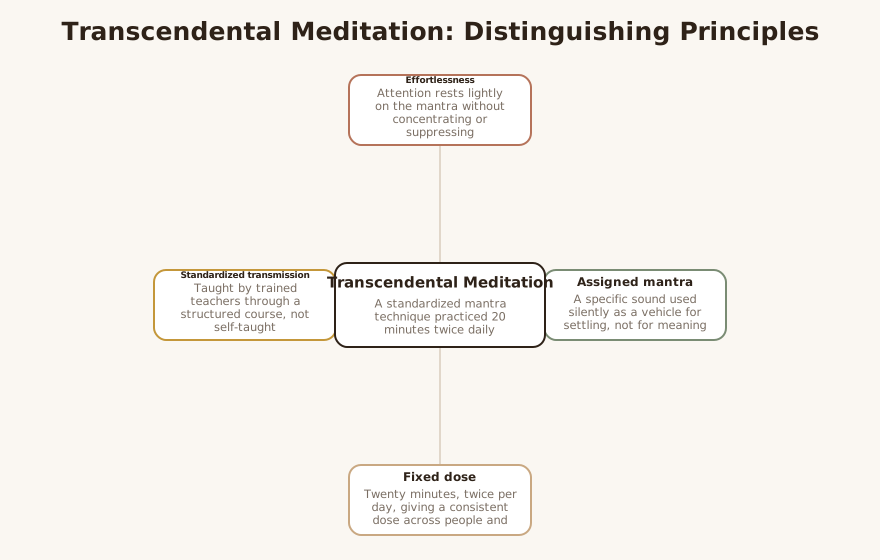
Several principles distinguish TM from other contemplative methods. First, effortlessness: practitioners are taught not to concentrate, suppress thoughts, or monitor the breath, but to allow attention to rest lightly on the mantra and to return to it without strain 3. Second, the assigned mantra: each learner receives a specific sound to use silently, and the technique treats this sound as a vehicle for settling rather than as a word with semantic meaning 4. Third, a fixed dose: the canonical prescription is 20 minutes, twice per day, which gives the practice an unusually consistent “dose” across individuals and studies 4.
A fourth principle is standardized transmission through trained teachers and a structured course, which is why TM is generally not something a clinician self-teaches from a handout 3. The program’s own framing emphasizes that proper instruction is necessary for the technique to be practiced “correctly” 2. Clinically, the working hypothesis behind TM is that this twice-daily settling reduces physiological arousal and sympathetic activation, which in turn is proposed to benefit stress-linked conditions such as hypertension and anxiety 4.
Interventions & Techniques
The intervention itself is the practice, delivered as a course rather than as discrete therapist techniques 3. A standard TM course involves an introduction, personal instruction in which the mantra is assigned, and follow-up sessions to verify correct practice 3. After training, the client is expected to self-administer the 20-minute sessions at home, typically once in the morning and once in the afternoon or early evening 4.
For a therapist who is not a TM teacher, the realistic “techniques” are referral and integration rather than direct delivery LLM. You can frame TM as an adjunctive self-regulation practice, coordinate around a client who is already practicing, and use session time to process what arises during meditation LLM. Cleveland Clinic’s patient-facing guidance positions TM as a low-risk relaxation practice that can complement, rather than replace, conventional care 4.
LLM-generated illustrative example (not a guideline): A client with chronic work stress reports that her physician suggested meditation. Rather than improvising a mantra protocol, the therapist clarifies that TM specifically requires a certified course, helps her weigh the cost and time commitment against generic relaxation alternatives, and agrees to use early sessions to track how twice-daily practice affects her sleep and reactivity LLM.
Evidence Base
Honesty about the evidence is essential here, because TM’s marketing often outruns its data LLM. TM has accumulated one of the largest trial literatures in meditation research, so in terms of sheer volume the field is established 5. The maturity of the literature, however, refers to its size and longevity — not to settled, high-confidence efficacy LLM.
The pivotal independent appraisal is the AHRQ comparative-effectiveness review summarized by Goyal and colleagues, which evaluated meditation programs across many trials 1. Two findings from that review should anchor any clinician’s expectations. First, when meditation programs were compared against active control conditions — not just waitlists or no treatment — the evidence that they outperform those controls was generally weak 1. Second, the moderate-strength benefits the review did identify (for anxiety, depression, and pain) were associated chiefly with mindfulness programs, and the review found insufficient evidence that mantra-based programs such as TM improved most outcomes more than active comparators 1. In other words, the strongest independent synthesis did not establish TM-specific superiority 1.
A second major caveat is conflict of interest. A substantial share of the supportive TM research has been conducted by investigators affiliated with TM organizations or institutions, which raises the risk of allegiance bias and inflates the apparent effect sizes 6. More recent systematic work on mantra-based meditation continues to report meaningful methodological limitations — heterogeneity, small samples, and variable risk of bias — even where pooled effects on stress, anxiety, and related outcomes appear favorable 5. The fair summary for clinicians: TM is plausibly helpful for stress and anxiety symptoms and is low-risk, but claims of unique or large benefits over other relaxation or meditation practices are not well supported by independent, active-controlled evidence 1.
Populations & Indications
TM has been studied and promoted most heavily in adults seeking stress reduction, including working adults, students, and high-stress occupational groups 4. Cardiovascular populations — particularly adults with elevated blood pressure or cardiovascular risk — represent the most prominent clinical target of the research program 4. Anxiety and chronic stress are the most consistently cited psychological indications 5.
Trauma-exposed adults, including veterans, have also been a population of interest, and TM organizations actively promote the technique for post-traumatic stress; clinicians should hold these claims with appropriate caution given the evidence limitations above 6. In general, TM is best framed as an adjunctive practice for stress-linked presentations in adults who can tolerate sustained eyes-closed inner focus and who can commit to the daily dose 4.
Problems-for-Work
The presenting problems for which TM is most plausibly relevant cluster around stress and arousal regulation 5.
- Hypertension and physiological stress reactivity. TM is most often offered as a complementary practice for blood-pressure management, layered onto medical treatment rather than substituting for it 4. Application: coordinating with a client’s prescriber while the client practices twice daily and self-monitors readings LLM.
- Anxiety. Mantra-based meditation shows favorable but methodologically limited effects on anxiety symptoms, making TM a reasonable adjunct for clients who prefer a structured practice 5. Application: pairing daily practice with in-session processing of anticipatory worry LLM.
- Chronic stress and burnout. The twice-daily protocol gives clients a predictable downshift routine 4. Application: using TM as a behavioral anchor for occupationally stressed clients LLM.
- PTSD symptoms. TM is promoted for trauma populations, but the independent evidence is weaker than the marketing implies, so it should be positioned as adjunctive and monitored 6. Application: watching closely for arousal spikes during eyes-closed practice in trauma survivors LLM.
- Sleep disturbance. As a relaxation practice, TM may support clients whose insomnia is stress-driven 4. Application: tracking sleep latency alongside practice consistency LLM.
Contraindications, Cautions & Cultural Humility
TM is generally regarded as low-risk for most adults, and serious adverse events are uncommon 4. That said, clinicians should attend to a few cautions. Sustained, unguided inner focus can occasionally surface distressing material for trauma survivors, and dissociation-prone clients may need closer monitoring and grounding support LLM. TM is not a substitute for medication or evidence-based psychotherapy for conditions such as hypertension, severe anxiety, or PTSD, and should be framed as complementary 4.
There are practical cautions as well. TM is a paid, trademarked program, and the course fee plus the requirement to learn from a certified teacher can be a meaningful access barrier 6. Cultural humility matters on two fronts: first, TM is rooted in Vedic and Hindu tradition even though it is marketed in secular terms, and some clients may have religious or cultural feelings about adopting it 7. Second, the strong organizational and commercial interests behind TM warrant transparent discussion so clients can make informed, non-coerced choices, including the option of a free, secular alternative such as the Relaxation Response LLM.
Treatment-Plan Suggestions & SMART Objectives
| Goal | SMART objective (example) | Mechanism |
|---|---|---|
| Reduce stress reactivity | Client will complete two 20-minute TM sessions per day, 6 of 7 days weekly, for 8 weeks, logging completion 4 | Reduced physiological arousal via twice-daily settling 4 |
| Lower blood pressure (adjunct) | Client will maintain daily TM practice and record home BP 3x/week for 12 weeks, coordinating results with prescriber 4 | Sympathetic down-regulation as an adjunct to medical care 4 |
| Decrease anxiety symptoms | Client will practice daily and report a measurable drop on a standardized anxiety measure over 8 weeks 5 | Relaxation and reduced arousal associated with mantra practice 5 |
| Improve sleep | Client will practice TM and track sleep latency nightly for 4 weeks 4 | Pre-sleep arousal reduction 4 |
| Build a consistent self-regulation routine | Client will sustain twice-daily practice for 90% of days across 4 weeks 4 | Habit formation around a predictable downshift practice LLM |
| Process meditation experiences | Client will bring one notable practice experience to each weekly session for review LLM | Integration of meditation content with therapy goals LLM |
| Make an informed, value-aligned choice | Client will review TM’s cost, lineage, and evidence and confirm an informed decision before enrolling 6 | Autonomy and culturally humble shared decision-making LLM |
Common Misconceptions
A frequent misconception is that TM is uniquely or dramatically more effective than other forms of meditation; the strongest independent review did not establish such superiority over active comparators 1. Another is that any silently repeated word constitutes “doing TM” — the program treats the specific assigned mantra and certified instruction as essential to the technique as defined 2. Clients sometimes believe TM is a purely secular relaxation tool with no roots; in fact it derives from Vedic and Hindu tradition even though it is taught in secular language 7.
A clinically important misconception is that the supportive research is uniformly strong and independent; in reality much of it carries methodological limitations and organizational conflicts of interest 6. Finally, some clients assume TM can replace medication for conditions like high blood pressure, whereas clinical guidance positions it as a complement to conventional treatment 4.
Training & Certification
TM is taught only by instructors certified through the Maharishi Foundation and affiliated organizations, via a standardized course 3. For clinicians, this means there is no quick continuing-education pathway to “deliver TM” the way one might learn a brief relaxation script; becoming an authorized TM teacher requires the organization’s own training 6. Most therapists therefore engage with TM through referral, coordination, and integration rather than direct provision LLM. Clients themselves access the technique by enrolling in the official course, which includes personal instruction and follow-up 3.
Key Terms
- Mantra: a specific sound assigned to the practitioner for silent repetition, used as a vehicle for settling rather than for its meaning 4.
- Effortlessness: the defining instruction that the practice requires no concentration, thought suppression, or breath monitoring 3.
- Twice-daily dose: the canonical 20-minutes-twice-per-day prescription that gives TM unusually uniform “dosing” 4.
- Standardized transmission: delivery through a fixed course taught by certified instructors 3.
- Active control: a comparison condition that is itself a credible intervention, the benchmark against which TM’s specific benefits remained weakly supported 1.
- Allegiance/conflict-of-interest bias: distortion of results arising when much research is conducted by parties invested in the intervention 6.
Resources & Further Reading
▶ Watch — a video introduction to this concept:
- Goyal et al. (2014), Meditation Programs for Psychological Stress and Well-being — AHRQ / JAMA Internal Medicine
- Effectiveness of Mantra-Based Meditation on Mental Health: A Systematic Review and Meta-Analysis (PMC)
- What Is Transcendental Meditation (TM)? — Cleveland Clinic
- Transcendental Meditation — Britannica
- Maharishi Mahesh Yogi — Britannica
- Transcendental Meditation — Wikipedia
- Transcendental Meditation Technique — Official Website (Maharishi Foundation)
Reflective / Supervision Questions
- How do I present TM to a client in a way that is honest about both its low risk and its contested, conflict-laden evidence base LLM?
- When a client wants the physiological benefits without a paid, branded program, am I offering secular alternatives such as the Relaxation Response LLM?
- Am I attending to access and equity given the course cost, and to cultural or religious meaning given TM’s Vedic roots 7?
- For trauma-exposed clients, how am I monitoring eyes-closed practice for arousal or dissociation, and what grounding plan is in place LLM?
- Am I positioning TM as an adjunct rather than a substitute for medical and evidence-based psychological care for conditions like hypertension and PTSD 4?