
Most clinicians were trained to think of skill-building as something we deliver: we explain a coping strategy, the client practices it, and the skill transfers into their life. LLM Barbara Rogoff’s work suggests a different and more accurate picture of how people actually learn—not by receiving instruction in isolation, but by participating in meaningful, culturally organized activity alongside someone more skilled. 1 Her theory of guided participation and apprenticeship in thinking reframes development as a fundamentally social and cultural process, and it gives therapists a sharper way to think about parent-child work, psychoeducation, caregiver coaching, and the everyday business of helping someone acquire a competence they do not yet have. 1LLM
Type & Discipline
This is a theory, not a treatment package. 2 It is a developmental and cultural-psychological account of how cognitive skills are acquired through social participation, originating in Barbara Rogoff’s research in cultural and developmental psychology. 2 It belongs to the broader family of sociocultural theory, the tradition that locates the engine of cognitive development in social interaction and cultural context rather than in the individual head. 3 Its central objects of study are guided participation—the structured, often tacit ways more and less experienced people coordinate around a shared activity—and apprenticeship, the broader arrangement in which a novice grows toward competence through participation in valued cultural practices. 1 Because it is a theory rather than a manualized therapy, clinicians use it as a conceptual lens to inform how they structure skill-building and relational work inside established treatment modalities, not as a standalone intervention. LLM
Creators & Lineage
The theory is principally the work of Barbara Rogoff, a developmental and cultural psychologist whose 1990 book Apprenticeship in Thinking: Cognitive Development in Social Context set out the framework. 12 Rogoff’s central intellectual debt is to Lev Vygotsky, whose sociocultural theory held that higher cognitive functions originate in social interaction and are internalized by the child, and whose concept of the zone of proximal development—the gap between what a learner can do alone and what they can do with help—is the seed from which guided participation grows. 34 Rogoff extended Vygotsky’s relatively dyadic and instructional emphasis toward a richer, more naturalistic and explicitly cross-cultural account of how learning actually happens in everyday life. 4
The lineage also runs through Jerome Bruner’s notion of scaffolding, the idea that a more capable partner provides temporary, calibrated support that is gradually withdrawn as the learner gains competence. LLM Rogoff sits alongside and contributed to the traditions of situated learning, cognitive apprenticeship, and cultural-historical activity theory, all of which treat cognition as embedded in activity and culture rather than abstracted from them. LLM A distinctive feature of Rogoff’s later program is its attention to Learning by Observing and Pitching In (LOPI), documented through her lab’s research in Indigenous and Indigenous-heritage communities of the Americas, where children learn by keenly observing and contributing to the ongoing work of their families and communities rather than through formal instruction designed specially for them. 6 Her broader synthesis, The Cultural Nature of Human Development, carried this comparative, cross-cultural framing forward. 2
Core Principles
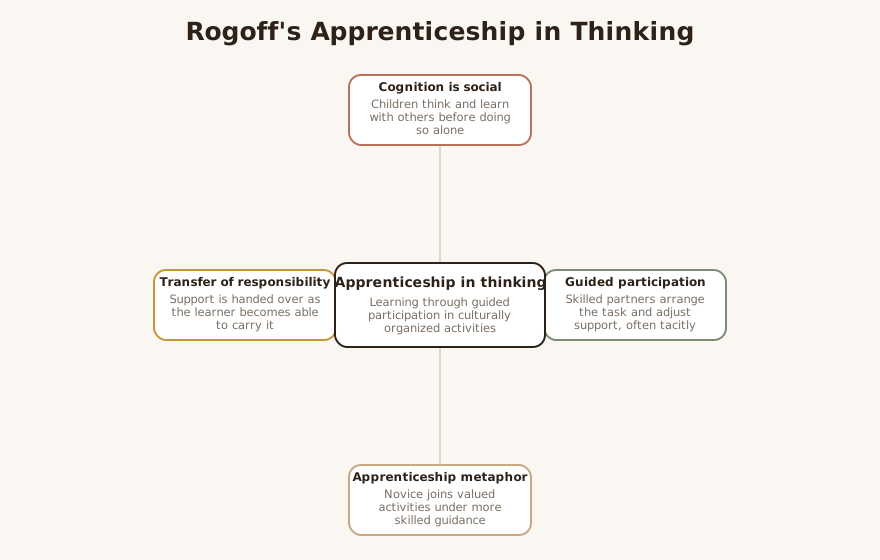
The first principle is that cognitive development is inherently social: children think and learn with other people before they can do so independently, and the structure of those joint activities shapes the structure of the resulting cognition. 14 The second is guided participation itself—the observation that in everyday life, adults and children (or any more- and less-experienced partners) routinely coordinate around shared tasks, with the more skilled partner arranging the activity, focusing attention, and adjusting support, often without any explicit teaching at all. 1 Much of this guidance is tacit and woven into the activity rather than delivered as instruction. 3
A third principle is the apprenticeship metaphor: the novice participates in culturally valued activities under the guidance of more skilled people, gradually taking on more responsibility and a more central role as competence grows. 1 A fourth is the gradual transfer of responsibility—support is initially substantial and then handed over to the learner as they become able to carry it, the same logic that animates scaffolding. 4LLM A fifth, and arguably Rogoff’s signature contribution, is cultural variation: there is no single, universal route to competence, because what counts as a skill, who teaches it, and how participation is organized differ profoundly across cultural communities. 5 Learning by observing and pitching in is, in many communities, the primary developmental engine, which means the instructional, adult-managed model familiar from Western schooling is one cultural arrangement among many rather than the human default. 65
Interventions & Techniques
The theory does not prescribe a fixed protocol, but its principles translate into recognizable clinical moves. LLM The first is participation over instruction: rather than lecturing a client or caregiver about a skill, the clinician structures a shared activity in which the skill is actually used, then participates alongside them. 1LLM The second is calibrated support with planned fading—offering as much structure as the person needs at the outset (modeling, cueing, sharing the cognitive load) and deliberately withdrawing it as they take over, mirroring scaffolding and the transfer of responsibility. 4LLM The third is attention to the joint structure of the activity: noticing how the clinician and client are coordinating, who is carrying which part of the task, and how attention is being directed, since guided participation often operates through these tacit arrangements rather than through explicit talk. 1
A fourth move is coaching guided participation in the client’s own relationships: helping a parent, teacher, or caregiver shift from instructing-at to participating-with the child, and from doing-for to doing-alongside. 3LLM A fifth is honoring observation and pitching in: recognizing that for many clients and families, learning by watching and contributing to real activity is more natural and effective than abstracted drills designed only for practice. 6
LLM-generated illustrative example (not a guideline): A clinician working with a parent and a withdrawn 7-year-old stops trying to “teach turn-taking” through a worksheet. Instead, they set up a simple shared cooking task in session. The clinician initially structures heavily—holding the bowl, narrating, offering the next step—then gradually steps back as the parent picks up the role of guiding partner and the child begins to anticipate steps and contribute. The competence (joint attention, turn-taking, frustration tolerance) develops inside the shared activity rather than being installed beforehand. LLM
Evidence Base
The maturity of this framework is best described as established: it is a highly influential, well-regarded developmental theory that reshaped how the field understands the social and cultural foundations of cognition. 4 Apprenticeship in Thinking was a landmark synthesis, and contemporaneous scholarly review placed it within the serious tradition of Vygotskian and cross-cultural developmental science. 4 Rogoff’s standing in the field—reflected in her decades of cited work and major comparative volumes—signals that the theory’s core claims are widely accepted within developmental and cultural psychology. 2
Honesty about the type of evidence is essential. LLM The empirical base is largely descriptive, observational, ethnographic, and cross-cultural rather than experimental: the theory is supported by close study of how learning and guidance actually unfold in families and communities, including extensive comparative work on learning by observing and pitching in. 56 This is a strength for ecological validity and a limitation for anyone seeking randomized-controlled-trial-style proof. LLM Crucially, guided participation is not itself an outcome-validated psychotherapy; there is no body of trials showing that “guided participation therapy” reduces a diagnosis. LLM Its clinical value is as a robust, well-supported model of how skill acquisition works, which clinicians fold into evidence-based modalities (behavioral parent training, dialectical behavior therapy skills coaching, occupational and speech work, family therapy) rather than deliver on its own. LLM
Populations & Indications
The theory was developed by studying children’s development across cultural communities, so its most natural fit is wherever a less-experienced person is acquiring competence with a more-experienced partner. 15 Children are the original and central population, and the framework is especially apt for understanding their learning and developmental difficulties. 2 Parents and caregivers are a second core group, since guided participation is the lens through which everyday caregiving can be understood and coached. 3 Students, learners, and educators are natural fits because the theory directly addresses how teaching and learning are organized—and how schooling’s instructional model is only one cultural arrangement. 56
Families across cultures are a defining population for this framework, because its insistence on cultural variation makes it unusually well-suited to working without imposing a single developmental norm. 5 Finally, therapists in skill-building roles—anyone coaching a coping skill, a communication skill, or a parenting skill—are themselves operating as guides in an apprenticeship, whether or not they name it as such. 1LLM Indications for reaching for this lens include presentations where a skill is failing to transfer, where instruction has been tried and stalled, or where the learning context is culturally mismatched to the helper’s assumptions. LLM
Problems-for-Work
The framework gives traction on several presenting concerns. LLM For learning and developmental difficulties, it shifts the question from “what is wrong inside the child” toward “how is this child’s participation in learning activities organized, and is the support calibrated to their zone of proximal development?” 4 For parent-child interaction problems, guided participation offers a concrete target: the quality of joint activity and the parent’s role as guiding partner rather than instructor or director. 3
For skill acquisition deficits, the apprenticeship model explains why abstracted, decontextualized practice often fails to generalize and why embedding the skill in meaningful shared activity helps. 1LLM For self-regulation difficulties, the Vygotskian premise that self-direction is first co-regulated with another and then internalized provides a developmental pathway: regulation is borrowed before it is owned. 4LLM For educational underachievement, the cultural-variation principle warns against pathologizing children whose home learning style (observing and pitching in) clashes with school’s instructional demands. 65 For sociocultural adjustment and caregiving difficulties, the framework’s comparative stance helps clinicians and families recognize and bridge differing cultural models of how children should learn. 5 And for scaffolding and support needs, it offers the central operating principle: provide structure matched to the learner, then fade it deliberately. 4
LLM-generated illustrative example (not a guideline): A teenager who immigrated two years ago is labeled “unmotivated” at school for waiting and watching rather than volunteering answers. Through this lens, the clinician reframes the behavior as a culturally learned style of careful observation before contributing—learning by observing and pitching in—rather than disengagement, and works with the family and school to build bridges into the classroom’s more performance-oriented expectations. LLM
Contraindications, Cautions & Cultural Humility
Because this is a conceptual lens rather than a procedure, there are no procedural contraindications; the cautions concern misuse. LLM The first is over-claiming: presenting guided participation as an evidence-based treatment when it is a developmental theory used to inform treatment risks misleading clients and overstating the science. LLM The second is romanticizing observation and pitching in: the LOPI research describes real and effective learning arrangements in specific communities, but it should not be flattened into a slogan or applied as a one-size-fits-all prescription. 6LLM
Cultural humility is not an add-on here; it is built into the theory’s core. 5 Rogoff’s central claim is that developmental pathways vary by cultural community, which directly cautions clinicians against treating any single model of “good” learning or “good” parenting as universal. 5 The practical implication is to treat the family’s own organization of learning as data to be understood rather than corrected, to notice when a child’s difficulty is actually a mismatch between home and institutional cultural models, and to avoid importing Western, schooled, instructional assumptions as if they were neutral facts of development. 65LLM The clinician should also hold the framework lightly enough to recognize that it explains how learning is organized without specifying what should be learned, which remains a value-laden, collaborative decision. LLM
Treatment-Plan Suggestions & SMART Objectives
| Goal | SMART objective (example) | Mechanism |
|---|---|---|
| Shift caregiver from instructing to guiding | Within 4 sessions, caregiver will lead one shared 10-minute activity per day in which they participate alongside the child rather than directing, logged 5 of 7 days | Guided participation in joint activity 1 |
| Calibrate and fade support for a target skill | Over 6 weeks, clinician and client will reduce prompting on a chosen self-care task from full modeling to a single verbal cue across 3 documented steps | Scaffolding with planned transfer of responsibility 4 |
| Build self-regulation via co-regulation | Within 8 sessions, caregiver will co-regulate one daily distress episode using a shared calming routine, fading their lead as the child initiates it on 2+ occasions | Co-regulation internalized as self-regulation 4 |
| Embed skill practice in meaningful activity | Within 4 weeks, client will practice a target communication skill inside one real, valued shared task per week rather than in isolated drills | Situated learning through participation 1 |
| Bridge home and school learning styles | Within 6 weeks, family and clinician will identify 2 concrete adjustments that connect the child’s observe-and-contribute style to classroom expectations | Honoring learning by observing and pitching in 6 |
| Increase clinician attunement to joint structure | Across the next 5 sessions, clinician will note in each progress record who carried which part of the shared task and how support shifted | Attending to the structure of guided participation 1 |
| Surface and respect cultural learning models | Within 3 sessions, clinician will elicit and document the family’s own beliefs about how their child best learns, without correction | Cultural-variation principle / cultural humility 5 |
Common Misconceptions
A first misconception is that guided participation is just a fancy word for teaching; in fact it emphasizes tacit, activity-embedded coordination that often involves no explicit instruction at all, which is precisely what distinguishes it from a lecture-and-practice model. 13 A second is that it is interchangeable with Vygotsky’s theory; Rogoff drew on Vygotsky but extended his work toward a more naturalistic, everyday, and explicitly cross-cultural account, including arrangements Vygotsky did not emphasize. 4 A third misconception is that there is one optimal, universal way for children to learn; the theory’s defining claim is the opposite—that learning arrangements vary meaningfully across cultural communities. 5 A fourth is that learning by observing and pitching in means passive watching; the research describes active, attentive observation paired with real contribution to ongoing activity. 6 A fifth is that guided participation is itself a therapy—it is a developmental theory that informs how clinicians structure skill-building, not a billable treatment protocol. LLM
Training & Certification
There is no certification in guided participation or apprenticeship in thinking, because it is an academic developmental theory rather than a credentialed clinical method. LLM Clinicians develop competence by reading the primary sources—Rogoff’s Apprenticeship in Thinking is the anchor text—and by studying the cross-cultural learning-by-observing-and-pitching-in materials produced by her lab. 16 Foundational background in Vygotskian sociocultural theory and Bruner’s scaffolding deepens the framework, and accessible secondary explainers can orient a clinician quickly. 435 Practical skill comes from integrating the lens into modalities the therapist is already trained and credentialed in—family therapy, behavioral parent training, skills coaching, or developmentally informed play work—rather than from any certificate specific to the theory. LLM
Key Terms
- Guided participation: The structured, often tacit ways more- and less-experienced partners coordinate around a shared activity, through which the novice develops competence. 1
- Apprenticeship (in thinking): The arrangement in which a novice grows toward competence by participating in culturally valued activities under the guidance of more skilled others, taking on more responsibility over time. 1
- Zone of proximal development: Vygotsky’s concept of the gap between what a learner can do alone and what they can do with help—the space in which guidance is effective. 4
- Scaffolding: Temporary, calibrated support provided by a more capable partner and gradually withdrawn as the learner gains competence. 4
- Transfer of responsibility: The handing over of task control from the guide to the learner as the learner becomes able to carry it. 4
- Learning by observing and pitching in (LOPI): A culturally widespread arrangement, documented especially in Indigenous-heritage communities, in which children learn through keen observation of and contribution to ongoing community activity. 6
- Cultural nature of development: The principle that developmental pathways and learning arrangements vary across cultural communities rather than following a single universal course. 5
Resources & Further Reading
▶ Watch — a video introduction to this concept:
- Rogoff, B. (1990). Apprenticeship in Thinking: Cognitive Development in Social Context (Oxford Academic)
- Barbara Rogoff (Wikipedia)
- Barbara Rogoff: Sociocultural Theory in Early Education (Early Years TV)
- Cognitive Tutelage — review of Apprenticeship in Thinking (Science, 1990)
- 1.6: Barbara Rogoff (Social Sci LibreTexts)
- Learning by Observing and Pitching In — Videos (UC Santa Cruz, Rogoff lab)
Reflective / Supervision Questions
- In my skill-building work with this client or family, am I instructing at them or participating with them—and what would it look like to shift toward shared activity? 1
- Have I calibrated my support to where the learner actually is, and do I have a deliberate plan to fade it, or am I doing the work for them indefinitely? 4
- Where might this child’s or family’s learning be organized around observing and pitching in, and am I misreading that style as deficit or disengagement? 6
- Whose cultural model of “good learning” or “good parenting” am I treating as the standard, and am I holding the family’s own model with genuine humility? 5
- Am I claiming more for this framework than the evidence supports—presenting a developmental theory as if it were a validated treatment? LLM
- Which established modality am I actually delivering this within, and does my formulation reflect that integration rather than the theory standing alone? LLM