
Type & Discipline
Cognitive apprenticeship is an instructional framework drawn from educational psychology rather than a psychotherapy modality 5. It belongs to the family of situated-learning and instructional-design approaches, which hold that knowledge is best acquired inside authentic activity rather than transmitted as abstract fact 5. Its defining move is to take the tacit, invisible reasoning that experts use and “bring these tacit processes into the open, where students can observe, enact, and practice them with help” 5. Where a traditional apprenticeship works because the task (laying brick, shaping wood) is physically observable, a cognitive apprenticeship must deliberately externalize mental processes that are otherwise hidden 1.
For practicing therapists, this matters in two concrete arenas. First, it is a structured account of how clinical expertise is transmitted in supervision and training 5. Second, when a clinician teaches a client a complex skill—emotion regulation, problem-solving, metacognitive monitoring—cognitive apprenticeship offers a sequenced method for doing so LLM. It is not, and should not be presented as, a stand-alone treatment with its own outcome trials LLM.
Creators & Lineage
The framework was articulated by Allan Collins, John Seely Brown, and Susan Newman in a 1987 technical report on teaching the craft of reading, writing, and mathematics 2. A widely read 1991 article by Collins, Brown, and Ann Holum, “Cognitive Apprenticeship: Making Thinking Visible,” brought the model to a broad educator audience and supplied its enduring tagline 1. The approach grew out of constructivist and situated-cognition research, which recognized that the context of learning strongly shapes what is actually learned 4.
Its theoretical roots are explicitly social and developmental. The model draws on Vygotsky’s zone of proximal development—the space between what a learner can do alone and what they can do with help—as the zone in which scaffolding and coaching operate 5. It incorporates situated cognition, the premise that knowledge develops within real-world contexts rather than as decontextualized rules 5. It rests on Bandura’s social learning theory, in which observation and modeling drive skill acquisition 5. The scaffolding construct itself traces to Bruner’s work on graduated, fading instructional support LLM. Cognitive apprenticeship is best understood as a synthesis: it weds the demonstrated power of apprenticeship to schooling’s capacity to systematize and generalize knowledge 1.
Core Principles
Cognitive apprenticeship organizes a learning environment along four dimensions: content, method, sequencing, and sociology 1.
Content specifies four kinds of knowledge that together constitute expertise: domain knowledge (concepts, facts, procedures); heuristic strategies, the practical “tricks of the trade” experts use; control (metacognitive) strategies that direct and monitor problem-solving; and learning strategies, the methods one uses to acquire new knowledge 1. A central claim of the model is that the last three—the strategic and metacognitive layers—are precisely what conventional instruction leaves implicit and therefore fails to teach 1.
Method comprises the six teaching techniques described in the next section 1. Sequencing follows three ordering principles: global before local (a conceptual map before detailed execution), increasing complexity, and increasing diversity of contexts to promote transfer 1. Sociology describes the social fabric of effective learning: situated in authentic tasks, embedded in a community of practice, animated by intrinsic motivation, and structured for cooperation 1.
The unifying principle is responsibility transfer: support is dense early and is progressively withdrawn so the learner moves from guided performance to autonomous practice 4. The learner is meant to internalize not just answers but “cognitive and metacognitive strategies for using, managing, and discovering knowledge” 4.
Interventions & Techniques
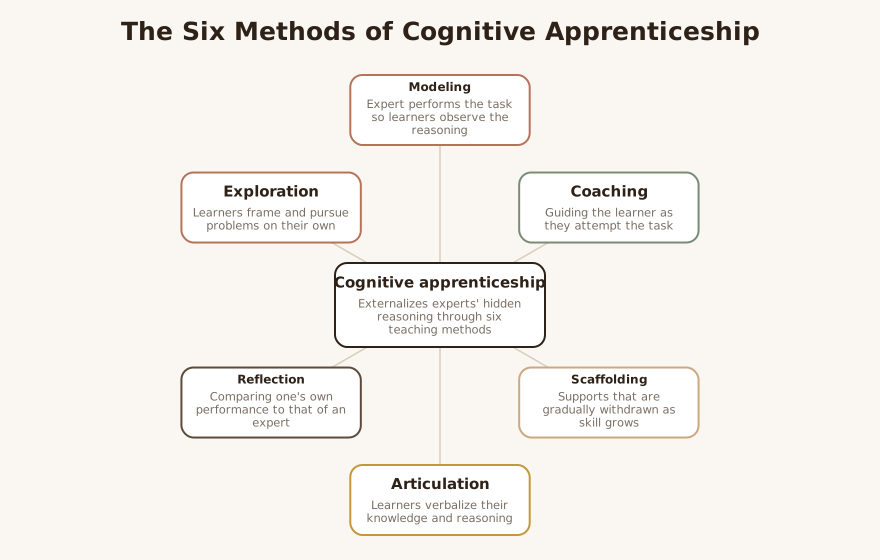
The framework’s operational core is six methods, typically deployed in roughly this progression 1.
Modeling. An expert performs the task while verbalizing the normally hidden reasoning, so the learner can build a mental model of expert performance 1. In supervision this is the supervisor thinking aloud through a case formulation rather than simply stating the conclusion LLM.
Coaching. The expert observes the learner performing and offers targeted hints, feedback, and reminders calibrated to move performance toward competence 1.
Scaffolding. Temporary supports—prompts, structure, partial completion—let the learner attempt activities just beyond independent capacity; the supports are designed to be removed 1.
Articulation. The learner is required to verbalize their own knowledge and reasoning, which exposes and clarifies it and surfaces gaps 4. Think-aloud protocols and asking a supervisee to justify each clinical decision are articulation moves 1.
Reflection. The learner compares their own process against that of an expert or a peer, often via an “abstracted replay” that highlights critical features of performance 1.
Exploration. Support fades further and the learner is pushed to frame and pursue their own problems within the domain, the hallmark of growing autonomy 4.
LLM-generated illustrative example (not a guideline): A supervisor teaching exposure planning models a hierarchy aloud for one case (modeling), then has the supervisee draft the next while offering hints (coaching, scaffolding), asks the supervisee to narrate their rationale (articulation), reviews a recorded session side-by-side (reflection), and finally assigns a novel referral for independent formulation (exploration) LLM.
Evidence Base
Honesty about maturity is essential here. Cognitive apprenticeship is an established and well-validated instructional framework, but its evidence base is educational, not a psychotherapy trial literature LLM. The foundational support comes from three instructional programs the authors analyzed 1. In reading, Palincsar and Brown’s reciprocal teaching—students and teacher taking turns leading questioning, summarizing, predicting, and clarifying—raised comprehension accuracy dramatically, from roughly 15% to 85% in early work 1. In writing, Scardamalia and Bereiter used procedural prompts to shift students from “knowledge-telling” to “knowledge-transforming,” increasing planning time and text quality 1. In mathematics, Schoenfeld taught problem-solving heuristics and control strategies through modeling, group work, and postmortem analysis 1.
Beyond these origins, the framework has been adopted in technology-rich and online learning environments and, increasingly, in medical and clinical skills training 5. What it does not possess is a body of randomized controlled trials establishing it as a clinical treatment for any disorder LLM. For a clinician, the appropriate claim is that cognitive apprenticeship is an evidence-informed method for teaching skills—whether to trainees or to clients in skills-focused work—not an evidence-based treatment in the trial sense LLM.
Populations & Indications
The framework is indicated wherever a complex, partly tacit cognitive skill must be transmitted 1. The clearest clinical fit is the training context: trainees, supervisees, and clinical educators developing case conceptualization, intervention selection, and self-correction 5. Because the model targets the strategic and metacognitive layers of expertise, it suits learners who can already perform component steps but cannot yet orchestrate them 1.
It also applies to client-facing skills work LLM. With adolescents and adult learners, the same six methods structure the teaching of self-regulation, planning, and metacognitive monitoring—domains where simply telling a person what to do rarely produces durable skill LLM. Apprentices in skilled professions and students more broadly are the original population for whom the model was designed 2.
Problems-for-Work
- Skill acquisition deficits. When a supervisee can recite a protocol but cannot execute it under live conditions, modeling plus faded scaffolding bridges the recitation-to-performance gap 1.
- Metacognitive skill deficits. Articulation and reflection directly target the control strategies that monitor one’s own thinking, the layer the model says conventional teaching neglects 1.
- Self-regulated learning deficits. The progressive fading of support is designed precisely to hand monitoring and management of learning back to the learner 4.
- Problem-solving deficits. Schoenfeld’s mathematics work shows the method building both heuristic and control strategies for ill-structured problems 1.
- Knowledge transfer gaps. The sequencing principle of increasing diversity of contexts is the framework’s explicit lever for transfer, an area traditional apprenticeship neglects 1.
- Professional competency development. In medical and clinical education the model structures how tacit expert judgment is made observable to trainees 5.
Contraindications, Cautions & Cultural Humility
There are no medical contraindications to an instructional method, but there are real fit cautions LLM. The model is demanding of expert time and attention; modeling and coaching cannot be mass-delivered, and thin coaching collapses the method into mere demonstration LLM. Scaffolding carries a dependence risk: supports that are never faded can entrench reliance rather than build autonomy, so the removal of support is as deliberate as its provision 1. Learner readiness matters—articulation and reflection presuppose enough baseline competence to have a process worth examining, and pushing exploration too early can overwhelm LLM.
Cultural humility deserves explicit attention. The method works by making one expert’s thinking visible and holding it up as the standard, which embeds that expert’s assumptions, idioms, and values LLM. In clinical training this can quietly reproduce a single cultural frame of what “good” clinical reasoning looks like LLM. A culturally responsive use of the framework invites multiple expert models, treats the learner’s own reasoning as a legitimate object of inquiry rather than an error to be corrected toward one ideal, and remains explicit that articulation and think-aloud demands are themselves culturally loaded for learners from contexts that do not prize verbalized self-explanation LLM.
Treatment-Plan Suggestions & SMART Objectives
| Goal | SMART objective (example) | Mechanism |
|---|---|---|
| Strengthen self-monitoring of clinical or coping decisions | Within 6 weeks, learner will narrate their reasoning aloud for 3 of 4 practiced tasks without prompting LLM | Articulation surfaces tacit reasoning for inspection 4 |
| Reduce reliance on external structure | Over 8 sessions, learner will complete a target task with one fewer scaffold per session until performing it independently LLM | Scaffolding with deliberate fading transfers responsibility 1 |
| Build problem-solving for novel situations | By session 10, learner will frame and attempt 2 self-generated problems in the domain LLM | Exploration cultivates autonomous problem-framing 4 |
| Improve transfer of a skill across contexts | Within 4 weeks, learner will apply the target strategy in 3 distinct contexts with accurate fit judgments LLM | Sequencing for increasing diversity promotes transfer 1 |
| Develop accurate self-appraisal | Across 5 sessions, learner will compare their performance to a model and identify 2 specific gaps each time LLM | Reflection via abstracted replay calibrates self-assessment 1 |
| Acquire a multi-step procedural skill | Within 3 weeks, learner will reproduce a 5-step procedure modeled aloud with 80% fidelity LLM | Modeling builds a mental model of expert performance 1 |
| Increase strategic (heuristic) repertoire | By week 6, learner will name and apply 3 heuristics during coached practice LLM | Coaching delivers tricks-of-the-trade in context 1 |
Common Misconceptions
“It is a kind of therapy.” It is an instructional framework; its clinical home is supervision, training, and skills teaching, not a delivered treatment with outcome trials 5.
“Modeling means just showing the answer.” The defining feature is verbalizing the reasoning, not displaying the product—silent demonstration omits the very thing the model exists to teach 1.
“Scaffolding is permanent support.” Supports are by definition temporary and faded; persistent scaffolding contradicts the goal of autonomy 1.
“It is the same as traditional apprenticeship.” Traditional apprenticeship relies on physically observable tasks; the cognitive version must deliberately externalize hidden mental processes and explicitly teach transfer, which traditional apprenticeship rarely does 1.
“It is mainly about content knowledge.” The framework’s distinctive contribution is the heuristic, control, and learning strategies—the strategic layers that ordinary instruction leaves tacit 1.
Training & Certification
There is no credential, certification, or licensing body for cognitive apprenticeship; it is an instructional framework, not a proprietary or regulated method LLM. Clinicians and supervisors typically encounter it through the primary literature—the 1987 technical report and the 1991 American Educator article remain the canonical statements—and through faculty-development and clinical-education programs that adopt its vocabulary 21. Competence comes from deliberate practice of the six methods within supervision rather than from a course completion certificate LLM.
Key Terms
- Making thinking visible. The core aim: externalizing experts’ tacit reasoning so learners can observe and practice it 5.
- Modeling, coaching, scaffolding, articulation, reflection, exploration. The six teaching methods, progressing from expert-led demonstration to learner autonomy 1.
- Heuristic strategies. The practical “tricks of the trade” experts use that are rarely taught explicitly 1.
- Control (metacognitive) strategies. Processes that direct, monitor, and evaluate one’s own problem-solving 1.
- Zone of proximal development. The Vygotskian gap between independent and assisted performance, the operating range for scaffolding 5.
- Situated cognition. The premise that knowledge develops within authentic contexts rather than as abstract rules 5.
- Abstracted replay. A reflection device that re-presents a performance to highlight its critical features 1.
- Fading. The deliberate, graduated withdrawal of support as competence grows 4.
Resources & Further Reading
▶ Watch — a video introduction to this concept:
- Collins, Brown & Holum (1991): Cognitive Apprenticeship: Making Thinking Visible
- Collins, Brown & Newman (1987): Teaching the Craft of Reading, Writing, and Mathematics (ED284181)
- Cognitive Apprenticeship (ISLS research topic)
- Cognitive Apprenticeship (Learning-Theories.com)
- Cognitive apprenticeship — Wikipedia
Reflective / Supervision Questions
- When I supervise, do I model my actual reasoning aloud, or do I present only my conclusions and leave the thinking invisible? LLM
- For each skill I teach, which scaffolds am I providing, and what is my concrete plan to fade them? LLM
- Am I requiring the learner to articulate their reasoning, or am I doing all the verbalizing myself? LLM
- Whose “expert thinking” am I holding up as the standard, and what cultural assumptions does it carry? LLM
- Where on the modeling-to-exploration continuum is each supervisee, and is the support I offer matched to that position? LLM
- Am I teaching transfer—varying contexts deliberately—or training a skill that will stay locked to one situation? LLM