
Type & Discipline
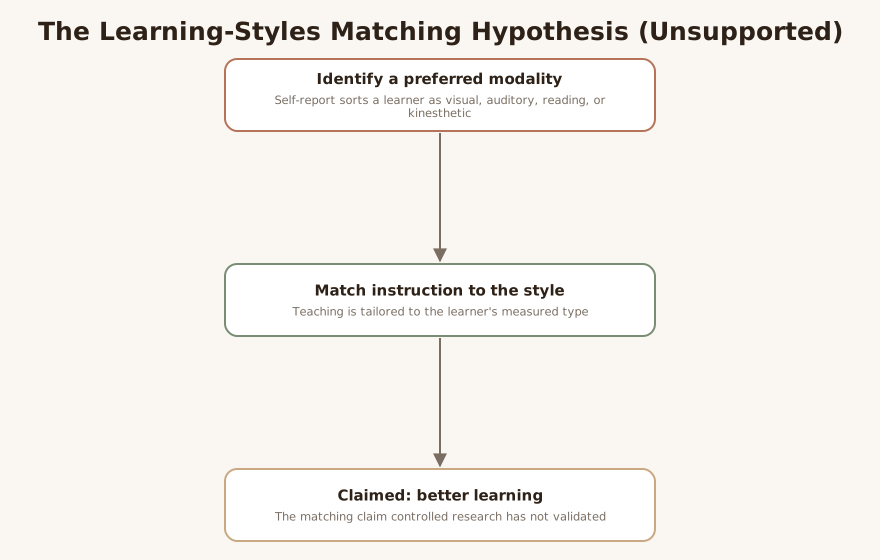
Learning Styles is a theory drawn from educational psychology, specifically from the family of instructional myths, and it is not a treatment or a recognized clinical modality LLM. Its core claim is that each person has a preferred sensory channel for taking in information and learns best when instruction is delivered through that channel LLM. The most widely circulated version sorts learners into visual, auditory, reading/writing, and kinesthetic preferences, often abbreviated as the VARK model LLM. For clinicians the concept matters less as something to apply than as a belief to recognize, gently correct, and replace with evidence-based learning strategies when it appears in clients, trainees, or the surrounding educational systems LLM. Understanding why the theory is popular, and why it does not hold up, is itself the clinically useful skill LLM.
Creators & Lineage
The idea that people differ in how they prefer to learn is old and intuitive, but the specific modality-preference framework most clinicians encounter today is associated with Neil Fleming, who developed the VARK questionnaire to describe visual, auditory, reading/writing, and kinesthetic preferences LLM. Fleming presented VARK as a tool for reflection on study habits rather than a fixed neurological trait, though in popular use it hardened into the stronger and unsupported claim that matching instruction to a measured preference improves learning LLM. By one count, the broader literature contains more than seventy distinct learning-style instruments and classifications, reflecting decades of proliferation across education 4. The theory sits in a wider intellectual lineage of educational psychology and the cognitive psychology of learning, and it is frequently grouped with multiple-intelligences theory and constructivist ideas that emphasize individual differences in how knowledge is built LLM. Its persistence is a story about how an appealing intuition can outrun its evidence base LLM.
Core Principles
The learning-styles theory rests on two linked claims that must be separated LLM. The first, weaker claim is descriptive: people have preferences for how information is presented, and many will readily report that they are a “visual” or “hands-on” learner LLM. This claim is largely uncontroversial, because preferences clearly exist and can be measured with self-report instruments 4. The second, stronger claim is the one that defines the theory and fails empirically: that tailoring instruction to a learner’s measured style produces better learning than a non-matched approach 2. This stronger claim is known as the meshing or matching hypothesis, and it is the proposition on which the theory’s educational value entirely depends 2.
A central principle, often unstated, is that styles are treated as stable, trait-like, and consequential, such that a mismatch between teaching method and learner preference is presumed to cause underachievement 4. The framework therefore implies that learners are best served by being sorted and then taught differently from one another according to their type LLM. Reviews emphasize that this picture oversimplifies a complex cognitive process and that, in practice, preferences are often unstable across subjects and over time, which undercuts the assumption of a fixed style 4. The appeal of the theory is that it flatters both intuition and the desire to individualize teaching, which is part of why it remains so durable despite the evidence LLM.
Interventions & Techniques
Because Learning Styles is an unsupported theory rather than a method, the clinically appropriate “interventions” are not ways to apply it but ways to address the belief and substitute strategies that actually work LLM. The first technique is non-shaming psychoeducation: naming that the matching idea is intuitive and common, then explaining that controlled research has not found a learning benefit from teaching to a style 2. The aim is to loosen a fixed self-concept (“I can’t learn this way because I’m a visual learner”) without dismissing the client’s genuine preferences or effort LLM.
A second technique is to redirect toward multimodal instruction, which means presenting and rehearsing material in more than one format rather than restricting it to a single supposed channel 3. Reviews note that learners generally benefit from combining words and visuals, and that this combined approach outperforms words alone for most people regardless of stated preference 3. A favorable recent synthesis likewise recommended multimodal instruction as more effective and less costly than building separate tracks for each learner 3.
A third technique is to build metacognition, helping the client reflect on how they actually study, monitor what is working, and distinguish the comfortable feeling of a preferred format from real, durable learning 4. Closely related is teaching the genuinely evidence-supported strategies that learning-styles thinking tends to crowd out, such as spaced practice, retrieval practice, and elaboration, which have far stronger empirical support than modality matching LLM.
LLM-generated illustrative example (not a guideline): An adult client in treatment for anxiety says she keeps failing a licensing exam “because I’m an auditory learner and the course is all reading.” The clinician validates the frustration, briefly explains that matching study to a single channel has not been shown to help, and reframes the problem as a study-skills one. Together they replace passive re-reading with spaced self-testing and writing summaries in her own words, and her perceived helplessness decreases as scores rise LLM.
Evidence Base
The evidence base for Learning Styles as a useful theory is best described as historical and, on the decisive question, negative LLM. The benchmark review by Pashler, McDaniel, Rohrer, and Bjork specified the experiment required to validate the theory: learners must be grouped by style, randomly assigned to different instructional methods, and tested identically, with the theory confirmed only if the best method differs depending on style, a crossover interaction 2. Across the large literature, the authors found virtually no studies meeting this standard, and those that did generally failed to show the predicted interaction, leading to their conclusion that there is no adequate evidence base to justify incorporating learning-styles assessments into general educational practice 2. An earlier large review of seventy-one learning-style models reached a comparably blunt verdict against adoption 4.
The most recent and most favorable evidence does not rescue the strong claim LLM. A 2024 meta-analysis of the matching hypothesis pooled twenty-one studies and found a small positive effect for matching, with a Hedges’ g of about 0.32, but the crossover interaction that actually tests the theory appeared in only about twenty-six percent of outcome measures 3. The authors concluded the effect was too small and too infrequent to warrant widespread adoption and that it remains far from conclusive that matching instruction to style produces any real benefit 3. In short, even the synthesis most sympathetic to the idea cautions against using it in practice LLM. By contrast, surveys document how entrenched the belief remains: roughly ninety-three percent of teachers in one UK sample endorsed it, and a majority of higher-education faculty and institutions still teach or affirm it 5. The gap between near-universal belief and absent evidence is the defining feature of this topic LLM.
Populations & Indications
The theory was developed for and about students, educators, and adult learners, and these remain the populations among whom clinicians most often encounter it 5. In a behavioral-health setting, the relevant populations are clients whose presenting concerns intersect with school or training, including children, adolescents, and college or graduate students, as well as adult learners returning to study or preparing for examinations LLM. Trainees and supervisees are an equally important population, because clinicians-in-training frequently absorb the learning-styles belief during their own education and may carry it into how they teach clients 5.
The clinical “indication” is therefore not to deliver the theory but to address it when it functions as a barrier LLM. Healthcare trainees specifically are worth attention, as scoping reviews of newer generations of health-professions students emphasize technology-integrated and multimodal approaches and caution against simplistic preference-matching, recommending instead that educators plan instruction around theory-based frameworks suited to the discipline 7. Across all these groups, the concept is indication-neutral with respect to diagnosis: it shapes beliefs about how one learns rather than marking any particular disorder LLM.
Problems-for-Work
Several presenting problems map onto this topic, and in each case the work is to correct a belief and install a better strategy LLM. For misconceptions about learning, the task is direct psychoeducation that separates the harmless fact of preference from the unsupported claim that preference dictates how one must be taught 2. For instructional mismatch beliefs, where a client attributes failure to a teacher or course not matching their style, the work reframes an external, fixed explanation into a modifiable, strategy-based one, which tends to restore a sense of agency LLM.
For study skill deficits, the clinician can pivot from style-talk to teaching the methods that demonstrably help, such as spaced and retrieval practice and multimodal review, which is often the more powerful lever once the style framing is set aside 4. For academic underachievement, identifying that effort is being misdirected by a style belief can be one component of a broader plan that also screens for attention, mood, sleep, and learning-disability factors LLM. For engagement difficulties, the clinician can use the client’s genuine preferences to increase initial buy-in while being honest that variety and difficulty, not exclusive channel-matching, drive durable learning 3.
LLM-generated illustrative example (not a guideline): A 15-year-old client insists he “only learns by watching videos” and refuses to read assigned material, fueling conflict at home. The clinician treats the belief as the target, validates that video can be engaging, and gently tests the claim by having him retrieve and explain content after both video and reading, showing him that active recall, not the format, is what makes it stick LLM.
Contraindications, Cautions & Cultural Humility
There are no pharmacological contraindications here, but there are real cautions about how the topic is handled LLM. The first is iatrogenic discouragement: framing a person as a fixed “type” can lead them to avoid subjects or formats they believe are mismatched, narrowing their options and reinforcing helplessness, a harm flagged in the higher-education literature 5. A second caution is that confronting a cherished belief can feel invalidating, so the clinician should correct the claim while explicitly honoring the client’s preferences, effort, and lived experience rather than implying they were foolish to hold it LLM.
A third caution is to avoid replacing one rigid frame with another; the goal is flexibility and evidence-based strategy, not a new label 4. Cultural humility is also relevant because educational expectations, the prestige attached to particular ways of knowing, and prior schooling experiences vary widely across communities, and what reads as a “learning style” is often a learned habit shaped by a person’s educational history and resources LLM. Clinicians should also remember that genuine, diagnosable differences exist, including specific learning disabilities, sensory impairments, and attention disorders, and that none of these should be conflated with or dismissed as a mere “style,” which would risk missing a condition that warrants assessment and accommodation LLM. The respectful stance debunks the myth without invalidating the person and without overlooking real, accommodatable needs LLM.
Treatment-Plan Suggestions & SMART Objectives
The examples below are illustrative templates to adapt, not prescriptions, and they assume the topic appears inside a recognized modality such as psychoeducation within cognitive behavioral therapy or structured clinical supervision LLM.
| Goal | SMART objective (example) | Mechanism |
|---|---|---|
| Correct the matching misconception | Within 2 sessions, the client will state in their own words that matching instruction to a “style” is not shown to improve learning | Psychoeducation replaces an unsupported belief with an accurate model 2 |
| Shift from fixed to flexible self-view | Within 3 sessions, the client will describe themselves as someone who uses several strategies rather than a single fixed “type” | Loosening a trait-like self-concept restores agency over learning 4 |
| Adopt multimodal study | Over 4 weeks, the client will study target material in at least two formats per topic and log the practice | Multimodal encoding generally outperforms single-channel review 3 |
| Install retrieval and spaced practice | Over 4 weeks, the client will complete two spaced self-tests per week instead of passive re-reading | Evidence-based strategies drive durable learning that style-matching does not 4 |
| Build metacognitive monitoring | Within 6 sessions, the client will rate, after each study block, whether it produced real recall versus mere familiarity | Metacognition separates comfortable preference from actual learning 4 |
| Reduce mismatch-blame attributions | Within 6 sessions, the client will reframe one “the course didn’t match my style” thought into a strategy-focused alternative | Modifiable attributions increase persistence and reduce helplessness LLM |
| Screen for genuine learning barriers | Within 4 sessions, the clinician and client will review whether attention, mood, or a possible learning disability warrants referral | Avoids mislabeling a treatable condition as a “style” LLM |
| Update a supervisee’s teaching beliefs | Within one quarter, the supervisee will replace style-based plans with multimodal, evidence-based instructional choices | Corrects a belief absorbed in training before it shapes client care 5 |
Common Misconceptions
The largest misconception is the theory itself: that people learn best when taught in their preferred modality, a claim that controlled research has not supported 2. A related error is conflating the two distinct claims, treating the harmless existence of preferences as if it proved the consequential matching hypothesis, when only the latter has been tested and failed 2. Another misconception is that styles are stable, fixed traits, whereas reviews note that preferences are often unstable across subjects and time 4.
People also assume the belief is fringe, when in fact it is endorsed by the large majority of teachers and many faculty and institutions, which is precisely why clinicians keep meeting it 5. A subtler misconception, sometimes invoked to defend the theory, is that the 2024 meta-analysis “proves it works”; in fact that synthesis found only a small, infrequent effect and its authors concluded it does not warrant adoption 3. Finally, debunking learning styles is sometimes misread as denying individual differences altogether, when the actual message is to use evidence-based, multimodal methods for everyone rather than sorting people into channels 3.
Training & Certification
There is no clinical certification in Learning Styles, and clinicians need no credential to discuss the concept with clients, because it is a popular educational theory rather than a proprietary or regulated method LLM. Most clinicians absorb the idea informally through their own schooling and professional training, which is one reason the belief is so widespread among educators and trainees 5. The relevant professional development is therefore corrective: becoming familiar with the primary critiques and the recommended alternatives so the topic can be handled accurately 2. University teaching centers, such as Yale’s Poorvu Center, publish accessible summaries of why the theory is considered a neuromyth and what to do instead, and these are useful, free orientation for any clinician who works with learners 4. The core skill is the ability to debunk the matching claim without invalidating the client and to substitute strategies with genuine empirical support LLM.
Key Terms
The meshing hypothesis, also called the matching hypothesis, is the central testable claim that instruction tailored to a learner’s style produces better learning than non-matched instruction 2. A crossover interaction is the specific statistical pattern, where the best instructional method reverses depending on style, that would be required to confirm the theory and that is largely absent in the data 2. VARK refers to the visual, auditory, reading/writing, and kinesthetic categories of the most popular modality-preference model LLM. A neuromyth is a common but scientifically unsupported belief about the brain and learning, the category into which learning styles is now placed by teaching centers 4. Multimodal instruction means presenting and rehearsing material in more than one format, the recommended practice for all learners 3. Metacognition is awareness and monitoring of one’s own learning, distinguishing genuine recall from the mere feeling of familiarity 4.
Resources & Further Reading
▶ Watch — a video introduction to this concept:
- Pashler, McDaniel, Rohrer & Bjork (2008/2009), “Learning Styles: Concepts and Evidence” (PubMed record)
- Is it really a neuromyth? A meta-analysis of the learning styles matching hypothesis (Frontiers in Psychology, 2024)
- Learning Styles as a Myth (Yale Poorvu Center for Teaching and Learning)
- The Learning Styles Myth is Thriving in Higher Education (Frontiers / PMC)
- Learning styles, preferences and needs of Generation Z healthcare students: Scoping review (PubMed record)
Reflective / Supervision Questions
- When a client explains a failure by appealing to their “learning style,” do you treat the belief as fact, or as a target for gentle correction? LLM
- How do you debunk the matching claim without invalidating the client’s genuine preferences and effort? LLM
- Where in your own practice or psychoeducation might you still be implicitly endorsing learning styles, perhaps through language absorbed in your own training? LLM
- When you encounter a struggling learner, how do you distinguish a misdirected study belief from a genuine learning disability, attention disorder, or sensory difference that warrants assessment? LLM
- What evidence-based strategies, such as spaced and retrieval practice and multimodal review, are you prepared to offer in place of the discarded style framework? LLM