
Type & Discipline
Sociodrama is an experiential, action-based group method situated at the intersection of social psychology and education rather than individual psychotherapy proper 1. It belongs to the family of Morenian action methods, sharing its theoretical and technical roots with psychodrama and sociometry 2. Where psychodrama explores the private life of one individual, sociodrama takes as its subject matter the shared roles, situations, and tensions of a collective—the group itself becomes the protagonist 2. Jacob L. Moreno defined it as “a deep action method dealing with intergroup relations and collective ideologies,” and the contemporary literature frames it as a learning method that creates deep understanding of the social systems that shape us individually and collectively 5.
Because its locus is the social rather than the intrapsychic, sociodrama is at home in classrooms, organizations, community meetings, conflict-resolution settings, and group therapy rooms where a shared theme—not a single person’s history—is the work 25. It is best understood not as a free-standing “school of therapy” but as a structured method that a trained clinician or facilitator deploys within group, educational, or community contexts LLM.
Creators & Lineage
Sociodrama was developed by Jacob L. Moreno (1889–1974), the psychiatrist who also originated psychodrama, sociometry, and group psychotherapy as a coherent system 6. Moreno adapted the dramaturgical techniques he had built for psychodrama and scaled them upward to address sociological and group-level concerns 1. His earliest experiments trace to the “Living Newspaper” work with young actors in Vienna around 1920–1922, in which audiences chose a newspaper article and the actors spontaneously enacted it 2. Moreno later described sociodrama explicitly as an approach to help people overcome their own cultural rigidities and create a collective catharsis, formalizing the concept in his 1943 paper on intercultural relations and in Who Shall Survive? 5.
The lineage runs directly through psychodrama (the individual-focused sibling method), sociometry (Moreno’s science of the networks of attraction, repulsion, and connection within groups), and role theory (his account of personality as a constellation of enacted roles) 2. Sociometry is described as the foundation of both psychodramatic and sociodramatic group work, bringing to light the networks of connection that make collective enactment legible 2. Moreno founded the American Society of Group Psychotherapy and Psychodrama (ASGPP) in 1942 to carry this body of work forward; the organization continues to promote creativity, spontaneity, and encounter to enhance relationships between individuals, families, and communities 6. Subsequent contributors—including Zerka T. Moreno, who articulated the concept of “surplus reality,” and authors such as Patricia Sternberg and Antonina Garcia—extended and codified the method 2.
Core Principles
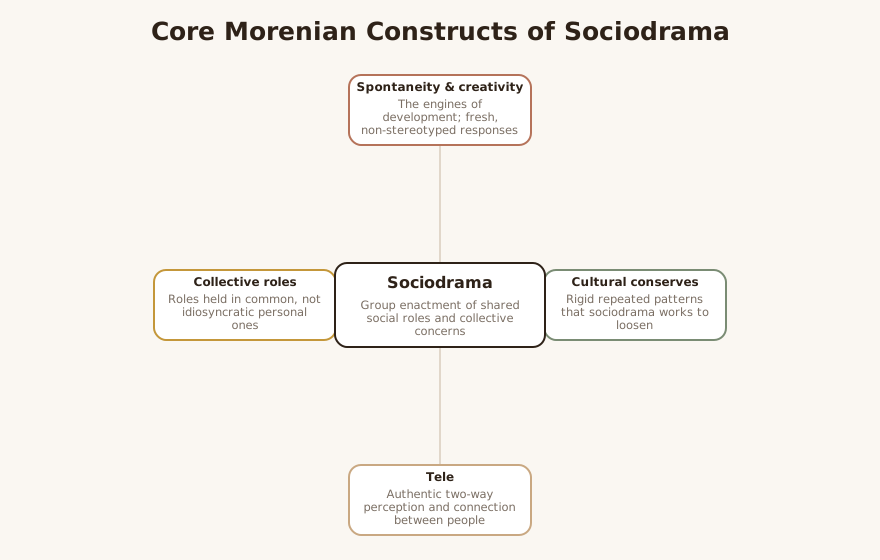
Several Morenian constructs anchor the method.
Spontaneity and creativity. Moreno’s “Canon of Creativity” positions spontaneity and creativity as the engines of human development 3. Spontaneity, in sociodramatic terms, is the capacity to operate in an authentic manner with oneself and with others in the here-and-now 5. Sessions are deliberately designed to raise the spontaneity of the group, because spontaneity is what allows fresh, non-stereotyped responses to emerge 5.
Cultural conserves. Moreno contrasted living spontaneity with the “cultural conserve”—rigid, repeated patterns that, while sometimes a stepping stone, become an obstacle to growth when held too tightly 34. Much of sociodrama’s social-change ambition is about loosening these conserves 3.
Tele. Tele names the authentic two-way perception and connection between people, the mutual “feeling-into” that is foundational to genuine encounter 4. It is distinguished from one-directional projection LLM.
Collective roles. Sociodrama works with roles people hold in common—as citizens, colleagues, daughters, mothers, members of a profession—rather than the idiosyncratic personal roles of one protagonist 2. Role is understood as culturally recognized behavior with both shared/collective and individual/private dimensions 3. The method works “from the outside in,” transforming objective social realities into subjective, felt understanding, the mirror image of psychodrama’s “inside-out” movement 4.
The group as protagonist. Rather than a single individual taking the protagonist role, in sociodrama the group itself becomes the protagonist; there may be a central role around which the action revolves, but not a central person 2.
Interventions & Techniques
Sociodrama applies essentially all of the psychodramatic action techniques, redirected toward shared roles 2.
- Warm-up, action, and sharing structure the session: a warming-up phase prepares and connects the group, a dramatization/action phase enacts the scene, and a sharing phase invites collective reflection 34.
- The double is an auxiliary who voices the inner, partially hidden thoughts and feelings of a role, using empathic projection to “feel into” that role’s inner world 2. Doubling can be given to any role to surface what it would prefer to keep hidden 2. Multiple doubles allow several participants to externalize an actor’s unspoken feelings simultaneously 3.
- Role reversal has a person exchange into another role, speak and feel from it, then return—yielding experiential insight by seeing oneself and the situation from the other’s vantage point 2.
- The mirror moves a person outside the scene to view it from a distance and gain fresh perspective; the audience itself often functions as a mirror by engaging roles in dialogue 2.
- Soliloquy invites a participant alone in the action space to speak aloud their in-the-moment thoughts or feelings 23.
- Role presentation and role interview let a member take on and introduce a role, then field questions to deepen and enliven it; role presentation also doubles as a warm-up 2.
- Sociometric tools—spectrograms and locograms—chart the “psycho-geography” of the group by having members physically place themselves along a continuum in the room (e.g., from “we have enough information” to “none at all”), surfacing relationship structures and viewpoints in space 5.
- Sculpture of future projection creates a living tableau of a desired future state 3.
- The Living Newspaper enacts a current event or news article spontaneously, a special form of sociodrama 2.
LLM-generated illustrative example (not a guideline): In a session on staff–patient tension on an inpatient unit, the facilitator might warm the group up with a spectrogram (“Stand here if you feel heard at work; here if you feel unheard”), then build a scene with collective roles—“the rushed nurse,” “the frightened patient,” “the absent administrator”—using doubling and role reversal so a nurse briefly speaks from the patient’s role and back. LLM
Surplus reality—the dimension of imagination and “as-if” that goes beyond ordinary reality—lets the group give voice to absent figures, abstractions, or imagined futures 2.
Evidence Base
The maturity of sociodrama’s evidence base is best described as established as a practice tradition but thin in controlled outcome research LLM. The method has nearly a century of documented clinical, educational, and community use and a substantial descriptive and theoretical literature, but it is not represented by a robust body of randomized trials 15.
Several primary sources are candid about this. One contemporary author notes that sociodrama as a methodology “is still in development,” that its philosophical foundation has not been extensively formulated, and that the writing in the field is “largely focused on application rather than theory” 5. The general reference literature similarly treats the topic as underdeveloped relative to better-studied modalities 1. The strongest recent primary work tends to be qualitative and participatory: for example, a study using sociodrama as a “potential stage” for participative research with professionals serving vulnerable families demonstrated value for surfacing tacit practice patterns and generating practical wisdom (phronesis), while explicitly acknowledging methodological limitations such as the absence of the families themselves from the session 3.
The honest clinical takeaway: sociodrama has strong face validity and a coherent mechanistic rationale grounded in spontaneity, role theory, and sociometry, and it is widely used and taught, but clinicians should present it to clients and stakeholders as an experiential method with a long practice history rather than as an empirically validated treatment for a specific disorder 35LLM.
Populations & Indications
Sociodrama is indicated wherever a shared concern, role set, or relational system is the focus of work 2. Documented and apt populations include:
- Group therapy members working a common theme rather than one person’s biography 2.
- Students and educators, including supervision of trainees developing therapeutic competency through role-play 4.
- Communities in conflict, where Moreno aimed the method at intergroup and intercultural dilemmas, race relations, and discrimination 5.
- Teams and organizations—e.g., a department of science professionals working a contentious policy issue 5.
- Adolescents and other groups for whom action and play lower the threshold to engagement LLM.
- Oppressed or vulnerable populations, for whom sociodrama is often the preferable first method—working with shared rather than private roles builds trust and emotional safety before any individual is asked to expose personal material 23.
Problems-for-Work
- Intergroup conflict. Spectrograms and role reversal let opposing factions literally stand in each other’s positions; in one documented session, scientists polarized on climate-change certainty discovered, with surprise, the range of views among colleagues they had assumed agreed with them 5.
- Prejudice and stigma. Enacting collective roles around a stigmatized condition—e.g., a multi-scene sociodrama organized around the role of a person newly diagnosed with HIV—allows a group to examine attitudes through action rather than debate 2.
- Empathy deficits. Repeated role reversal expands worldview by requiring participants to speak and feel from another’s role 2.
- Communication difficulties. Sharing phases and audience-as-mirror dialogue make implicit reactions explicit and relational 25.
- Collective trauma processing. The “Personal Living Newspaper” variant transforms shared disaster experience into enacted “newspaper” form for collective healing 2.
- Social skill deficits. The role-taking → role-playing → role-creating progression structures practice toward spontaneous, flexible enactment 4.
LLM-generated illustrative example (not a guideline): A high-school class with escalating cliques might work the problem-for-work “intergroup conflict” via a sociodrama of collective roles—“the new kid,” “the in-group,” “the bystander”—with role reversal so members speak from the role they normally exclude. LLM
Contraindications, Cautions & Cultural Humility
Sociodrama is an activating, exposing method, and several cautions follow LLM.
Sequence safety before depth. With oppressed or fragile groups, the literature explicitly advises sociodrama (shared roles) before any individual-focused work, and only after enough trust and emotional safety have been built does deeper personal exploration become appropriate 2. Pushing toward personal disclosure prematurely risks harm LLM.
Spontaneity is not coercion. The aim is to raise spontaneity, not to compel performance; a frightened or pressured group will produce stereotyped, defended responses, which is the opposite of the method’s goal 5. Facilitators are reminded that leading a large group does not require being frightening 5.
Surplus reality and strong affect. Enacting absent figures, trauma scenes, or charged roles can mobilize powerful emotion; de-roling (formally leaving a role and returning to oneself) and a genuine sharing phase are not optional flourishes but containment steps 2.
Cultural humility. Because the method’s explicit subject matter is culture, “cultural conserves,” intergroup relations, and collective ideology, facilitators must attend to their own positionality and the power dynamics in the room 345. Mishandled, a sociodrama about prejudice can re-enact it LLM. A noted limitation in participatory applications is enacting roles about an absent group rather than with them—e.g., professionals dramatizing vulnerable families without those families present 3.
Scope. This is not a stand-alone treatment for acute psychiatric crisis, and clinicians should not represent it as an evidence-based cure for a specific disorder 35LLM.
Treatment-Plan Suggestions & SMART Objectives
| Goal | SMART objective (example) | Mechanism |
|---|---|---|
| Reduce intergroup conflict in a group | Within 6 weekly sessions, each member will complete at least 2 role reversals enacting an opposing position and articulate one previously unrecognized view of the “other” side | Role reversal yields experiential perspective-taking 2 |
| Increase empathy / perspective-taking | Over 4 sessions, members will participate in doubling for a collective role they do not identify with, rated by facilitator as accurate empathic voicing in ≥3 instances | Doubling uses empathic projection into another’s inner world 2 |
| Build group cohesion and safety | By session 2, 100% of members will place themselves on at least 3 spectrograms and report (0–10) reduced anxiety about “who is in this group” | Sociometric warm-up surfaces and connects the group 5 |
| Raise group spontaneity | Across 5 sessions, group will generate ≥2 non-stereotyped, here-and-now responses per session as observed by the facilitator | Spontaneity counters cultural conserves 35 |
| Process a shared/collective event | Within 3 sessions, the group will enact one Living Newspaper scene of the shared event and complete a structured sharing phase | Surplus-reality enactment enables collective catharsis 2 |
| Improve social/role skills | Over 6 sessions, each adolescent will demonstrate the role-taking → role-playing → role-creating progression in at least one target social role | Staged role development builds flexible enactment 4 |
| Reduce stigma toward a condition | Within 4 sessions, members will enact a central stigmatized role and identify ≥2 of their own attitudes shifted, per self-report | Action-based exploration surfaces implicit attitudes 2 |
Common Misconceptions
- “Sociodrama is just psychodrama for groups.” The difference is substantive, not scale: psychodrama explores one person’s private roles and life story (inside-out), while sociodrama explores roles held in common and shared situations (outside-in), with the group—not an individual—as protagonist 24.
- “It requires acting talent.” The method runs on spontaneity and authentic here-and-now response, not theatrical skill; role presentation and warm-ups are designed to lower the threshold for ordinary participants 25.
- “It’s a validated treatment for [disorder].” It is an established practice tradition with a long history and a thin controlled-outcome base; the field itself notes it is “still in development” 15.
- “It’s only catharsis.” Catharsis is one aim, but explicit goals also include insight, more complete emotional expression, and experimentation with new behavior and attitudes in a supportive environment 2.
- “Sociometry is a separate, optional add-on.” Sociometry is described as the foundation of sociodramatic group work, not a detachable extra 2.
Training & Certification
Formal training in sociodrama is embedded within the broader psychodrama/sociometry credentialing pipeline rather than offered as an isolated certificate LLM. In the United States, the ASGPP—founded by Moreno in 1942—encourages professional training, maintains a directory of certified trainers, and works with the American Board of Examiners in Psychodrama, Sociometry and Group Psychotherapy to establish credentialing standards; it also runs annual conferences with 90+ workshops, online symposiums, and forums 6. Practitioner designations in this tradition include T.E.P. (Trainer, Educator, Practitioner), reflected in the credentials of authors in the source literature 25. Internationally, parallel bodies exist (for example, Australian and New Zealand boards of examiners referenced in the literature) 5. Because the method activates strong group process, supervised practice and personal experience as a group member are central to competent training 2LLM.
Key Terms
- Spontaneity: authentic, creative, here-and-now responding; the central engine of the method 5.
- Cultural conserve: a rigid, repeated pattern that can block growth when held too tightly 34.
- Tele: authentic, two-way perception and connection between people 4.
- Role (collective vs. private): culturally recognized behavior; sociodrama works the collective dimension 23.
- Group as protagonist: the whole group, not one person, is the subject of the action 2.
- Double / multiple doubles: auxiliary voicing of a role’s hidden inner experience, sometimes by several members at once 23.
- Role reversal: exchanging into another role to gain its perspective 2.
- Mirror: stepping outside the scene to view it afresh; the audience can serve this function 2.
- Soliloquy: speaking aloud one’s in-the-moment thoughts while alone in the action space 2.
- Surplus reality: the imaginal “as-if” dimension that exceeds ordinary reality 2.
- Sociometry / spectrogram: the study and spatial mapping of group connections and positions 25.
- Warm-up / action / sharing: the three phases of a session 34.
Resources & Further Reading
▶ Watch — a video introduction to this concept:
- Sociodrama (Wikipedia) 1
- A Concise Introduction to Psychodrama, Sociodrama and Sociometry — Herb Propper, ASGPP 2
- Sociodrama as a “potential stage” for participative research with vulnerable families (PMC7573865) 3
- Sociodrama and Role-Play: Theories and Interventions (Redalyc) 4
- Using Sociodrama and Sociometry to Create Group Environments — Peter Howie, Psychodrama Australia 5
- About Us — ASGPP 6
Reflective / Supervision Questions
- For this group, is the work genuinely shared (sociodrama) or is one member’s private material the real focus (psychodrama)? Have I chosen the method that matches the locus of the problem? 2
- What cultural conserves—my own included—are operating in this group, and would loosening them help or destabilize the work right now? 3
- Have I built enough sociometric safety (warm-up, spectrograms) before asking anyone to enact a charged collective role? 25
- Am I raising spontaneity or inadvertently coercing performance? What in the room tells me which? 5
- Whose voice is absent from the enactment, and does enacting roles about that absent group risk caricature rather than understanding? 3
- Did I close the action properly—de-roling and a real sharing phase—or did I leave members holding strong affect? 2
- How will I describe this method’s evidence base honestly to clients and stakeholders, given that it is an established practice tradition with limited controlled-outcome research? 15