
Few ideas are as deeply woven into both lay and clinical intuition as catharsis — the belief that giving an emotion expression brings relief. LLM The word and the concept arrive in modern therapy carrying more than two thousand years of philosophical and clinical freight, and they also arrive partly discredited by experimental psychology. LLM For a practicing therapist, the task is neither to embrace catharsis as a universal mechanism nor to dismiss it, but to understand precisely what it does and does not predict, so that “letting it out” is used where it helps and abandoned where it harms. LLM This article traces the construct from Aristotle through the founders of psychoanalysis to contemporary anger research, and translates that arc into clinical judgment. LLM
Type & Discipline
Catharsis is a construct — an explanatory idea about how emotion works — rather than a therapy, a technique, or a manualized procedure. LLM Its disciplinary home straddles philosophy and clinical psychology: the term originates in aesthetics and dramatic theory and later migrates into psychiatry and psychoanalysis as an account of symptom relief. 43 Within psychology the concept now lives most actively in the literature on emotional processing and, pointedly, in social-psychological research on anger and aggression. 52 Because it is a construct, catharsis is best understood as a hypothesis about a mechanism — that expressing a feeling discharges it and reduces its pressure — that can be embedded inside many different modalities or, on examination, rejected. LLM The family it belongs to is emotional processing: the broad question of what happens, therapeutically and physiologically, when avoided or constricted affect is brought into awareness and given expression. LLM
Creators & Lineage
The lineage of catharsis has three distinct stages. LLM The first is Aristotle’s Poetics, where catharsis names the effect of tragedy on the spectator — the “purgation” or “purification” of emotions, classically of pity and fear, achieved by arousing those very emotions through the drama. 64 Aristotle’s usage is famously compressed and contested; the Poetics offers the term almost in passing, and centuries of commentary have debated whether he meant a quasi-medical purging, a moral clarification, or an intellectual purification of the emotions. 67 The medical resonance is not accidental, since katharsis in Greek carried connotations of cleansing and evacuation. 7
The second stage is the clinical appropriation by Josef Breuer and Sigmund Freud. 3 In their collaboration on hysteria — culminating in Studies on Hysteria (1895) — Breuer found that the symptoms of his patient “Anna O.” abated when, often under hypnosis, she could recall the forgotten circumstances of a symptom’s origin and discharge the accompanying affect in words. 13 Breuer and Freud generalized this into the proposition that hysterical symptoms arise from “strangulated” affect attached to a traumatic memory, and that recovery follows when that affect is abreacted — given motor or verbal discharge — and the memory is brought back into normal associative consciousness. 13 This was the explicit “cathartic method,” and it is the direct ancestor of psychoanalysis; Freud later moved from hypnotic catharsis to free association, but the affect-discharge logic persisted. 3
The third stage is twentieth- and twenty-first-century social and clinical psychology, which subjected the discharge hypothesis to experiment. 5 Sociologist Thomas Scheff theorized catharsis as the controlled re-experiencing of distressing emotion at an “optimal distance” — close enough to feel, far enough to remain safe — reviving an interest in productive emotional release. 7 Against that, experimentalists such as Brad Bushman tested whether venting anger actually reduces it, and found largely the opposite. 2 The modern construct is therefore Janus-faced: a respected idea about emotional processing on one side, and a refuted folk theory of “blowing off steam” on the other. 52
Core Principles
At its core, classical catharsis rests on a hydraulic image of emotion: feeling is a kind of pressure that builds up and must be released, and expression is the valve. 5 In the Aristotelian register, the principle is that arousing pity and fear through tragedy purges or purifies the spectator of those emotions, leaving a kind of equilibrium. 46 In the Breuer–Freud register, the principle is that affect detached from its memory and denied normal discharge becomes pathogenic, and that re-attaching the affect to the memory and discharging it (“abreaction”) dissolves the symptom. 13 Both share the premise that unexpressed emotion is the problem and expression is the cure. LLM
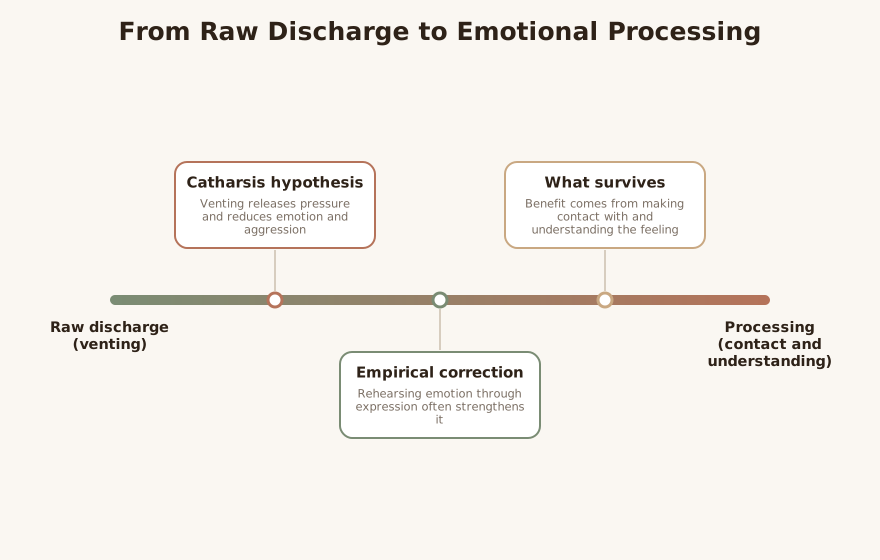
The modern principle is a correction to this picture. LLM Social-psychological research distinguishes the catharsis hypothesis — that venting reduces the underlying emotion and subsequent aggression — from the empirical finding that rehearsing an emotion through expression often strengthens rather than weakens it. 52 The operative principle that survives is more subtle: emotional benefit comes not from raw discharge but from processing — making contact with the feeling, understanding it, and integrating it with memory and meaning, which is closer to Breuer and Freud’s emphasis on recovering the memory than to a simple act of venting. 1LLM
Interventions & Techniques
As a construct, catharsis is not itself an intervention, but it animates a recognizable family of techniques. LLM The original was Breuer’s hypnotic-cathartic procedure: inducing a hypnoid state, helping the patient recover the forgotten precipitating scene, and enabling the affect to be expressed in words so the symptom could resolve. 13 Its descendants include abreactive and emotionally expressive methods across modern therapies, and the experiential “expressing the feeling out loud” maneuvers used in humanistic work. LLM
In contemporary practice, the cathartic intuition shows up wherever clients are encouraged to give voice to suppressed emotion — narrating a trauma, addressing an absent figure, or allowing grief to surface. LLM The crucial modern refinement, drawn from both Scheff’s “optimal distance” and the abreaction literature, is that expression must be paired with processing: contacting the emotion, but within a window that allows reflection rather than mere flooding. 71
The intervention that the evidence most clearly warns against is “venting” in the literal sense — striking a pillow, hitting a punching bag, or ruminating aloud on a provocation to “get the anger out.” 2 In controlled experiments, participants who vented anger this way were subsequently more aggressive, not less. 2
LLM-generated illustrative example (not a guideline): A client who “blows off steam” by ranting about a coworker for the first ten minutes of each session leaves feeling temporarily lighter but reports the resentment returns sharper by midweek. The therapist reframes the work from discharging the anger to understanding what the anger is protecting — and the venting, which had been rehearsing the grievance, gives way to processing it. LLM
Evidence Base
The construct is established in the sense of being old, central, and extensively discussed; the mechanism it proposes is, for anger and aggression, largely contradicted by controlled research. LLM This is the honest summary a clinician should carry. LLM
The Aristotelian and psychoanalytic foundations are historical and theoretical rather than experimental: they are documented, influential, and clinically generative, but they were never established by the standards of modern outcome research. 63 Breuer and Freud’s case-based evidence — most famously Anna O. — launched a paradigm but is anecdotal by current criteria, and Anna O.’s actual long-term course has been the subject of later historical scrutiny. 17
The experimental evidence is where the construct fares worst. LLM Bushman’s (2002) studies directly tested the venting hypothesis: participants angered by a confederate’s insulting feedback were assigned to vent (hit a punching bag while thinking about the provocateur), to a distraction condition, or to a control, then given a chance to behave aggressively. 2 Venting did not lower anger or aggression; participants who ruminated while venting remained the angriest and behaved the most aggressively, and those who simply did nothing fared better than those who vented. 2 The conclusion — that venting “to get it off your chest” feeds rather than extinguishes the flame — is consistent with the broader social-psychological verdict that the catharsis-of-aggression hypothesis is not supported. 25 What does retain support is the narrower, processing-oriented reading: controlled re-experiencing at optimal distance, and the recovery and integration of emotionally charged memory, rather than discharge as such. 71
Populations & Indications
Because catharsis is a construct rather than a treatment, “indications” means the populations for whom emotional expression and processing — appropriately framed — are clinically relevant. LLM The original clinical population was adults with what was then called hysteria, in whom recovering and discharging affect attached to a forgotten event relieved symptoms. 1 Its modern analogues are trauma survivors carrying avoided or “strangulated” affect, clients with unresolved grief, and clients whose affect is chronically suppressed or constricted. LLM
The population where the cathartic intuition most needs correction is clients with anger and aggression difficulties, for whom venting is precisely the wrong prescription. 2 Here the indication is to replace the discharge model with regulation, processing, and meaning-making. 2LLM Across populations, the through-line is that contacting avoided emotion can help, but only when paired with reflection and integration rather than rehearsal. 12
Problems-for-Work
The construct maps onto several problems-for-work, with the recurring clinical skill being to distinguish processing from venting. LLM
- Anger and aggression dysregulation: the clearest case where the catharsis hypothesis fails — venting rehearses and amplifies anger, so the work is regulation and reappraisal, not discharge. 2
- Unresolved grief: giving avoided grief expression and helping it find meaning and integration, consistent with recovering the charged memory rather than only releasing affect. 1LLM
- Trauma-related avoidance: contacting “strangulated” affect attached to a traumatic memory within a tolerable window, the lineal concern of the cathartic method. 13
- Suppressed or constricted affect: helping a chronically over-controlled client access and articulate feeling, where some expressive benefit is plausible. LLM
- Rumination: recognizing that “venting” rumination prolongs distress, so the target is interrupting the rehearsal rather than indulging it. 2
LLM-generated illustrative example (not a guideline): A bereaved client believes she must “cry it all out” to heal and is frustrated that nightly sobbing alone leaves her no better. The therapist shifts the focus from quantity of release to quality of contact — staying with the grief long enough to find the unspoken words to her late mother — and the felt shift comes from meaning, not volume. LLM
Contraindications, Cautions & Cultural Humility
The principal caution is the strongest empirical finding in this entry: do not prescribe venting for anger, because controlled studies show it increases rather than decreases anger and aggressive responding. 2 More broadly, uncontained emotional discharge can flood a client beyond their window of tolerance, which is why Scheff’s framing insists on “optimal distance” — emotion close enough to feel but distanced enough to remain processable. 7 Clinicians should be wary of treating tears, rage, or dramatic abreaction as evidence of progress in themselves; intensity of expression is not equivalent to therapeutic change. 2LLM
The historical record also counsels humility: the cathartic method’s founding case is more complicated than its legend, and a method’s longevity is not proof of its mechanism. 17 Cultural humility matters because the value placed on emotional expression is itself culturally variable — the assumption that “letting it out” is universally healthy reflects particular cultural norms, and for many clients restraint, containment, or communal and ritual forms of processing may be more congruent. LLM Aristotle’s catharsis, after all, was a public, aesthetic, and communal experience, not a private act of venting, a reminder that “expression” takes many culturally shaped forms. 46
Treatment-Plan Suggestions & SMART Objectives
| Goal | SMART objective (example) | Mechanism |
|---|---|---|
| Replace venting with anger regulation | Within 6 sessions, client identifies 3 personal “venting” behaviors and substitutes a regulation strategy in at least 2 logged anger episodes | Venting rehearses and amplifies anger; interrupting it reduces aggressive responding 2 |
| Process avoided trauma-related affect | Over 8 sessions, client narrates the target memory with affect at a tolerable distance and reports reduced intrusive distress | Re-attaching and processing “strangulated” affect to the memory relieves symptom pressure 13 |
| Move grief from discharge to meaning | Within 6 sessions, client articulates the unspoken message to the lost figure and rates grief as more bearable | Recovery and integration of charged memory, not volume of release, drives relief 17 |
| Build tolerance for emotional expression | Over 5 sessions, client names and stays with one suppressed feeling per session without shutting down | Controlled contact with avoided affect at optimal distance 7 |
| Reduce ruminative “venting” | Within 4 sessions, client reduces rehearsal-style venting and reports shorter anger duration | Distraction and disengagement outperform rumination for anger 2 |
| Reframe the “let it all out” belief | By session 3, client can state why expression alone does not resolve emotion and identify processing as the goal | Corrects the hydraulic/discharge folk model with a processing model 25 |
| Restore emotionally charged memory to awareness | Across 8 sessions, client recalls and verbalizes a previously avoided precipitating event with appropriate affect | The cathartic method’s core: returning the memory to normal associative consciousness 1 |
Common Misconceptions
The most consequential misconception is that venting reliably reduces anger — the “blow off steam” model that experimental research directly contradicts. 2 A second is that Aristotle’s catharsis meant private emotional venting; in the Poetics it describes the purgation or clarification of pity and fear produced in an audience by tragedy, a communal aesthetic effect rather than a self-help technique. 46 A third is that the cathartic method was a clean success: Breuer and Freud’s account is foundational but case-based, and the famous Anna O. story is more ambiguous in the historical record than the textbook version suggests. 17 A fourth is that more intense expression equals more healing — intensity is not the active ingredient; processing and integration are. 2LLM Finally, clinicians sometimes treat “catharsis” and “abreaction” as proven mechanisms; they are better held as historically important hypotheses, one of which (the discharge of aggression) has largely failed empirical test. 32
Training & Certification
There is no certification in “catharsis,” because it is a construct rather than a credentialed method. LLM Clinicians encounter it within training in the traditions that inherited it: psychodynamic and psychoanalytic training, where the cathartic method is taught as the origin point of the field, and experiential and emotion-focused trainings, where emotional contact and expression are central. 3LLM The most important “training” a contemporary clinician needs around catharsis is literacy in the experimental evidence — knowing that the venting hypothesis is not supported — so that the folk model is not enacted uncritically. 2 Supervision is the realistic venue for developing judgment about when expression aids processing and when it merely rehearses distress. LLM
Key Terms
- Catharsis: the purgation, purification, or clarification of emotion through its arousal and expression; classically Aristotelian, later medicalized. 46
- Cathartic method: Breuer and Freud’s procedure of relieving hysterical symptoms by recovering the precipitating memory and discharging its attached affect. 13
- Abreaction: the discharge — verbal or motor — of affect attached to a repressed or dissociated memory. 13
- Strangulated affect: Breuer and Freud’s term for emotion denied normal discharge and thereby rendered pathogenic. 1
- Catharsis hypothesis (of aggression): the testable claim that venting anger reduces subsequent anger and aggression — largely unsupported by experiment. 52
- Optimal distance: Scheff’s condition for productive emotional re-experiencing — close enough to feel, far enough to remain safe. 7
Resources & Further Reading
▶ Watch — a video introduction to this concept:
- Breuer, J. & Freud, S. (1895) — Studies on Hysteria
- Bushman (2002) — Does Venting Anger Feed or Extinguish the Flame? (Personality and Social Psychology Bulletin)
- Cathartic Method — Encyclopedia.com (International Dictionary of Psychoanalysis)
- Catharsis — Encyclopaedia Britannica
- Catharsis (Social Psychology) — iResearchNet
- Aristotle — Poetics (catharsis term) — Criticalink, University of Hawai’i
- Catharsis — Wikipedia
Reflective / Supervision Questions
- When a client “vents” in session and reports feeling better, how do I tell whether I am witnessing genuine emotional processing or a rehearsal that will sharpen the distress by midweek? 2LLM
- Where in my own practice do I implicitly run a hydraulic “let it out” model of emotion, and how would I behave differently if I took the venting research seriously? 2LLM
- How do I help a client contact avoided affect at an optimal distance — close enough to feel, contained enough to process — rather than flooding them? 7LLM
- What cultural assumptions about emotional expression am I bringing, and how might restraint, ritual, or communal forms of processing be more congruent for this client? 4LLM
- How do I describe the history and the mixed evidence of catharsis to a client who arrives convinced that “crying it all out” is what they need? 12LLM