
Type & Discipline
Role theory is a theory drawn from sociology and social psychology, not a treatment, diagnosis, or stand-alone billable modality LLM. Its central proposition is that a substantial portion of observable human behavior is patterned — that people behave in characteristic ways tied to the social positions they occupy, and that these patterns are organized by socially shared “roles” carrying expectations, rights, and obligations 1. The home discipline is sociology, with a long-standing presence in social psychology, where the construct of role has served as a bridge between the individual and the social structures within which the individual acts 6.
For a clinician, the value of role theory is not that it is something one delivers but that it supplies a vocabulary for case formulation: it lets a therapist ask, of any presenting difficulty, which social positions a person occupies, what is expected of them in each, and where those expectations collide, overload, or shift LLM. Because it is a descriptive and explanatory frame rather than an intervention, it travels across modalities and informs how a clinician reads a caregiver’s exhaustion, a new parent’s disorientation, or a couple’s chronic friction, rather than constituting a therapy in itself LLM. The term “role” is widely used, but its precise meaning varies across writers, and part of the field’s history has been an effort to discipline that variation into testable propositions about expectations and behavior 1.
Creators & Lineage
Role theory has no single author; it emerged from several converging traditions in the early-to-mid twentieth century 4. The anthropologist Ralph Linton gave the field one of its enduring distinctions by separating status — a position a person occupies in a social structure — from role — the dynamic enactment of the rights and duties attached to that status 4. This status/role pairing remains foundational and supplies the basic grammar by which role theory describes social life LLM.
A second root is symbolic interactionism, descending from George Herbert Mead, which emphasized that selves and roles are constructed and negotiated in interaction — that people learn to take the role of the other, anticipate responses, and improvise their conduct rather than mechanically execute a script 4. From this lineage comes the more agentic, interactionist strand of role theory, often associated with the language of “role-making” as well as role-taking 3. A third root is the structural-functionalist tradition of Talcott Parsons, which treated roles as the building blocks of social systems and emphasized how shared role expectations integrate and stabilize society 4. These two roots pull in different directions — one toward improvisation and meaning, the other toward structure and stability — and much of role theory’s internal debate reflects that tension 1.
A fourth, especially clinically resonant root is Erving Goffman’s dramaturgical theory, which analyzed social life through the metaphor of theatrical performance, examining how people present a self, manage impressions, work “front stage” and “back stage,” and maintain or repair the roles they perform before audiences 4. The sociologist Bruce J. Biddle later consolidated and critically reviewed these strands, mapping the field’s competing perspectives — functional, symbolic-interactionist, structural, organizational, and cognitive — and pressing the discipline toward clearer, more empirically testable formulations 1. The clinical branch of the lineage runs into family systems theory, where the analysis of roles, rules, and complementary positions became part of how therapists describe the patterned functioning of families LLM.
Core Principles
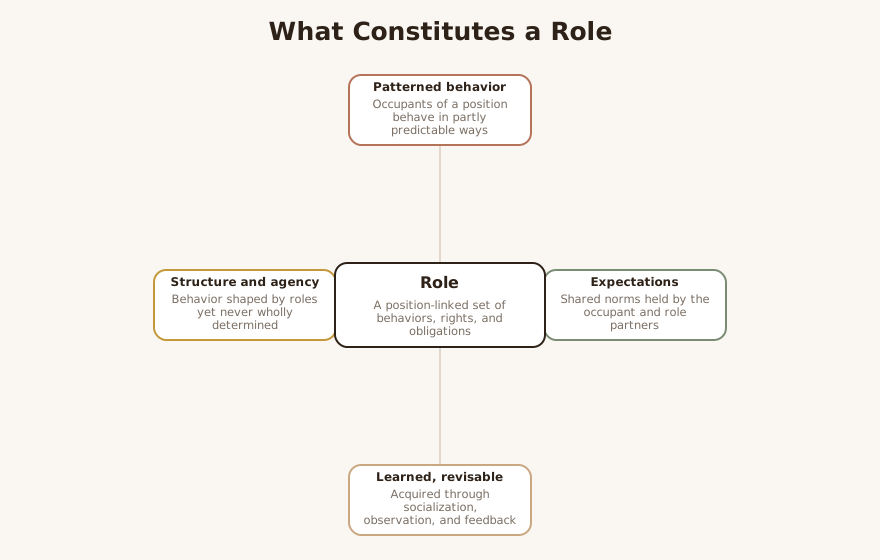
The first principle is that behavior is patterned and tied to social position: people who occupy the same social location tend to behave in characteristic, partly predictable ways, and these patterns are what role theory calls roles 1. A role is not a person but a position-linked set of behaviors and expectations; the same individual occupies many roles at once — parent, employee, spouse, caregiver, patient — and moves among them across the day LLM.
The second principle is that roles are governed by expectations — shared, normative understandings of how an occupant of a position ought to behave, together with the rights and obligations that attach to it 6. Expectations are the conceptual engine of much role-theoretic work: they are held by the role occupant and by others (“role partners”), they can be communicated and learned, and behavior is understood as substantially shaped by them, though never wholly determined by them 1. Roles are learned through socialization, observation, and feedback, so they are acquired and revisable rather than innate 5.
The third principle concerns the relationship between structure and agency. In the more structural and functionalist reading, roles are relatively fixed expectations into which people are slotted and which integrate the social system; in the more interactionist reading, roles are actively made, negotiated, and improvised in interaction, so people are authors as well as occupants of their roles 3. Contemporary treatments generally hold both: roles constrain behavior through expectation while leaving room for interpretation, improvisation, and change 1. The fourth principle is that strain is built into the system: because each person holds multiple roles and because the expectations within and across roles can be incompatible, conflict and overload are normal structural features of social life rather than signs of individual deficiency 6.
Interventions & Techniques
Because role theory is an explanatory framework rather than a therapy, there are no “role-theory techniques”; its clinical value lies in directing attention and shaping interventions delivered through recognized modalities LLM. The first practical move is role mapping — making explicit the full set of positions a client occupies, the expectations attached to each, who holds those expectations, and where the expectations are unclear, overloaded, or in collision 6. This converts a diffuse sense of being “overwhelmed” or “lost” into a specific, workable picture of which roles are straining and why LLM.
A second move is to name and locate the specific role problem using the framework’s distinctions: is the client facing role conflict (incompatible demands from two roles, such as worker and parent), role strain (too many or too heavy demands within a single role), role ambiguity (unclear expectations), or role transition (a change in the constellation of roles, such as becoming a parent, a caregiver, or a retiree) 3. Each label points toward a different focus of work, which is why the precision the framework offers is clinically useful LLM. A third move, drawn from the interactionist strand, is to support role negotiation and role-making — helping clients renegotiate expectations with role partners, decline or delegate obligations, and author revised versions of a role rather than passively absorb an inherited script 3. A fourth, drawn from the dramaturgical strand, is to attend to impression management and front/back-stage strain — the cost of sustaining a performance that diverges from inner experience, as when a client maintains a competent “front stage” while privately depleted 4.
LLM-generated illustrative example (not a guideline): A client describes feeling like a failure “at everything.” Role mapping reveals she is simultaneously a full-time employee, the primary caregiver for an ailing parent, and a mother of two — three roles whose expectations directly collide for the same hours. Renaming her distress as role conflict and caregiver strain, rather than personal inadequacy, reframes the target: the work becomes renegotiating expectations with siblings and employer and deliberately shedding obligations, pursued within a structured psychotherapy rather than as a separate procedure LLM.
Evidence Base
The honest appraisal is that role theory is an established, foundational framework within sociology and social psychology — durably influential, continuously taught and cited for the better part of a century, and structurally embedded in adjacent clinical theories — but it is a conceptual framework rather than an intervention with its own outcome trials LLM. Its standing rests on conceptual fertility and explanatory usefulness across many domains rather than on efficacy data for the framework as a technique LLM.
Biddle’s review documents both the breadth of the field and its long-standing internal problem: “role” has been used inconsistently, the competing perspectives have sometimes talked past one another, and the construct’s very flexibility has made unified empirical testing difficult 1. That candor is part of the field’s maturity — the framework has been productive precisely because it generates testable claims about expectations and behavior, even as critics note its tendency toward loose definition and, in its more functionalist forms, an over-emphasis on consensus and stability at the expense of conflict and change 1. Specific constructs derived from it — role conflict, role strain, role ambiguity, role overload — have a substantial empirical literature in organizational and occupational research, where they are linked to stress and strain outcomes 3. For the clinician, the defensible stance is to use role theory as a generative heuristic for formulation — a reliable way to widen attention to a client’s social positions and the expectations bearing on them — rather than as a validated causal law or a proven, manualized treatment LLM.
Populations & Indications
Role theory’s natural focus is people whose difficulties are bound up with the social positions they occupy and the expectations attached to them 6. Working adults are a paradigmatic population, because occupational roles are a dense site of conflict, ambiguity, and overload, and because the framework’s organizational constructs map directly onto workplace stress 3. Families and couples are equally apt, since the framework illuminates how partners and members hold, communicate, and clash over role expectations, and how the breakdown of shared expectations drives conflict 4.
People in life transitions are a core indication, because transitions are, in role-theoretic terms, reorganizations of a person’s role set — adding roles, shedding them, or transforming their content 3. Becoming a parent, launching from the family of origin, retiring, immigrating, divorcing, or moving into a caregiving role each restructures the constellation of expectations a person lives under, which is often exactly where the presenting distress sits LLM. Caregivers are a specifically indicated group, since caregiving frequently layers a demanding new role onto existing ones without removing any, producing the overload the framework names as caregiver burden LLM. Adolescents are apt because identity development is in part a process of trying on, integrating, and committing to roles, and because adolescence concentrates role experimentation and role conflict 5. Finally, members of organizations — teams, institutions, congregations — are an indicated focus, since role clarity, conflict, and ambiguity are central to how groups function and to the strain individuals carry within them 3.
Problems-for-Work
The framework maps onto a recognizable cluster of problems. Role conflict is central: a client pulled between incompatible demands — the employee expected to stay late and the parent expected to be home — experiences genuine, structurally produced distress, and naming it as conflict between roles (rather than a character flaw) is itself clinically useful 3. Role strain and role overload name the situation in which a single role, or the sum of roles, imposes more than a person can carry, a common engine of occupational stress and caregiver burden 3.
Role transition distress is a distinct problem-for-work: the disorientation, grief, or adjustment difficulty that accompanies a reorganization of one’s role set, which frequently presents clinically as an adjustment disorder around a major life change LLM. Family conflict and relationship conflict are illuminated by mismatched or contested role expectations — partners operating from incompatible scripts about who does what, or a family whose role assignments have not updated for a member’s development 4. Identity disturbance connects to role theory through the relationship between role and self: when valued roles are lost, blocked, or never consolidated, the sense of who one is can become unstable, and adolescents in particular may struggle to integrate competing role demands into a coherent identity 5. Interpersonal dysfunction more broadly can be read as difficulty reading, meeting, or negotiating the role expectations that organize social life 6.
LLM-generated illustrative example (not a guideline): A recently retired man presents with low mood and a sense of “uselessness.” Formulated through role theory, the problem is a role transition: the abrupt loss of an occupational role that had organized his time, status, and identity, with no new roles yet built to replace it. The problem-for-work is reframed from “depression with no cause” to role-transition distress, and the plan centers on deliberately constructing and investing in new roles, pursued within an established psychotherapy LLM.
Contraindications, Cautions & Cultural Humility
The foremost caution is conceptual restraint: role theory is a heuristic from social science, not a validated clinical law, so a clinician should not present a role formulation as a proven mechanism or treat “this is role conflict” as a verdict rather than one hypothesis among several LLM. The framework’s own literature warns that the term “role” is used loosely and that its more functionalist versions can over-emphasize consensus and conformity, which in the consulting room risks subtly pressuring a client to fit a normative expectation rather than to question or revise it 1.
A second, central caution concerns cultural humility about what roles ought to look like LLM. Role expectations are culturally and historically specific — what is expected of a “good” parent, spouse, daughter, or employee, and how much role flexibility is sanctioned, varies enormously across cultures, classes, and communities 5. A clinician working from an unexamined cultural template can mislabel a client’s role arrangement as pathological role strain when it is, in the client’s own frame, a valued and adaptive structure of obligation and continuity LLM. Gender is a particularly loaded axis here, since gender roles carry powerful, contested expectations, and the framework can either expose or unwittingly reinforce them depending on how it is used 4. Power matters too: the therapy room is itself a set of roles, and the clinician holds authority in deciding which role configuration counts as healthy LLM. Cultural humility requires interpreting a client’s roles against their own cultural and relational frame, holding role formulations as hypotheses to be checked with the client, and remaining alert that “reducing role conflict” should mean helping the client toward their preferred arrangement, not the clinician’s LLM.
Treatment-Plan Suggestions & SMART Objectives
| Goal | SMART objective (example) | Mechanism |
|---|---|---|
| Build awareness of one’s full role set | Within 4 sessions, client will map their current roles, the expectations attached to each, and who holds them, in session | Makes implicit role demands explicit so strain points can be located 6 |
| Identify the specific role problem | Within 4 sessions, client will accurately distinguish role conflict, role strain, and role ambiguity across 3 stressful situations | Precise labeling directs the focus of intervention 3 |
| Reduce role overload through renegotiation | Over 8 weeks, client will renegotiate or delegate 2 role obligations with a role partner, logged between sessions | Lowers demand load by reshaping expectations rather than the person 3 |
| Navigate a major role transition | Over 10 sessions, client will define and begin investing in 2 new or revised roles to replace a lost one, reviewed across sessions | Rebuilds a coherent role set after transition-driven disruption LLM |
| Resolve a couple’s contested role expectations | Over 8 sessions, partners will make explicit and agree on a revised division of 3 disputed role obligations | Replaces mismatched implicit scripts with shared, negotiated expectations 4 |
| Strengthen role-based identity | Over 10 sessions, client will identify and act on 2 valued roles that express who they want to be, observed across sessions | Links self-coherence to investment in chosen roles 5 |
| Reduce front/back-stage performance strain | Within 6 sessions, client will identify 2 settings where impression management is depleting and test one more authentic stance | Lowers the cost of sustaining a divergent role performance 4 |
| Build assertive role negotiation skills | Within 8 sessions, client will decline or modify an unwanted role expectation in 3 real situations without collapsing into compliance | Converts passive role-taking into active role-making 3 |
Common Misconceptions
A frequent error is treating roles as rigid, fixed scripts that people merely execute; the interactionist strand of the framework insists that roles are also made — negotiated, interpreted, and improvised — so a person is an author of their roles, not only an occupant 3. A second misconception is that role theory is a single, unified theory; in fact it is a family of perspectives — functional, symbolic-interactionist, structural, organizational, cognitive — that define “role” somewhat differently and have at times been in tension, which is precisely what reviews of the field have worked to clarify 1.
A third misconception is conflating status and role: status is the position one holds in a social structure, while role is the dynamic enactment of the rights and duties attached to it, and collapsing the two loses the distinction that makes the framework analytically useful 4. A fourth is reading role conflict and role strain as signs of individual pathology; the framework’s point is that they are normal, structurally produced features of occupying multiple roles, which reframes a client’s distress as a predictable consequence of their social position rather than a personal failing 6. A fifth is treating this as a therapy one “does”; it is a descriptive frame that informs interventions delivered through other modalities LLM. A sixth, flagged within the literature itself, is assuming role theory implies that conformity to expectations is healthy — its more functionalist versions lean that way, but the framework can equally illuminate the cost of conformity and the value of revising or resisting a role 1.
Training & Certification
There is no certification in “role theory”; it is foundational theory studied within sociology, social psychology, and adjacent clinical traditions rather than a credentialed technique LLM. Clinicians typically first encounter it in coursework on social psychology, sociology, family systems, and human development, where Linton’s status/role distinction, Mead’s interactionism, Parsons’s functionalism, and Goffman’s dramaturgy are part of the background canon 4. Reading a consolidating review such as Biddle’s mapping of the field’s perspectives remains a standard route to understanding role theory in its mature form, and handbook treatments situate it within the broader structure of social psychology 16.
For applied competence, the relevant training lives in the recognized modalities that operationalize role concepts — interpersonal psychotherapy, with its explicit focus on role transitions and role disputes; family and couples therapies, which analyze role complementarity and conflict; and organizationally informed approaches to occupational stress LLM. Generalist therapists can legitimately use role theory for formulation provided they represent its status as an explanatory heuristic honestly, hold their role hypotheses as testable with the client, and pursue supervision before relying on it in complex family, couple, or cross-cultural work LLM.
Key Terms
Role — a socially defined set of behaviors and expectations attached to a position, which a person both enacts and improvises 1. Status — the position a person occupies within a social structure, distinct from the role that enacts its rights and duties 4. Role expectations — the shared, normative understandings of how an occupant of a position ought to behave, held by the occupant and by role partners 6. Role-taking / role-making — taking the perspective and expectations of others versus actively constructing and negotiating one’s own role 3. Role conflict — incompatible demands arising between two or more roles a person holds 3. Role strain / role overload — excessive or competing demands within a single role, or across the sum of one’s roles 3. Role ambiguity — unclear or poorly communicated expectations about how a role should be performed 3. Role transition — a change in a person’s role set through gaining, losing, or transforming roles 3. Role set — the full constellation of roles a single person occupies at a given time LLM. Dramaturgy / impression management — Goffman’s analysis of social life as performance, including front-stage and back-stage conduct 4. Socialization — the process through which people learn the roles and expectations of their society 5.
Resources & Further Reading
▶ Watch — a video introduction to this concept:
- Biddle, B. J. (1986) — Recent Developments in Role Theory (Annual Review of Sociology)
- Role Theory — Encyclopedia of Social Theory (SAGE)
- Role Theory — an overview (ScienceDirect Topics)
- Role theory (Wikipedia)
- Understanding Role Theory in Social Psychology (PubAdmin.Institute)
- Role Theory — Handbook of Social Psychology (Springer)
Reflective / Supervision Questions
- When a client says they are “failing at everything,” have I mapped their actual role set and located where the expectations collide, before treating the distress as a personal deficiency 6?
- Am I distinguishing precisely between role conflict, role strain, role ambiguity, and role transition for this client, or am I using “overwhelmed” as a catch-all that obscures the specific target 3?
- Whose role expectations am I implicitly treating as the healthy norm — the client’s, their family’s, or my own cultural template — and have I checked that against the client’s own values 5?
- Am I leaving room for role-making and renegotiation, or am I subtly helping the client conform better to an inherited role that may itself be the problem 1?
- For a client in a major life transition, am I attending to the loss and reconstruction of roles, or only to the symptom that the transition produced 3?