
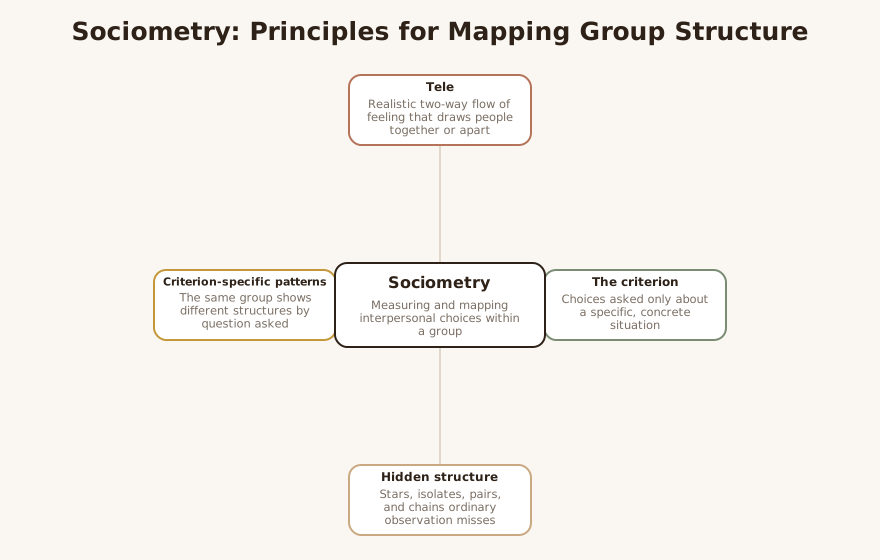
Sociometry is a method for making the invisible relational life of a group visible. Where most group assessment relies on what members say about themselves, sociometry asks who is drawn to whom, who is avoided, and who connects otherwise disconnected people — and then represents those patterns as data and as diagrams 2. For the practicing therapist, it offers a structured way to read the social field of a therapy group, a family, a classroom, or a team rather than treating it as an undifferentiated mass 4.
Type & Discipline
Sociometry is best classified as a measurement and mapping technique that sits at the intersection of social psychology and sociology, with a strong applied tradition in group psychotherapy and action methods 1. It is sometimes described as the quantitative study of social relationships, concerned with measuring the attractions and repulsions between people in a group 1. As a discipline it is foundational rather than free-standing in clinical work: it is the assessment-and-intervention substrate beneath psychodrama and sociodrama rather than a standalone talk therapy 4.
It carries a dual identity that the clinician should hold in mind. On one hand it is a research method with formal procedures, indices, and diagramming conventions — an early ancestor of modern social network analysis 1. On the other hand it is an experiential, action-oriented practice in which the group itself enacts and explores its own structure 4. The clinical power of sociometry lies in moving fluidly between those two registers: gathering relational data and then putting that data to therapeutic use in the room 6.
Creators & Lineage
Sociometry was developed by Jacob Levy Moreno, a Vienna-trained psychiatrist who emigrated to the United States and is also the originator of psychodrama and group psychotherapy 1. Moreno introduced the term and the systematic method, and his collaborator Helen Hall Jennings contributed substantially to the empirical and statistical refinement of the approach 1. Moreno’s broader project was a “science of society” grounded in spontaneity, creativity, and the directly observable choices people make toward one another 3.
The method launched into wide visibility with Moreno’s 1934 work Who Shall Survive?, which presented sociometry as both a research tool and a vehicle for social healing 3. From this root grew an interconnected family of methods that together form Moreno’s lineage: psychodrama, in which an individual’s inner and interpersonal world is enacted; sociodrama, which explores shared collective and role-based themes; and role theory, Moreno’s account of how persons are constituted through the roles they take 4. Sociometry also stands as a recognized precursor to contemporary social network theory, sharing its central insight that the unit of analysis is the relationship, not the isolated individual 1.
Core Principles
The organizing concept of sociometry is tele — Moreno’s term for the two-way flow of feeling between people, the accurate sensing of one person for another that draws them together or pushes them apart 4. Tele is distinguished from transference: where transference distorts the other through projection, tele is the realistic, mutual perception that underlies genuine attraction or rejection 4. Sociometry assumes that these tele relationships, though usually unspoken, form a real and measurable structure within any group 3.
A second principle is the criterion: choices are never asked in the abstract but always in relation to a specific, concrete activity or situation — for example, “Whom in this group would you want beside you in a difficult moment?” 3. Sociometric structure is criterion-specific, so the same group can show very different patterns depending on what is being asked about 3. This matters clinically because it warns against treating one snapshot of “who likes whom” as a fixed social fact LLM.
Third, sociometry holds that every group has a hidden structure of stars, isolates, pairs, and chains that ordinary observation misses, and that bringing this structure into awareness is itself therapeutic 2. The act of measuring is not neutral: making the relational field visible changes how members experience and act within it 6. Finally, Moreno insisted that sociometric exploration should be done with the group rather than on it, with members as active participants in studying their own relationships 4.
Interventions & Techniques
The classic data-gathering instrument is the sociometric test, in which each member privately indicates whom they would choose or reject for a given criterion, often with a rationale and sometimes ranked 1. These choices are then represented in a sociogram, a diagram in which individuals are points (nodes) and their choices are lines (arrows) connecting them, so that the group’s structure can be seen at a glance 5. The sociogram makes immediately legible who is highly chosen, who is left out, and where mutual pairs and cleavages lie 5.
Reading a sociogram involves a vocabulary of structural positions. A star is a member who receives many choices; an isolate receives none or very few; a mutual pair choose each other; and a member who bridges otherwise separate clusters occupies a connecting or “gatekeeper” role 5. From the raw choices one can also compute simple indices — for instance, a member’s choice status relative to group size — that quantify position within the network 5.
Beyond paper-and-pencil testing, action sociometry brings these measurements into live enactment. In spectrograms, members place themselves along an imagined line to indicate the degree of some attribute or feeling; in locograms, they move to areas of the room representing options; and in action sociograms or “step-in” sociometry, members physically choose by standing near, touching, or moving toward those they feel connected to 2. These embodied techniques let the group experience its own structure directly and warm members up toward psychodramatic or sociodramatic work 6.
LLM-generated illustrative example (not a guideline): In an outpatient process group, the facilitator invites members to “place a hand on the shoulder of someone whose presence helps you feel safe enough to speak.” When two members are left untouched, the facilitator names this gently and uses it as the warm-up for exploring belonging — turning a sociometric observation into the session’s therapeutic focus LLM.
Evidence Base
The maturity of sociometry is best described as established: it is a long-standing, well-documented method with a coherent theoretical base, a recognized place in the history of social science, and decades of applied use across clinical, educational, and organizational settings 1. It is credited as a forerunner of social network analysis, and its core diagramming and measurement logic has been absorbed into mainstream relational research 1.
Honesty requires distinguishing methodological maturity from a robust modern outcome-trial base. The provided literature documents sociometry primarily as a measurement framework and an applied clinical practice rather than through contemporary randomized controlled trials of sociometric intervention 3. Its strongest empirical claim is as a reliable way to describe group structure — the validity of sociometric status as a measurable social fact — rather than as a stand-alone treatment with quantified effect sizes 1. Clinicians should therefore treat sociometry as a mature assessment-and-process technology embedded within evidence-informed group methods, not as an independently trial-validated therapy LLM. Its clinical credibility rests substantially on its integration with psychodrama and group psychotherapy, fields in which it functions as the relational diagnostic layer 6.
Populations & Indications
Sociometry is applicable wherever people form a bounded group with ongoing relationships. Its core clinical home is the therapy group, where it maps cohesion, alliance patterns, and members at risk of dropping out 4. It is widely used with families, treating the household as a small relational network whose alliances, coalitions, and exclusions can be surfaced and worked with 4.
Beyond clinical settings, sociometry has a strong tradition in schools and classrooms, where Moreno and Jennings originally applied it to understand peer acceptance and rejection among students 1. It is equally suited to teams and organizations, where it illuminates informal influence, communication channels, and friction that the formal org chart conceals 6. At the largest scale it extends to communities, consistent with Moreno’s ambition to study and heal the structure of whole social systems 3. Across all of these, the common indication is the same: a need to understand and intervene on the relational structure of a collective rather than the symptoms of any single individual 4.
Problems-for-Work
Sociometry directly addresses several recurring clinical problems. For group cohesion difficulties, a sociogram can reveal whether a group is a single connected web or a set of disconnected cliques, guiding the facilitator’s choices about pairing, sequencing, and structure 2. For social isolation within groups, identifying isolates — members who give and receive few choices — flags those most at risk and invites targeted bridging interventions before they disengage 5.
For interpersonal conflict, mapping mutual rejections and cleavages locates the structural fault lines so the work can be aimed where the tension actually lives rather than at convenient scapegoats 5. For peer rejection, especially in school and youth settings, sociometric status data identifies rejected and neglected children with more precision than teacher impression alone 1. For communication difficulties, the network view shows where information does and does not flow, exposing bottlenecks and gatekeepers 6. And for general relationship-dynamics assessment, sociometry provides a baseline structural picture that can be re-measured over time to track relational change 4.
LLM-generated illustrative example (not a guideline): A family attends sessions reporting “constant arguing.” A simple criterion question — “Whom do you go to when you’re upset?” — reveals that two children both route exclusively through one parent, leaving the other parent peripheral. The clinician reframes the presenting “conflict” as a structural imbalance in support-seeking, and the treatment focus shifts accordingly LLM.
Contraindications, Cautions & Cultural Humility
The most important caution is that sociometric exposure can wound. Asking members to reveal — or having them learn — who is chosen and who is rejected can deepen the shame of an already-isolated member if handled carelessly 2. Action and “step-in” methods, which make choices physically visible, require enough group safety and clinician skill that no member is left publicly exposed as unwanted LLM. Voluntariness, confidentiality of individual choices, and the option to pass are baseline ethical safeguards LLM.
Sociometric data is also a snapshot of a specific criterion at a specific moment, not a verdict on a person’s worth or a stable trait 3. Treating a low choice-status as an inherent deficit rather than a property of a particular group-and-criterion is a clinical and conceptual error 3. Cultural humility is essential here: norms about expressing preference, rejection, hierarchy, and physical proximity vary widely, so what reads as “isolation” or “low status” in one cultural frame may reflect culturally appropriate reserve in another LLM. The criterion questions themselves should be examined for cultural and contextual bias before being treated as objective measurement LLM. Finally, because sociometry can concentrate attention on a single visible “isolate,” the clinician must guard against inadvertently re-creating scapegoating dynamics under the banner of assessment LLM.
Treatment-Plan Suggestions & SMART Objectives
| Goal | SMART objective (example) | Mechanism |
|---|---|---|
| Reduce a member’s isolation in group | Within 8 weeks, the identified isolate will be involved in at least 2 mutual choices on a connection criterion, per a repeated sociogram | Bridging interventions targeting documented isolate position 5 |
| Increase overall group cohesion | Over 6 sessions, increase the proportion of members in the connected main network from baseline to ≥80% on a repeated sociometric test | Surfacing and reworking structural cleavages 2 |
| Surface and address a hidden conflict | Within 3 sessions, name the primary mutual-rejection pair in a structured exercise and complete one facilitated dialogue | Action sociometry locating the relational fault line 4 |
| Improve communication flow on a team | Within 4 weeks, identify all gatekeeper roles via a communication-criterion sociogram and establish one alternate channel | Network mapping of information bottlenecks 6 |
| Build relational self-awareness | By session 5, each member will articulate their own sociometric position and one choice pattern in their own words | Doing sociometry with the group as co-investigators 4 |
| Track relational change over time | Administer the same criterion sociometric test at intake and at week 10 and review shifts with the group | Re-measurement of tele-based structure 3 |
| Strengthen a peripheral family member’s connection | Within 6 weeks, the peripheral parent will be named as a support figure by at least one child on a repeated family criterion | Restructuring support-seeking pathways 4 |
Common Misconceptions
A first misconception is that sociometry is merely a sorting tool that ranks people as popular or unpopular. In Moreno’s framework it is a study of tele — real, mutual relational perception — and is meant to be done collaboratively with the group, not used to label members 4. A second is that a sociogram captures fixed traits; in fact every sociometric picture is bound to a specific criterion and moment and shifts when either changes 3.
A third misconception conflates sociometry with simple popularity polling. The method is criterion-anchored and structural: it asks about concrete situations and analyzes the resulting network of mutuals, isolates, and bridges, not raw likeability 5. A fourth is that sociometry and psychodrama are the same thing. Sociometry is the measurement and structural layer; psychodrama and sociodrama are the enactment methods that frequently build on it, and the three are distinct members of Moreno’s larger system 4. Finally, some treat sociometry as a purely historical curiosity, overlooking that its relational logic survives directly in modern social network analysis 1.
Training & Certification
Sociometry is taught primarily within the broader training pathway for psychodrama and group methods rather than as an isolated credential 4. Professional psychodrama associations — such as the AANZPA in the Australia/New Zealand region and parallel bodies elsewhere — situate sociometry alongside psychodrama and sociodrama as one of the three interlocking competencies of a Morenian practitioner 4. Dedicated training organizations, including institutes such as the Hudson Valley Psychodrama Institute and the Michigan Psychodrama Center, offer experiential coursework in sociometric theory, testing, sociogram construction, and action methods 2.
Because action sociometry is experiential and can expose group members emotionally, supervised practice is the norm: trainees typically learn by participating in, then facilitating, sociometric exercises under an experienced trainer before leading them independently 6. Clinicians integrating sociometry should pursue it within a recognized psychodrama/group-method training sequence rather than self-teaching from diagrams alone LLM.
Key Terms
- Tele: The two-way flow of accurate feeling and perception between people that draws them toward or away from one another; the basic relational unit sociometry measures 4.
- Criterion: The specific, concrete situation or activity in relation to which members make their choices; sociometric structure is always criterion-bound 3.
- Sociometric test: The instrument in which members indicate whom they would choose or reject for a given criterion 1.
- Sociogram: A diagram mapping individuals as nodes and their choices as connecting lines, revealing group structure visually 5.
- Star / Isolate / Mutual pair: Structural positions — a heavily chosen member, a rarely or never chosen member, and two members who choose each other 5.
- Action sociometry: Embodied, in-the-room versions of sociometric measurement such as spectrograms, locograms, and step-in choices 2.
Resources & Further Reading
▶ Watch — a video introduction to this concept:
- Sociometry — Encyclopedia.com
- Introduction to Sociometry — Hudson Valley Psychodrama Institute
- Sociometry: A Conceptual Introduction (IJESRR)
- Sociometry — AANZPA
- Sociogram — Wikipedia
- The Science of Sociometry and Its Application — Michigan Psychodrama Center
Reflective / Supervision Questions
- When I look at my current group, can I name the stars, isolates, mutual pairs, and bridges — or am I treating the group as an undifferentiated whole? LLM
- What criterion am I implicitly using when I judge who is “doing well” in the group, and would a different criterion reveal a different structure? LLM
- How do I protect an identified isolate from public exposure or scapegoating when I surface relational structure in the room? LLM
- Where might my reading of “low status” or “isolation” reflect cultural norms about preference, reserve, or proximity rather than relational difficulty? LLM
- Am I doing sociometry with my group as co-investigators, or on them as subjects — and how would the group know the difference? LLM
- If I re-measured this group in eight weeks, what structural change would tell me my interventions were working? LLM