
Philosophical counseling (also called philosophical practice or clinical philosophy) is a contemporary movement in practical philosophy that applies philosophical thinking to the resolution of personal problems 7. It treats philosophy not as an academic subject but as a method of inquiry brought to bear on how a person reasons, what they value, and how they understand their own life 1. For licensed clinicians, it is best understood as a body of dialogical technique and a worldview-oriented stance rather than a credentialed mental-health treatment in its own right LLM.
Type & Discipline
Philosophical counseling is a modality whose parent discipline is philosophy, not psychology or medicine 7. Its working materials are arguments, concepts, and worldviews rather than symptoms, diagnoses, or biochemistry 5. Proponents frame it as addressing “cognitive dilemmas” and value conflicts rather than “biochemical imbalances,” which is the central conceptual line they draw between their work and psychotherapy 5. It sits within an applied-philosophy / counseling family alongside neo-Socratic dialogue, applied ethics consultation, and organizational philosophical consulting 5. For a therapist, the most useful framing is that philosophical counseling supplies a set of methods for examining beliefs and improving thinking that can be folded into recognized clinical work, not a replacement for it LLM.
Creators & Lineage
The modern field is usually dated to Gerd B. Achenbach, who established himself as a consultant philosopher in Germany and founded a society for philosophical practice in 1982 7. Peter Koestenbaum’s 1978 book The New Image of the Person is cited as a foundational text, and Lou Marinoff founded the American Philosophical Practitioners Association (APPA) in 1998, doing much to popularize the practice in the United States 7. Elliot Cohen’s Logic-Based Therapy and Peter B. Raabe’s writing are also frequently named contributors 76. The intellectual lineage runs back to the Socratic tradition of philosophy as a search for the good life, and it draws explicitly on Stoicism, existentialism, and Eastern philosophy 75. Its proximate cousins in the clinical world are existential psychotherapy, logotherapy, and the rationalist strand of cognitive behavioral therapy LLM.
Core Principles
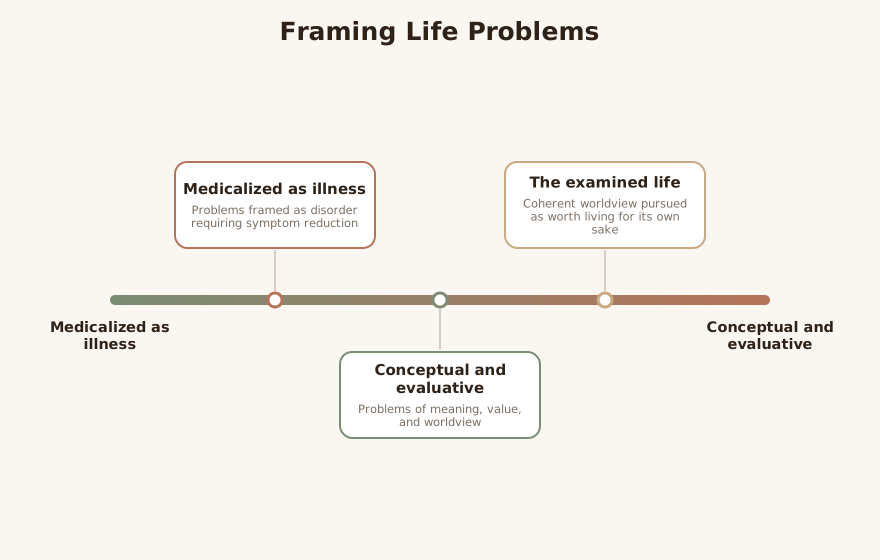
The first principle is that many life problems are conceptual and evaluative, not pathological, and so are amenable to clarified thinking rather than symptom reduction 6. The second is that the client is presumed competent and autonomous; the counselor’s job is to help them reason well, not to interpret unconscious material or correct a disorder 7. A third principle is the deliberate avoidance of the medicalization of ordinary life difficulties, offering an alternative for people who prefer not to frame their struggles as illness 7. A fourth is that examining and, where needed, revising one’s worldview, values, and ethical commitments is itself a route to greater well-being 3. Underlying all of this is the classical conviction that the examined life, lived with internal coherence, is worth pursuing for its own sake LLM.
Interventions & Techniques
Core activities include examining the client’s arguments, clarifying and defining important terms, exposing conflicts and inconsistencies in their reasoning, and exploring relevant philosophical theories 7. Sessions are often described in roughly five movements: clarifying the problem, analyzing underlying assumptions, exploring it through philosophical concepts, dialogue that tests different perspectives, and reflection on insights for practical application 6. Socratic questioning and dialogue are the central method 6. Named structured approaches include Marinoff’s PEACE process and Achenbach’s more open, principle-based stance, alongside Cohen’s Logic-Based Therapy, which builds on Albert Ellis’s rational emotive behavior therapy to identify and correct irrational beliefs through logical analysis 57. Delivery formats range from individual consultation to neo-Socratic group dialogue and organizational consulting 5.
LLM-generated illustrative example (not a guideline): A 52-year-old client who has met financial goals reports feeling “successful but empty.” Rather than scoring depressive symptoms, the counselor invites him to define what he means by a “good life,” surfaces an unexamined assumption that worth equals productivity, and works through the Stoic distinction between what is and is not within his control. LLM
Evidence Base
The evidence base for philosophical counseling is emerging and largely conceptual rather than empirical 6. The literature is dominated by theoretical and professional writing, and proponents and critics alike acknowledge that it lacks the kind of controlled outcome research that supports established psychotherapies 6. There are no robust randomized trials, effect sizes, or standardized outcome measures that would let a clinician compare it to evidence-based treatments LLM. What does exist is institutional maturation: specialized journals, biennial international conferences since the mid-1990s, associations in many countries, and thousands of certified practitioners, which signal a developing profession rather than a validated intervention 5. The honest summary for a referring clinician is that philosophical counseling is intellectually coherent and increasingly organized, but its empirical foundation remains thin LLM.
Populations & Indications
The practice is aimed at adults who are broadly high-functioning and are wrestling with meaning, values, and direction rather than acute symptoms 6. It is most often described for people facing life transitions, career changes, midlife crises, ethical dilemmas, and existential questions, particularly those actively examining their belief systems 6. APPA frames common areas of help as resolving moral dilemmas, finding meaning, achieving fulfillment, improving happiness, and managing change 1. From a clinical standpoint it maps well onto existential concerns, older adults reviewing a life, and people with chronic illness reconstructing a livable narrative around loss and limitation LLM. The shared thread is that the presenting concern is about how to think and live, not a diagnosable disorder requiring treatment 5.
Problems-for-Work
Philosophical counseling techniques are well suited to existential distress, loss of meaning, demoralization, and the value conflicts that arise when a person’s commitments collide 6. They also apply to decision-making difficulties, identity confusion, and the quarter-life and midlife crises that often present as a crisis of purpose rather than pathology 6. For a licensed clinician, the same methods can support adjustment difficulties, grief, and mild-to-moderate anxiety when these are bound up with meaning and worldview LLM.
LLM-generated illustrative example (not a guideline): A graduate student with mild anxiety frames her distress as “not knowing if any career is the right one.” Within supportive therapy, the clinician uses conceptual clarification to separate the unanswerable question (“which path is objectively correct?”) from the answerable one (“which values do I want this decade to express?”), reducing the paralysis driving the anxiety. LLM
Contraindications, Cautions & Cultural Humility
The defining caution is built into the field itself: philosophical practitioners are not, by virtue of that role, licensed to diagnose or treat mental health disorders 6. This boundary is not academic. In 2004, City College of New York temporarily closed Marinoff’s practice over concerns that he was offering mental-health services without a license, illustrating the legal and ethical stakes when the line is crossed 7. Active suicidality, psychosis, severe or melancholic depression, mania, and other acute psychiatric conditions are outside scope and require screening and referral to appropriate clinical care LLM. A clinician using these techniques should treat them as adjunctive to a diagnostic and risk framework, never as a substitute for one LLM. Cultural humility matters because “the good life,” virtue, and meaning are culturally and spiritually loaded; the counselor must examine, not impose, a worldview, and remain alert to imposing a Western philosophical canon on clients whose frameworks differ LLM.
Treatment-Plan Suggestions & SMART Objectives
| Goal | SMART objective (example) | Mechanism |
|---|---|---|
| Reduce existential distress | Within 8 sessions, client articulates a personally endorsed source of meaning and rates distress ≤4/10 on 3 consecutive check-ins | Clarifying values; examining worldview 3 |
| Resolve a value conflict | Within 6 sessions, client maps the competing values in one recurring dilemma and states a reasoned, livable resolution | Exposing conflicts/inconsistencies in reasoning 7 |
| Reduce decision paralysis | Within 4 sessions, client distinguishes controllable from uncontrollable factors in a pending decision and commits to one next step | Socratic dialogue; Stoic dichotomy of control 7 |
| Strengthen sense of identity | Within 10 sessions, client drafts and revises a coherent personal narrative they can articulate in session | Conceptual clarification of self-defining terms 6 |
| Address demoralization | Within 8 sessions, client reframes a perceived failure within a chosen ethical/meaning framework and reports renewed agency | Ethics-as-therapy reflection on virtue and meaning 3 |
| Process meaning after loss/illness | Within 12 sessions, client identifies values that remain viable despite limitation and acts on one weekly | Existential reflection on meaning and purpose 6 |
| Improve quality of reasoning | Within 6 sessions, client identifies 2 recurring irrational beliefs and applies a logical-analysis method to each | Logic-Based Therapy / REBT-derived analysis 7 |
Common Misconceptions
A first misconception is that philosophical counseling is simply unlicensed psychotherapy; its practitioners explicitly position it as a different enterprise focused on philosophical dimensions of life rather than clinical treatment 6. A second is that it is merely casual conversation about big ideas; in practice it follows structured methods such as argument analysis and staged Socratic dialogue 6. A third is that it is evidence-based in the clinical sense, when in fact it lacks the empirical validation expected of licensed mental-health fields 6. A fourth is that it can safely substitute for treatment of mental illness, which the field itself denies 7. Finally, some assume it is unregulated improvisation, but recognized associations now offer codes of ethics and tiered certification 25.
Training & Certification
There is no government licensure for philosophical counseling, and it has not been incorporated into regulated healthcare systems; credentialing instead runs through professional associations 5. The APPA offers tiered membership and certification, including Certified Practitioner status and structured programs 1. Its Philosophical Counseling Level 1 program is a three-day intensive covering roughly eighteen topics, including the relationship between philosophy and psychology/psychiatry, client suitability, ethical practice with a Code of Ethical Practice, demonstration counseling, and the legal and business aspects of practice 2. Admission is restricted: Adjunct membership requires an earned M.A., ABD, or Ph.D. in philosophy, while Affiliate membership is open to recognized professionals in fields such as psychology, social work, psychiatry, law, or pastoral counseling 2. Other bodies, including the National Philosophical Counseling Association, offer parallel credentials, though the field is still working to standardize curricula and ethical guidelines 75.
Key Terms
- Philosophical practice / clinical philosophy — Alternative names for the same applied-philosophy modality 7.
- Socratic dialogue — Structured questioning used to examine beliefs and expose inconsistencies 6.
- Logic-Based Therapy (LBT) — Elliot Cohen’s method built on Ellis’s REBT, correcting irrational beliefs through logical analysis 7.
- PEACE process — Marinoff’s structured stepwise approach to philosophical consultation 5.
- Neo-Socratic dialogue — A facilitated group method, typically around ten participants, exploring a question collaboratively 5.
- Medicalization — The framing of ordinary life difficulties as illness, which the modality deliberately seeks to avoid 7.
- Ethics as therapy — Martin’s framing of value, virtue, and meaning examination as contributing to psychological health 3.
Resources & Further Reading
▶ Watch — a video introduction to this concept:
- American Philosophical Practitioners Association (APPA) — official site
- Philosophical Counseling, Level 1 — APPA certification program
- Martin, “Ethics as Therapy: Philosophical Counseling and Psychological Health” (IJPP PDF)
- Martin, “Philosophical Counseling and Psychological Health” (Chapman Digital Commons)
- From Academia to Action: Philosophical Practice as an Emerging Profession (Dialogue, Cambridge Core)
- What is Philosophical Counseling? (Listening.com explainer)
- Philosophical counseling — Wikipedia
Reflective / Supervision Questions
- When a client presents with a “meaning” concern, how do I decide whether the work in front of me is philosophical, clinical, or both, and what would tip me toward referral? LLM
- Where is the line, in my own practice, between helping a client examine a worldview and subtly imposing mine? LLM
- If I incorporate Socratic or value-clarification techniques, can I clearly articulate the billable modality and medical necessity that frame the session? LLM
- How would I screen these high-functioning, meaning-focused clients for the acute risk that the philosophical frame can obscure? LLM
- Given the thin evidence base, how do I describe these methods to clients honestly without either overselling or dismissing them? LLM