
Type & Discipline
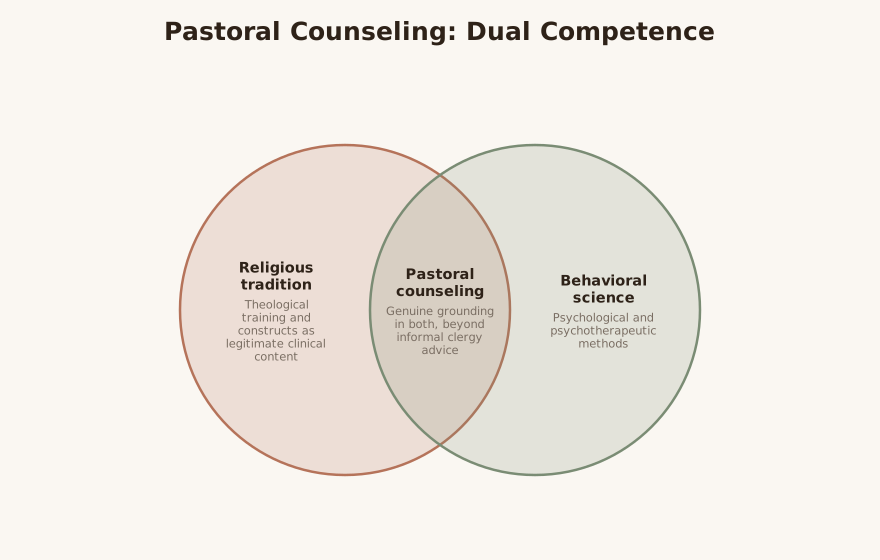
Pastoral counseling is a modality of spiritually integrated care delivered by clergy and other religiously trained professionals who blend contemporary psychological methods with religious training to address both psychological and spiritual concerns 5. It sits at the intersection of two disciplines: pastoral psychology/theology and clinical mental health practice, and is most precisely defined as a clinical practice that integrates psychological and theological disciplines, carried out by clergy and others who have received graduate training in both religion and behavioral science 4. Unlike chaplaincy (which is primarily presence-based spiritual care) or secular psychotherapy (which brackets religious content), pastoral counseling deliberately holds both frames at once LLM. For practicing therapists, the most useful way to locate it is as a faith-grounded counterpart to mainstream talk therapy rather than as a distinct theoretical school with its own change theory LLM.
The discipline is “established” in the sense that it has a century-long institutional history, formal training pathways, and professional certification bodies 53. It is not “established” in the sense of having a large body of randomized controlled outcome trials for pastoral counseling as a named modality LLM.
Creators & Lineage
Pastoral counseling emerged in early-twentieth-century North America as religious organizations began incorporating psychiatry and clinical psychology into the preparation of clergy 5. Richard Cabot, a Harvard physician, advocated in 1925 for clinical training of ministerial candidates, seeding what became the clinical pastoral education movement 5. In the 1930s, Anton Boisen pioneered the supervised placement of theological students alongside people experiencing mental-health conditions, an experiential training model that remains foundational to the field 5. Around the same period, minister Norman Vincent Peale and psychiatrist Smiley Blanton collaborated to establish the American Foundation of Religion and Psychiatry, now known as the Blanton-Peale Institute, institutionalizing the marriage of clergy and clinical care 5.
Seward Hiltner is widely regarded as a central theorist who helped systematize pastoral counseling as a formal discipline within seminary education during the mid-twentieth century LLM. The modality’s psychological lineage draws heavily on person-centered (Rogerian) and existential traditions: the empathic, non-directive stance and the focus on meaning, suffering, and finitude map naturally onto pastoral concerns such as forgiveness, suffering, and repentance LLM. The field formally organized in 1963 with the founding of the American Association of Pastoral Counselors (AAPC), which in 2019 consolidated with the Association for Clinical Pastoral Education (ACPE) 5.
Core Principles
Several principles distinguish pastoral counseling from generic supportive listening. First, it presumes that a client’s religious history and family background can function as either a source of pathology or a reservoir of coping resources, and that both deserve clinical attention 4. Second, most pastoral counselors operate from a belief in a divine power and understand the therapeutic encounter as mediating a healing dimension of being itself, which shapes how meaning and hope are framed in session 4. Third, the modality treats theological constructs — faith, forgiveness, reverence, stewardship, evil, suffering, and repentance — as legitimate clinical content rather than as material to be redirected toward purely secular framing 2.
A fourth, often underappreciated principle is dual competence: the pastoral counselor is expected to hold genuine training in both a religious tradition and behavioral science, not merely to layer scripture over folk advice 4. This dual grounding is what is meant to differentiate credentialed pastoral counseling from informal clergy advice LLM.
Interventions & Techniques
In practice, pastoral counseling is methodologically eclectic and borrows widely from secular psychotherapy. Reported approaches include insight-oriented work, behavioral therapy, human-potential models such as transactional analysis and Gestalt, and relational therapy, alongside explicitly spiritual growth practices 2. The integrative move is to deploy these standard techniques while also incorporating religious resources — prayer, scripture reading, and participation in community worship — when they are congruent with the client’s faith 4.
A characteristic intervention is the explicit examination of how a client’s religious upbringing and family-of-origin beliefs contribute to current distress or resilience, allowing distorted or punitive theology to be named and reworked 4. Counselors may also introduce or revisit theological concepts directly, helping a client move from, for example, a framework of divine punishment toward one of grace, suffering, or repentance 2.
LLM-generated illustrative example (not a guideline): A bereaved congregant says her husband’s death was God punishing her for a past affair. A pastoral counselor might use insight-oriented and cognitive work to surface the belief, then engage her own tradition’s theology of forgiveness to gently test the “punishment” attribution — work a secular therapist might be reluctant to enter and a non-clinically-trained pastor might handle without attending to the underlying depressive cognitions LLM.
Evidence Base
Honesty about evidence is important here. Pastoral counseling is best described as an established practice tradition rather than an empirically validated brand-name modality LLM. The accessible professional and explainer literature documents its definition, history, and training infrastructure in detail but provides little controlled outcome data for pastoral counseling specifically 25. One clinical overview explicitly offers historical context and indications without empirical effectiveness figures 2.
This does not mean the work is ineffective. Because pastoral counselors largely use the same insight-oriented, behavioral, and relational techniques as secular therapists, the broader evidence base for those component approaches plausibly transfers 2LLM. Likewise, the wider literature on religious and spiritual integration in psychotherapy supports matching intervention to client worldview LLM. The honest summary for clinicians: the modality’s mechanisms are familiar and reasonable, its outcomes for faith-congruent clients are likely comparable to mainstream care, but pastoral counseling per se lacks the trial density of, say, CBT LLM.
Populations & Indications
Pastoral counseling is indicated chiefly for people for whom faith is a central organizing frame, and it serves a broad demographic — clients seeking care aligned with Christian, Jewish, Native American, or other faith traditions 2. Reported populations include religious and faith-oriented individuals, couples, bereaved persons, congregants, and people facing terminal or chronic illness with existential dimensions 2. Veterans and others carrying moral injury — distress over acts that violate deeply held moral or spiritual commitments — are a population for whom an explicitly moral-spiritual frame can be especially apt LLM.
It is particularly effective in several scenarios: bereavement and loss that raise theological questions; terminal or chronic illness with existential weight; clients who interpret their mental illness as divine punishment; clients in conflict over religious beliefs or scriptural misinterpretation; transitions from institutional care back into community; and as an initial point of engagement for people reluctant to see a psychiatrist 2. That last indication makes pastoral counselors a useful front door to the mental-health system for faith communities 2.
Problems-for-Work
The modality is applied across a range of presenting problems where psychological and spiritual material intertwine.
- Grief and bereavement. When loss triggers questions like “why did God allow this,” pastoral work can hold both the depressive symptomatology and the theological crisis simultaneously 2LLM.
- Spiritual struggle / religious conflict. Clients wrestling with doubt, scriptural misinterpretation, or a punitive image of God are a core indication 2.
- Guilt and shame. Theologically framed guilt can be addressed through the tradition’s own resources of forgiveness and repentance rather than only through secular reframing 2LLM.
- Moral injury. For veterans and others, distress at having transgressed a moral code can be engaged in explicitly moral-spiritual terms LLM.
- Existential distress and life transitions. Terminal illness, aging, and major role changes raise meaning questions that the modality is built to address 2.
- Marital and relationship conflict. Couples seeking faith-congruent counsel on commitment, fidelity, and reconciliation are commonly served LLM.
- Depression and anxiety. These are treated with the same behavioral and insight-oriented methods used elsewhere, situated within the client’s belief system 2LLM.
Contraindications, Cautions & Cultural Humility
Several cautions are explicit in the clinical literature. Referral to pastoral counseling is contraindicated when a patient rejects spirituality, when a patient appears to be using clergy contact to avoid needed psychiatric treatment, or when there is role confusion — for instance, when the proposed counselor is also the client’s own pastor 2. Dual-relationship and boundary risks are therefore a real concern, since the counselor may simultaneously hold pastoral authority over the client’s faith community LLM.
A second structural caution is credentialing variability. Most states do not require licensure to use the title, so some people presenting as pastoral counselors lack formal clinical training 4. Clinicians making referrals should verify credentials rather than assume them LLM. Pastoral counselors are also not, in most jurisdictions, a substitute for licensed psychiatric or psychological care when serious psychopathology, suicidality, or psychosis is present, and they should triage such presentations appropriately LLM.
Cultural humility cuts in two directions. The modality’s strength — entering a client’s worldview — becomes a liability if the counselor’s own tradition is imposed on a client from a different faith or denomination, or if non-religious clients are pathologized LLM. Faithful practice requires matching the intervention to the client’s actual beliefs, not the counselor’s 4LLM.
Treatment-Plan Suggestions & SMART Objectives
| Goal | SMART objective (example) | Mechanism |
|---|---|---|
| Reduce theologically framed guilt | Within 8 weeks, client will identify and verbally challenge 3 punitive God-attributions tied to guilt, rating belief conviction below 40/100 | Cognitive restructuring using the client’s own tradition of forgiveness 24 |
| Process grief with spiritual dimension | Over 10 sessions, client will articulate a coherent meaning narrative for the loss and report PHQ-9 reduction of >=5 points | Insight-oriented and relational processing of bereavement 2 |
| Address moral injury | Within 12 weeks, client will complete a structured forgiveness/repentance exercise and reduce shame-related avoidance behaviors by half | Moral-spiritual reframing within an explicit value system 2LLM |
| Resolve religious-belief conflict | Within 6 sessions, client will distinguish inherited scriptural misinterpretations from core values and report reduced distress on a 0-10 scale | Examination of religious history as resource vs. pathology 4 |
| Stabilize existential distress in illness | Over 8 sessions, client will identify 2 sources of meaning and report increased hope on a validated measure | Existential meaning-making and spiritual resourcing 2LLM |
| Strengthen marital reconciliation | Within 10 sessions, couple will demonstrate 3 faith-congruent repair behaviors and reduce conflict frequency | Relational therapy plus shared value clarification 2LLM |
| Engage treatment-reluctant client | Within 3 sessions, client will accept a warm handoff to licensed psychiatric care if indicated | Pastoral relationship as low-threshold entry point 2 |
Common Misconceptions
- “Pastoral counseling is just clergy giving advice.” Properly defined, it requires graduate training in both religion and behavioral science and supervised clinical experience, distinguishing it from informal pastoral advice 4.
- “It only uses prayer and scripture.” It is methodologically eclectic, drawing on behavioral, insight-oriented, Gestalt, transactional-analysis, and relational techniques 2.
- “It is only for Christians.” It serves clients across Christian, Jewish, Native American, and other faith traditions 2.
- “Any pastoral counselor is licensed and vetted.” Most states do not regulate the title, so credentials vary and should be verified 4.
- “It replaces psychiatric care.” It is contraindicated when used to avoid needed psychiatric treatment, and should triage serious illness appropriately 2LLM.
Training & Certification
Training pathways are well developed. One common route begins with a bachelor’s degree in a behavioral or social science, a master’s in counseling or marriage and family therapy (ideally from a CACREP-accredited program), and graduate and post-graduate supervised internship experience 3. A more theologically intensive route combines a multi-year seminary degree with a master’s or doctoral degree in pastoral counseling, including supervised clinical experience and, often, personal psychotherapy 4.
Certification is offered by several bodies. The National Board for Certified Pastoral Counselors (NBCPC) offers tiered credentials (roughly NCPC 1 through 3, plus supervisor certification), with requirements scaling from an associate or bachelor’s degree and 100 hours of pastoral counseling work up to a doctoral degree with 1,000 hours 3. The American Association of Pastoral Counselors (AAPC) historically required ordination, a graduate theology degree, and Clinical Pastoral Education units for admission, and accredits centers and training programs 34. The National Board of Certified Counselors (NBCC) is also referenced as a relevant credentialing body 3. Pastoral counselors practice in hospitals, hospice, parishes, seminaries, counseling centers, private practice, and community organizations 34.
Key Terms
- Pastoral counselor. Clergy or others with graduate training in both religion and behavioral science who deliver care integrating psychological and theological disciplines 4.
- Clinical Pastoral Education (CPE). Supervised experiential training pairing theological students/clergy with people in distress, traceable to Boisen’s model and used as a credentialing requirement 53.
- AAPC. American Association of Pastoral Counselors, founded 1963; certifying body that merged with ACPE in 2019 5.
- Moral injury. Distress from acts that transgress one’s deeply held moral or spiritual commitments, a fitting target for moral-spiritual work LLM.
- Spiritual struggle. Conflict, doubt, or distress centered on one’s relationship to the sacred or to a faith tradition 2LLM.
Resources & Further Reading
▶ Watch — a video introduction to this concept:
- Pastoral counseling: What is it, and when can it help? — The Hospitalist (MDedge)
- How to Become a Pastoral Counselor: Degree, Certification & Licensure — OnlineCounselingPrograms.com
- What is Pastoral Counseling? — pastoral-counseling.org
- Pastoral counseling — Wikipedia
Reflective / Supervision Questions
- When a client frames distress in theological terms, do I reflexively redirect toward secular language, and what is lost or gained when I do LLM?
- How would I verify a pastoral counselor’s credentials before referring, given that most states do not regulate the title 4?
- Where is the line between honoring a client’s faith and importing my own beliefs into the room LLM?
- For a treatment-reluctant, faith-oriented client, would a pastoral counselor be a more effective first point of contact than a direct psychiatric referral 2?
- Am I alert to dual-relationship risk when a counselor also holds pastoral authority over the client’s community 2LLM?
- For a client presenting with serious psychopathology or suicidality, what is my threshold for ensuring licensed psychiatric care is engaged alongside or instead of pastoral work LLM?