
Type & Discipline
Rational Emotive Behavior Therapy (REBT) is a structured, active-directive psychotherapy within clinical psychology, and it is the original cognitive-behavioral approach from which the broader CBT family descends.3 It is a present-focused, semi-structured talk therapy that targets the rigid evaluative beliefs a person holds about events rather than the events themselves.7 REBT is best understood as a philosophically grounded form of cognitive restructuring delivered within a behavioral framework, combining cognitive disputation, emotive techniques, and behavioral homework.4 Within the cognitive-behavioral family it is distinguished by its explicit philosophy of human disturbance and its emphasis on a small set of core irrational belief processes rather than a large catalog of situation-specific distortions.7
Creators & Lineage
REBT was developed by Dr. Albert Ellis in 1955, who positioned it as the pioneering form of cognitive behavior therapy.3 Ellis, originally trained in psychoanalysis, grew dissatisfied with its passivity and reframed emotional problems as products of current belief systems that could be actively challenged.5 His most widely read clinical and self-help statement of the approach was co-authored with Robert A. Harper in A New Guide to Rational Living, which translated the theory into accessible, directive self-change methods.6
The intellectual lineage of REBT is explicitly philosophical LLM. Ellis repeatedly credited Stoic philosophy — the idea that people are disturbed not by things but by their views of things — as a foundational influence on the model LLM. REBT in turn shaped Aaron Beck’s cognitive therapy and the wider CBT movement; the two approaches share the premise that thinking mediates emotion but differ in emphasis and style.4 More recent third-wave approaches, including Acceptance and Commitment Therapy, share REBT’s interest in the relationship between a person and their thoughts, though they diverge on whether the goal is to dispute and change beliefs or to alter one’s relationship to them LLM.
Core Principles
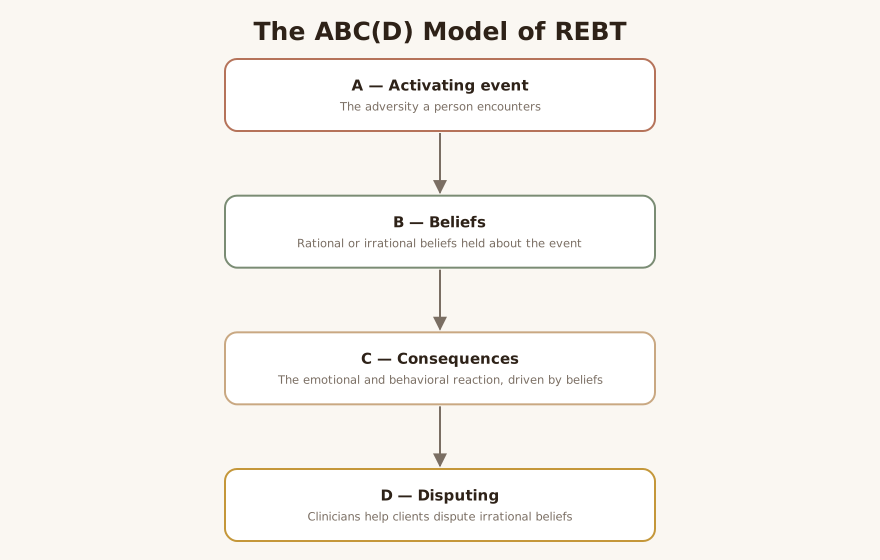
The central organizing principle of REBT is captured in the ABC model: it is not activating events (A) that directly cause emotional and behavioral consequences (C); rather, it is the beliefs (B) one holds about those events that drive the reaction.7 This means two people can encounter the same adversity and respond very differently depending on the beliefs they bring to it LLM.
REBT distinguishes rational from irrational beliefs and identifies a small set of recurring irrational belief processes.7 The primary irrational belief is demandingness — rigid musts and shoulds, for example “I want to be successful and therefore I must.”7 From this flow three secondary irrational beliefs: awfulizing (“if I do not succeed it will be awful”), low frustration tolerance (“it is unbearable to fail”), and self- or other-depreciation (“when I fail, it means that I am a complete failure”).7 Each has a rational counterpart: flexible preferences, anti-awfulizing, high frustration tolerance, and unconditional self- or other-acceptance.7
A defining and clinically important principle is the binary model of distress.7 REBT holds that healthy negative emotions paired with adaptive behavior stem from rational beliefs, whereas unhealthy negative emotions paired with maladaptive behavior stem from irrational beliefs.7 These are treated as qualitatively different states, not merely milder versus stronger versions of the same feeling.7 Clinically, this reframes the therapeutic goal: the aim is not to eliminate negative feelings about genuine adversity but to convert unhealthy disturbance (e.g., anxiety, depression, rage) into healthy negative emotion (e.g., concern, sadness, annoyance) that still motivates action LLM. Ellis also emphasized unconditional self-acceptance — valuing oneself independent of performance or others’ approval — as a cornerstone of psychological resilience.4
Interventions & Techniques
The signature REBT intervention is disputing (the D in the ABC[DE] sequence): the therapist actively and sometimes forcefully challenges the client’s irrational beliefs, helping them reformulate dysfunctional thinking into more realistic and flexible attitudes.3 In the fuller ABCDE framework, after identifying the Activating event, Belief, and Consequence, the clinician helps the client Dispute the belief and arrive at an Effective new philosophy or effective behavior.5 A common cognitive disputation method is Disputing Irrational Beliefs (DIBS), in which the therapist questions the belief directly — asking whether objective facts support it and weighing evidence for and against it.4
Disputation typically operates along three lines: empirical (is this belief consistent with reality?), logical (does it follow logically?), and pragmatic (does holding it help or harm you?) LLM. REBT also draws on emotive and behavioral techniques — among them reframing, positive visualization, bibliotherapy with self-help books and audio-visual guides, and homework assigned between sessions to reinforce new beliefs through action.5 Behavioral experiments and exposure-style assignments are used to test rigid predictions and build frustration tolerance in vivo LLM. Stylistically, REBT is often more confrontational than Beck’s cognitive therapy and makes deliberate use of humor to puncture the seeming absurdity of rigid demands.4
LLM-generated illustrative example (not a guideline): A client says, “My presentation has to go perfectly or I’m a failure.” The clinician maps this to the ABC model (A: upcoming presentation; B: demand plus self-depreciation; C: panic and avoidance), then disputes: “Where is the evidence that one imperfect presentation makes you a failure as a person? Is it true, logical, and helpful to hold that rule?” The reformulated effective belief becomes a preference: “I strongly want to do well, but I don’t have to be perfect, and an imperfect talk would be disappointing — not awful.” LLM
Evidence Base
The evidence base for REBT is best characterized as established.1 A systematic review and meta-analysis spanning 50 years of rational-emotive and cognitive-behavioral therapy synthesized the accumulated literature and supports REBT as an efficacious intervention across a range of clinical and subclinical problems.1 As one of the longest-standing members of the CBT family, REBT has been studied across decades, and the broad conclusion is that it is generally effective and broadly comparable to other established psychotherapies, including standard CBT, for several common presentations.1
The theoretical heart of the model — the ABC claim that beliefs, not events, drive consequences — has received empirical support, though with important caveats.2 A study testing the ABC model found that individuals scoring higher on overall irrational thinking reported a significantly greater frequency of daily hassles, and those higher in awfulizing and low frustration tolerance reported greater intensity of hassles.2 However, this was a correlational design that measured rather than experimentally manipulated beliefs, so it documents association rather than proving that irrational beliefs cause emotional consequences.2 Clinicians should hold the model as well-supported but recognize that direction-of-causation questions remain only partially resolved by the available data.2 Honest framing for clients and supervisees: REBT is a mature, evidence-based therapy, not an experimental one, but the field’s outcome literature is uneven in quality and not every problem has equally strong support LLM.
Populations & Indications
REBT has been applied across adults, adolescents, and couples, and is well suited to general outpatient populations seen in routine practice.5 It is frequently used with anxiety-disorder clients and with people who present with anger problems, two areas that map cleanly onto the model’s emphasis on demandingness and low frustration tolerance.3 The institute that carries Ellis’s legacy describes REBT as targeting unhealthy emotions such as unhealthy anger, depression, anxiety, and guilt, alongside maladaptive behaviors including procrastination and addiction.3
Indications include negative emotional states — anxiety, depression, guilt, self-worth problems, and anger — as well as self-defeating behaviors such as aggression, unhealthy eating, and procrastination.5 Because the core method is teachable and homework-driven, REBT fits clients who can engage with a degree of cognitive abstraction and who are willing to practice between sessions LLM. It can be delivered individually, in couples work, and in group or psychoeducational formats LLM.
Problems-for-Work
REBT is particularly well matched to problems organized around rigid demands and intolerance of discomfort LLM. Generalized anxiety and social anxiety often rest on demands for certainty and approval (“I must know this will be fine”; “everyone must approve of me”), which are disputed toward flexible preferences.3 Major depressive disorder frequently involves self-depreciation (“I am worthless because I failed”), addressed through unconditional self-acceptance.4
Anger and irritability map directly onto other-directed demands (“you must treat me fairly”) and low frustration tolerance, making them prototypical REBT targets.3 Perfectionism and guilt and shame reflect self-directed musts and global self-rating, reframed through preferences and self-acceptance.7 Procrastination is approached as a low-frustration-tolerance problem — “I can’t stand doing this boring task now” — countered by building high frustration tolerance and behavioral activation.5 Phobias and low self-esteem are addressed by combining belief disputation with behavioral exposure and acceptance-based reframing of self-worth.4
LLM-generated illustrative example (not a guideline): A client with chronic irritability reports rage when colleagues miss deadlines. The clinician identifies the irrational demand (“They absolutely should not be so careless”) and the low frustration tolerance (“I can’t bear it”). Work targets converting unhealthy anger into healthy annoyance by replacing the demand with a strong preference and rehearsing high-frustration-tolerance coping statements before team meetings. LLM
Contraindications, Cautions & Cultural Humility
There are no absolute contraindications documented in the provided sources, but several cautions follow from the model’s style and assumptions LLM. REBT’s characteristically confrontational stance and its direct challenging of beliefs can feel invalidating to clients in acute crisis, those with significant trauma histories, or clients for whom rapport is still fragile, and should be paced accordingly.4 The technique of disputing a client’s beliefs requires a strong therapeutic alliance so the client experiences it as collaborative rather than dismissive LLM.
Cultural humility is essential when deciding which beliefs are labeled “irrational” LLM. What a clinician judges to be a rigid demand may reflect a culturally embedded value, family obligation, or response to real discrimination, and disputation must not pathologize legitimate cultural norms or minimize genuine adversity LLM. The model’s distinction between healthy and unhealthy negative emotion is useful here: the goal is never to argue someone out of justified distress about real harm, only to loosen rigid, self-defeating evaluations of it.7 Clinicians should select a licensed professional with appropriate cognitive-behavioral and REBT training and recognize that insurance coverage and access vary.5
Treatment-Plan Suggestions & SMART Objectives
| Goal | SMART objective (example) | Mechanism |
|---|---|---|
| Reduce performance anxiety | Within 8 weeks, identify and dispute 3 perfectionistic “must” beliefs and reduce avoidance of presentations from weekly to none, logged in a homework diary | Disputing demandingness; converting unhealthy anxiety to healthy concern3 |
| Decrease anger reactivity | Over 6 weeks, apply an ABC analysis to 2 anger episodes per week and report a self-rated shift from rage to annoyance in at least half of episodes | Disputing other-directed demands; building high frustration tolerance7 |
| Address depressive self-criticism | Within 10 sessions, replace global self-rating statements with 3 rehearsed unconditional-self-acceptance statements, practiced daily | Self-acceptance replacing self-depreciation4 |
| Reduce procrastination | Over 4 weeks, complete one previously avoided task per day using a “discomfort-tolerance” coping plan, tracked on a checklist | Disputing low frustration tolerance; behavioral activation5 |
| Manage social anxiety | Within 8 weeks, complete 2 graded social exposures per week while disputing approval demands, with pre/post anxiety ratings | Disputation plus behavioral experiment4 |
| Reduce excessive guilt | Within 6 sessions, distinguish responsibility from self-condemnation in 3 situations and articulate a flexible preference for each | Anti-awfulizing and self-acceptance7 |
| Increase distress tolerance | Over 5 weeks, practice one frustration-tolerance exercise daily and report a measurable increase in willingness to sit with discomfort | High frustration tolerance training7 |
Common Misconceptions
A frequent misconception is that REBT and CBT are interchangeable LLM. They share the premise that thinking mediates emotion, but REBT emphasizes a small set of core irrational beliefs and unconditional self-acceptance, takes a more confrontational and humor-using stance, and locates disturbance in self-constructed rigid demands rather than primarily in childhood-derived automatic thoughts.4 A second misconception is that REBT aims to make clients “stop having negative feelings”; in fact the model explicitly distinguishes healthy negative emotions, which it preserves, from unhealthy ones, which it targets.7
A third misconception is that “irrational” means stupid or that the client is being told their feelings are wrong LLM. In REBT, irrational refers specifically to beliefs that are rigid, illogical, inconsistent with reality, and unhelpful — not to intelligence or to the validity of distress about genuine adversity.7 Finally, some assume REBT is purely cognitive talk; in practice it relies heavily on between-session behavioral homework and emotive techniques to consolidate change.5
Training & Certification
Formal training in REBT is offered primarily through the Albert Ellis Institute, the organization Ellis founded to disseminate the approach.3 The institute provides a range of professional development pathways including professional workshops, professional training programs, externships and fellowships, and an Ellis Scholars program, which together form the recognized route toward REBT competency and credentialing.3 Beyond institute-specific training, clinicians typically integrate REBT within general cognitive-behavioral practice, and clients are advised to seek a licensed professional who holds both broad CBT training and specific REBT training.5 For self-study and adjunctive client work, Ellis and Harper’s A New Guide to Rational Living remains a foundational text.6
Key Terms
- ABC(DE) model: The core framework — Activating event, Belief, Consequence, then Disputing and the Effective new belief — holding that beliefs, not events, drive emotional consequences.75
- Demandingness: The primary irrational belief; rigid musts and shoulds (“I must succeed”).7
- Awfulizing: A secondary irrational belief that an outcome would be terrible or catastrophic.7
- Low frustration tolerance (LFT): The belief that discomfort or difficulty is unbearable.7
- Self-/other-depreciation: Global negative rating of oneself or others based on specific events.7
- Unconditional self-acceptance: Valuing oneself independent of performance or approval.4
- Disputing / DIBS: Actively challenging irrational beliefs on empirical, logical, and pragmatic grounds.34
- Healthy vs. unhealthy negative emotions: Qualitatively distinct emotional outcomes arising from rational versus irrational beliefs.7
Resources & Further Reading
▶ Watch — a video introduction to this concept:
- 50 years of rational-emotive and cognitive-behavioral therapy: A systematic review and meta-analysis (David et al., 2018)
- A test of the ABC model underlying rational emotive behavior therapy (PubMed)
- REBT/CBT Therapy — Albert Ellis Institute
- What is Rational Emotive Behavior Therapy (REBT)? — Simply Psychology
- Rational Emotive Behavior Therapy — Psychology Today
- A New Guide to Rational Living — Ellis & Harper
- REBT, Irrational and Rational Beliefs (PMC review)
Reflective / Supervision Questions
- When you label a client’s belief “irrational,” how confident are you that it is rigid and self-defeating rather than a culturally embedded value or a reasonable response to real adversity? LLM
- Are you preserving healthy negative emotion, or are you implicitly pushing the client toward not feeling distress at all about genuine harm?7
- Given REBT’s confrontational style, is the therapeutic alliance strong enough that disputation lands as collaborative rather than invalidating?4
- How are you using between-session homework to consolidate belief change behaviorally, rather than relying on in-session insight alone?5
- Where does your case conceptualization rest on the established evidence base, and where are you extrapolating beyond it?1
- For a client who is not responding, is the issue the belief content, the depth of conviction in the new belief, or insufficient behavioral practice and exposure? LLM