
Type & Discipline
Logic-Based Therapy (LBT) is a modality of philosophical counseling rather than a school of clinical psychology, though it is explicitly built as an adaptation of cognitive-behavioral therapy.6 It is sometimes described as a “philosophical cousin” of rational emotive behavior therapy (REBT), sharing the premise that emotions follow from beliefs and that some of those beliefs are irrational.6 Where it departs from mainstream clinical practice is in its disciplinary home: LBT was developed within philosophy and critical thinking, and it asks the practitioner to function partly as a logician and partly as a guide toward philosophical virtue.1
For practicing therapists, the most useful framing is that LBT sits at the intersection of formal logic, applied ethics, and the cognitive tradition.1 It treats the syllogism — the deductive structure of premises leading to a conclusion — as the central unit of analysis for emotional reasoning.6 This is a meaningful conceptual choice: instead of cataloguing distortions descriptively, LBT tries to reconstruct the client’s emotional reasoning as an argument and then test that argument for validity and soundness.6LLM
A clinician adopting LBT should expect a method that is intellectually demanding and language-heavy, well suited to verbally fluent, reflective clients, and less suited to acute crisis stabilization.LLM
Creators & Lineage
LBT was created by Elliot D. Cohen, a philosopher and one of the principal architects of the modern philosophical-counseling movement.16 Cohen developed the approach over several decades and articulated its mature form in Theory and Practice of Logic-Based Therapy, which frames the work as integrating critical thinking and philosophy into psychotherapy.1 He has also popularized the method for general audiences, including through his Psychology Today writing, where he distilled LBT into a portable, self-help-friendly sequence.3
The intellectual lineage is layered. The most direct ancestor is REBT: LBT inherits the ABC model and the conviction that irrational premises generate disturbed emotion.6 Behind REBT stands the broader cognitive-behavioral tradition, from which LBT takes the basic assumption that changing thinking changes feeling.6 Reaching further back, LBT draws heavily on Stoic philosophy and on a wide canon of Western and world philosophy for both its diagnostic and its prescriptive content.5LLM
A distinctive feature of the lineage is its explicitly philosophical and, in some treatments, spiritual character.5 Scholarly commentary has examined LBT’s metaphysics — its assumptions about reality, value, and the self — as a serious object of study, signaling that the approach intends to be a philosophy of living and not only a clinical technique.4 More recent work has explored its spirituality, situating the “transcendent virtues” within questions of meaning, transcendence, and the sacred.5
Core Principles
LBT rests on a small set of interlocking commitments. The first is that emotions are largely the product of reasoning, and that this reasoning can be reconstructed as a deductive argument with premises and a conclusion.6 On this view, a distressing emotion is the conclusion of a syllogism whose premises the client implicitly accepts.6
The second principle is that emotional disturbance typically arises from logical fallacies in those premises — errors of reasoning that LBT names and classifies.6 Cohen identifies a catalogue of such fallacies, with “cardinal fallacies” that recur across many forms of distress.6LLM Familiar examples include demanding perfection, awfulizing or catastrophizing, and “I-can’t-stand-it-itis,” a stance of low frustration tolerance.6LLM
The third and most characteristic principle is the pairing of each fallacy with a transcendent virtue that serves as its antidote.6 Rather than merely disputing an irrational belief, LBT asks the client to cultivate a guiding virtue — and to draw on philosophy, literature, religion, or other wisdom traditions as “uplifting philosophies” that make the virtue concrete and livable.65 This prescriptive, virtue-oriented move is what most clearly separates LBT from a purely corrective cognitive approach.LLM
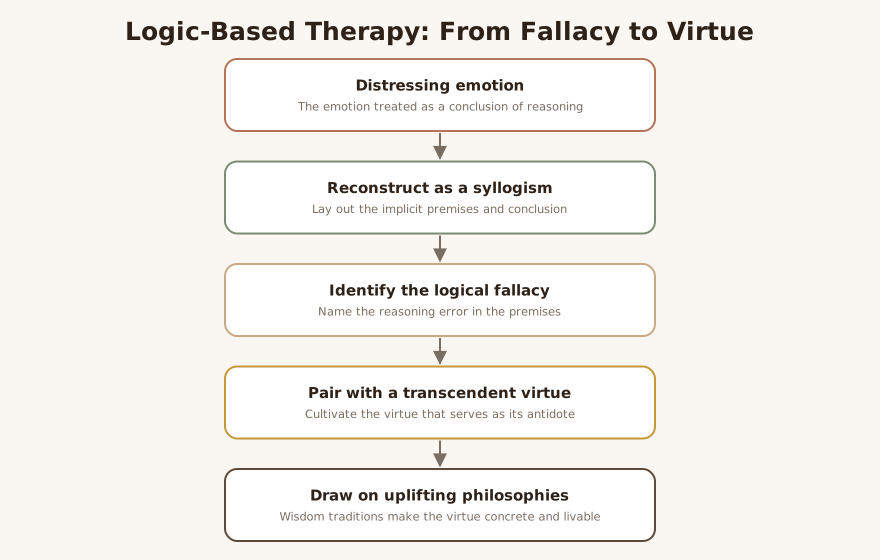
A fourth principle is methodological: LBT is a structured, stepwise process.6 The therapist and client move through a defined sequence — identifying the emotional reasoning, locating the fallacy, refuting it, naming the guiding virtue, and building a plan to live by it.63
Interventions & Techniques
The operational core of LBT is its six-step method, which Cohen has presented in both scholarly and accessible forms.13 In broad strokes, the steps are: (1) identify the emotion and the reasoning behind it; (2) reconstruct that reasoning as a syllogism with explicit premises; (3) locate the fallacy in the premises; (4) identify the transcendent virtue that counters the fallacy; (5) find an “uplifting philosophy” or guiding idea that embodies the virtue; and (6) apply the virtue through a concrete plan of action.63
The first technical skill the clinician needs is emotional-reasoning reconstruction — eliciting the implicit premises behind a feeling and writing them out as a valid or invalid argument.6LLM This is a teachable critical-thinking move and is the part of LBT most transferable to other modalities.LLM
The second is fallacy identification, using LBT’s named taxonomy of reasoning errors to pinpoint where the argument fails — most often in an unsound premise rather than an invalid form.6LLM The third is refutation, where the client examines the offending premise and the standards by which they would judge it irrational.6LLM
The fourth and most distinctive technique is virtue cultivation paired with uplifting philosophy: the clinician helps the client name the antidote virtue and then locate a philosophical, literary, or spiritual source that makes that virtue vivid and motivating.65 The closing technique is behavioral application — translating the virtue into willed action, so that the new reasoning is rehearsed in living rather than left as an insight.6LLM
LLM-generated illustrative example (not a guideline): A client says, “I bombed the presentation, so I’m a failure and I can’t bear facing my team.” Reconstructed, the premises are roughly: “If I perform less than perfectly, I am worthless” and “I cannot stand the discomfort of their judgment.” LBT would name the fallacies (demanding perfection; low frustration tolerance), pair them with the virtues of self-respect and courage/forbearance, and help the client adopt a guiding idea — perhaps a Stoic line on what is and is not within our control — then plan a specific next interaction with the team. LLM
Evidence Base
The honest summary is that LBT’s evidence base is emerging and theory-driven rather than trial-driven.LLM The literature provided here is dominated by conceptual and philosophical work — a book-length statement of theory and practice, scholarly analyses of LBT’s metaphysics and spirituality, and accessible explanatory writing — rather than randomized controlled trials or large outcome studies.1453 Clinicians should therefore treat LBT as a structured, philosophically grounded framework with face validity and a clear mechanistic rationale, not as an empirically validated treatment with established effect sizes.LLM
Two points temper this caution. First, LBT inherits much of its mechanistic logic from REBT and CBT, traditions with substantial outcome evidence; to the extent LBT operates through the same cognitive change processes, that adjacent evidence offers indirect, partial support.6LLM Second, LBT has attracted serious academic scrutiny of its conceptual foundations, which is a marker of intellectual maturity even where outcome data are sparse.45
For ethical practice, the implication is to be transparent with clients: present LBT as a reasoned, philosophically rich method, and where symptom severity warrants, combine or substitute it with treatments that carry stronger empirical backing.LLM Within an established evidence-based modality, LBT’s techniques may be most defensible as adjuncts — for example, importing its fallacy-and-virtue framing into a course of cognitive therapy.LLM
Populations & Indications
LBT is best matched to verbally fluent, reflective adults who find meaning in ideas — what might be called philosophically minded clients.LLM Its emphasis on syllogistic reconstruction and on drawing from wisdom traditions presupposes a client who can engage abstract reasoning and tolerate cognitive work.6LLM High-functioning individuals who are intellectually engaged but stuck in rigid reasoning are a natural fit.LLM
The presentations most clearly addressed by LBT’s machinery are anxiety-spectrum and perfectionism-related concerns.LLM Worriers and people with anxiety often reason from catastrophizing and demanding premises that map neatly onto LBT’s named fallacies, and the virtue-based antidotes give them something constructive to cultivate rather than merely a belief to discard.6LLM Clients with perfectionism — whose distress is frequently organized around demanding-perfection reasoning — are a paradigm indication.6LLM
LBT can also serve clients seeking not only symptom relief but a coherent philosophy of living, given its explicit orientation toward virtue, meaning, and, for some, spirituality.5LLM
Problems-for-Work
LBT is organized around problems that can be expressed as faulty reasoning, which makes its problems-for-work unusually legible.LLM
- Cognitive distortions and irrational beliefs. The whole method is built to surface, name, and refute the premises underlying distorted thinking.6 Application: writing out the client’s implicit syllogism and testing each premise for soundness.6LLM
- Catastrophizing / awfulizing. A cardinal fallacy in LBT, countered by virtues such as courage and equanimity.6LLM Application: replacing “this is unbearable” reasoning with a guiding philosophy of proportion.LLM
- Demandingness (demanding perfection). Targeted directly as a cardinal fallacy and paired with antidote virtues such as unconditional self-acceptance and metaphysical security.6LLM Application: helping a perfectionist client distinguish strong preference from absolute demand.LLM
- Low frustration tolerance (“I-can’t-stand-it-itis”). Named explicitly and countered by cultivating fortitude.6LLM Application: planning graded exposure to discomfort backed by a Stoic guiding idea.LLM
- Emotional reasoning. Addressed by reconstructing the emotion-to-conclusion inference and checking whether the feeling actually entails the conclusion.6LLM
- Generalized worry. Worriers’ chains of “what if” reasoning are reframed as arguments whose premises can be examined and refuted.6LLM
Contraindications, Cautions & Cultural Humility
LBT’s intellectual demands are also its main contraindication.LLM Clients in acute crisis, those with significant cognitive impairment, or those who experience analytic dispute as invalidating may be poorly served by a method centered on reconstructing and refuting their reasoning.LLM Because the provided evidence base is conceptual rather than outcome-based, LBT should not be offered as a stand-alone treatment for conditions where empirically supported therapies exist and severity is high; it is more defensibly used as an adjunct in such cases.14LLM
A specific caution concerns the transcendent virtues and uplifting philosophies at the heart of the model.65 These are frequently sourced from particular philosophical, literary, religious, and spiritual traditions, and LBT’s literature has an explicit spiritual dimension.5 This raises a real risk of imposing the therapist’s own worldview.LLM Cultural humility here means co-selecting guiding philosophies from the client’s own tradition and values rather than defaulting to a Stoic or Western canon, and remaining alert to clients for whom virtue language carries unwelcome moral or religious connotations.5LLM
A further caution: framing distress as a “fallacy” can shade into implying the client is reasoning badly, which may feel shaming.LLM The intervention should locate the error in a premise, never in the person.6LLM
Treatment-Plan Suggestions & SMART Objectives
| Goal | SMART objective (example) | Mechanism |
|---|---|---|
| Reduce catastrophic appraisals | Over 6 weeks, client will reconstruct 2 anxiety-provoking situations per week into explicit syllogisms and identify the operative fallacy in each, logged in a worksheet. | Emotional-reasoning reconstruction and fallacy identification6 |
| Loosen perfectionistic demands | Within 8 weeks, client will reframe 3 “must/should” demands into strong preferences and rate distress before/after, achieving a 2-point drop on a 0–10 scale. | Refutation of demanding-perfection fallacy; virtue of self-acceptance6 |
| Build frustration tolerance | Over 4 weeks, client will complete one planned exposure to a tolerable discomfort each week while applying a chosen guiding philosophy, with a written reflection. | Behavioral application of fortitude virtue countering low frustration tolerance6 |
| Cultivate a guiding virtue | Within 3 sessions, client will identify one transcendent virtue and one uplifting philosophy from their own tradition that embodies it. | Virtue cultivation paired with uplifting philosophy65 |
| Interrupt emotional reasoning | Daily for 2 weeks, client will note one instance of feeling-as-evidence and test whether the feeling entails the conclusion, in a brief log. | Examining the emotion-to-conclusion inference6 |
| Increase reflective self-monitoring | By session 6, client will independently complete the six-step LBT sequence on one between-session situation and review it in session. | Internalizing the structured six-step method63 |
| Strengthen sense of meaning | Over treatment, client will articulate, in writing, a personal philosophy of living connecting chosen virtues to valued action. | Spiritual/meaning dimension of transcendent virtue5 |
Common Misconceptions
A first misconception is that LBT is merely REBT with new vocabulary.LLM While the kinship is real and acknowledged, LBT’s defining contribution — the systematic pairing of each fallacy with a transcendent virtue and an uplifting philosophy drawn from wisdom traditions — is genuinely additive rather than cosmetic.65LLM
A second is that LBT is “just self-help” because it has been presented in portable, popular form.3 The accessible versions are deliberate simplifications of a method that, in its scholarly form, engages formal logic and a worked-out metaphysics.14LLM
A third misconception is that LBT is an empirically validated psychotherapy on par with established CBT protocols.LLM The available literature is predominantly philosophical and conceptual, and clinicians should not overstate its outcome evidence.145LLM
A fourth is that the “transcendent virtues” are inherently religious; while LBT has a spirituality literature, the virtues are framed broadly enough to be cultivated in secular as well as religious terms.5LLM
Training & Certification
Formal training in LBT is offered through the National Philosophical Counseling Association (NPCA), which runs LBT workshops and a training pathway toward credentialing as a practitioner of the method.2 This situates LBT within the philosophical-counseling field rather than within clinical-psychology licensure boards.2LLM
Clinicians should note the distinction between LBT certification as a philosophical-counseling competency and their underlying clinical license.LLM For a licensed therapist, NPCA training is best understood as adding a structured technique-set to existing scope of practice, not as a substitute for clinical credentials.LLM Cohen’s Theory and Practice of Logic-Based Therapy functions as the foundational text for serious study of the method.1
Key Terms
- Transcendent virtue — a guiding virtue (e.g., courage, self-respect, fortitude) cultivated as the antidote to a specific logical fallacy.6
- Cardinal fallacy — a recurring core error of reasoning that LBT targets across many presentations, such as demanding perfection or awfulizing.6LLM
- Uplifting philosophy — a philosophical, literary, religious, or other wisdom-tradition source the client draws on to make a transcendent virtue concrete and motivating.6
- Emotional reasoning (as syllogism) — the LBT premise that an emotion is the conclusion of a deductive argument that can be reconstructed and tested.6
- Six-step method — the structured LBT sequence from identifying emotional reasoning through behavioral application of the antidote virtue.63
- I-can’t-stand-it-itis — LBT’s term for low frustration tolerance, treated as a cardinal fallacy.6LLM
Resources & Further Reading
▶ Watch — a video introduction to this concept:
- Cohen, E. D. — Theory and Practice of Logic-Based Therapy (Cambridge Scholars Publishing)
- National Philosophical Counseling Association — LBT Workshops / Training
- Logic-Based Therapy to Go — Psychology Today (Elliot D. Cohen)
- The Metaphysics of Logic-Based Therapy (LBT) from Elliot D. Cohen’s Viewpoint
- The Spirituality of Logic-Based Therapy (Religions, MDPI)
- Logic-based therapy — Wikipedia
Reflective / Supervision Questions
- When I reconstruct a client’s emotion as a syllogism, am I genuinely surfacing their implicit premises, or am I imposing the argument I expect to find? LLM
- For this client, do the transcendent virtues and uplifting philosophies I am proposing come from their own values and tradition, or from mine? LLM
- Given that LBT’s outcome evidence is still emerging, have I been honest with this client about what the method can and cannot promise, and have I considered whether a more empirically supported treatment is indicated? LLM
- Does my use of “fallacy” language risk shaming the client, and am I consistently locating the error in a premise rather than in the person? LLM
- Is this client’s presentation reflective and stable enough for the analytic demands of LBT, or would the method’s intellectual load be a poor fit right now? LLM
- Where I am using LBT as an adjunct within an established modality, am I clear in my own formulation about which mechanism is doing the therapeutic work? LLM