
Type & Discipline
Epoché, also called phenomenological bracketing, is a philosophical method rather than a psychotherapy, a manualized protocol, or a clinical diagnosis LLM. It belongs to phenomenology, the philosophical movement founded by Edmund Husserl in the first decades of the twentieth century to describe the structures of experience and consciousness as they are actually lived 1. The term epoché is borrowed from the ancient Greek skeptics, where it named the suspension of judgment; Husserl repurposes it to name a deliberate, methodical “switching off” of our ordinary belief in the existence of the world so that we can attend to how things appear to consciousness rather than rushing to claims about what they really are 2. Bracketing is the closely related image: we put our existence-positing assumptions “in brackets,” like a mathematical expression we set aside without erasing, so that they no longer operate while we describe the phenomenon 4.
For the clinician the value of the concept is not as a treatment but as a description of a stance — a disciplined way of attending to a client’s experience with one’s own theories, diagnoses, and reactions held in suspension LLM. It supplies a rigorous philosophical account of what skilled therapists already gesture toward when they speak of “setting aside assumptions,” “beginner’s mind,” or non-judgmental presence LLM. Understood this way, epoché is best treated as a methodological construct that can inform how a clinician listens within recognized therapies — existential-phenomenological, person-centered, and mindfulness-based work in particular — not as a standalone modality in its own right LLM.
Creators & Lineage
The method’s author is Edmund Husserl (1859–1938), the German philosopher, trained originally as a mathematician, who founded phenomenology as a rigorous descriptive science of consciousness 1. Husserl’s governing ambition was to return philosophy “to the things themselves,” meaning the phenomena of experience described exactly as they present themselves, before they are overlaid with theory, explanation, or metaphysical assumption 1. The epoché and the phenomenological reduction are the methodological gateway to that project: techniques for clearing away the sediment of the “natural attitude” so the structures of experience become visible 2.
Central to Husserl’s analysis is the concept of intentionality, the thesis that consciousness is always consciousness of something — every act of awareness is directed toward an object, whether perceived, remembered, imagined, or judged 1. Bracketing does not deny these objects; it suspends our naive conviction that they exist independently and turns attention instead to the correlation between the act of experiencing and what is experienced 2. Husserl developed and refined these ideas across major works including the Logical Investigations, Ideas I, and the Cartesian Meditations, where the reduction takes a more explicitly transcendental form 1.
The clinical and applied descendants of the method are several LLM. Within psychology, Amedeo Giorgi adapted Husserl’s insights into the descriptive phenomenological method, a structured qualitative research procedure in which the investigator brackets prior knowledge to describe the lived structure of a phenomenon from participants’ accounts LLM. In existential-phenomenological psychotherapy, Ernesto Spinelli has made the epoché a cornerstone of practice, recasting it as a set of rules for the therapist’s way of attending — suspending assumptions, describing rather than explaining, and treating no aspect of the client’s account as more or less significant in advance LLM. The broader phenomenological tradition, running through Martin Heidegger, Maurice Merleau-Ponty, and Jean-Paul Sartre, also informs existential therapy’s emphasis on lived experience over diagnostic abstraction LLM.
Core Principles
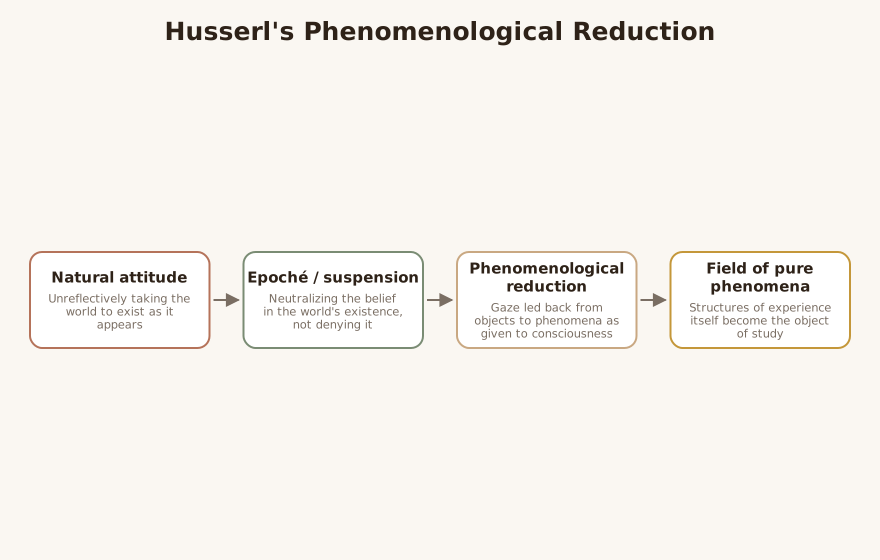
The first principle is the natural attitude and its suspension. In ordinary life we are immersed in what Husserl calls the natural attitude: we unreflectively take the world and its objects to exist just as they appear, and we constantly posit, judge, and theorize about them 2. The epoché is the deliberate act of suspending this existence-belief — not doubting or denying the world, as Descartes did, but neutralizing our commitment to it so that the world’s being is no longer the focus and the world’s appearing can be examined 3. This suspension is the precondition for phenomenological seeing 2.
The second principle is the phenomenological reduction proper. Once the natural attitude is bracketed, attention is “led back” (the literal sense of reductio) from the objects naively taken as existing to the phenomena as they are given in and to consciousness 3. The reduction does not throw anything away; it changes the direction of our gaze, from the world as believed-in to the world as experienced, so that the structures of experience itself become the object of study 2. What remains after the reduction is the field of pure phenomena and their correlation with the acts that intend them 4.
The third principle is intentionality and correlation. Because consciousness is always consciousness of something, the reduced field is not a private mental interior cut off from the world but a structured relation between the experiencing act and its object-as-experienced 1. Bracketing therefore does not isolate the subject; it discloses the lived relation between subject and world more clearly by removing the assumptions that ordinarily obscure it 2. This is why phenomenological description aims at the how of appearing, not the whether of existence 1.
The fourth principle is presuppositionlessness as an ideal and a discipline. Husserl held that rigorous description requires setting aside not only metaphysical claims but inherited theories, prejudices, and the investigator’s own expectations, so the phenomenon can show itself on its own terms 1. This is an asymptotic ideal rather than a state ever perfectly achieved — bracketing is something one does, repeatedly and imperfectly, rather than a condition one attains once and keeps LLM. The point is the ongoing, self-aware effort to notice and suspend what one is bringing to the encounter 4.
Interventions & Techniques
Because epoché is a method and not a manual of clinical procedures, it does not prescribe techniques in the way a treatment protocol does; instead it disciplines the clinician’s attention and reframes the act of listening LLM. Its primary clinical use is to cultivate a stance: the therapist deliberately suspends diagnostic labels, theoretical commitments, and personal reactions in order to receive the client’s experience as it is described, before interpreting or explaining it 2. Naming this as a practiced discipline, rather than an attitude one simply possesses, is itself the contribution, because it makes “non-judgment” something one actively does and can get better at LLM.
Ernesto Spinelli’s adaptation translates Husserl’s method into three working rules that map onto recognizable clinical moves LLM. The rule of epoché asks the clinician to set aside, as far as possible, initial biases and assumptions so the client’s account can be met freshly LLM. The rule of description asks the clinician to describe and stay with the immediate and concrete — what is actually said, felt, and shown — rather than leaping to explanation, causal theory, or interpretation LLM. The rule of horizontalization, or equalization, asks the clinician to resist ranking the elements of the client’s account by assumed importance, treating each as initially worthy of attention rather than pre-selecting what “matters” LLM.
These rules find natural homes across modalities LLM. In person-centered therapy the epoché underwrites the empathic, non-judgmental, unconditional reception of the client’s frame of reference LLM. In mindfulness-based interventions it parallels the cultivation of non-reactive, present-moment observation in which appraisals are noticed and held lightly rather than acted on LLM. In assessment, bracketing guards against premature closure by deferring the clinician’s first interpretation long enough for the client’s own meaning to emerge 4.
LLM-generated illustrative example (not a guideline): A client says, “I had a panic attack at my sister’s wedding.” The clinician notices an immediate internal story forming — social anxiety, fear of crowds, a tidy formulation — and deliberately brackets it. Instead of confirming the hypothesis, they ask the client to describe the moment exactly as it was lived: what was seen, the bodily sensations, the precise thought, the timing. The client describes not crowds but a sudden conviction, on seeing her sister, that “I’m the one who never gets chosen.” The bracketed formulation would have missed the phenomenon entirely LLM.
Evidence Base
Honesty about evidence requires distinguishing two senses of “established” LLM. As a philosophical method, the epoché is firmly established: it is one of the foundational concepts of twentieth-century phenomenology, anchored in Husserl’s major primary texts and the subject of a very large scholarly literature in philosophy 1. In that sense it is a mature, canonical construct with rigorous secondary treatment in the authoritative philosophical encyclopedias 2. What it is not is an empirically validated clinical intervention with controlled outcome data, because it is a method in philosophy and qualitative inquiry rather than a treatment that has been trialed against comparators LLM.
The scrutiny the concept has received is itself largely philosophical and methodological rather than outcome-based LLM. Within philosophy there is genuine debate about what the reduction accomplishes and whether Husserl’s later “transcendental” turn — bracketing not just the world but arriving at a transcendental ego — is coherent or necessary, a debate that motivated later phenomenologists such as Heidegger and Merleau-Ponty to revise the method in different directions 1. Within qualitative research, scholars dispute whether full bracketing of the investigator’s presuppositions is ever achievable, with many arguing it functions as a reflexive discipline and an aspiration rather than a completed state LLM. Clinicians should therefore present epoché, when relevant, as a powerful methodological stance and not as a scientifically validated technique for symptom change LLM.
The defensible clinical position is that the concept earns its place through the quality of attention and the reduction of premature interpretation it fosters, while disorder-specific change is pursued through therapies that carry their own evidence base LLM. The mechanisms it sharpens — accurate empathy, suspension of bias, and careful description — are themselves associated with good practice, but the epoché supplies their philosophical grammar, not their outcome trials LLM.
Populations & Indications
The method is most directly useful for clinicians and therapists in training, for whom learning to suspend the first formulation is a core skill and a frequent failure point LLM. It gives trainees an explicit, practicable account of how to listen before concluding, and a language for the discipline of non-judgment that supervision can name and shape 2. It is, in this sense, as much a tool for the practitioner as a frame for the client LLM.
For clients, the stance it cultivates serves adults seeking self-understanding, who benefit from a therapist able to receive their experience freshly rather than slot it into a category LLM. It is apt with people who hold rigid cognitive styles, where the clinician’s own willingness to suspend interpretation models a more flexible relationship to one’s appraisals 4. It is especially relevant with multicultural and cross-cultural clients, where bracketing the clinician’s culturally shaped assumptions is an ethical as well as a methodological necessity LLM. And it dovetails with the work of mindfulness practitioners, for whom the non-reactive observation of experience is already a trained capacity LLM.
Problems-for-Work
The concept maps onto several presenting problems by sharpening how the clinician — and, by modeling, the client — relates to interpretation itself LLM. For premature closure and assumptions in assessment, the epoché names the precise discipline of deferring the first formulation so the client’s own meaning can surface, and gives supervision a way to catch the moment a clinician’s hypothesis outran the data 4.
LLM-generated illustrative example (not a guideline): A clinician notices they have been treating a client’s lateness as “resistance” for three sessions. Practicing the epoché, they bracket the interpretation and simply describe the pattern back to the client with curiosity. The client reveals the lateness is a bus route that does not align with the appointment time — a logistical fact the resistance frame had hidden LLM.
For cognitive distortions and rigid interpretations and judgmental thinking, the method offers a stance in which appraisals are noticed as appraisals and held in suspension rather than taken as facts, a move adjacent to cognitive defusion and to mindful observation 4. For rumination and reactivity to experience, bracketing the impulse to explain or fix can interrupt the automatic elaboration of a thought, letting it be described and seen rather than spun forward LLM. For anxiety driven by appraisal and perfectionism, distinguishing the phenomenon as lived from the catastrophic interpretation layered onto it can loosen the grip of the appraisal LLM.
LLM-generated illustrative example (not a guideline): A perfectionistic client reports “I completely failed the presentation.” The clinician invites a bracketed, descriptive account — what was actually said, how colleagues actually responded, moment by moment — separating the lived event from the global verdict “failure” the client had fused with it LLM.
For therapeutic empathic failure and bias, the epoché is a direct corrective: it is the clinician’s own discipline of suspending reactions and assumptions that prevents the formulation from overwriting the person 2.
Contraindications, Cautions & Cultural Humility
The central caution is conceptual: bracketing can be misunderstood as the suspension of clinical judgment altogether, which would be unsafe LLM. The epoché suspends premature interpretation, not the clinician’s responsibility to assess risk, recognize danger, or act on duty-to-protect obligations; safety assessment is not the kind of “assumption” one brackets LLM. A clinician who treats a suicide disclosure phenomenologically without also responding to it as a risk has misapplied the method LLM.
A second caution is that full presuppositionlessness is unattainable, and treating it as achievable can breed a false confidence that one has “set aside” one’s biases when one has not 1. The honest practice is ongoing reflexivity — actively noticing what one is bringing — rather than a claimed neutrality, which is precisely where unexamined bias hides LLM. The discipline is the noticing, not a destination of pure objectivity 4.
Cultural humility is where the method shows its greatest clinical value and its sharpest limits LLM. The assumptions most worth bracketing are often the clinician’s culturally embedded norms about emotion, family, distress, and help-seeking, and the epoché provides a disciplined way to suspend them so the client’s own framework can be heard LLM. Yet bracketing one’s assumptions does not mean bracketing knowledge of structural realities, racism, or the client’s social context; suspending a hasty interpretation is not the same as feigning a naivety that ignores real-world constraints and inequities LLM. The method is also a poor primary fit in acute crisis or active psychosis, where containment, structure, and reality-testing take priority over open phenomenological exploration LLM.
Treatment-Plan Suggestions & SMART Objectives
| Goal | SMART objective (example) | Mechanism |
|---|---|---|
| Reduce premature closure in assessment | Over 4 sessions, clinician will defer initial formulation and produce a purely descriptive account of the presenting concern before naming a hypothesis | Suspending the natural attitude to attend to the phenomenon as given 2 |
| Increase client’s non-judgmental observation | Within 8 weeks, client will, 3 times per week, describe one distressing experience in concrete sensory terms before adding any interpretation | Bracketing appraisal to separate the lived event from the judgment about it 4 |
| Loosen fusion with rigid interpretations | Over 10 sessions, client will identify 2 recurring interpretations and re-describe the underlying experiences without them | Returning attention from the believed-in conclusion to the experience itself 3 |
| Interrupt rumination | Within 6 weeks, client will practice a brief descriptive “what is actually here now” exercise at the onset of 2 rumination episodes weekly | Suspending the impulse to explain so the thought is observed rather than elaborated LLM |
| Strengthen clinician’s cultural humility | Over 6 sessions with cross-cultural clients, clinician will record one culturally shaped assumption bracketed per session in supervision notes | Disciplined suspension of the clinician’s natural attitude toward the client’s framework 1 |
| Reduce reactivity to appraisal-driven anxiety | Within 8 weeks, client will distinguish, for 3 anxiety episodes, the lived trigger from the catastrophic interpretation layered onto it | Re-directing attention from the feared object to how it is appearing 1 |
| Improve empathic accuracy | Over 5 sessions, clinician will reflect the client’s described experience without explanatory addition and check accuracy with the client | Horizontalization and description rather than premature interpretation 4 |
Common Misconceptions
A first misconception is that the epoché means doubting or denying the existence of the world; Husserl is explicit that it neither denies nor doubts but suspends our existence-belief, leaving the world untouched while changing how we attend to it 3. A second is that bracketing empties the mind or aims at a blank, contentless state; on the contrary, it redirects a full and active consciousness from objects-as-believed to objects-as-experienced, and consciousness remains always consciousness of something 1. A third is that one performs the reduction once and is thereafter “bracketed”; in practice it is a repeated, effortful act, never perfectly completed, that must be renewed in each encounter LLM.
A fourth misconception is that phenomenology is therefore purely subjective or anti-scientific; Husserl conceived it as a rigorous descriptive science aimed at the invariant structures of experience, with method and discipline at its core 1. A fifth is that bracketing requires the clinician to abandon all knowledge and theory, when what it suspends is the premature application of theory, not the practitioner’s competence, training, or duty to assess safety LLM. Finally, clinicians sometimes equate the epoché with simply “being open-minded”; its distinctive claim is more demanding — a deliberate, named, practiced suspension of the natural attitude rather than a vague good intention 2.
Training & Certification
There is no certification in “epoché,” and there should not be; it is a philosophical method absorbed into clinical and research practice rather than a credentialed technique LLM. Clinicians most often encounter it through training in existential and existential-phenomenological psychotherapy, where Husserl’s foundational texts and their reputable commentaries are core reading 1. Familiarity with the authoritative encyclopedic treatments equips a clinician to use the method accurately rather than as a loose synonym for open-mindedness 2.
Practitioners who wish to work explicitly in this tradition typically pursue post-qualification training in existential therapy and engage with applied formulations such as Ernesto Spinelli’s three rules of epoché, description, and horizontalization, and with Amedeo Giorgi’s descriptive phenomenological method for those doing qualitative research LLM. As with any borrowed construct, the ethical requirement is competence and honest scope: the method should inform how one listens and formulates within one’s licensed practice, not be represented as a standalone evidence-based treatment LLM.
Key Terms
Epoché — the deliberate, methodical suspension of our ordinary belief in the existence of the world, “switching off” the natural attitude so phenomena can be described as they appear 2. Phenomenological reduction — the leading-back of attention from objects naively taken as existing to the phenomena as given in consciousness 3. Bracketing — the image of placing existence-positing assumptions “in brackets,” setting them aside without erasing them, so they no longer operate during description 4. Natural attitude — the everyday, unreflective stance in which we take the world and its objects to exist exactly as they appear 2. Intentionality — the thesis that consciousness is always consciousness of something, always directed toward an object 1. Phenomenon — a thing precisely as it presents itself to and in experience, the proper object of phenomenological description 1. Presuppositionlessness — the methodological ideal of setting aside inherited theories, prejudices, and expectations so the phenomenon shows itself on its own terms 1. Horizontalization (equalization) — Spinelli’s rule of resisting the pre-ranking of elements of a client’s account by assumed importance LLM. Transcendental reduction — Husserl’s later, more radical form of the reduction, leading back to the structures of the experiencing ego itself 1.
Resources & Further Reading
- Edmund Husserl — Stanford Encyclopedia of Philosophy
- The Phenomenological Reduction — Internet Encyclopedia of Philosophy
- Phenomenological reduction — Encyclopaedia Britannica
- Bracketing (phenomenology) — Wikipedia
- The Phenomenological Epoché and Reduction | Husserl | Cartesian Meditations — YouTube
Reflective / Supervision Questions
- When I form my first impression of a client, can I name the assumptions I am bringing, and what would it mean to bracket them long enough to hear the phenomenon as the client lives it LLM?
- Where is the line, for this client, between the disciplined suspension of premature interpretation and the suspension of necessary clinical judgment about safety LLM?
- Which of my own culturally shaped norms about emotion, family, or distress most need bracketing with this particular client, and how would I know if I had failed to suspend them LLM?
- Am I treating bracketing as a state I have achieved (“I’m not biased”) or as a repeated discipline I have to renew in each encounter LLM?
- When I feel certain I understand what a client means, what would change if I described their experience back without any explanatory addition and checked it against their own words LLM?
- How do I hold the methodological power of the epoché while being honest, with myself and in supervision, that it is a stance and a discipline rather than a validated treatment for symptom change LLM?