
Type & Discipline
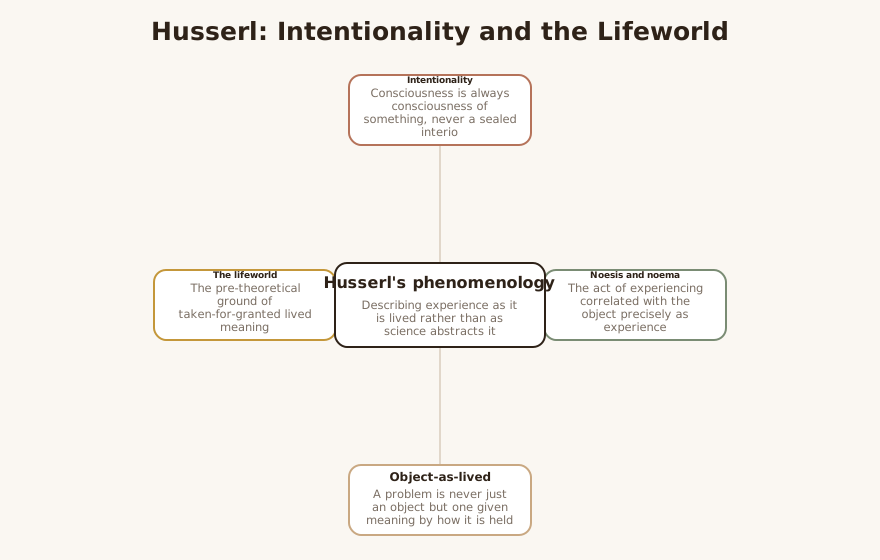
Intentionality and the lifeworld (Lebenswelt) are two linked concepts from philosophy, not a psychotherapy, a manualized protocol, or a clinical diagnosis LLM. They belong to phenomenology, the philosophical movement Edmund Husserl founded in the early twentieth century to describe the structures of conscious experience as it is actually lived rather than as it is explained by natural science 2. Intentionality is the thesis that consciousness is always consciousness of something — every act of awareness is directed toward an object, whether perceived, remembered, imagined, feared, or judged 3. The lifeworld is Husserl’s name for the pre-theoretical world of taken-for-granted meaning in which we always already live and act, the world as it is given before science abstracts and idealizes it 4.
For the clinician the value of these ideas is not as a treatment but as a description of what a therapist is actually attending to when a client speaks LLM. Intentionality reframes “symptoms” and “emotions” as directed acts — a depression that is about something, an anxiety of something — rather than free-floating internal states LLM. The lifeworld reframes the proper object of therapeutic attention as the client’s lived, meaningful world, not the depersonalized world of diagnostic categories or neurochemical mechanisms LLM. Both are best treated as constructs that inform how a clinician listens within recognized therapies — existential-phenomenological, Gestalt, and Daseinsanalytic work in particular — rather than as standalone modalities LLM.
Creators & Lineage
The author of both concepts is Edmund Husserl (1859–1938), the German philosopher, originally trained as a mathematician, who founded phenomenology as a rigorous descriptive science of consciousness 1. Husserl took the concept of intentionality from his teacher Franz Brentano, who had revived the scholastic idea that mental phenomena are distinguished by their directedness toward a content, and made it the cornerstone of his analysis of consciousness 3. His governing ambition was to return philosophy “to the things themselves” — to the phenomena of experience described exactly as they present themselves — and intentionality is the structural feature that makes such description possible 1.
The lifeworld came to prominence in Husserl’s late work, above all the unfinished Crisis of the European Sciences (1936), where he argued that modern science had forgotten its own foundation 4. His claim is that the mathematized world of physics is not the real world but an achievement abstracted from the concrete lifeworld of ordinary perception and practice — and that the “crisis” of the sciences is precisely this forgetting of their grounding in lived experience 4. Phenomenology’s task becomes, in part, to recover and describe the lifeworld that science presupposes but cannot see 2.
The applied descendants of these ideas are the bridge to clinical work LLM. Alfred Schutz developed the lifeworld into a social phenomenology of everyday life, analyzing the taken-for-granted intersubjective world of typifications and shared meaning LLM. Amedeo Giorgi adapted Husserl’s framework into descriptive phenomenological psychology, a method for describing the structures of lived experience from first-person accounts LLM. The existential-phenomenological psychotherapies, Binswanger and Boss’s Daseinsanalysis, Gestalt therapy’s field theory and notion of contact, and hermeneutic phenomenology all draw on Husserl’s insistence that experience is directed and world-embedded LLM.
Core Principles
The first principle is intentionality itself: consciousness is always consciousness of something, never a self-enclosed interior 3. Every mental act has an object toward which it is directed, and that object may or may not exist — one can fear a danger that is not real, remember an event that did not happen, hope for an outcome that will not come — yet the experience is still of its object 3. This directedness is the most basic structural fact about mind, and it dissolves the picture of consciousness as a sealed container that then has to “reach out” to a separate world 2.
The second principle is the correlation of act and object, what Husserl named the noesis (the act of experiencing) and the noema (the object precisely as experienced) 3. The same object can be intended in countless ways — the same person perceived, remembered, longed for, dreaded — and phenomenology describes how the object’s meaning shifts with the manner of intending it 3. For the clinician this means a client’s “problem” is never just an object in the world but an object-as-lived, given meaning by the way it is held in experience LLM.
The third principle is the lifeworld as the ground of all meaning 4. Before any theory, measurement, or explanation, we live in a world that is already meaningful, practical, and shared — a world of familiar tasks, relationships, and significances we do not normally question 4. This pre-theoretical world is the soil out of which every more sophisticated account, including science, grows, and to which every such account remains tacitly indebted 4. The lifeworld is not a private mental construction but the common horizon within which things show up as the things they are 5.
The fourth principle is the primacy of lived experience over abstraction 2. Husserl’s critique is that we habitually substitute the idealized world of theory for the concrete world of experience, then mistake the abstraction for reality — the map for the territory 4. Phenomenology corrects this by leading attention back to the lifeworld and to the intentional structure of the experiences in which the world is given 2. The point is not to reject science but to remember what it stands on 4.
Interventions & Techniques
Because intentionality and the lifeworld are descriptive concepts rather than a manual of procedures, they do not prescribe techniques the way a protocol does; instead they shape what the clinician attends to and how a formulation is built LLM. Their primary clinical use is to orient the therapist toward the client’s lived world and the directedness of their experience — to ask not only what a client feels but what that feeling is of and how the surrounding world is showing up for them LLM. Naming experience as intentional turns vague affect into something describable: a mood is a way the whole world is colored, an anxiety has an object even when that object is hard to name LLM.
A first clinical move is the descriptive exploration of the client’s lifeworld — eliciting how their world of work, body, relationships, and time is actually lived rather than how it ought to look on paper LLM. This is the explicit aim of existential and Daseinsanalytic work, which maps the client’s relationship to world, others, body, and time as dimensions of a single lived situation LLM. A second move is attending to the intentional object of a symptom: helping a client discover what a panic is about, what an avoidance is fleeing, so the experience is restored to its world-relation rather than treated as a context-free malfunction LLM.
These principles find natural homes across modalities LLM. In Gestalt therapy, field theory and the notion of contact are direct heirs of intentionality — the person is always in contact with a field, and disturbance is understood as a disturbance of that contacting LLM. In existential-phenomenological therapy, the therapist describes the client’s mode of being-in-the-world rather than explaining it causally LLM. In trauma-informed and meaning-centered work, restoring a sense of an inhabitable, meaningful world is itself the aim, and the lifeworld concept gives that aim a precise philosophical name LLM.
LLM-generated illustrative example (not a guideline): A client reports feeling “numb, like nothing is real, like I’m watching my life through glass.” Rather than coding this immediately as a derealization symptom, the clinician explores it as a disturbance of the intentional arc: the client’s perceptions still occur, but objects no longer arrive with their usual significance — the kitchen is recognized but not lived-in, the partner is seen but not met. Naming the loss as a thinning of the lifeworld, not a defect of perception, gives the client language for what is missing and a direction for its recovery LLM.
Evidence Base
Honesty about evidence requires distinguishing two senses of “established” LLM. As philosophical concepts, intentionality and the lifeworld are firmly established — they are among the foundational ideas of twentieth-century phenomenology, anchored in Husserl’s primary texts and the subject of a very large, rigorous scholarly literature treated in the authoritative philosophical encyclopedias 1. Intentionality in particular is one of the central problems of the entire philosophy of mind, debated continuously from Brentano to the present 3. In that sense both concepts are mature and canonical 2.
What they are not is empirically validated interventions with controlled outcome data, because they are philosophical and descriptive constructs rather than treatments trialed against comparators LLM. The scrutiny they have received is largely philosophical: debates over whether intentionality can be naturalized, over the status of the noema, and over whether Husserl’s later transcendental turn is coherent — debates that led Heidegger, Merleau-Ponty, and Sartre to revise his framework in different directions 1. The lifeworld concept’s main applied legacy runs through qualitative and descriptive phenomenological research, where it grounds methods for studying lived experience rather than supplying an outcome-measured therapy LLM.
The defensible clinical position is that these concepts earn their place by sharpening the object of therapeutic attention — the client’s directed, world-embedded experience — while disorder-specific change is pursued through therapies that carry their own evidence base LLM. A clinician should present intentionality and the lifeworld as a way of seeing rather than as scientifically validated techniques for symptom change LLM.
Populations & Indications
The concepts are most directly useful with clients whose presenting difficulty is itself a disturbance of lived meaning or of the felt reality of the world LLM. People experiencing depersonalization or derealization describe a breakdown in the ordinary intentional relation to self and world, and a phenomenological frame gives both clinician and client a non-pathologizing language for what has thinned or detached 3. Adults seeking meaning, and older adults reflecting on a life, are working with the structure of their lifeworld — what their world has been of and for 4.
For trauma survivors, trauma can be understood not only as a memory but as a rupture of the taken-for-granted world, where basic trustworthiness is broken and recovery involves re-establishing an inhabitable world LLM. For multicultural clients, the lifeworld concept insists that the clinician attend to a world structured by meanings they may not share, guarding against substituting the therapist’s taken-for-granted world for the client’s LLM. And for clinicians in training, learning to hear experience as directed and world-embedded — rather than as a list of context-free symptoms — is a core formulation skill these concepts make explicit and teachable LLM.
Problems-for-Work
The concepts map onto several presenting problems by restoring experience to its lived, directed, world-embedded form LLM. For meaninglessness and loss of purpose, the lifeworld frame reorients work away from abstract questions about “the meaning of life” toward the concrete texture of the client’s own world — what once mattered, what has gone flat, and where significance might be recovered 4.
LLM-generated illustrative example (not a guideline): A retired client says “nothing means anything anymore.” Rather than debating meaning in the abstract, the clinician explores the client’s lifeworld concretely: the workshop that used to be a place of absorption now stands unused, the morning routine has lost its directedness. The work becomes re-inhabiting specific regions of a world rather than solving meaning as a philosophical problem LLM.
For depersonalization-derealization and cognitive distancing from lived experience, naming the trouble as a disturbance of intentional directedness — perception intact but stripped of its usual meaning-saturation — gives a precise, validating description and a recovery target 3. For anhedonia and avolition, intentionality reframes the loss as a collapse of felt directedness toward objects that once drew the person, so the work is to notice and rebuild concrete pulls rather than manufacture motivation in the abstract LLM. For alienation and disconnection, the lifeworld concept locates the problem in a rupture of the shared, taken-for-granted world, and frames reconnection as re-entry into a common world of meaning 5.
LLM-generated illustrative example (not a guideline): A client describes life as “going through the motions” and feeling unable to want anything. The clinician tracks, across a week, the rare moments when something still genuinely drew the client — a song, a brief conversation — treating these as surviving threads of intentional directedness to be noticed and widened, rather than asking the client to “find motivation” from nowhere LLM.
For existential distress and identity disturbance, the concepts frame the work as describing and clarifying how the client lives their world and themselves within it, restoring a sense of authorship over a world that had felt foreign LLM.
Contraindications, Cautions & Cultural Humility
The central caution is conceptual: these are descriptive frames, not interventions, and they do not substitute for active treatment where one is indicated LLM. A client with severe depersonalization secondary to trauma, panic, or a medical condition needs assessment and evidence-based care for those causes; the phenomenological language is a way of understanding and validating the experience, not a stand-alone remedy LLM. Treating “exploring the lifeworld” as sufficient when structured intervention is warranted would be a misapplication LLM.
A second caution concerns acute states. In active psychosis, severe dissociation, or acute crisis, open-ended phenomenological exploration of a destabilized world can deepen disorganization rather than help; containment, grounding, structure, and reality-testing take priority LLM. The concepts are best suited to reflective work with a client who has enough stability to describe and inhabit their experience, not to moments demanding stabilization LLM.
Cultural humility is where the lifeworld concept shows its greatest value and its sharpest demand LLM. The concept’s core teaching is that every person lives within a taken-for-granted world of meaning — and that the clinician has one too 4. The clinician’s lifeworld, with its culturally embedded norms about emotion, family, distress, time, and the self, is precisely what is most invisible to them and most easily mistaken for “reality,” so the discipline is to attend to the client’s world without substituting one’s own LLM. At the same time, attending to a client’s lived world is not a license to ignore the structural realities — racism, poverty, marginalization — that shape and constrain that world; the lived world is always also a socially and materially conditioned world LLM.
Treatment-Plan Suggestions & SMART Objectives
| Goal | SMART objective (example) | Mechanism |
|---|---|---|
| Restore felt directedness in anhedonia | Over 6 weeks, client will record 3 weekly moments when something genuinely drew their attention or interest, however briefly | Noticing surviving intentional directedness toward objects rather than manufacturing motivation abstractly LLM |
| Re-inhabit a flattened lifeworld | Over 8 sessions, client will identify and re-enter 2 concrete regions of daily life that have lost their lived significance | Re-establishing meaningful relation to a taken-for-granted world 4 |
| Give language to derealization | Within 4 sessions, client will describe their experience as a change in how the world is given, distinguishing intact perception from lost significance | Reframing the disturbance as one of intentional directedness, not perceptual defect 3 |
| Clarify the object of a symptom | Over 5 sessions, client will articulate what a recurring anxiety episode is about, naming its intentional object | Restoring the symptom’s world-relation rather than treating it as context-free 3 |
| Recover sources of meaning | Within 10 sessions, client will map which regions of their world once carried significance and identify one to re-engage | Reorienting from abstract meaning to the concrete lifeworld 4 |
| Strengthen clinician’s cultural attunement | Over 6 cross-cultural sessions, clinician will note in supervision one taken-for-granted assumption from their own lifeworld per session | Attending to the client’s world without substituting the clinician’s own LLM |
| Re-establish a trustworthy world after trauma | Over 12 sessions, client will identify 2 ordinary, predictable features of daily life that still feel reliable and build from them | Repairing the ruptured taken-for-granted basis of the lifeworld LLM |
Common Misconceptions
The first and most consequential misconception is that “intentionality” means doing something on purpose or with intent LLM. In Husserl’s sense it is a technical term for the directedness of consciousness toward an object — its always being of or about something — and has nothing to do with deliberateness or will; an involuntary fear is just as intentional, in this sense, as a deliberate plan 3. A second misconception is that the “lifeworld” is a synonym for “worldview,” “opinion,” or mere subjectivity; it is the pre-theoretical, largely shared world of taken-for-granted meaning within which all worldviews and opinions are formed, not one belief among others 4.
A third misconception is that phenomenology is anti-science or merely subjective; Husserl conceived it as a rigorous descriptive science aimed at the invariant structures of experience, and his critique of science was that it forgets its grounding in the lifeworld, not that it is worthless 2. A fourth is that intentionality makes the mind a sealed inner box that “represents” an outer world; on the contrary, the thesis dissolves the inner/outer container picture by holding that consciousness is already directed at and engaged with its objects 3. A fifth misconception is that these concepts supply a therapy; they supply a way of seeing what experience is, which various therapies then put to work LLM.
Training & Certification
There is no certification in “intentionality” or “the lifeworld,” and there should not be; they are philosophical concepts absorbed into clinical and research practice rather than credentialed techniques LLM. Clinicians most often encounter them through training in existential-phenomenological psychotherapy, Daseinsanalysis, and Gestalt therapy, where Husserl’s foundational ideas and their reputable commentaries are core reading 1. Familiarity with the authoritative encyclopedic treatments equips a clinician to use the concepts accurately rather than as loose slogans about “lived experience” 2.
Practitioners who wish to work explicitly in this tradition typically pursue post-qualification training in existential or Gestalt therapy and, for those doing qualitative research, engage with Amedeo Giorgi’s descriptive phenomenological method and Alfred Schutz’s social phenomenology as the applied bridges from Husserl to the human sciences LLM. As with any borrowed construct, the ethical requirement is competence and honest scope: the concepts should inform how one listens and formulates within one’s licensed practice, not be represented as standalone evidence-based treatments LLM.
Key Terms
Intentionality — the thesis that consciousness is always consciousness of something, always directed toward an object, whether or not that object exists 3. Noesis — the act of experiencing, the experiencing side of the intentional correlation 3. Noema — the object precisely as it is experienced, the meaning-correlate of the intentional act 3. Lifeworld (Lebenswelt) — the pre-theoretical world of taken-for-granted, lived, and shared meaning in which we always already live and act, prior to scientific abstraction 4. Natural attitude — the everyday, unreflective stance in which we take the world and its objects to exist exactly as they appear 2. The Crisis — Husserl’s late work arguing that the modern sciences had forgotten their grounding in the lifeworld 4. Phenomenon — a thing precisely as it presents itself to and in experience, the proper object of phenomenological description 1. Being-in-the-world — the existential-phenomenological reframing of the person as inseparable from a lived world, a clinical heir of intentionality LLM. Intersubjectivity — the shared, common character of the lifeworld, developed into a social phenomenology by Alfred Schutz 5.
Resources & Further Reading
▶ Watch — a video introduction to this concept:
- Edmund Husserl — Stanford Encyclopedia of Philosophy
- Phenomenology — Stanford Encyclopedia of Philosophy
- Intentionality — Stanford Encyclopedia of Philosophy
- Life-world — New World Encyclopedia
- Edmund Husserl’s Philosophy and Lifeworld (Lebenswelt) — PhilosophiesOfLife.org
Reflective / Supervision Questions
- When a client describes a symptom, do I ask what it is of or about — restoring its world-relation — or do I treat it as a context-free internal state LLM?
- Whose lifeworld am I attending to in this session, and where might I be substituting my own taken-for-granted world of meaning for the client’s LLM?
- For a client reporting derealization or numbness, can I distinguish, with them, between intact perception and a loss of lived significance — and does that distinction change the direction of the work LLM?
- Where, in this client’s flattened or meaningless world, are the surviving threads of directedness I could help them notice and widen LLM?
- Am I using “lived experience” and “the lifeworld” as precise descriptive concepts, or as vague slogans that let me avoid the discipline of concrete description LLM?
- How do I hold the value of phenomenological attention while being honest, in supervision, that intentionality and the lifeworld are ways of seeing rather than validated treatments for symptom change LLM?