
Type & Discipline
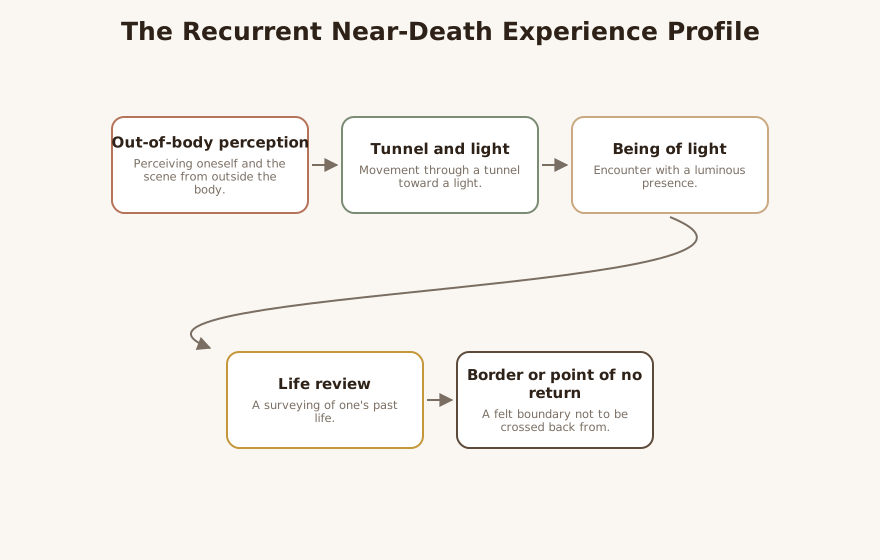
A near-death experience (NDE) is a construct, not a treatment: it names a recurrent, patterned profile of experiences reported by people who have come close to death, studied within the psychology of religion and consciousness research 4. Britannica defines it as a “mystical or transcendent experience reported by people who have been on the threshold of death,” and catalogs its frequent elements—hearing oneself declared dead, feelings of peacefulness, the sense of leaving one’s body, moving through a dark tunnel toward a bright light, a life review, the crossing of a border, and meetings with spiritual beings, often deceased friends and relatives 4. The clinically important fact for therapists is that this is a describable, countable phenomenon with validated measurement and documented sequelae, not a diagnosis and not an intervention 1.
For clinicians, the categorical point matters: “near-death experience” belongs to the literature on anomalous experience, and the clinician’s task is integration and differential reasoning rather than treatment of the experience itself LLM. An NDE is something a patient brings to therapy—often years later, often having told no one—rather than something the therapist induces or treats away LLM. Mislabeling its aftermath as psychopathology is the central clinical risk, and avoiding that error is most of the competence this construct demands 2.
Creators & Lineage
The modern field begins with psychiatrist Raymond Moody, who popularized the term “near-death experience” in his 1975 book Life After Life, describing it as a profound personal experience associated with death or impending death and naming its common elements—detachment from the body, feelings of peace, encounters with light, and life reviews 5. Moody’s work moved scattered anecdotes into a recognizable phenomenology 5.
Kenneth Ring extended this in 1980 by simplifying Moody’s framework into a five-stage continuum—peace, body separation, entering darkness, seeing light, and entering another realm—and by documenting consistent value changes in survivors, including greater appreciation for life, higher self-esteem, and greater compassion for others 5. The decisive methodological turn came from psychiatrist Bruce Greyson, who in 1983 introduced a standardized assessment scale that allowed the phenomenon to be quantified and compared across studies rather than described impressionistically 1. Greyson’s decades of work cataloging more than a thousand cases form much of the contemporary clinical literature on the phenomenon 6. Nancy Evans Bush and others later documented that distressing NDEs—experiences in which people felt persecuted, distressed, or frightened—also occur and warrant clinical attention, balancing the early literature’s emphasis on the peaceful, transcendent variety 5. The International Association for Near-Death Studies (IANDS), founded in 1978, has since served as the principal hub for research dissemination, clinician education, and experiencer support 2.
Core Principles
The first principle is phenomenological regularity: across cultures and individuals, NDEs recur in a recognizable cluster of features rather than as idiosyncratic dreams 4. The same elements—out-of-body perception, the tunnel and light, the encounter with a “being of light,” the life review, the border or point of no return, and knowledge seemingly acquired outside normal perception—reappear with enough consistency to be measured 2.
The second principle is measurability: Greyson’s scale operationalizes the experience into 16 items grouped into four components—cognitive, affective, paranormal, and transcendental—so that a clinician or researcher can characterize an account quantitatively rather than relying on intuition 3. This is what separates NDE research from purely anecdotal accounts of the paranormal LLM.
The third principle is durable aftereffect: the defining clinical feature of an NDE is not the event but what follows it. NDEs frequently produce “pervasive and durable changes in beliefs, attitudes, and values”—commonly a loss of the fear of death, a strengthened belief in an afterlife, a new sense of purpose, increased compassion and spirituality, and lessened concern for material gain, recognition, or status 2. Britannica summarizes the typical aftereffects as greater spirituality and decreased fear of death 4.
The fourth principle is interpretive openness. The causes of NDEs remain uncertain; cultural and physiological explanations have been offered, but none is settled 4. A 2022 set of guidelines proposed the term “recalled experience of death” (RED) to impose more rigorous criteria—requiring documented life-threatening conditions and excluding coma phenomena such as dreams or delirium—precisely because the older terminology blurred authentic accounts with other states 5. The clinician does not need to resolve the metaphysics to treat the patient well LLM.
Interventions & Techniques
There is no “NDE therapy,” and no technique set is owned by the construct itself LLM. What the literature offers the clinician is a stance and a set of integrative tasks delivered inside established modalities LLM. The first task is normalization and validation: because experiencers frequently fear ridicule and may have doubts about their own sanity, simply receiving the account without alarm and naming that such experiences are well-documented can be therapeutic in itself 2. Many experiencers have never disclosed the event for fear of rejection by friends or professionals, so the disclosure itself is often the clinical event 2.
The second task is meaning integration—helping the patient situate a profound, often worldview-altering event within their ongoing life narrative without forcing premature closure on what it “means” LLM. This is the natural province of meaning-centered and existential approaches, since the experience typically reorganizes the patient’s relationship to death, purpose, and value LLM. The third task is differential clarification: distinguishing genuine NDE aftermath from psychopathology so that normal, even growth-promoting, sequelae are not pathologized 2. The fourth task is relational repair: NDEs can create value incongruities with spouses and family, contributing in some cases to broken relationships and high divorce rates, which may call for couples or family work 2.
LLM-generated illustrative example (not a guideline): A cardiac-arrest survivor finally tells her therapist, two years on, “I floated above the table and watched them work on me, and I’ve never told anyone because they’d think I was crazy.” A clinician using an integrative stance might respond, “Thank you for trusting me with that—experiences like this are well-documented after cardiac arrest, and you’re not crazy for having had it. I’m more interested in what it’s changed for you than in deciding whether it was ‘real.’” The work then turns to how her loss of death-anxiety and new priorities are reshaping her marriage and career. LLM
Evidence Base
Honesty requires splitting two claims that are often conflated LLM. As a phenomenon and a measurement target, the NDE is established. The Greyson Near-Death Experience Scale, introduced in 1983, has been validated across multiple peer-reviewed studies of its construction, reliability, validity, and scaling properties 1. It contains 16 items, each scored 0–2 for a maximum of 32, with a score of 7 or higher treated as an NDE for research purposes; among experiencers the mean score has been reported at about 15 (SD 7.84) 3. Prevalence is also documented, though the figures differ by population and method: an analysis of nine prospective studies across four countries yielded an average incidence of about 17% among critically ill patients, while Britannica reports that near-death experiences are reported by about one-third of those who come close to death 24. With advances in resuscitation, an estimated 9 million Americans have reported NDEs 2.
As a basis for treatment, however, there is no validated “NDE therapy” and no outcome literature establishing that any specific intervention improves NDE-related distress LLM. The clinical integration guidance that exists is expert consensus and clinical observation—rooted in the recognition that NDEs may be confused with psychopathology but have “profoundly different sequelae requiring different therapeutic approaches”—rather than randomized trials 2. The field is also actively tightening its own definitions: the 2022 “recalled experience of death” reframing exists precisely because vague terminology made it hard to separate authentic NDEs from other states, and recent scholarship notes that some experiences once counted as distressing NDEs may instead reflect ICU delirium 5. The defensible clinician position is therefore: treat the phenomenon and scale as established, treat the clinical integration as consensus-grade and apply it inside an empirically supported modality, and do not represent NDE work as an evidence-based standalone treatment LLM.
Populations & Indications
The most direct population is survivors of life-threatening medical events—cardiac-arrest survivors, ICU patients, and others resuscitated from critical illness—since the incidence figures derive from exactly these groups and the disclosure often surfaces during or after recovery 2. NDE experiencers as a population may present long after the event, frequently carrying years of silence and a fear that disclosure will be met with ridicule, which makes the therapeutic relationship the precondition for any other work 2.
The bereaved are an adjacent population: NDE accounts commonly involve meetings with deceased friends and relatives, and a grieving client’s own past NDE—or a dying relative’s reported experience—can become central material in grief work 4. People presenting in spiritual crisis or spiritual emergency, in whom a profound experience has destabilized their existing belief system, are indicated for integrative work, because NDEs can place experiences in conflict with previously held beliefs 2. Finally, couples and families affected by an experiencer’s changed values are an indicated unit of treatment when an NDE-driven reorientation strains relationships 2.
Problems-for-Work
Spiritual crisis. When an NDE collides with a client’s prior worldview—religious, secular, or otherwise—the resulting destabilization is a workable problem: the task is integration of the experience into a coherent meaning system rather than adjudication of its truth 2.
Disclosure shame and fear of ridicule. Many experiencers withhold the account for years out of fear of being thought insane or being rejected by professionals; the clinical work is creating enough safety for disclosure and then validating the experience as documented and non-pathological 2.
Death-anxiety shifts. NDEs characteristically reduce or eliminate the fear of death; this is usually adaptive but can itself need processing—when, for instance, a partner finds the client’s new equanimity about dying alienating or frightening 4.
Distressing-NDE aftermath. Not all NDEs are peaceful; some leave experiencers with long-term depression, doubts about their sanity, and persistent distress, and these sequelae are legitimate targets for standard treatment of depression and anxiety alongside meaning work 2.
Relational strain from value change. Lessened concern for material status and a reorganized sense of purpose can produce value incongruities with family, contributing to broken relationships; couples or family intervention addresses the relational fallout directly 2.
Contraindications, Cautions & Cultural Humility
The principal caution is diagnostic: NDE aftermath is easily mistaken for psychopathology, and the literature provides a usable differential 2. NDEs are distinguishable from depersonalization, which lacks the hyperalertness and enhanced affect characteristic of NDEs; from dissociation, where NDE-related dissociative symptoms remain within the range of the normal population; and from PTSD, in that experiencers may show moderate elevation of intrusive thoughts but lack the avoidance symptoms typical of clinical PTSD 2. They differ from temporal-lobe seizures, which produce fragmented bits of music and bizarre, dream-like imagery rather than the coherent NDE narrative, and from psychosis, since NDEs follow a clear stressful precipitant in people with good premorbid functioning 2. Treating a well-organized, growth-promoting NDE aftermath as a thought disorder would be a serious clinical error LLM.
A second caution is definitional: because some experiences once labeled distressing NDEs may instead reflect ICU delirium, and because the field is moving toward stricter “recalled experience of death” criteria, clinicians should hold the label loosely and attend to the medical context rather than reflexively classifying any vivid perimortem report as an NDE 5. Risk and stabilization come first: distressing NDEs can be accompanied by long-term depression, so suicide-risk assessment and symptom-focused treatment must not be deferred in favor of metaphysical exploration 2.
Cultural and spiritual humility is essential LLM. NDEs are interpreted through cultural and religious frameworks, and the clinician’s task is to support the client’s own meaning-making rather than impose either a materialist or a spiritualist reading—causes remain uncertain, and the therapist does not need to settle them to be helpful 4. Pathologizing a client’s spiritual interpretation, or conversely endorsing a particular metaphysics as fact, both overstep the clinician’s role LLM.
Treatment-Plan Suggestions & SMART Objectives
| Goal | SMART objective (example) | Mechanism |
|---|---|---|
| Enable safe disclosure | Within 4 sessions, client will narrate the full NDE account in session at least once, reporting reduced fear of ridicule | Validation and normalization reduce disclosure shame 2 |
| Integrate the experience into life narrative | Over 10 sessions, client will articulate a personal account of what the experience means for their values, without forced closure | Meaning integration reorganizes the event into the ongoing self-narrative LLM |
| Address distressing-NDE depression | Within 8 weeks, client’s depression rating will drop from severe to mild on a standardized measure | Symptom-focused treatment runs alongside meaning work for distressing aftermath 2 |
| Reduce relational strain from value change | Over 6 conjoint sessions, partners will report two shared agreements about changed priorities | Couples work repairs value incongruities that follow an NDE 2 |
| Differentiate aftermath from psychopathology | By session 3, clinician will complete and document a structured differential (depersonalization, PTSD, seizure, psychosis) | Accurate differential prevents mislabeling normal sequelae 2 |
| Process shifted death anxiety | Within 6 sessions, client will report increased comfort discussing mortality with family members | Working with reduced death-fear stabilizes its relational impact 4 |
| Support meaning-centered growth | Across treatment, client will identify and act on one value-aligned change attributable to the experience | Aftereffect-driven reorientation channeled into purposeful action 2 |
Common Misconceptions
“An NDE is a sign of psychopathology.” The literature is explicit that NDEs may be confused with psychopathology but have profoundly different sequelae requiring different therapeutic approaches, and the differential distinguishes them from depersonalization, dissociation, PTSD, seizures, and psychosis 2.
“NDEs are always peaceful and positive.” Distressing NDEs—involving persecutory, frightening, or distressing content—are documented, and some leave lasting depression and relationship disruption 52.
“There’s no way to study this objectively.” The Greyson scale provides a validated, reliable 16-item instrument with established psychometrics, which is what moved the field beyond anecdote 13.
“Researching NDEs means endorsing life after death.” The causes remain uncertain and cultural and physiological explanations coexist; measuring and clinically supporting the experience does not commit the clinician to any metaphysical conclusion 4.
“An NDE is the clinical problem to be treated.” The experience itself is not pathology; the workable problems are its sequelae—disclosure shame, spiritual crisis, distressing-NDE depression, and relational strain LLM.
Training & Certification
There is no licensure or certification in “near-death experience treatment,” because NDE work is integrative rather than a discrete modality LLM. The International Association for Near-Death Studies (IANDS), founded in 1978, is the principal source of clinician education, providing educational materials, support groups, downloadable clinical resources, continuing-education offerings, and the field’s journal 2. Competent practice rests on training in the established modalities that carry the integrative work—existential and meaning-centered psychotherapy for the meaning tasks, evidence-based treatment of depression and anxiety for distressing aftermath, and couples or family therapy for relational fallout LLM. Familiarity with the Greyson scale helps a clinician characterize an account precisely and avoid over- or under-reading it 3. Because NDE aftermath intersects with spirituality, mortality, and risk, ongoing supervision is valuable wherever the clinician’s own beliefs about death and the afterlife could shape the work LLM.
Key Terms
Near-death experience (NDE) — a mystical or transcendent experience reported by people on the threshold of death, marked by recurrent elements such as out-of-body sensation, a tunnel and light, a life review, and meetings with deceased others 4.
Greyson NDE Scale — a 16-item instrument, each item scored 0–2 (maximum 32), with four components (cognitive, affective, paranormal, transcendental) and a research cutoff of 7 or higher to qualify as an NDE 3.
Life review — a characteristic NDE element in which the experiencer perceives a rapid survey of their life, frequently with heightened moral or emotional significance 4.
Distressing NDE — a near-death experience experienced as persecutory, frightening, or distressing rather than peaceful, sometimes followed by lasting depression and relational disruption 52.
Recalled experience of death (RED) — a 2022 reframing intended to impose stricter criteria, requiring documented life-threatening conditions and excluding coma phenomena such as dreams or delirium 5.
Aftereffects — the durable post-NDE changes in beliefs, attitudes, and values, commonly reduced fear of death, increased spirituality, greater compassion, and lessened concern for status 24.
Resources & Further Reading
▶ Watch — a video introduction to this concept:
- The Near-Death Experience Scale: Construction, Reliability, and Validity (Greyson, 1983)
- Getting Comfortable With Near-Death Experiences: An Overview (Missouri Medicine / PMC)
- Quantifying the Phenomenon: Greyson’s Near-Death Experience Scale (IANDS)
- Near-death experience (Britannica)
- Near-death experience (Wikipedia)
- Learnings from 1,000+ Near-Death Experiences — Dr. Bruce Greyson (University of Virginia)
Reflective / Supervision Questions
- When a client discloses an NDE, do I notice my own reaction—skepticism, fascination, discomfort—and keep it from shaping whether I validate or subtly pathologize the account? LLM
- Have I completed a genuine differential (depersonalization, dissociation, PTSD, temporal-lobe seizure, psychosis) before concluding that what I am seeing is NDE aftermath rather than treatable pathology? 2
- Am I treating the experience itself as the problem, or am I working the actual clinical problems—disclosure shame, spiritual crisis, distressing aftermath, relational strain? LLM
- Can I hold the metaphysical question open—neither asserting nor denying life after death—while still being fully useful to the client’s meaning-making? 4
- For a distressing NDE, have I prioritized risk assessment and depression treatment before metaphysical exploration? 2
- How would my work change if I considered that the client’s report might reflect ICU delirium rather than a classical NDE, and am I attending to the medical context closely enough to tell? 5