
Few presentations test a clinician’s diagnostic humility like a client who arrives convinced that their sense of self is dissolving, that consciousness has cracked open, and that something is being born in the crisis. The transpersonal tradition gave this presentation a name — spiritual emergency — and a wager: that some of these episodes are not disease but difficult passages of transformation. LLM This article lays out the construct, its lineage, the evidence (which is thin), and how a careful clinician can hold the differential without either pathologizing the sacred or romanticizing genuine psychosis. LLM
Type & Discipline
Spiritual emergency is a clinical construct rather than a manualized modality or a discrete diagnosis. LLM It belongs to transpersonal psychiatry and the broader family of transpersonal psychology — the tradition that takes spiritual, mystical, and non-ordinary states of consciousness as legitimate objects of psychological study rather than as epiphenomena to be reduced. LLM The term names a category of acute crisis: an episode of non-ordinary consciousness, accompanied by emotional, perceptual, and psychosomatic upheaval, that the originators framed as an evolutionary crisis rather than a mental disease. 3
Because it is a construct and not a treatment, “doing spiritual emergency work” in practice means applying an interpretive lens and a stance of support within whatever established modality a clinician already practices. LLM The wager embedded in the term is deliberate wordplay: emergency contains emergence, signalling crisis and opportunity at once. 5
Creators & Lineage
The construct was introduced in the 1980s by psychiatrist Stanislav Grof and psychotherapist Christina Grof, who edited the foundational anthology Spiritual Emergency: When Personal Transformation Becomes a Crisis (1989), a collection contending that mainstream psychiatry routinely misdiagnoses transformative episodes as mental illness and suppresses them through medication and institutionalization. 1 The book argued, controversially, that “spiritual emergencies can become gateways to higher levels of functioning” when properly supported. 1
The lineage is plural. It draws on Eastern contemplative traditions — most visibly the concept of kundalini awakening — and on Jungian psychology, with its attention to individuation, archetypal material, and the purposive unconscious. LLM It is methodologically a crisis-intervention framework, concerned with how families and professionals can hold an acute episode without escalating harm. 1 The most consequential downstream figure for ordinary clinical practice is David Lukoff, whose work (with Lu and Turner) traced the transpersonal roots of the new DSM-IV category, carrying a softened version of the idea into mainstream nosology. 2 That migration matters: the field’s only formal foothold is not “spiritual emergency” but the neutral “Religious or Spiritual Problem” code. 5
Core Principles
First, not all non-ordinary states are pathological. The originating claim is that many individuals in altered states accompanied by emotional and psychosomatic manifestations are undergoing a developmental crisis rather than suffering disease. 3 Second, context and the diagnostician partly determine the label. One clinical commentary argues bluntly that the primary difference between psychosis and spiritual emergency “has more to do with the diagnostician and the suggested treatment than anything else,” noting that shamans and prophets are honored for transcendent experiences while others are diagnosed for phenomenologically similar phenomena. 4 This is a provocation, not a license to abandon diagnostic rigor — but it usefully flags how cultural framing shapes outcome. LLM
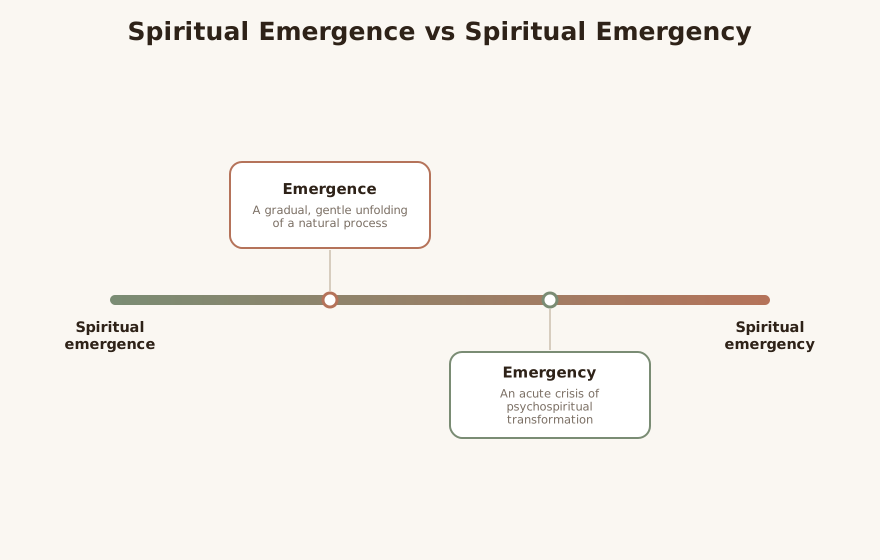
Third, crisis carries transformative potential. The Grofs held that, properly understood and treated as difficult stages of a natural process, these episodes can yield emotional and psychosomatic healing, creative problem-solving, personality transformation, and consciousness evolution. 3 Fourth, emergence and emergency are distinct. Spiritual emergence is a gradual, gentle unfolding that does not impair functioning; spiritual emergency is the acute, destabilizing form involving ego disruption, intuition overriding logic, and at the severe end, ecstasy, paranoia, detachment from reality, or compulsive behavior. 5 The clinician’s task is partly to locate where on that continuum a client sits. LLM
Interventions & Techniques
There is no proprietary protocol; the “interventions” are a stance and a set of supportive practices layered onto ordinary care. LLM The core move is to normalize without dismissing — to express the experience in an educational and transformative frame rather than a purely pathologizing one — while keeping the client safe. 4 Recommended practical supports include journaling and grounding techniques, with grounding explicitly invoked (after teachers such as Jack Kornfield) to anchor a client who is flooded by symbolic or affective material. 4
In the psychedelic context, support emphasizes non-judgmental, safe environments, reframing experiences in non-pathologizing language, and structured integration and meaning-making work after a destabilizing experience. 5 Risk factors that shape this work include inadequate preparation, pre-existing trauma, and the absence of cultural scaffolding for metabolizing non-ordinary experience. 5 Community resources such as the Spiritual Emergence Network are cited as referral options for clients who need specialized peer support. 5
LLM-generated illustrative example (not a guideline): A meditator on a long retreat develops surges of energy up the spine, insomnia, and a frightening sense of unreality. The clinician validates the experience as a known phenomenon, slows the contemplative practice, prescribes grounding (regular meals, sleep, physical movement, reduced sitting), and frames the work as stabilizing first and meaning-making later — while monitoring closely for any drift toward functional collapse. LLM
Evidence Base
The honest label is emerging, and it should be stated without softening. There are no randomized controlled trials of “spiritual emergency” as an intervention, no outcome studies establishing that the supportive-reframe approach changes trajectories relative to standard care, and no systematic reviews on which to anchor practice. LLM The literature is conceptual, phenomenological, and clinical-anecdotal: edited anthologies, transpersonal-journal articles, and practitioner commentary. 13 The originating evidentiary move — the claim that these episodes are evolutionary rather than pathological — rests on the Grofs’ theoretical foundation and case observation rather than controlled data. 3
The construct lives largely within transpersonal-psychology circles. 5 Its one durable footprint in mainstream psychiatry is indirect and deliberately diluted: Lukoff’s advocacy produced the DSM-IV “Religious or Spiritual Problem” category, which uses neutral language and pointedly does not import the Grofs’ stronger transformational claims. 52 For a practicing clinician, the takeaway is calibrated: the differential — taking spiritual and cultural context seriously before diagnosing — is defensible and now has nosological cover, while the stronger therapeutic claim that crisis reliably yields growth remains unproven. LLM
Populations & Indications
The construct is most often invoked with clients whose presentations sit at the intersection of altered states and meaning. LLM Meditators and contemplative practitioners can destabilize during intensive practice, particularly around kundalini-type phenomena. 5 Psychedelic users are a central modern population: psychedelics can trigger a spiritual emergency by rapidly propelling shifts in consciousness, and a new way of seeing can be destabilizing for some. 5 People in an explicit spiritual or mystical crisis, and religiously or spiritually identified clients whose frameworks are central to their distress, are core indications. LLM
Trauma survivors warrant special attention because pre-existing trauma is a named risk factor for a non-ordinary experience tipping into crisis. 5 Young adults — often in the developmental window where identity, first psychotic breaks, and intense spiritual searching all converge — are a population where the differential is hardest and most consequential. LLM
Problems-for-Work
The construct is clinically useful precisely because it forces a careful differential. LLM Key problems-for-work include:
- Religious or spiritual problem (V62.89). The on-label use: a client distressed by a spiritual experience or loss of faith, where the spiritual content is the locus of work rather than a symptom to suppress. 5
- Depersonalization/derealization. Both psychosis and spiritual emergency can involve “escaping the limiting boundaries of the self,” so unreality phenomena must be assessed for context and function rather than labeled on surface form alone. 4
- Existential crisis and identity disturbance. Ego disruption and the felt dissolution of identity are hallmark features the clinician helps the client metabolize rather than only medicate. 51
- Panic and acute anxiety and sleep disturbance. These often accompany the energetic and perceptual surges and are the most tractable, immediate targets for grounding and stabilization. LLM
- Acute psychosis, brief psychotic disorder, and mania (differentials). Here the construct functions as a caution, not a diagnosis: a reminder to evaluate spirituality’s role, personal history, and neurological factors before concluding, while never withholding psychiatric care when indicated. 5
LLM-generated illustrative example (not a guideline): A young adult presents with grandiose religious certainty, three nights without sleep, and pressured speech after a psychedelic experience. The clinician treats the safety and sleep problems immediately, declines to settle prematurely on a “growth” narrative, and arranges psychiatric evaluation — using the spiritual-emergency lens to stay respectful of the content without letting it delay needed care. LLM
Contraindications, Cautions & Cultural Humility
The central caution is the inverse of the construct’s own argument: the lens that protects clients from over-pathologizing can, misapplied, under-recognize treatable and dangerous illness. LLM A “spiritual emergency” frame is contraindicated as a substitute for assessment whenever there is suicidal ideation, command phenomena, escalating disorganization, functional collapse, or risk to self or others — these demand standard psychiatric evaluation and care regardless of spiritual content. LLM Even sympathetic accounts stress that professional supervision remains essential for a positive outcome; this is not a do-it-yourself reframe. 4
Proper assessment is multi-axial: evaluating the role of spirituality, personal history, and neurological factors together, and noting that those in spiritual emergency typically retain substantial ability to differentiate inner experience from consensus reality — a feature that, when absent, should raise concern for a primary psychotic process. 5 Cultural humility is structurally required by the construct itself, which originates in the observation that the same phenomena are honored in some cultural contexts and pathologized in others. 4 The clinician should hold the client’s own religious or spiritual framework as data, not noise — while staying alert that “respecting the framework” can become a rationalization for inaction. LLM
Treatment-Plan Suggestions & SMART Objectives
| Goal | SMART objective (example) | Mechanism |
|---|---|---|
| Stabilize acute symptoms | Within 2 weeks, client will use a grounding routine (sleep, meals, movement) on ≥5 days/week, reducing acute anxiety from 8/10 to ≤5/10 | Grounding and routine restore physiological regulation 4 |
| Reduce derealization distress | Within 4 weeks, client will report depersonalization/derealization episodes as “tolerable” on ≥4 of 7 days using a name-and-anchor technique | Normalizing plus grounding lowers threat appraisal of unreality 4 |
| Differentiate experience from consensus reality | By session 6, client will accurately distinguish inner imagery from shared reality in 100% of reviewed episodes, documented in session | Reality-testing tracks the key safety feature of the differential 5 |
| Restore sleep | Within 3 weeks, client will achieve ≥6 hours of sleep on ≥5 nights/week via sleep-hygiene plan | Sleep restoration reduces destabilization and escalation risk LLM |
| Integrate the experience | Over 8 weeks, client will complete weekly journaling and articulate ≥2 personal meanings of the experience without functional impairment | Integration and meaning-making convert crisis into coherence 5 |
| Maintain safety net | By session 2, client will identify 3 supports and a crisis plan, and consent to psychiatric review if red-flag criteria emerge | Crisis-intervention scaffolding prevents under-treatment 4 |
| Engage spiritual framework as resource | Within 6 weeks, client will name ≥1 element of their spiritual framework that supports coping, used ≥2x/week | Working within the client’s meaning system strengthens alliance LLM |
Common Misconceptions
“Spiritual emergency is a DSM diagnosis.” It is not. The DSM carries only the neutral “Religious or Spiritual Problem” category; “spiritual emergency” itself is a transpersonal construct that the manual deliberately did not adopt in its stronger form. 52 “If it looks spiritual, it can’t be psychosis.” False and dangerous: the phenomenologies overlap, and the construct’s own proponents insist on careful assessment of history and neurological factors. 5 “Reframing replaces psychiatric care.” The supportive reframe is layered onto, not substituted for, clinical care and supervision. 4 “The growth outcome is established.” It is a theoretical claim from the founders, not a finding from controlled research. 3LLM
Training & Certification
There is no accredited licensure pathway in “spiritual emergency” comparable to established evidence-based modalities. LLM The knowledge base is transmitted through the transpersonal-psychology literature, the Grofs’ writings, and practitioner communities. 13 In adjacent psychedelic spaces, role-specific designations such as “Spiritual Emergence Coach” exist, and networks such as the Spiritual Emergence Network function as referral and peer-support infrastructure rather than as clinical-credentialing bodies. 5 Clinicians should treat the construct as a supplementary lens to integrate into existing scope-of-practice training, not as a standalone qualification. LLM
Key Terms
- Spiritual emergency — an acute, destabilizing crisis of psychospiritual transformation framed as potentially growth-promoting. 3
- Spiritual emergence — the gradual, non-impairing form of the same developmental process. 5
- Kundalini awakening — an energetic/contemplative phenomenon, drawn from Eastern traditions, that is a recognized type of spiritual emergency. 4
- Integration — structured post-experience meaning-making, central to psychedelic-context support. 5
- Religious or Spiritual Problem (V62.89) — the neutral DSM category that carried a diluted version of the construct into mainstream nosology. 52
Resources & Further Reading
▶ Watch — a video introduction to this concept:
- Spiritual Emergency: When Personal Transformation Becomes a Crisis (Grof & Grof, book record) 1
- Lukoff, Lu & Turner — From Spiritual Emergency to Spiritual Problem: The Transpersonal Roots of the New DSM-IV Category 2
- Grof & Grof — Spiritual Emergency: The Understanding and Treatment of Transpersonal Crises (Int’l Journal of Transpersonal Studies) 3
- Is It Psychosis or a Spiritual Emergency? (Psychology Today) 4
- Understanding ‘Spiritual Emergency’ in the Context of Psychedelics (Psychedelics Today) 5
Reflective / Supervision Questions
- When I lean toward a “spiritual emergency” framing, am I responding to the client’s clinical picture, or to my own comfort with — or discomfort toward — spiritual content? LLM
- What specific red flags would move me from a supportive-reframe stance to insisting on psychiatric evaluation, and have I named them explicitly with this client? LLM
- Am I treating the client’s religious or spiritual framework as legitimate data while staying honest that respecting the framework is not the same as withholding indicated care? LLM
- How would I document and defend my reasoning if this client’s trajectory were later reviewed — does my differential show genuine rigor rather than a foregone conclusion in either direction? LLM