
Type & Discipline
Religion, Spirituality, and Health (R/S-health) is not a therapy or a technique but a multidisciplinary research program — a body of epidemiological and psychological evidence describing how religious and spiritual involvement relates to mental and physical health outcomes 1. Its disciplinary home sits at the intersection of epidemiology, public health, and the psychology of religion, and its outputs are observational findings and theoretical syntheses rather than manualized treatments 2LLM. For the practicing clinician, the program matters because it supplies the empirical rationale for taking a patient’s spiritual life seriously in care, while also setting the boundaries of what that evidence can and cannot justify 4.
It is worth fixing the type distinction early, because R/S-health write-ups routinely blur it. What this program has established is an association between religious involvement and better health; what it has not established is that prescribing or delivering spiritual interventions causes better outcomes 4LLM. Holding that line is the single most important interpretive discipline a clinician can bring to this literature LLM.
Creators & Lineage
The modern field has several anchoring figures. Harold Koenig, a psychiatrist at Duke University, helped consolidate and systematize the empirical literature and directs research and training through Duke’s Center for Spirituality, Theology and Health, which since 1998 has functioned as a clearinghouse and a pipeline for training new researchers in the area 5. Koenig is also a senior editor of the field’s reference compendium, the Handbook of Religion and Health, now in its third edition, which catalogs the accumulated evidence across thousands of studies 1.
Tyler VanderWeele, an epidemiologist and biostatistician at Harvard, brought rigorous causal-inference methods to the question and co-directs Harvard’s Initiative on Health, Spirituality, and Religion, whose stated aim is to integrate religion and spirituality into both academic research and medical and public-health practice 3. VanderWeele’s analyses of large longitudinal cohorts — and his methodological framing of what those analyses can support — are central to the contemporary evidence base 4. Lisa Miller, a clinical psychologist, represents a complementary strand that links spirituality specifically to protection against depression, drawing on developmental and neuroimaging work in her public scholarship 6. David Larson is conventionally credited as an early figure who pressed for methodological seriousness in religion-and-health research; the specifics of his contribution sit outside the sources cited here and are noted only as lineage LLM.
Core Principles
The program’s first organizing principle is that religious and spiritual involvement is an exposure that can be measured and related prospectively to health outcomes, much as one would study diet, exercise, or social ties 2LLM. The second is that not all measures of religiosity behave alike: the most robust longitudinal associations with health arise when the exposure is religious service attendance, rather than private religious practices, affiliation, or self-assessed religiosity or spirituality 4. This distinction between public, communal participation and private, self-reported spirituality is one of the program’s most clinically consequential findings 4LLM.
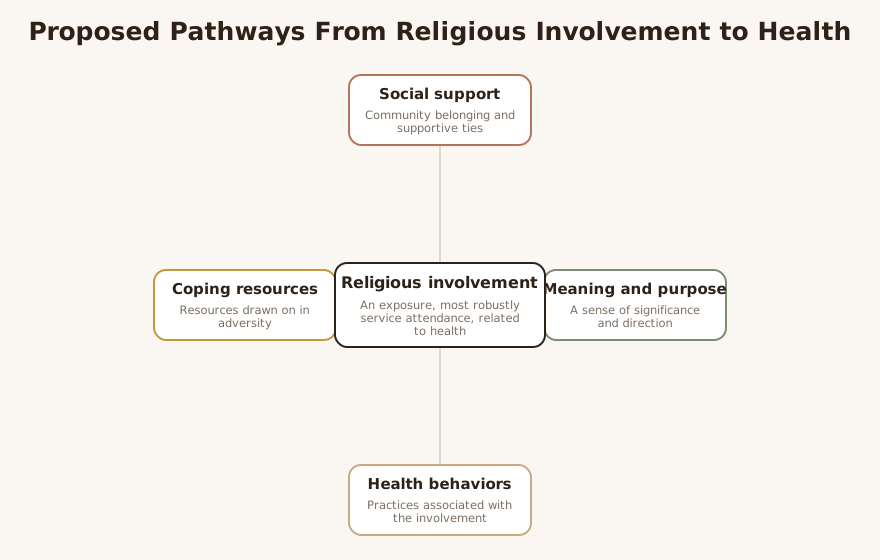
A third principle is methodological humility. Because the strongest evidence is observational, the program treats unmeasured confounding and the possibility that healthier people are more able to attend services (reverse causation) as live threats to interpretation, not as settled non-issues 4LLM. A fourth is mechanistic pluralism: where associations are found, plausible pathways include social support and community belonging, meaning and purpose, health behaviors, and coping resources, rather than a single explanatory mechanism 3LLM. Finally, the program is explicitly oriented toward translation — asking what, if anything, clinicians and public-health practitioners should responsibly do with the findings 4.
Interventions & Techniques
A research program has no proprietary techniques; its clinical value lies in how its findings are translated into ordinary practice LLM. The most direct translation endorsed in this literature is the spiritual history — asking neutral, open questions such as whether religion or spirituality is important to the patient in thinking about health and illness — so that the clinician learns whether this domain is a resource, a source of struggle, or neither 4. The framing recommended is invitational and patient-led rather than prescriptive 4LLM.
For patients who already identify with a religious or spiritual tradition, the literature supports respectful support of their existing resources — for instance, acknowledging and, where appropriate, encouraging continued participation in their own religious community as a source of social connection and meaning 4. For patients who are not religious, the parallel move is to encourage other, secular forms of community involvement, recognizing that communal participation, not religion per se, may carry much of the benefit 4LLM. Beyond the dyad, translation includes collaboration with chaplaincy and clergy where the patient wishes it, and routing identified spiritual distress into appropriate spiritually integrated care rather than handling it ad hoc LLM. None of these are interventions the R/S-health program invented; they are the clinically conservative actions its evidence can bear LLM.
LLM-generated illustrative example (not a guideline): A clinician seeing a recently bereaved older adult might ask, “Is faith or spirituality something that matters to you as you cope with this loss?” If the patient says their congregation is central, the clinician supports re-engaging with it as a source of community; if the patient is not religious, the clinician instead explores other groups and relationships that could provide the same belonging 4LLM.
Evidence Base
The maturity of this program is best described as established for the association and immature for causation — a distinction the literature itself insists on 4. On the association side, the evidence is robust. Pooled estimates reported in the field’s clinical commentary indicate that, comparing weekly religious service attendees with non-attendees, attendance is associated with roughly a 27% reduction in all-cause mortality risk and roughly a 33% reduction in the odds of subsequent depression, with longitudinal associations also reported for suicide, smoking cessation, substance use, cardiovascular outcomes, social support, meaning and purpose, and civic engagement 4. Several of the flagship cohort findings — lower all-cause mortality, lower depression, and lower suicide — were established specifically among U.S. women, and should be read with that population framing rather than generalized uncritically to all groups 3.
Two features sharpen the picture. First, the signal is strongest for service attendance as the exposure; private practice, affiliation, and self-assessed religiosity or spirituality show weaker and less consistent associations 4. Second, the syntheses uniformly note that the evidence is overwhelmingly observational: religious involvement is prospectively associated with better mental and physical health across large cohorts, but these are not randomized comparisons 24. Because the evidence is observational, unmeasured confounding remains possible, and the program’s own authors are explicit that it would be inappropriate to treat the associations as if they were established treatment effects 4. The plausible alternative that healthier people are simply more able to attend services (reverse causation) is a further reason for caution LLM.
The honest clinical summary: the correlation between religious involvement and better health is large, replicated, and institutionally recognized at major schools of public health and medicine 135. The causal claim — that adding spiritual content to care improves outcomes — rests on a much thinner intervention literature and should be advanced tentatively, if at all 4LLM.
Populations & Indications
The program’s findings are most directly relevant to patients for whom religion or spirituality is already salient, and to the populations where the cohort evidence is strongest. Religiously or spiritually identified clients are the clearest group: for them, the evidence supports treating their tradition as a potential health-protective resource worth assessing and, where they wish, supporting 4. Older adults and people with chronic or serious illness are heavily represented in this literature and are populations for whom meaning, coping, and community are often acutely in play 1LLM.
The findings also speak to groups in which spiritual resources are commonly mobilized: bereaved individuals, trauma survivors, clients in recovery from addiction, and veterans and others carrying moral injury, where spiritual struggle and spiritual support frequently coexist 1LLM. Importantly, the program does not indicate that religion should be promoted to non-religious patients; for them, the relevant translation is encouragement of other forms of community participation 4.
Problems-for-Work
- Major depressive disorder. Service attendance is prospectively associated with markedly lower odds of subsequent depression, making attention to a patient’s spiritual community and resources a reasonable adjunct to evidence-based depression care 46.
- Demoralization and loss of meaning. Where the presenting problem is meaninglessness rather than a discrete disorder, the meaning-and-purpose pathway documented in this literature is directly relevant 3LLM.
- Grief and bereavement. Spiritual frameworks and faith communities are common coping resources after loss; assessing and supporting them fits the evidence 1LLM.
- Substance use disorders / recovery. Associations with lower substance use and the centrality of community in recovery make spiritual resources a recognized support to mobilize 4LLM.
- Suicidality. Lower suicide rates have been observed in cohort data (notably among U.S. women), suggesting communal religious involvement may be one protective factor to assess, without treating it as a stand-alone intervention 34.
- Moral injury. For patients whose distress is organized around transgression, betrayal, or rupture of the sacred, the spiritual dimension is not optional to address 1LLM.
LLM-generated illustrative example (not a guideline): For a client in early addiction recovery whose home group at a faith-based fellowship is their main source of structure and belonging, a clinician might frame continued attendance as a health-protective community resource and coordinate it with relapse-prevention work, rather than treating the spiritual element as separate from the clinical plan 4LLM.
Contraindications, Cautions & Cultural Humility
The foremost caution comes from the program’s own authors: it would be inappropriate to universally promote service attendance solely on the grounds of the associations with health 4. The findings describe populations, not prescriptions; converting an epidemiological association into a directive to a specific patient overreaches the evidence and risks coercion 4LLM. Clinicians must also remain sensitive to patients who have suffered past negative experiences or even abuse within religious communities, for whom encouragement toward attendance would be harmful rather than helpful 4.
A second caution is the established-association-not-established-treatment problem restated at the bedside: because unmeasured confounding remains possible and the data are observational, a clinician should not promise health benefits from religious participation as though they were a proven causal effect 4LLM. Cultural and worldview humility is therefore not a courtesy but a methodological requirement — the same evidence that is generated largely in particular national and demographic cohorts (and, for several flagship findings, among women) cannot be assumed to transfer uniformly across cultures, traditions, and the non-religious 3LLM. The neutral, invitational stance — asking whether religion or spirituality matters to the patient and following their lead — is the safeguard against imposing the clinician’s values 4.
Treatment-Plan Suggestions & SMART Objectives
| Goal | SMART objective (example) | Mechanism |
|---|---|---|
| Assess spiritual resources and struggles | Clinician completes a neutral spiritual history within the first two sessions and documents whether R/S is a resource, a struggle, or neither | Invitational spiritual inquiry surfaces relevant supports without imposition 4 |
| Mobilize existing faith-community support | Religiously identified client reconnects with their congregation or group at least twice over 6 weeks and rates perceived support 0-10 | Social support and belonging pathway 4LLM |
| Strengthen meaning and purpose | Client identifies and acts on one source of meaning weekly for 4 weeks, tracked in session | Meaning-and-purpose pathway linked to better outcomes 3LLM |
| Support recovery community engagement | Client in recovery attends their chosen (faith-based or secular) community group weekly for 1 month | Community participation as a recovery and protective resource 4LLM |
| Address spiritual distress | Client and clinician name the specific spiritual struggle and agree on referral or in-session work within 3 sessions | Routing struggle into appropriate spiritually integrated care 1LLM |
| Encourage community for non-religious clients | Non-religious client joins or re-engages one secular community group within 6 weeks | Communal participation, not religion per se, may carry benefit 4LLM |
| Coordinate with chaplaincy/clergy | With consent, clinician makes one collaborative contact with the client’s chaplain or clergy within the episode of care | Interdisciplinary support of the patient’s own resources 4LLM |
Common Misconceptions
The largest misconception is that this literature proves religion makes people healthier. It establishes a robust prospective association, predominantly from observational cohorts; it does not establish that spiritual interventions cause better outcomes, and its authors caution explicitly against that leap 4LLM. A second is that “spirituality” is one undifferentiated exposure — in fact, communal service attendance carries the most robust health associations, while private spirituality, affiliation, and self-rated religiosity are weaker and less consistent predictors 4.
A third misconception is that the findings license recommending religion to patients; the program’s own translation is that promoting attendance universally on health grounds is inappropriate, and that non-religious patients should be pointed toward other community involvement instead 4. A fourth is that the cohort findings are uniform across everyone — several flagship results were observed among U.S. women, and generalization beyond the studied populations is an assumption, not a finding 3LLM. Finally, taking this literature seriously is sometimes mistaken for endorsing any particular faith; the clinical posture it supports is neutral assessment and support of the patient’s own resources, not advocacy 4LLM.
Training & Certification
There is no certification in “Religion, Spirituality, and Health” as such, because it is a research literature rather than a credentialed treatment LLM. The relevant training pathways are research-oriented and translational. Duke’s Center for Spirituality, Theology and Health runs an established annual multi-day summer research workshop, topic-specific workshops (including on moral injury and spirituality in patient care), monthly research seminars, and continuing medical education materials — aimed at preparing clinicians and investigators to conduct and apply work in this area 5. Harvard’s Initiative on Health, Spirituality, and Religion sponsors a biennial graduate course on religion, well-being, and public health and convenes faculty, clinicians, and clergy around the same questions 3.
For a practicing therapist, the realistic development goal is not certification but competence: understanding what the evidence supports, learning to take a neutral spiritual history, and knowing how to route spiritual struggle or distress into appropriate spiritually integrated care 4LLM. The Handbook of Religion and Health serves as the field’s reference text for clinicians who want a grounding in the underlying evidence 1.
Key Terms
- Religious service attendance — frequency of attending communal religious services; the exposure with the most robust longitudinal health associations in this literature 4.
- Private spirituality / self-assessed religiosity — individual, self-reported religious or spiritual practice and identity; associated with health more weakly and less consistently than attendance 4.
- Observational (cohort) evidence — prospective study of naturally occurring exposure rather than randomized assignment; the dominant evidence type here, and the reason causal claims are restrained 24.
- Unmeasured confounding — the possibility that an unaccounted-for third factor explains an association; explicitly flagged as a live caution in this evidence base 4.
- Reverse causation — the possibility that better health enables greater participation rather than the reverse; a standard alternative explanation for attendance-health links LLM.
- Meaning and purpose — a candidate mechanism linking religious involvement to better outcomes, alongside social support and health behaviors 3LLM.
- Spiritual history — a brief, neutral clinical inquiry into whether religion or spirituality matters to the patient’s health and coping 4.
Resources & Further Reading
▶ Watch — a video introduction to this concept:
- Handbook of Religion and Health (Koenig, VanderWeele & Peteet, 3rd ed., Oxford University Press)
- Religion and Health: A Synthesis (VanderWeele, Oxford University Press chapter PDF)
- Initiative on Health, Spirituality, and Religion — VanderWeele Research Group, Harvard T.H. Chan School of Public Health
- Invited Commentary: Religious Service Attendance and Implications for Clinical Care, Community Participation, and Public Health (American Journal of Epidemiology)
- Center for Spirituality, Theology and Health — Duke University (Koenig)
- Spirituality Protects Against Depression — Dr. Lisa Miller, Author of The Awakened Brain (YouTube)
Reflective / Supervision Questions
- When I draw on this literature with a patient, am I careful to present a robust association rather than implying that religious participation will causally improve their health 4LLM?
- Do I distinguish between communal service attendance and private spirituality when I assess and document, given that the evidence treats them differently 4?
- Have I checked whether the cohort findings I am leaning on actually apply to this patient’s population, or am I generalizing results observed in specific groups 3LLM?
- For a non-religious patient, am I prepared to support secular community involvement rather than defaulting to a religious recommendation 4LLM?
- Have I screened for a history of religious harm or abuse before encouraging any form of religious engagement 4?
- Am I keeping my own spiritual or anti-religious values out of the recommendation, holding the neutral, patient-led stance the evidence supports 4LLM?